宏观流动性宽松预期

Search documents
长江有色:美联储决议落地市场偏暖避险与看涨交织 29日镍价或小涨
Xin Lang Cai Jing· 2026-01-29 03:16
Core Viewpoint - The nickel market is experiencing a complex interplay of supply constraints and demand dynamics, influenced by macroeconomic factors and geopolitical tensions, leading to a volatile price environment. Supply Side - Global nickel supply is characterized by a stark contrast between international expectations of tightness and domestic realities of abundance, with Indonesia's significant reduction in nickel mining quotas being a key driver of supply contraction [3] - The Indonesian nickel mining quota has decreased by 34%, exacerbating global supply concerns, while short-term factors such as the rainy season in the Philippines and geopolitical disturbances in the Democratic Republic of Congo (DRC) further tighten supply expectations [3] - In contrast, domestic supply remains stable with steady release of smelting capacity and high social inventory levels, leading to a relaxed supply environment [3] Demand Side - Demand for nickel is structurally driven, with stainless steel maintaining stable demand while the electric vehicle battery sector, particularly high-nickel ternary materials, emerges as a strong growth engine [3] - However, high nickel prices are dampening immediate purchasing enthusiasm among downstream enterprises, which are primarily focused on essential stockpiling [3] Industry Dynamics - The industry is increasingly characterized by a dual-core structure where Indonesia dominates resource supply and China leads in smelting and application, resulting in profit concentration at the upstream resource level while midstream smelting companies face rising cost pressures [4] - The futures market reflects concerns over long-term supply through a backwardation structure, although short-term pressures from high inventory levels in exchanges and the spot market persist [4] Price Trend Forecast - The nickel market is undergoing a fundamental restructuring, with short-term price movements expected to remain volatile due to high inventory levels and cautious purchasing behavior from downstream sectors [5] - Core support for medium-term prices remains robust, driven by significant policy support from reduced Indonesian mining quotas, heightened resource supply concerns due to geopolitical risks in the DRC, and ongoing global liquidity easing [5] Future Outlook - Future nickel price movements will largely depend on three key variables: the actual implementation of Indonesian policies, developments in the DRC situation, and the intensity of post-holiday restocking demand from downstream sectors [6] - The nickel market is expected to experience intense short-term volatility, but medium to long-term prospects remain positive due to constrained supply and structurally strong demand [6]


沪锡:一夜之间,行情转向了吗?
对冲研投· 2026-01-16 12:00
Group 1 - The core viewpoint of the article is that the current rally in the non-ferrous metals market is primarily driven by speculative capital inflow rather than fundamental supply-demand dynamics, with tin being the most elastic metal due to its low holding volume [1][11][22] - The recent surge in tin prices, from 300,000 CNY/ton to 350,000 CNY/ton, occurred over 30 trading days, while the jump to 400,000 CNY/ton took only 6 days, indicating a rapid speculative environment [1][11] - Historical patterns show that previous price surges, such as the one in early 2022, were followed by significant corrections, suggesting that the current market may be nearing a similar turning point [2][10] Group 2 - The article outlines that the last major price surge occurred from late 2021 to early 2022, driven by supply constraints from Myanmar and increased domestic smelting capacity, leading to a significant imbalance in the market [4][10] - The collapse phase from March to October 2022 was characterized by a combination of high prices suppressing demand and a recovery in supply, which ultimately led to a drastic price drop [10][14] - Current signals indicate that the upward momentum in tin prices may be waning, with increasing pressure for rational market behavior as supply from Myanmar begins to stabilize and domestic inventories remain low [11][15][21] Group 3 - The article highlights that regulatory measures have been implemented to cool down the market, including increased margin requirements and trading limits on tin futures [21] - The sentiment indicator for the commodity market peaked at 5.73 on January 7, 2025, but has since retreated to a more normalized level of 2.6, indicating a cooling of speculative enthusiasm [18][22] - The focus for future market movements will likely shift back to fundamental factors, including the stability of actual supply and the real recovery of downstream consumption [22]

齐盛期货:焦煤上行高度受限
Qi Huo Ri Bao· 2026-01-15 03:07
Core Viewpoint - The recent rebound in coking coal futures is driven by ample liquidity and a temporary increase in industrial inventory demand, but the upside potential is limited due to supply pressures from coal mine restarts and cautious downstream winter storage sentiment [1] Group 1: Market Dynamics - The macroeconomic environment has improved, providing solid support for commodity prices, with expectations of interest rate cuts abroad and a marginal improvement in domestic inflation data [1] - The strong performance of non-ferrous and precious metals, particularly silver and copper, has positively influenced the entire industrial sector, making coking coal an attractive option for investors seeking to capitalize on lower valuations [1] - Recent rumors of production cuts in coal capacity in regions like Shaanxi and Inner Mongolia have amplified market sentiment, although the actual impact on supply remains limited [2] Group 2: Supply and Demand Factors - The pace of imported Mongolian coal has slowed, with daily customs clearance volumes around 1,200 trucks, indicating reduced import pressure [3] - Domestic coking coal production has begun to recover in January, with previously halted mines resuming operations, although the increase is not expected to be rapid due to ongoing safety regulations [3] - Steel mills have shown a slight recovery in iron output, with daily production rising from 2.2743 million tons to 2.295 million tons, providing some support for coking coal demand [4] Group 3: Inventory and Pricing Trends - The auction situation for coking coal has improved, with a significant decrease in the failure rate and stabilizing transaction prices [4] - Current inventory levels at steel mills indicate a cautious approach to winter storage, with an average usable days of coking coal inventory around 12.8 days, suggesting limited aggressive purchasing [4] - The overall market sentiment is characterized by low inventory and low transaction volumes, indicating that while there is demand, it lacks the strength to drive a significant price increase [4] Group 4: Future Outlook - The rebound in coking coal futures is seen as a valuation correction rather than a sign of a strong market, with ongoing supply increases and cautious demand limiting upward price movement [5] - The market is expected to continue a volatile but generally strong trend in the short term, with potential risks if iron output recovery falls short of expectations or if coal mine restarts accelerate [5]
黄金、白银、铜,年轻人正在贵金属市场里“交作业”
第一财经· 2026-01-05 13:20
Core Viewpoint - The article discusses the increasing interest of young investors in precious metals, particularly gold and silver, driven by macroeconomic factors and the AI industry revolution. It highlights a shift from traditional savings to more speculative trading behaviors among younger demographics, emphasizing the role of social media and community dynamics in shaping investment decisions [3][11]. Group 1: Young Investors' Behavior - Young investors, like the character Yuanyuan, are actively engaging in gold investments, utilizing strategies to optimize their purchases through discounts and promotions, reflecting a trend of meticulous research and community sharing in investment practices [5][6]. - The concept of "doing homework" in gold trading has emerged as a social currency among young investors, where sharing successful purchase strategies fosters community engagement and knowledge exchange [7][11]. - Data from JD Finance indicates that over 50% of gold investors are from the post-90s generation, with a preference for flexible and lightweight investment options, showcasing a trend towards fragmented financial management [8]. Group 2: Shift to Other Metals - As gold prices stabilize, younger investors are exploring other metals like copper and silver, shifting their mindset from risk-averse savings to trend-based trading, driven by clearer supply-demand data in these markets [9][10]. - The article notes that some young investors, such as Linna, have transitioned from gold to silver investments, influenced by community discussions on market trends and industrial applications of these metals [10][11]. Group 3: Market Outlook - The price of gold has seen significant increases, with a reported rise of over 66% since early 2025, reaching levels not seen in nearly 46 years, which has fueled the interest of young investors [13]. - Analysts express a generally positive outlook for the continuation of the gold market's upward trend, citing concerns over the dollar's credibility and ongoing global monetary expansion as key factors supporting gold's value [14]. - Strategic metals like copper and silver are expected to benefit from the same macroeconomic conditions as gold, with their demand driven by the AI revolution and industrial applications, indicating potential for price increases [15].

铂金罕见涨停、钯金大涨,发生了什么?还能持续多久?
Hua Er Jie Jian Wen· 2025-12-15 13:57
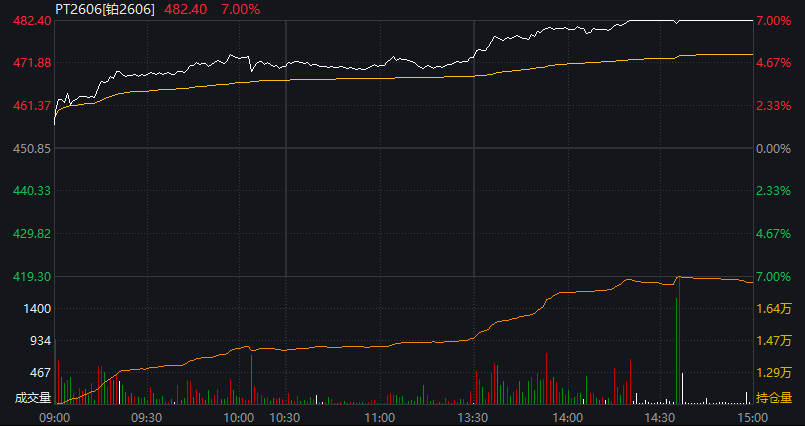
Core Viewpoint - The recent surge in platinum and palladium prices is driven by a combination of macroeconomic liquidity expectations, supply-demand imbalances, and strong market sentiment, marking a significant shift in the precious metals market [1][6][13]. Group 1: Market Performance - On December 15, platinum futures on the Shanghai Futures Exchange hit a 7% limit-up, closing at 482.4 yuan per gram, marking the first limit-up since its listing; palladium futures also rose by 4.73% to 407.6 yuan per gram [1]. - Trading volume for platinum futures surged by 237% to 41,832 contracts, while palladium trading volume skyrocketed by 498% [2]. - Internationally, platinum futures in New York rose over 2% to $1,805 per ounce, and palladium futures increased by 4% to $1,610.50 per ounce [2][3]. Group 2: Supply and Demand Dynamics - Analysts attribute the price surge to macroeconomic easing expectations, tight physical supply, resilient demand, and the overall positive sentiment in the precious metals sector [6][13]. - South Africa, which produces over 70% of the world's platinum, faces structural issues such as power shortages and aging infrastructure, contributing to supply constraints [13]. - The World Platinum Investment Council (WPIC) forecasts a third consecutive year of platinum market shortages, with a potential gap of 30 tons by 2025, indicating a structural supply-demand mismatch [13]. Group 3: Macroeconomic Influences - A weaker US dollar and rising expectations for Federal Reserve rate cuts, particularly with speculation around Kevin Warsh's potential nomination as Fed Chair, have lowered US Treasury yields and the holding costs for precious metals [6][10]. - The market is actively trading on the Fed's policy shift, with expectations of two rate cuts next year, which has further supported precious metals prices [10]. Group 4: Investment Trends - Investment demand remains robust, with China being the largest platinum consumer market; the introduction of platinum and palladium futures options has provided new investment and hedging tools, leading to increased demand [14]. - The rise in ETF holdings indicates a significant recovery in investor sentiment towards precious metals [14]. Group 5: Future Outlook - The sustainability of the current price rally for platinum and palladium will depend on several key variables, including the maintenance of high leasing rates, the macroeconomic environment, and the speed of supply recovery [15]. - Despite the bullish sentiment, concerns remain regarding the potential for high leasing rates to decline, which could lead to market corrections [16].