
战略资源价值重估

Search documents
国泰海通香江策论:事件点评:美伊战云投射国际秩序重构,战略资源迎来反转式价值重估
Haitong Securities International· 2026-02-25 15:39
Geopolitical Context - The U.S.-Iran tensions escalated in January 2026, transitioning into a phase of "high-pressure coercion + parallel negotiations" in February[1][2] - The U.S. military significantly increased its presence in the Middle East, deploying two carrier strike groups with approximately 140-150 aircraft, while intensifying sanctions on Iranian officials and oil trade[1][18] Market Reactions - During the warning phase (January 1-15, 2026), Brent crude oil rose by 4.9%, while the Baltic Dirty Tanker Index (BDTI) surged by 13.7%[4][23] - In the conflict phase (from January 15, 2026, to present), oil prices increased by an additional 11.0%, and BDTI continued to strengthen, rising by 20.6%[4][23] Risk Assessment - The market is currently pricing "transportation risk" ahead of "supply disruption," indicating a lower probability of a decisive U.S. resolution to the Iran issue[4][22] - The geopolitical situation is expected to remain volatile, with potential scenarios including troop withdrawal or escalation of military presence impacting strategic resources like gold and energy[4][30][31] Historical Comparisons - Historical data shows that different types of geopolitical conflicts have varying impacts on oil prices and shipping rates, with the current U.S.-Iran situation focusing on crude supply and transit security risks[4][34] - The Red Sea crisis (November 2023 to January 2024) resulted in Brent crude falling by 11% and BDTI dropping by 15%, while the Baltic Clean Tanker Index (BCTI) rose by 14.5%[4][26] Strategic Resource Valuation - The ongoing restructuring of the international order is likely to lead to a revaluation of strategic resources, including gold and defense sectors, which are expected to outperform crude oil in the medium to long term[4][10][32] - If the conflict does not escalate into a prolonged closure of the Strait of Hormuz, oil shipping and crude oil prices may revert to fundamental logic after initial volatility[4][32]
1年暴涨3.7倍!比白银更疯涨的金属
Ge Long Hui· 2026-02-25 14:12
Core Viewpoint - The tungsten market is expected to outperform other commodities like gold and lithium in 2025-2026, with tungsten prices having already increased by over 220% in 2025, surpassing gold's performance [1][2]. Supply and Demand Dynamics - As of February 25, 2025, the price of tungsten iron in Shanghai has exceeded 1.0225 million yuan per ton, a 3.7-fold increase compared to the same period last year [3]. - The price of black tungsten concentrate reached 705,000 yuan per ton in 2026, up 53.26% year-to-date, while ammonium paratungstate (APT) is priced at 1.05 million yuan per ton, up 56.72%, both hitting historical highs [5]. - China's tungsten reserves account for 52% of the global total, and its production represents 83%, making it the leading tungsten supplier globally [7]. - From 2025, China will tighten tungsten resource management, leading to a significant reduction in supply, with the first batch of tungsten concentrate mining quotas set at 58,000 tons, a 6.5% decrease from the previous year [7]. - Export controls on tungsten products will further tighten global supply, with a projected 27.5% decrease in tungsten exports in 2025 [7][8]. - The slow release of overseas tungsten production capacity will not compensate for the supply reduction from China, with new non-Chinese tungsten concentrate capacity expected to be less than 5,000 tons by 2026 [8]. Demand Growth - Tungsten's applications are expanding beyond traditional sectors into high-end fields such as renewable energy, military, and semiconductors [10]. - Key drivers of demand growth include photovoltaic tungsten wire and PCB drill bits, with strong demand from military and semiconductor sectors [11]. - Since September 2025, tungsten concentrate inventories have been depleting, leading to tight spot supply and increased demand for replenishment from downstream enterprises [12]. Industry Profitability - The rise in tungsten prices is improving profitability across the industry, with significant benefits for resource-rich and high-end processing companies [15]. - Companies with their own tungsten resources, such as Zhangyuan Tungsten, are experiencing substantial profit increases, with stock prices rising over 136% this year [17]. - High-end processing companies, like Zhongtung High-tech, are also benefiting from price increases and strong demand for high-end tungsten products, with stock prices up over 112% [20]. Long-term Outlook - The ongoing rise in tungsten prices is expected to become a long-term norm rather than a short-term market speculation [14]. - The strategic value of tungsten is increasing amid global competition for strategic mineral resources, with China holding a dominant position in the tungsten market [25]. - The valuation logic for tungsten has shifted, with its dual attributes of being a strategic resource and high-end manufacturing material likely to enhance its valuation further [23][24].


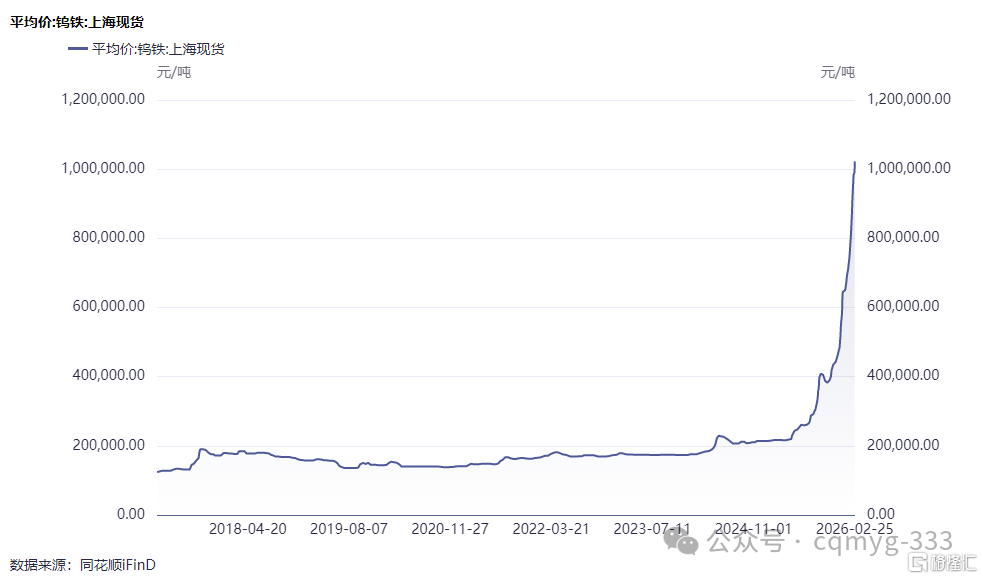
资源博弈与科技革命加速格局重塑,战略资源价值攀升
Zhong Guo Neng Yuan Wang· 2026-02-12 02:08
Group 1 - The core viewpoint of the report indicates that the non-ferrous metal smelting and rolling processing industry achieved a cumulative revenue of 97,733.9 billion yuan in 2025, reflecting a year-on-year increase of 14%, with total profits rising by 22% year-on-year, driven by rising metal prices [1][3] - The report highlights that the mining and selection industry saw the largest profit increase, while the profit growth in smelting and rolling processing was contrary to the decline in actual processing fees, mainly due to some smelting companies owning their own mines [1][3] Group 2 - In 2025, the prices of major non-ferrous metals were influenced by tariffs, expectations of interest rate cuts by the Federal Reserve, and geopolitical factors, leading to a general increase in prices, except for lead and medium-heavy rare earths [2] - Precious metals experienced the highest price increases, with gains exceeding 100%, while small metals saw an approximate increase of 78%, and industrial metals rose by around 30% [2] - Specific price increases included tungsten rising by 343%, COMEX gold and silver increasing by 81% and 178% respectively, copper and tin rising by 51% and 67%, and neodymium oxide increasing by 97%, while dysprosium oxide saw a significant decline [2] Group 3 - The performance of the non-ferrous metal industry in 2025 reflected the price trends, with the mining and selection industry achieving a cumulative revenue of 4,247.4 billion yuan, a year-on-year increase of 12.7%, and operating profits of 1,248.7 billion yuan, up 36.1% [3] - The report indicates that the profit growth in the non-ferrous metal sector is consistent with the price trends, with the overall profit of the Shenwan non-ferrous sector increasing by 72%, and net profits for precious metals, industrial metals, and small metals rising by 94%, 68%, and 77% respectively [3] - The report also notes that the rare earth, lithium, nickel, gold, and copper sectors saw significant profit increases, while some new material profits declined by 17% [3]
稀有金属ETF基金(561800)翻红上扬冲击3连涨,稀土产品价格加速上涨,小金属战略资源价值加速重估
Xin Lang Cai Jing· 2026-02-10 02:12
Group 1 - The core viewpoint of the news highlights the significant performance of rare metal ETFs and the rising prices of rare earth elements, particularly praseodymium and neodymium, driven by supply constraints and increased demand in high-end applications [1][2] Group 2 - As of February 10, 2026, the CSI Rare Metal Theme Index (930632) increased by 0.13%, with notable gains in constituent stocks such as Shenghe Resources (up 3.94%) and Xiamen Tungsten (up 2.13%) [1] - The top ten weighted stocks in the CSI Rare Metal Theme Index account for 59.71% of the index, with companies like Luoyang Molybdenum and Northern Rare Earth leading the list [1] - The rare metal ETF fund (561800) experienced a scale growth of 9.7447 million yuan in the past week, with a share increase of 10 million units [1] - Over a 21-day trading period, the rare metal ETF fund saw net inflows on 13 days, totaling 45.9237 million yuan [1] Group 3 - Prices for praseodymium and neodymium have surged, with praseodymium oxide and metal prices rising by 7.59% and 6.27% respectively on February 9, 2026, and a year-to-date increase of 34% for praseodymium oxide [2] - A research institution predicts a further decline in praseodymium and neodymium production in February due to tight raw material supply, which may lead to continued price increases [2] - According to Wucai Securities, small metal prices are expected to rise by approximately 78% in 2025, with tungsten leading at a 343% increase and praseodymium oxide at 97%, reflecting a revaluation of strategic resources driven by resource competition and technological advancements [2] - The rare metal ETF fund tracks the CS Rare Metal Index, which primarily allocates to lithium carbonate, small metals, and rare earth sectors, with lithium content between 30% and 40%, making it a top investment tool for rare metal industry exposure [2]
铝价 料进入拉锯模式
Qi Huo Ri Bao· 2026-01-30 03:36
Group 1 - Aluminum prices have reached a historical high of 25,640 CNY/ton, reflecting a long-term revaluation of aluminum as a strategic resource, despite high inventory and weak demand before the Spring Festival [1][7] - The geopolitical tensions, particularly between the US and Venezuela, have heightened supply chain vulnerabilities, impacting the pricing logic of industrial metals like aluminum [2] - The Middle East, especially Iran, poses a significant threat to aluminum supply due to its reliance on imported raw materials, with potential US tariffs increasing production costs and risking supply disruptions [2] Group 2 - The premium for aluminum in the European and American markets has surged, with the premium for shipments to Japan in Q1 2026 reaching 195 USD/ton, a 127% increase from Q4 2025 [3] - The financial market has shown a strong correlation between aluminum prices and stock performance, with significant gains in aluminum sector stocks indicating a bullish sentiment [4] - Despite the bullish market sentiment, the industrial fundamentals are weak, with a notable decline in production across major consumer sectors, leading to increased inventory levels [5] Group 3 - The copper-aluminum price ratio has provided a basis for aluminum price support, although the demand for aluminum as a substitute for copper is limited in the short term [6] - Regulatory measures have been implemented to stabilize the market and prevent excessive volatility, with the Shanghai Futures Exchange introducing risk control measures for aluminum trading [6] - Overall, aluminum prices are expected to fluctuate within the range of 23,500 to 25,500 CNY/ton, with high volatility anticipated as the market adjusts to seasonal demand and regulatory impacts [7]
暖风频吹处 真金烈火时——论铜镍锡何以领衔年末行情?
Xin Lang Cai Jing· 2025-12-26 03:38
Core Viewpoint - The current surge in metal prices is driven by a combination of improved macro liquidity expectations and individual supply narratives of metal varieties, with copper, nickel, and tin showing significant elasticity due to their "global scarcity stories" [2][3] Group 1: Price Movements - Copper prices have surged, with the average price reported at 98,030 yuan/ton, an increase of 2,960 yuan, driven by a warming macro atmosphere and concerns over global supply disruptions [1] - Nickel prices have also risen significantly, with an average price of 131,600 yuan/ton, up by 4,250 yuan, supported by resilient demand from the new energy sector and uncertainties in Indonesian industrial policies [1] - Tin prices continue to operate at high levels, with an average price of 334,000 yuan/ton, increasing by 1,750 yuan, primarily due to rigid supply constraints and strong consumption from emerging sectors like AI servers and photovoltaic welding strips [1] Group 2: Supply and Demand Dynamics - Zinc, aluminum, and lead have seen limited price increases, with respective rises of 120 yuan, 40 yuan, and 25 yuan, constrained by a lack of strong demand catalysts [1] - The market is transitioning from pure demand concerns to a re-evaluation of future supply security and cost support, indicating a shift in trading focus [1][2] Group 3: Market Trends and Future Outlook - The overall market is characterized by a structural trend rather than a uniform increase, with macro factors like a weaker dollar and global liquidity expectations contributing to an upward atmosphere [3] - The investment logic in the metal market is undergoing profound restructuring, with a focus on macro liquidity drivers, strategic resource value reassessment, and differentiated sector performance as key themes for 2026 [4] - Small metals such as rare earths, tungsten, and antimony are positioned at the intersection of multiple growth curves, driven by their critical roles in future industries [4][5]
