
钨铁

Search documents
钨行业月度跟踪:2月供给收缩支撑钨价加速上行,关注新年度开采总量控制指标-20260306
Xiangcai Securities· 2026-03-06 07:48
Investment Rating - The industry investment rating is maintained at "Overweight" [2][41] Core Insights - The tungsten industry continues to show strong market performance, with a cumulative increase of 35.91% in February, significantly outperforming the benchmark (CSI 300) by 35.82 percentage points [5] - The valuation of the industry (TTM P/E ratio) has risen from 55.45x at the beginning of the month to 75.76x, currently at 97.52% of its historical percentile [5] - Domestic tungsten product prices have surged due to tight resource supply, with significant increases in both black and white tungsten concentrate prices [6][8] - The international tungsten prices have also risen, reflecting the upward trend in domestic prices [8] Monthly Performance Summary - In February, the domestic tungsten concentrate price for 65% black tungsten increased by 32.89% month-on-month to 684,500 CNY/ton, and by 375.35% year-on-year [8] - The price for 65% white tungsten rose by 32.92% month-on-month to 682,000 CNY/ton, with a year-on-year increase of 379.06% [8] - The ammonium paratungstate (88.5%) price increased by 32.63% month-on-month to 1,006,000 CNY/ton, with a year-on-year increase of 374.87% [8] - Tungsten powder prices also saw significant month-on-month increases, with prices for tungsten powder (≥99.7%, 2-10um) rising by 37.32% to 1,717.5 CNY/kg, and a year-on-year increase of 440.99% [8] Supply and Demand Dynamics - The tungsten supply chain is experiencing a seasonal decline in production, exacerbating supply tightness, with domestic tungsten concentrate production dropping by 39.46% month-on-month in February [9] - The operating rate for tungsten concentrate production fell to 35.31%, below the previous year's levels during the Spring Festival [9] - Inventory levels across the tungsten supply chain are at historical lows, with significant reductions in stock for tungsten concentrate, ammonium paratungstate, and tungsten powder [11] Profit Distribution and Market Outlook - The profit margins for tungsten concentrate are expanding due to resource scarcity and price increases, with simulated gross profit reaching 539,400 CNY/ton, a month-on-month growth of 50.71% [11] - The midstream sector is also seeing profit expansion, while the downstream sector faces pressure due to cost transmission issues [11] - Long-term, the tightening of tungsten supply due to various factors, including declining ore grades and stricter mining controls, is expected to support higher tungsten prices [11][38] - The report suggests that the first batch of tungsten mining control indicators for 2026 is expected to tighten, reinforcing the supply constraint logic [38]

ETF日报:在“反内卷”政策推进下,煤炭行业有望继续受益
Xin Lang Cai Jing· 2026-02-27 13:03
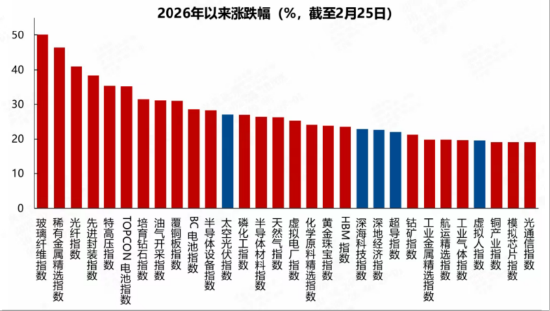
Core Viewpoint - The main theme in the capital market since the beginning of 2026 has been "price increases," which has permeated various industries and become a focal point for market transactions [10] Group 1: Market Performance - The A-share market showed divergence today, with the Shanghai Composite Index rising by 0.39% in the afternoon, while the ChiNext Index fell by over 1% [1] - The total trading volume in the Shanghai and Shenzhen markets was 2.51 trillion yuan, slightly lower than the previous trading day [1] Group 2: Price Increase Trends - Since the beginning of the year, 25 out of the top 30 concept indices have been related to the "price increase" logic, indicating a broadening trend across various sectors including oil and gas, chemicals, construction materials, and technology [10] - The "price increase" is expected to be a core factor driving market style diffusion throughout the year, reflecting industry prosperity [10] Group 3: Steel Sector Insights - The steel ETF has shown strong performance, with a cumulative increase of 10.64% this week, driven by both supply and demand catalysts [13] - Demand-side factors include favorable real estate policies in key cities, while supply-side factors indicate a contraction in 2026, leading to an accelerated phase of industry consolidation [13][14] - The steel sector is currently viewed as a bottoming area with significant elasticity potential, as low inventory levels could lead to price increases if demand catalyzes [14] Group 4: Rare Metals Surge - Rare metals such as tungsten and rare earths have seen a collective surge, with several stocks hitting historical highs, driven by four main factors [5][6] - The first factor is a dramatic increase in spot prices, with tungsten prices reaching 1.0225 million yuan per ton, up 3.7 times from the previous year [6] - The second factor is a tightening supply side, with mining quotas and environmental regulations limiting production capacity [6] - The third factor is the explosive demand from emerging industries, particularly in sectors like photovoltaics and semiconductors [6] - The fourth factor involves a global reassessment of critical mineral strategies, which has added a "safety premium" to these commodities [7] Group 5: Coal Sector Developments - The coal ETF rose by 2.82% today, influenced by production halts during the Spring Festival and ongoing reductions in Indonesian coal output [18] - The coal market is expected to benefit from policies aimed at reducing production capacity, with potential upward price elasticity if market conditions exceed expectations [19] - The coal sector is viewed as having room for a rebound, especially as other commodities have seen significant price increases [19]

1年暴涨3.7倍!比白银更疯涨的金属
Ge Long Hui· 2026-02-25 14:12
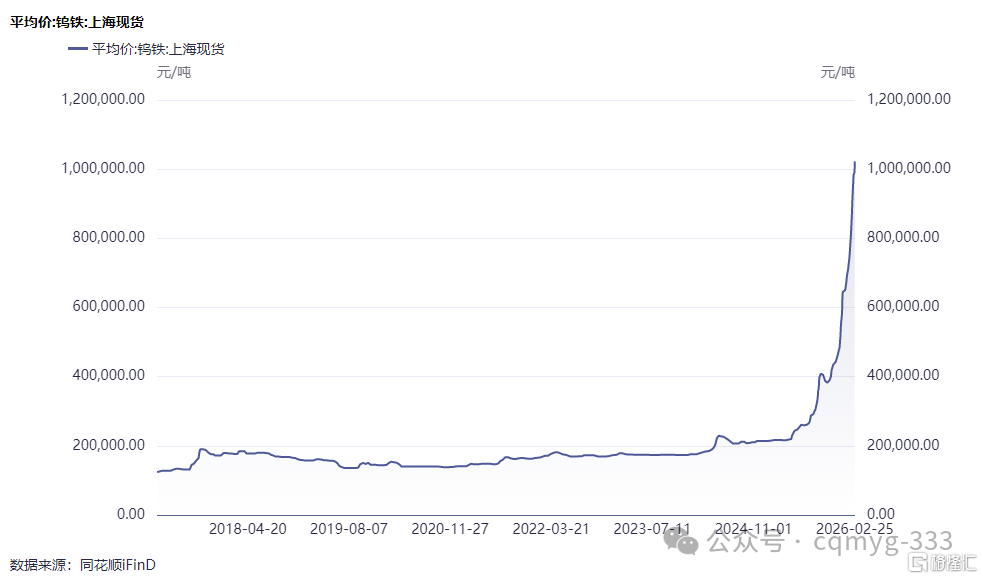
Core Viewpoint - The tungsten market is expected to outperform other commodities like gold and lithium in 2025-2026, with tungsten prices having already increased by over 220% in 2025, surpassing gold's performance [1][2]. Supply and Demand Dynamics - As of February 25, 2025, the price of tungsten iron in Shanghai has exceeded 1.0225 million yuan per ton, a 3.7-fold increase compared to the same period last year [3]. - The price of black tungsten concentrate reached 705,000 yuan per ton in 2026, up 53.26% year-to-date, while ammonium paratungstate (APT) is priced at 1.05 million yuan per ton, up 56.72%, both hitting historical highs [5]. - China's tungsten reserves account for 52% of the global total, and its production represents 83%, making it the leading tungsten supplier globally [7]. - From 2025, China will tighten tungsten resource management, leading to a significant reduction in supply, with the first batch of tungsten concentrate mining quotas set at 58,000 tons, a 6.5% decrease from the previous year [7]. - Export controls on tungsten products will further tighten global supply, with a projected 27.5% decrease in tungsten exports in 2025 [7][8]. - The slow release of overseas tungsten production capacity will not compensate for the supply reduction from China, with new non-Chinese tungsten concentrate capacity expected to be less than 5,000 tons by 2026 [8]. Demand Growth - Tungsten's applications are expanding beyond traditional sectors into high-end fields such as renewable energy, military, and semiconductors [10]. - Key drivers of demand growth include photovoltaic tungsten wire and PCB drill bits, with strong demand from military and semiconductor sectors [11]. - Since September 2025, tungsten concentrate inventories have been depleting, leading to tight spot supply and increased demand for replenishment from downstream enterprises [12]. Industry Profitability - The rise in tungsten prices is improving profitability across the industry, with significant benefits for resource-rich and high-end processing companies [15]. - Companies with their own tungsten resources, such as Zhangyuan Tungsten, are experiencing substantial profit increases, with stock prices rising over 136% this year [17]. - High-end processing companies, like Zhongtung High-tech, are also benefiting from price increases and strong demand for high-end tungsten products, with stock prices up over 112% [20]. Long-term Outlook - The ongoing rise in tungsten prices is expected to become a long-term norm rather than a short-term market speculation [14]. - The strategic value of tungsten is increasing amid global competition for strategic mineral resources, with China holding a dominant position in the tungsten market [25]. - The valuation logic for tungsten has shifted, with its dual attributes of being a strategic resource and high-end manufacturing material likely to enhance its valuation further [23][24].


1年暴涨3.7倍,比白银更疯涨的金属
3 6 Ke· 2026-02-25 11:54
Core Viewpoint - The tungsten market is expected to outperform other commodities like gold and lithium in 2025-2026, driven by a combination of policy, resource constraints, and strong demand [1][8]. Supply and Demand Dynamics - Tungsten prices have surged over 220% in 2025, significantly outpacing gold [2]. - As of February 25, 2025, the price of tungsten iron in Shanghai reached 1.0225 million yuan per ton, a 3.7-fold increase from the previous year [4]. - The price of black tungsten concentrate has reached 705,000 yuan per ton in 2026, up 53.26% year-to-date, while ammonium paratungstate (APT) is at 1.05 million yuan per ton, up 56.72% [6]. - China's tungsten reserves account for 52% of the global total, with production at 83%, making it the dominant supplier [10]. - From 2025, China will tighten tungsten resource management, leading to a significant reduction in supply, with a 6.5% decrease in the first batch of tungsten concentrate mining quotas [10]. - Export controls on tungsten products will further tighten global supply, with a projected 27.5% decrease in tungsten exports in 2025 [10]. Market Performance - A-share tungsten stocks have shown remarkable performance, with companies like Xianglu Tungsten and Zhangyuan Tungsten seeing increases of 159.34% and 136% respectively [7]. - The supply-demand imbalance is expected to persist, with a projected global tungsten supply gap of 18,500 tons by 2026, increasing annually [15]. Industry Trends - The demand for tungsten is expanding beyond traditional applications into high-end sectors such as renewable energy, military, and semiconductors [12][13]. - The consumption of tungsten concentrate has been rising, with low inventory levels prompting downstream companies to replenish stocks, further driving up prices [14]. - Companies with proprietary tungsten resources, like Zhangyuan Tungsten, are expected to see significant profit increases due to rising prices [17]. Investment Opportunities - The price increase is benefiting the entire tungsten industry chain, particularly resource-rich and high-end processing companies [16]. - Institutions have set target prices for leading companies like Zhangyuan Tungsten and Zhongtung High-tech, indicating potential upside of 19%-34% and 19%-27% respectively [19][24]. - The economic viability of tungsten recycling is improving, with the recycling rate expected to rise from 21% in 2023 to over 30% by 2025, benefiting companies like Xiamen Tungsten [26]. Strategic Importance - The ongoing rise in tungsten prices reflects a revaluation of strategic resources amid global competition, with China holding a pivotal role in the tungsten market [29].

策略周度思考 20260201:中盘蓝筹系列:大宗涨价的两条主线-20260201
Orient Securities· 2026-02-01 07:02
Group 1: Historical Price Trends - Historical price trends of commodities follow a sequence: precious metals, industrial metals, petrochemicals, and agricultural products[9] - Since 1970, there have been five significant commodity bull markets, defined by a price increase of over 50%[10] - The typical price increase sequence occurs in less than one quarter for precious metals, about two quarters for petrochemicals, and approximately one quarter for agricultural products[12] Group 2: Current Market Dynamics - Current market dynamics are influenced by domestic industrial transformation and global political changes[28] - Commodities closely tied to traditional industries, such as real estate, are expected to perform poorly due to reduced demand elasticity[30] - Emerging economies are expected to drive future demand growth, with a decoupling from developed economies observed[30] Group 3: Price Increase Pathways - The current price increase is characterized by external rather than internal factors, focusing on two main lines: industrialization in emerging economies and geopolitical tensions affecting import prices[43] - The first main line involves price increases driven by industrialization in emerging economies, which is expected to continue due to China's support[44] - The second main line is influenced by geopolitical risks, which can directly threaten commodity prices and create cost transmission effects[44] Group 4: Investment Outlook - The report is optimistic about the price outlook for the chemical and agricultural sectors while being conservative about commodities closely related to the real estate chain[44] - Risks include market performance falling short of expectations, insufficient pricing of geopolitical risks, and potential underperformance in industry development[45]
钨行业月度跟踪:1月钨价延续强势上涨,矿端供应紧张短期难改-20260130
Xiangcai Securities· 2026-01-30 03:50
Investment Rating - The industry rating is upgraded to "Overweight" from "Buy" due to rapid valuation increases and optimistic expectations reflected in stock prices [5]. Core Insights - The tungsten industry has shown strong market performance with a significant valuation increase, outperforming the benchmark index [2]. - Domestic tungsten prices have reached historical highs, driven by tight supply at the mining level and rising prices for long-term contracts [3]. - The supply chain remains constrained by tight raw material availability, leading to limited demand release and reduced transaction volumes [6]. Price Statistics - In January 2026, the average price of 65% black tungsten concentrate increased by 26.69% month-on-month to 510,600 CNY/ton, and by 254.75% year-on-year, with the increase from December 2025 expanding by 72.05 percentage points [5]. - The average price of 65% white tungsten concentrate rose by 26.76% month-on-month to 508,700 CNY/ton, with a year-on-year increase of 256.66% [5]. - The average price of ammonium paratungstate (APT) increased by 26.2% month-on-month to 751,400 CNY/ton, with a year-on-year increase of 254.53% [5]. Supply and Demand Dynamics - The supply of tungsten concentrate has slightly decreased, with weekly production dropping from 1,880 tons to 1,870 tons [6]. - The production of APT is estimated to increase by 5.88% in January 2026, but the overall supply remains constrained due to tight raw material availability [6]. - Demand is primarily driven by essential needs, with limited room for growth as rising raw material prices suppress downstream replenishment [6]. Profitability Analysis - Mining profits are expanding due to resource scarcity and price increases, with simulated gross profit for tungsten concentrate reaching 334,900 CNY/ton, a month-on-month increase of 40.77% [6]. - The midstream refining sector is also seeing steady profit growth, while downstream processing and alloy sectors are experiencing profit pressure due to lagging price transmission [6]. Investment Recommendations - The long-term outlook for the tungsten industry is positive, with supply constraints expected to strengthen due to declining ore grades and increased mining costs [6]. - Short-term expectations indicate that tight supply conditions will likely persist, supporting strong tungsten concentrate prices [6]. - Continued focus is recommended on companies with rich tungsten resources and integrated industrial layouts, particularly those investing in deep processing and emerging product areas [7].
涨幅吊打金银!这个品种景气周期能持续多久?
Ge Long Hui· 2026-01-21 09:55
Core Viewpoint - The rare metal tungsten, referred to as "industrial teeth," is expected to be the standout performer in the non-ferrous metal market in 2025, with tungsten prices skyrocketing from 200,000 yuan/ton at the beginning of the year to 600,000 yuan/ton by year-end, marking a staggering 300% increase and setting a historical high [1][3]. Supply and Demand Dynamics - The surge in tungsten prices is driven by a combination of rigid supply constraints and explosive demand growth, with APT (the core product of tungsten smelting) social inventory plummeting from a normal level of 600 tons to below 200 tons, and hard alloy companies having only 12 days of raw material inventory left, significantly below the 30-day safety line [3][4]. - The supply side is constrained by three main factors: policy control, resource depletion, and difficulty in increasing overseas production. The annual mining quota for tungsten in China has been reduced by 8.3% to 56,800 tons for 2025, limiting production even as prices rise [4][5]. Demand Explosion - The demand structure for tungsten has fundamentally changed in 2025, with the share of demand from new energy and high-end manufacturing rising from 15% in 2024 to 30%, moving away from traditional steel industry reliance [6][8]. - The photovoltaic industry is a major source of demand growth, with tungsten wire replacing carbon steel wire in silicon wafer cutting due to its superior strength and wear resistance [8]. - The demand from the electric vehicle sector is also rapidly increasing, with each vehicle requiring approximately 2-8 kg of tungsten, and global EV sales expected to grow by 20% in 2025, adding 10,500 tons of tungsten demand [8]. Profit Distribution - The profits from the surge in tungsten prices are not evenly distributed across the industry chain, with upstream resource companies being the biggest winners. For instance, a 10,000 yuan/ton increase in tungsten prices can boost net profits significantly for companies like Xiamen Tungsten and Zhongtung High-tech [9][10]. - Midstream smelting companies face challenges due to rising raw material costs and tight supply, leading to reduced profit margins for smaller firms [10]. Future Outlook - The consensus in the industry is that the supply-demand gap will remain unbridgeable, with tungsten prices expected to stay high for the next 3-5 years. The global primary tungsten supply growth rate is projected to be only 2%-3% from 2026 to 2030, significantly lower than demand growth [11][12]. - Analysts predict that black tungsten concentrate prices will fluctuate between 460,000 and 520,000 yuan/ton in 2026, with potential for prices to exceed 500,000 yuan/ton if China tightens exports further [12]. Investment Opportunities - Investors are advised to focus on three key areas: upstream resource leaders like Xiamen Tungsten and Zhangyuan Tungsten, high-end manufacturing leaders like Zhongtung High-tech, and niche players in high-value sectors such as tungsten-based new materials and military-grade tungsten alloys [13][14]. - The demand growth for tungsten is closely tied to the most promising growth sectors over the next 5-10 years, providing long-term support for tungsten prices and enhancing the investment value of leading companies in the industry [14].

涨幅吊打金银!这个品种景气周期能持续多久?
格隆汇APP· 2026-01-21 09:42
Core Viewpoint - The rare metal tungsten, referred to as the "industrial tooth," is expected to be the standout performer in the non-ferrous metals market in 2025, with prices skyrocketing from 200,000 yuan/ton at the beginning of the year to 600,000 yuan/ton by year-end, marking a staggering 300% increase and setting a historical high [4]. Supply and Demand Dynamics - The surge in tungsten prices is driven by a combination of rigid supply constraints and structural demand explosions, with APT (the core product of tungsten smelting) social inventory dropping from a normal level of 600 tons to below 200 tons, and hard alloy companies having only 12 days of raw material inventory, significantly below the 30-day safety line [7][11]. - The supply side is constrained by three main factors: policy control, resource depletion, and the difficulty of increasing overseas production. The annual mining quota for tungsten in China was set at 56,800 tons for 2025, an 8.3% decrease from the previous year, limiting production even as prices rise [10][11]. Demand Explosion - Demand for tungsten has fundamentally shifted, with the share from new energy and high-end manufacturing rising from 15% in 2024 to 30% in 2025, moving away from traditional steel industry reliance [13]. - The photovoltaic industry is a major growth driver, with tungsten wire replacing carbon steel wire in silicon wafer cutting due to its superior strength and wear resistance. The demand from the new energy vehicle sector is also rapidly increasing, with each vehicle requiring 2-8 kg of tungsten [15]. Profit Distribution in the Industry - The profit from rising tungsten prices is unevenly distributed across the industry, favoring upstream resource companies. For instance, a 10,000 yuan/ton increase in tungsten prices can boost net profits significantly for companies like Xiamen Tungsten and Zhongtung High-tech [17]. - Midstream smelting companies face challenges due to rising raw material costs and tight supply, with some small firms experiencing profit margins dropping below 10% [18]. Future Outlook - The consensus for the tungsten industry in 2026 and beyond is that the supply-demand gap will remain unbridgeable, with prices expected to stay high for the next 3-5 years. The global primary tungsten supply growth rate is projected to be only 2-3% annually from 2026 to 2030, significantly lower than demand growth [20][21]. - Analysts predict that the price of black tungsten concentrate will fluctuate between 460,000 and 520,000 yuan/ton in 2026, with potential to exceed 500,000 yuan/ton if China tightens exports further [21]. Investment Opportunities - Investment opportunities in the tungsten industry should focus on three key areas: upstream resource leaders like Xiamen Tungsten and Zhangyuan Tungsten, high-end manufacturing leaders like Zhongtung High-tech, and niche players in high-value segments such as tungsten-based new materials and military-grade tungsten alloys [22][23].

中钨在线:钨价坚挺之势未改 行情节节攀高
Xin Lang Cai Jing· 2026-01-20 03:29
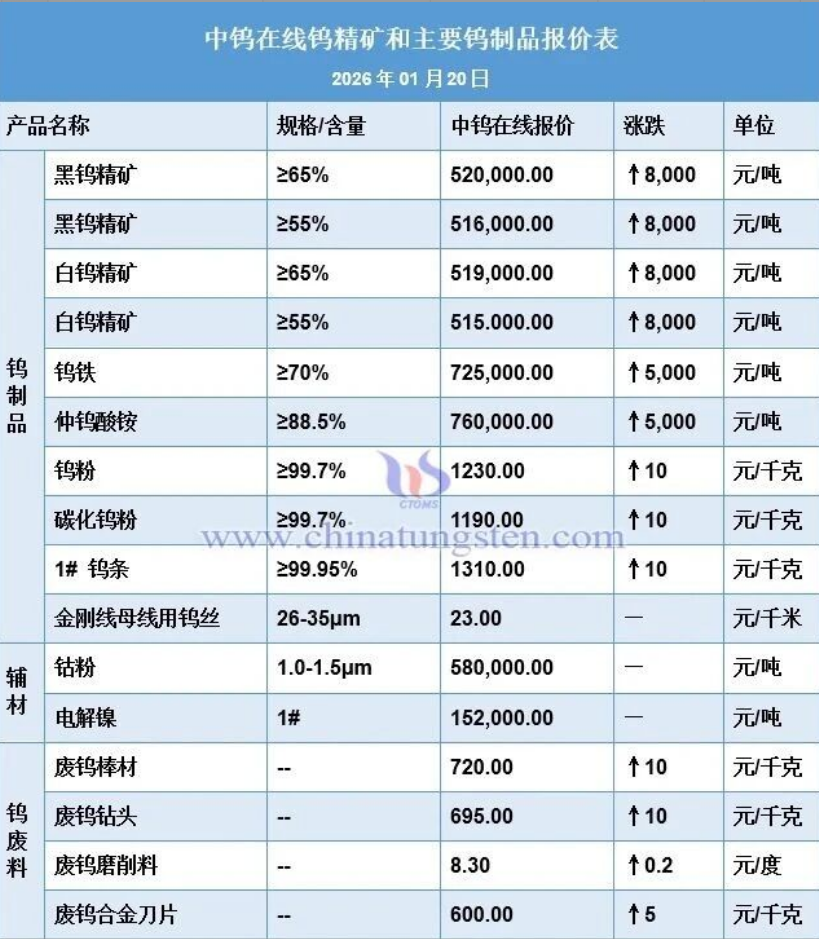
Group 1 - The tungsten market is experiencing tight supply as miners hold back inventory, supporting high prices for tungsten products [1][2] - As of January 20, 2026, the price for black tungsten concentrate (≥65%) is reported at 520,000 CNY per ton, reflecting a 13.0% increase since the beginning of the year [3] - The price for white tungsten concentrate (≥65%) is reported at 519,000 CNY per ton, with a 13.1% increase since the start of the year [4] Group 2 - The price for ammonium paratungstate (APT) in China is reported at 760,000 CNY per ton, up 13.4% year-to-date, while European APT prices range from 987 to 1050 USD per ton (approximately 60.8 to 64.7 million CNY), marking a 10.7% increase [4] - Tungsten powder prices are at 1,230 CNY per kilogram, showing a 13.9% increase since the beginning of the year [4] - The price for tungsten carbide powder is reported at 1,190 CNY per kilogram, with a 14.2% increase year-to-date [5] Group 3 - Tungsten iron prices are reported at 725,000 CNY per ton, reflecting an 11.5% increase since the start of the year [8] - The price for tungsten scrap materials, such as waste tungsten rods and drill bits, has also seen significant increases, with waste tungsten rods priced at 720 CNY per kilogram (up 20.0%) and waste tungsten drill bits at 695 CNY per kilogram (up 19.8%) [10][11] Group 4 - The macroeconomic environment in China is stable, with GDP projected to reach 14,018.79 billion CNY in 2025, growing by 5% [12] - The automotive industry is driving demand for tungsten products, particularly in hard alloy tools and wear parts, although the rise of electric vehicles may reduce tungsten usage in traditional cutting tools [12] - In 2025, China's automotive production and sales are expected to reach 34.53 million and 34.40 million units, respectively, with new energy vehicles accounting for 47.9% of total new car sales [12]
钨涨价逻辑及后续行情展望
2026-01-19 02:29
Summary of Tungsten Market Conference Call Industry Overview - The conference call focuses on the tungsten market, discussing price trends, supply-demand dynamics, and regulatory impacts for the years 2025 and 2026 [1][2][3]. Key Points and Arguments Price Trends and Influencing Factors - In 2025, the tungsten market experienced significant price fluctuations due to various factors: - Q1: Export control policies led to inventory sell-offs, causing price declines [2]. - Q2: Continued enforcement of export controls and anti-smuggling measures supported domestic prices [2]. - Q3: The introduction of anti-involution policies resulted in increased profits for large enterprises, driving up prices for downstream products like tungsten powder [2][5]. - Q4: Supply tightness in APT (Ammonium Paratungstate) due to tax policies and maintenance at smelting plants pushed prices higher [2][5]. Supply and Demand Dynamics - For 2026, domestic tungsten demand is projected at approximately 75,000 tons, while supply is expected to be around 65,000 tons, resulting in a supply gap of about 10,000 tons [3][24]. - Global demand is anticipated to grow at a rate of 4.5% to 5% [3][24]. - The tungsten concentrate production is expected to continue declining in 2026, even with imports, due to environmental and operational issues affecting supply [1][6]. Regulatory and Policy Impacts - The anti-involution policy aims to prevent unreasonable price increases and is crucial for stabilizing the market [11]. - The 15th Five-Year Plan emphasizes prohibiting the expansion of low-end production capacity and promoting high-end transformation in the tungsten industry [12]. - Export controls from Japan on tungsten are expected to remain in place, potentially becoming a normalized measure in the context of geopolitical tensions [29]. Future Price Predictions - Market participants predict that tungsten prices could reach 800,000 to 1,000,000 CNY per ton, but this is contingent on policy adjustments [13]. - The valuation of strategic metals like tungsten is expected to be reassessed, reflecting their strategic importance rather than just production costs [13][14]. Inventory and Market Conditions - Current inventory levels among traders and manufacturers are low, with many firms operating with minimal stock due to unexpected price increases [20][22]. - Major traders maintain operational inventories around 200 tons, while social inventory levels are expected to be low overall [21]. Application and Demand Structure - The demand for tungsten in various applications is evolving, with hard alloys remaining the largest segment, followed by materials for photovoltaic and nuclear fusion applications [26][27]. - Emerging industries are expected to have a stronger acceptance of high-priced tungsten products, while traditional sectors may see a reduction in demand [24]. Other Important Insights - The market is closely monitoring the impact of supply-side reforms and environmental regulations on production capabilities [10][14]. - The potential for recycled tungsten to increase in supply is recognized, with current recycling rates expected to rise to meet tightening raw material availability [16]. This summary encapsulates the key discussions and insights from the tungsten market conference call, highlighting the complex interplay of supply, demand, regulatory impacts, and future market expectations.