政策效应

Search documents
11月全省经济行平稳向好
Zheng Zhou Ri Bao· 2025-12-17 00:57
Economic Overview - The economic operation in Henan province shows a stable and positive trend, with major economic indicators growing faster than the national average, indicating enhanced resilience [1] Industrial Performance - In November, the industrial added value above designated size in Henan increased by 8.0% year-on-year, accelerating by 0.1 percentage points from the previous month and surpassing the national growth rate by 3.2 percentage points [1] - From January to November, the industrial added value grew by 8.4%, maintaining the same growth rate as the previous ten months and exceeding the national rate by 2.4 percentage points [1] - Key industrial chains contributed significantly, with a 10.5% increase in added value in November, accounting for 85.0% of the growth in the province's industrial sector [1] Investment Trends - Fixed asset investment in Henan showed steady growth, with a year-on-year increase of 4.3% from January to November, outpacing the national growth rate by 6.9 percentage points [1] - Investment in projects worth over 100 million yuan grew by 8.6%, contributing 5.6 percentage points to the overall investment growth [1] - Private investment continued to gain momentum, increasing by 6.8% from January to November, consistently higher than the overall investment growth rate since April of the previous year [1] Consumer Market - The retail sales of consumer goods in November reached 269.199 billion yuan, growing by 4.4%, which is 1.3 percentage points higher than the national average [2] - From January to November, the total retail sales amounted to 2,641.515 billion yuan, with a growth rate of 5.8%, exceeding the national growth rate by 1.8 percentage points [2] - Nearly 70% of retail goods maintained growth, with significant increases in upgraded consumer products such as wearable smart devices and smartphones [2] Policy Impact - The effects of policies are being fully realized, with the added value of the equipment manufacturing industry growing by 14.7% in November, outpacing the overall industrial growth rate by 6.7 percentage points [2] - Investment in equipment and tools saw an 11.1% increase from January to November, exceeding the overall investment growth rate by 6.8 percentage points [2] - Retail sales of photographic and communication equipment surged, with growth rates of 92.9% and 43.1% respectively in November [2]
11月70城房价数据出炉:新房价格环比上涨城市增多,有何信号?
Mei Ri Jing Ji Xin Wen· 2025-12-15 13:02
Core Viewpoint - The November data from the National Bureau of Statistics indicates a positive trend in new home prices across major cities, with an increase in the number of cities experiencing month-on-month price rises, suggesting a release of year-end housing demand and effective policy impacts [1][3][4] Group 1: New Home Prices - In November, 8 out of 70 major cities reported a month-on-month increase in new home prices, with Shanghai leading at a 5.1% year-on-year increase, followed by Hangzhou at 3% and Hefei at 1.3% [1][4] - The month-on-month decline in new home prices for first-tier cities was 0.4%, with Shanghai increasing by 0.1% while Beijing, Guangzhou, and Shenzhen saw declines of 0.5%, 0.5%, and 0.9% respectively [3][5] - Year-on-year, first-tier cities experienced a 1.2% decline in new home prices, with Shanghai's 5.1% increase contrasting with declines in Beijing, Guangzhou, and Shenzhen of 2.1%, 4.3%, and 3.7% respectively [3][4] Group 2: Second-Hand Home Prices - First-tier cities saw a continued month-on-month decline in second-hand home prices, with decreases of 1.3% in Beijing, 0.8% in Shanghai, 1.2% in Guangzhou, and 1.0% in Shenzhen [5][6] - Year-on-year, second-hand home prices in first-tier cities fell by 5.8%, with specific declines of 6.8% in Beijing, 4.6% in Shanghai, 7.2% in Guangzhou, and 4.8% in Shenzhen [5][6] - The increase in new home supply in first-tier cities, along with a rise in the proportion of transactions for second-hand homes priced at 3 million yuan or below, has impacted the demand for upgrading housing [5][6]


黄金、比特币大震荡:传统投资逻辑不灵了?|财经早察
2 1 Shi Ji Jing Ji Bao Dao· 2025-11-20 02:40
Group 1 - The core viewpoint of the article discusses the recent volatility in Bitcoin and gold prices, highlighting a simultaneous decline in both risk and safe-haven assets, which is considered an unusual phenomenon in traditional investment logic [1][4]. - Bitcoin experienced a significant drop, falling below $90,000 for the first time in seven months after reaching a peak of over $126,000 on October 6, driven by macroeconomic expectations and policy effects [1][2]. - The divergence in the Federal Reserve's stance on interest rate cuts has led to market uncertainty, causing a tightening of liquidity that adversely affects high-risk assets like Bitcoin [2][4]. Group 2 - The anticipated favorable regulatory environment for cryptocurrencies has not materialized, leading to a decline in market sentiment and a subsequent sell-off of Bitcoin as investors reduce leverage [3][4]. - Gold's decline, despite being a traditional safe-haven asset, indicates a stronger force at play—specifically, the tightening of dollar liquidity, which has led investors to liquidate various assets indiscriminately [4][5]. - The recent sell-off in both Bitcoin and gold reflects a broader liquidity crisis in the U.S. market, where investors are forced to sell even relatively stable assets to cover margin calls [5].
黄金、比特币大震荡:传统投资逻辑不灵了?
2 1 Shi Ji Jing Ji Bao Dao· 2025-11-20 02:33
Group 1 - Bitcoin experienced a significant drop, falling below $90,000 for the first time in seven months after reaching a record high of over $126,000 on October 6 [1][2] - The decline in Bitcoin's price is attributed to changing macroeconomic expectations, particularly regarding the Federal Reserve's interest rate decisions, which have led to increased market uncertainty [2][3] - Institutional investors are reducing leverage and selling off high-risk assets like Bitcoin in response to rising funding costs, creating initial selling pressure [2][3] Group 2 - The anticipated favorable regulatory environment for cryptocurrencies has not materialized, leading to a loss of bullish sentiment in the market [3] - The simultaneous decline of gold, traditionally viewed as a safe-haven asset, is unusual and indicates a broader liquidity crisis in the market [4] - The strengthening of the US dollar and systemic tightening of liquidity have forced investors to liquidate various assets, including gold, to secure cash [4]
从“恢复性增长”迈向“结构性升级”
Chang Jiang Ri Bao· 2025-11-14 07:56
Group 1 - The core viewpoint of the article highlights the resilience of Wuhan's consumer market, with a slight increase in the Consumer Price Index (CPI) driven by both consumption upgrades and policy effects [1] - In October, Wuhan's CPI rose by 0.1% year-on-year, while the core CPI, excluding food and energy, increased by 1.0%, indicating a vibrant market [1] - The growth in core CPI is attributed to dual support from service and industrial consumer goods, with significant increases in travel and entertainment spending [1][3] Group 2 - The tourism sector in Wuhan has remained strong, ranking among the top ten popular travel destinations in China, contributing to rising prices for flights and accommodations by 4.4% and 4.0% respectively [1] - The demand for smart consumer electronics, such as tablets and wearable devices, has also surged, with prices increasing by 4.3% year-on-year [1] - The "post-90s" and "post-95s" generations are driving demand for maternal and infant care services, leading to a price increase of 3.2% in this sector [1] Group 3 - The automotive market is experiencing a shift, with a narrowing decline in prices for fuel and new energy vehicles, down by 3.4% and 1.3% respectively, while sales have significantly increased [1] - The introduction of national subsidies has positively impacted consumer spending in the automotive sector [1] - The demand for small household appliances, such as air fryers and coffee machines, has risen, with prices increasing by 2.8%, reflecting a growing trend towards enhancing living standards [3] Group 4 - Basic necessities, such as pork and fresh vegetables, have seen price declines of 19.5% and 7.7% respectively, contributing to lower living costs for residents [3] - The overall structure of consumer prices shows a trend of "six increases and two decreases" among eight major categories, with "other goods and services" experiencing a notable increase of 12.9% [3] - The analysis indicates that Wuhan's consumer market is transitioning from "recovery growth" to "structural upgrading," with ongoing policy effects and the emergence of new business formats expected to enhance the city's vibrancy and technological appeal [3]
苍原资本:A股市场慢涨行情有望延续
Sou Hu Cai Jing· 2025-10-28 03:47
Market Performance - The A-share market showed strong performance on October 27, with the Shanghai Composite Index approaching the 4000-point mark, indicating a bullish trend [1][4] - The market sentiment is gradually stabilizing, with active funds' reduction behavior nearing its end, reflecting a steady correction in investor confidence [4] Sector Analysis - Key sectors performing well include communication equipment, electronic components, consumer electronics, and non-ferrous metals, while gaming, wind power equipment, engineering consulting services, and mining sectors lagged [1] - The storage chip sector showed strength, with local stocks in Fujian performing well, and the computing hardware sector remained active [4] Economic and Policy Influences - Multiple factors such as the Fourth Plenary Session setting the tone for the "14th Five-Year Plan," the opening of the Federal Reserve's interest rate cut cycle, and the easing of China-US trade relations are contributing to a gradual upward trend in the A-share market [1] - The market is expected to continue its slow upward trend in the short term, with close attention needed on policy, capital flow, and external market changes [1] Technical Analysis - From a technical perspective, the index has broken through key resistance levels, with significant volume expansion indicating active market sentiment [4] - The Shanghai Composite Index has surpassed its previous trading range, suggesting potential for further upward movement [4] Mid-term Outlook - Despite potential supply-demand pressures in the spring of next year, the gradual clearing of production capacity and the effects of policies are expected to stabilize the economic and market bottom, serving as a key driving force for a new market rally [4] - Supportive factors for the fourth quarter include anti-involution policies, increased household savings entering the market, Federal Reserve interest rate cuts, and a reversal in technical indicators, suggesting a bullish outlook for A-shares [4]

【机构策略】A股市场慢涨行情有望延续
Zheng Quan Shi Bao Wang· 2025-10-28 00:57
Group 1 - The A-share market showed strong performance on October 27, with the Shanghai Composite Index approaching the 4000-point mark, driven by multiple factors including the Fourth Plenary Session's groundwork for the "14th Five-Year Plan," the onset of the Federal Reserve's rate cut cycle, and improved China-U.S. trade relations [1][2] - Various sectors performed differently, with communication equipment, electronic components, consumer electronics, and non-ferrous metals showing strong performance, while gaming, wind power equipment, engineering consulting services, and mining sectors lagged [1] - Technical analysis indicates that the index has broken through key resistance levels with significantly increased trading volume, reflecting a positive market sentiment and a gradual recovery of investor confidence [2] Group 2 - The storage chip sector showed strength, with local stocks in Fujian performing well, while soft drinks and engineering machinery sectors underperformed [2] - The market is expected to continue its upward trend in the short term, supported by the resolution of major macroeconomic events and a favorable technical outlook, with the potential for further gains as the index has broken out of previous trading ranges [2] - In the medium term, factors such as "anti-involution" policies, increased retail investor participation, the Federal Reserve's rate cuts, and technical reversals are expected to support a bullish trend in the A-share market for the fourth quarter [2]
民生证券:A股“跑赢”美股的来龙与去脉
智通财经网· 2025-08-22 04:45
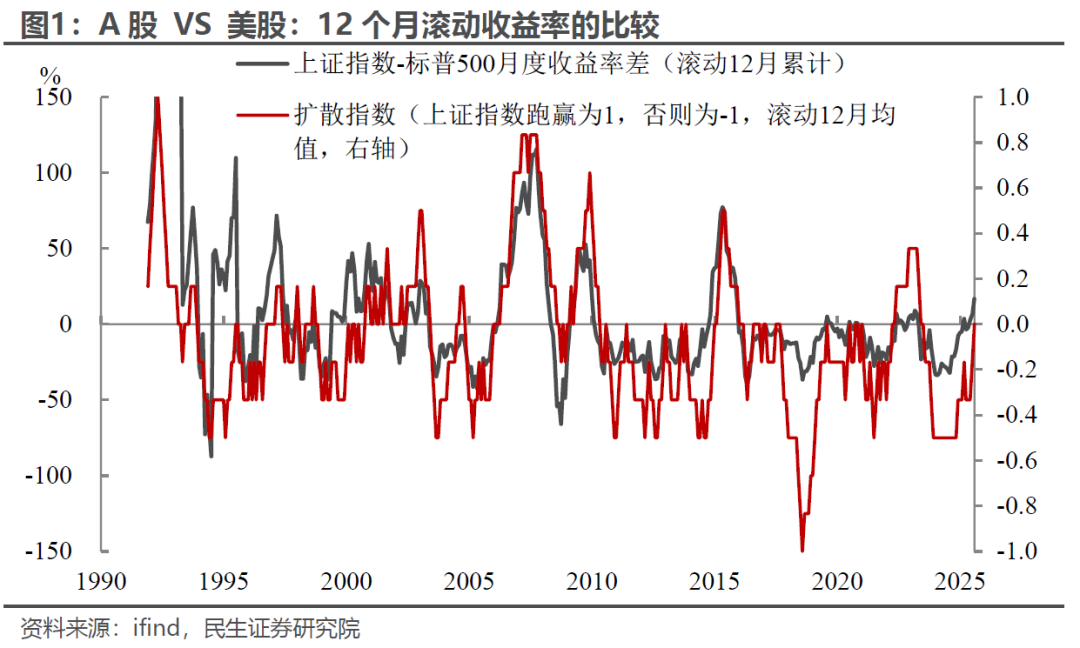
Group 1 - A-shares have outperformed U.S. stocks, with a relative excess return exceeding 15% since the second half of the year, marking the highest level since 2015 [1][3] - The probability of A-shares outperforming U.S. stocks increases when both markets rise together, with A-shares winning approximately 54% of the time in such scenarios [3][5] - Historical analysis shows that A-shares have outperformed U.S. stocks in 10 distinct phases since the early 1990s, with the average duration of these phases being around 10 months [5][6] Group 2 - The main factors influencing A-share performance during winning phases include valuation and earnings contributions, with valuation changes playing a more significant role [6][10] - In winning phases, sectors such as machinery, finance, military, and technology tend to perform better, although specific sector performance can vary by economic conditions [10][12] - A-shares typically outperform during upward phases of the economic cycle, but can also win during U.S. economic downturns if the U.S. market experiences significant corrections [12][17] Group 3 - The current winning phase for A-shares began in June 2025, with the potential for continuation depending on market conditions and policy support [20][21] - Future performance may depend on whether both markets enter a cooling phase, with a greater decline in U.S. stocks, or if A-shares continue to rise independently [21]
5月中国中小企业发展指数上升,企业效益有所回升投资意愿增强
Bei Ke Cai Jing· 2025-06-10 13:38
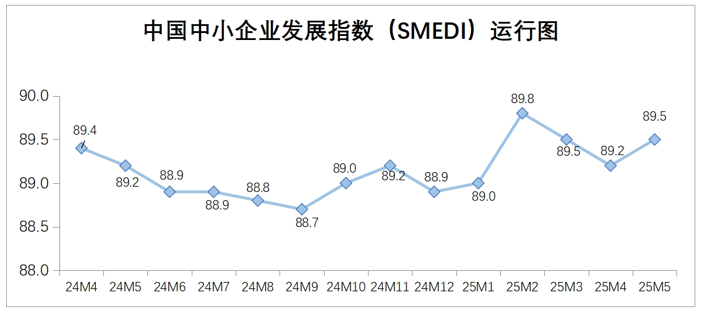
Core Insights - The Small and Medium Enterprises Development Index (SMEDI) in China rose to 89.5 in May, marking a 0.3 point increase from April, indicating a significant recovery after two months of decline [1][5]. Economic Performance - Since the beginning of the year, the production and sales of small and medium enterprises (SMEs) in China have shown continuous improvement, with innovation and vitality emerging strongly, providing robust support for industrial economic growth [3]. - The macroeconomic sentiment index, comprehensive operation index, market index, funding index, labor index, investment index, and efficiency index all increased in May, reflecting a positive trend in SME performance [5]. Industry and Regional Analysis - In May, six out of eight industry indices increased, with notable rises in sectors such as industry, transportation, real estate, wholesale and retail, information transmission, software, and accommodation and catering [5]. - The development indices for SMEs in the eastern, central, and northeastern regions increased, while the western region saw a slight decline [5]. Policy and Institutional Environment - The institutional environment for promoting SME development has been continuously optimized, with several new regulations and guidelines introduced to support SMEs, including the implementation of the "Private Economy Promotion Law" [7][8]. - The Ministry of Industry and Information Technology emphasized the need for legal administration and the establishment of a complaint platform to protect the rights of SMEs [7]. Future Outlook - There is a clear indication of improved expectations for SME development, with market demand steadily improving, funding conditions enhancing, and increased labor demand [6]. - The government aims to expand demand and revitalize consumption, while also addressing the challenges faced by SMEs through various supportive measures [6].