
滚动复苏

Search documents
大摩:市场低估美股牛市 六大催化剂将点燃风险偏好
Zhi Tong Cai Jing· 2026-01-06 15:31
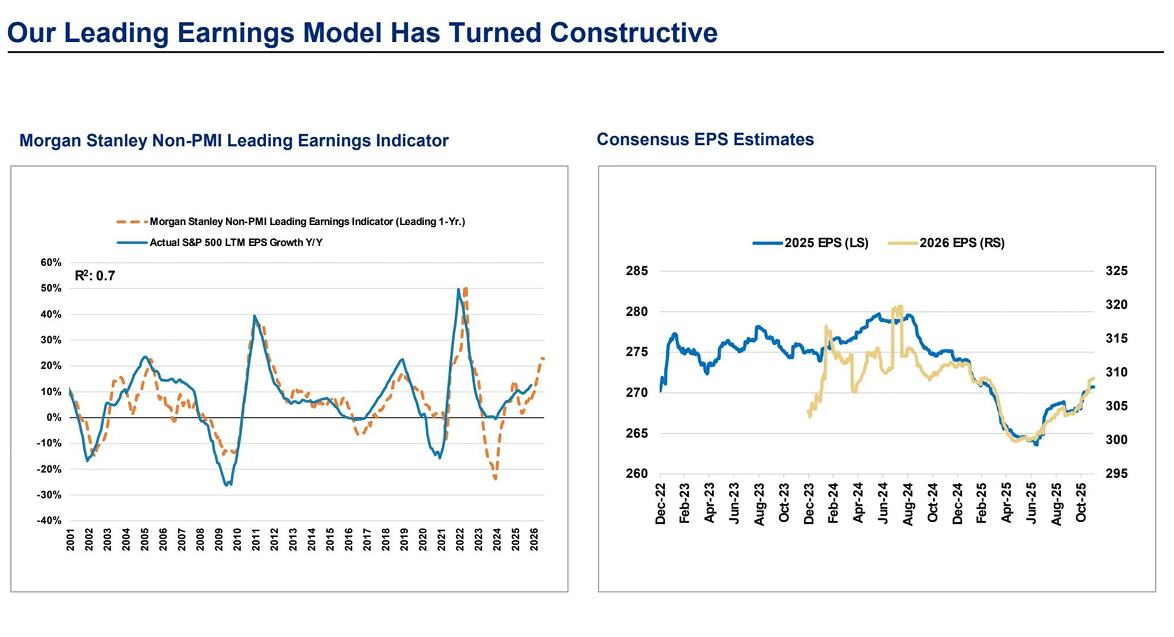
Core Viewpoint - Morgan Stanley's latest report led by top strategist Michael Wilson indicates that market consensus is significantly underestimating multiple bullish catalysts that will positively impact risk appetite and valuations as the market approaches 2026 [1][2] Group 1: Market Outlook - Morgan Stanley sets a target for the S&P 500 index at 7800 points by the end of 2026, defining this period as a "broad market bull market under rolling recovery" [2] - The firm anticipates a shift in market leadership from large-cap tech stocks benefiting from AI to mid-cap and cyclical core industries [2][6] - The report emphasizes that the current market consensus is underestimating several bullish catalysts, including deregulation, operational leverage, and accommodative monetary and fiscal policies [2][3] Group 2: Earnings Growth and Economic Factors - Morgan Stanley's model predicts that earnings per share (EPS) growth could reach 15% to 20% by late 2026, driven by declining expense growth and stronger pricing power [2][3] - The firm expects a significant acceleration in AI adoption this year, contributing to a 40 basis point expansion in net margins for the S&P 500 [2] - The anticipated deregulation in the financial sector is expected to unlock significant capital productivity, leading to strong growth in commercial and industrial loans [3] Group 3: Monetary Policy and Consumer Trends - Morgan Stanley economists forecast further interest rate cuts by the Federal Reserve in early 2026, along with monthly purchases of $40 billion in short-term Treasury bonds to enhance market liquidity [3] - The report highlights a shift in consumer spending from services to goods, with stronger pricing power in goods expected to benefit overall consumer spending [4] - The anticipated impact of the "Big and Beautiful" Act (OBBBA) is projected to increase U.S. personal income by approximately $65 billion by 2026 [4] Group 4: Economic Environment - The report describes a "Goldilocks" economic environment for the U.S. in 2026, characterized by moderate growth and stable inflation, with a downward trajectory for benchmark interest rates [5] - Morgan Stanley asserts that the U.S. stock market has transitioned from a "rolling recession" to a "rolling recovery," supported by improved cost structures and strong earnings revisions [6] - The firm defines the current situation as a "second-phase bull market under rolling recovery," emphasizing the return of risk appetite and investment breadth in financial markets [6]
?大摩:市场低估美股牛市 六大催化剂将点燃风险偏好
Zhi Tong Cai Jing· 2026-01-06 14:44
Core Viewpoint - Morgan Stanley's latest report led by top strategist Michael Wilson indicates that market consensus is significantly underestimating the positive impact of multiple bullish catalysts on risk appetite and valuations as the market approaches 2026 [1] Group 1: Market Outlook - Morgan Stanley sets a target for the S&P 500 index at 7800 points by the end of 2026, suggesting a broad-based stock market bull market driven by a rolling recovery [2] - The firm anticipates a shift in market leadership from large-cap tech stocks benefiting from AI to mid-cap and cyclical core industries by 2026 [2] - The report emphasizes that the current market consensus is underestimating several bullish catalysts, including deregulation, operational leverage, and accommodative monetary and fiscal policies [2] Group 2: Key Catalysts - Earnings growth trajectory is projected to reach 15-20% by late 2026, driven by declining expense growth and improved pricing power, with an expected net margin expansion of 40 basis points for the S&P 500 due to accelerated AI adoption [3] - Deregulation in the financial sector is expected to significantly enhance bank capital productivity, leading to strong growth in commercial and industrial loans [3] - Monetary policy is anticipated to include further interest rate cuts in early 2026, with the Federal Reserve expected to purchase $40 billion in short-term Treasury bonds monthly, enhancing market liquidity [3] Group 3: Economic Environment - The report highlights a potential acceleration in U.S. manufacturing activity due to the return of high-end manufacturing and favorable interest rates [4] - The "wallet share" shift from services to goods is ongoing, with improved pricing power for goods expected to boost consumer spending [4] - A weaker dollar and low gasoline prices are projected to support overall earnings growth for the S&P 500, providing a positive buffer for consumers [5] Group 4: Economic Growth Expectations - The "Goldilocks" scenario for the U.S. economy is anticipated, characterized by moderate growth and stable inflation, with the economy expected to transition to a favorable growth trajectory by 2026 [6] - Morgan Stanley defines the current phase as a "rolling recovery," marking the end of a three-year rolling recession, with a focus on earnings expansion and cyclical industry rotation [7] - The firm recommends an investment strategy of overweighting cyclical sectors such as financials, industrials, healthcare, and consumer discretionary while underweighting defensive sectors like consumer staples and real estate [7]
大摩:市场低估美股牛市 六大催化剂将点燃风险偏好
智通财经网· 2026-01-06 14:31
Core Viewpoint - Morgan Stanley's top strategist Michael Wilson leads a team that believes market consensus is significantly underestimating multiple bullish catalysts that will positively impact risk appetite and valuations as the market approaches 2026 [1][2] Group 1: Market Outlook - Morgan Stanley sets a target for the S&P 500 index at 7800 points by the end of 2026, indicating a broad-based stock market bull market driven by a rolling recovery [2] - The firm anticipates that the leadership in the U.S. stock market will expand from large-cap tech stocks benefiting from AI to include mid-cap and cyclical core industries [2][6] - The current stock market is viewed as being at the beginning of a new earnings cycle and structural bull market, with cyclical stocks expected to outperform past averages [2][6] Group 2: Key Catalysts - Earnings growth trajectory is projected to reach a high of 15-20% by late 2026, driven by declining expense growth and improved pricing power [3] - Regulatory easing is expected to benefit the financial sector, with significant releases in bank capital productivity anticipated from finalized eSLR rules [3] - Monetary policy is projected to see further interest rate cuts in early 2026, with the Federal Reserve expected to purchase $40 billion in short-term Treasury bonds monthly, enhancing market liquidity [3] Group 3: Economic Factors - The ISM cycle indicates a rebound in U.S. manufacturing activity, supported by low interest rates and a broadening of earnings upgrades [4] - Consumer spending is shifting from services to goods, with the "Big and Beautiful" Act expected to increase U.S. personal income by approximately $65 billion in 2026 [4] - A weaker dollar and low gasoline prices are expected to support overall earnings upgrades for the S&P 500 [4] Group 4: Economic Environment - The U.S. economy is anticipated to experience a "Goldilocks" scenario, characterized by moderate growth and stable inflation, as various economic policies take effect [5] - Morgan Stanley defines the current phase as a "rolling recovery," with a return to a typical early-cycle environment marked by improved corporate profitability and investment [6] - The firm recommends an investment strategy of overweighting cyclical sectors while underweighting defensive sectors, suggesting a focus on financials, industrials, healthcare, and discretionary consumption [6]
美股从AI一枝独秀到“周期群舞”! 大摩押注2026年踏向滚动式复苏 周期股领衔第二阶段牛市
智通财经网· 2025-12-08 10:30
Core Viewpoint - Morgan Stanley predicts a strong economic growth effect from the "One Big Beautiful Bill" (OBBBA) passed by the Trump administration in 2025, starting in 2026, leading to a "Goldilocks" macroeconomic environment in the U.S. with moderate growth and inflation [1][8]. Economic Outlook - The U.S. stock market has transitioned from a three-year "rolling recession" to a "rolling recovery," characterized by improved cost structures, strong earnings revisions, and released pent-up demand, creating a typical early-cycle environment [2]. - The Federal Reserve's anticipated interest rate cuts are expected to initiate a new capital expenditure cycle, with corporate investments, particularly in AI and manufacturing, becoming new growth engines [2]. Market Dynamics - The "Magnificent Seven" tech giants, including Nvidia and Google, will continue to lead earnings revisions in 2025, with expectations spreading to the S&P 493 constituents, particularly in industrial and financial sectors [6]. - Morgan Stanley defines the current situation as a "second phase bull market under rolling recovery," emphasizing a return of market risk appetite and broadening investment opportunities across various sectors [6][15]. Investment Strategy - Morgan Stanley recommends an "overweight" position in cyclical sectors such as financials, industrials, healthcare, and consumer discretionary goods, while suggesting a "low weight" in staples and real estate [13][14]. - The firm anticipates that the S&P 500 index could reach 9,000 points by 2026, driven by strong corporate earnings growth and AI-related capital expenditures [11]. Broader Market Trends - The market is expected to shift focus from defensive to offensive strategies, with AI remaining a key investment theme but not the sole driver of the upcoming bull market [9]. - The anticipated "risk reboot year" in 2026 will see a significant focus on microeconomic factors, with a unique combination of fiscal, monetary, and regulatory policies providing a strong boost to risk markets [11][14].

大摩Wilson警告:若贸易冲突不能在11月前解决,标普500将最多跌至5800点
Hua Er Jie Jian Wen· 2025-10-13 10:31
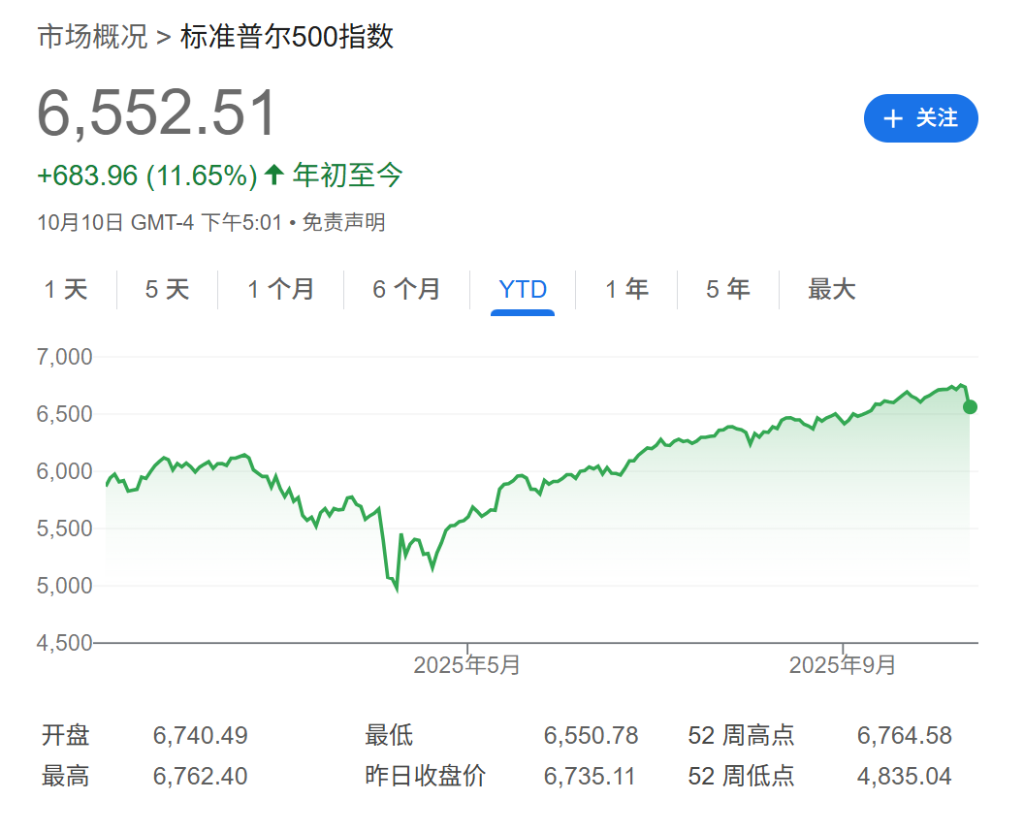
Core Viewpoint - Michael Wilson from Morgan Stanley warns that if trade tensions are not resolved before November, the U.S. stock market faces a potential decline of up to 11% [1][4]. Group 1: Market Predictions - In a pessimistic scenario, the S&P 500 index could drop to a range of 5800 to 6027 points, representing a decline of 8% to 11% from last Friday's closing price [1]. - Wilson highlights that the market is under pressure for a correction due to high investor exposure and elevated valuation levels [1][4]. Group 2: Recent Market Performance - The U.S. stock market experienced a significant drop last Friday, with the S&P 500 index falling by 2.7% and the Nasdaq 100 index plummeting by 3.5%, ending a record bull market driven by AI investments [3]. - As of the report, U.S. stock index futures showed an upward trend, with Nasdaq 100 futures rising by 2%, Dow futures up by 1.05%, and S&P 500 futures increasing by 1.5% [3]. Group 3: Trade Tensions and Economic Outlook - Wilson notes that the recent escalation in trade friction was unexpected, but the fundamental outlook remains optimistic [4]. - He emphasizes that if trade uncertainties persist into early November, a larger correction than most expect could occur [4]. - Despite short-term warnings, Wilson maintains that once trade tensions ease, the economy is expected to recover by 2026, supported by a strong argument that can withstand short-term tactical trade escalations [4].
Morgan Stanley CIO Mike Wilson: The early-cycle rolling recovery has begun
Youtube· 2025-09-23 12:45
Core Viewpoint - The economy is believed to be in a phase of reacceleration, with the recession risk considered to be behind us, despite the challenges in forecasting stock markets and economic conditions [2][3]. Economic Analysis - The market is thought to have been in a rolling recession for the past three years, with recent job revisions indicating that the labor cycle's trough occurred around March and April [3][4]. - The Federal Reserve is perceived to be lagging in its response to economic data, which may lead to continued bad numbers in the short term, despite the market already having bottomed [6][8]. Market Dynamics - Historically, the market tends to bottom during a recession rather than after it has ended, and the current situation aligns with this pattern [6][7]. - The Fed's current position is seen as more behind the curve compared to previous cycles, which could impact the recovery trajectory [8][14]. Interest Rates and Recovery - There is a belief that the Fed needs to cut rates to facilitate a full recovery, particularly to support small businesses and consumers who are currently facing high rates [10][11]. - The market is expected to experience tension due to the Fed's cautious approach, which may lead to a correction in the coming weeks [11][14]. Investment Outlook - The current phase is characterized as early cycle, suggesting that investors should consider buying stocks, as a new bull market is believed to have begun in April [12][13]. - The performance of small-cap and low-quality stocks is being monitored, as their underperformance could indicate broader market trends [14].
美国经济有多糟糕:失业率竟直线上升,美国民众勒紧裤腰带过日子
Sou Hu Cai Jing· 2025-09-16 06:22
Group 1: Economic Overview - The current U.S. economy is heavily supported by consumer spending, with many individuals still employed and able to spend [1] - However, the foundation of this "prosperity" appears unstable, as total debt has reached a historical high and serious delinquencies have also surged to a decade-high [1] - A recent PwC survey indicates that inflation and future uncertainties are prompting households to plan for reduced holiday spending by approximately 5.3% [1] Group 2: Employment Data - The unemployment rate stands at 4.3%, the highest since 2021, yet still below the long-term average of 5.7% since 1948 [3] - A significant downward revision of 911,000 non-farm jobs over the past year marks the largest adjustment since 2000, suggesting that real economic growth is weaker than previously reported [3] - In August, only 22,000 jobs were added, and for the first time since 2020, layoffs exceeded new hires, resulting in a net job loss of 13,000 [5] Group 3: Labor Market Dynamics - The balance of supply and demand in the labor market is shifting, with the number of job seekers surpassing available job openings for the first time in four years [5] - The employment index in manufacturing has dropped to a five-year low, indicating a cooling demand across various sectors, particularly in leisure, professional services, retail, and manufacturing [5] - Confidence among unemployed individuals in finding new jobs has plummeted to 44.9%, the lowest since this survey began in 2013 [5] Group 4: Financial Market Response - Despite a struggling real economy, the financial markets are thriving, with the S&P 500 index rising over 10% this year and reaching new historical highs [7] - Poor economic data is fueling expectations that the Federal Reserve will soon implement interest rate cuts, with traders predicting a 90% chance of a cumulative 75 basis points cut by year-end [7] - Major institutions, including Fitch and Bank of America, forecast at least two rate cuts by the Fed this year, with further cuts anticipated next year [7] Group 5: Economic Contradictions - The U.S. economy is characterized by conflicting perspectives, with some believing the worst is over due to improving corporate profits and confidence indicators, while others see a fragile consumer market underpinned by high debt levels [9] - The labor market shows low unemployment rates, yet internal conditions are deteriorating, creating a disconnect between the financial markets and the real economy [9] - This complex situation places the U.S. economy at a critical juncture, described as a bent steel bar that is "bending but not yet broken" [9] Group 6: Policy Challenges - Policymakers face the challenge of balancing inflation control, job stability, and market reassurance, where any action could exacerbate existing tensions [11] - Public sentiment reflects growing dissatisfaction with economic performance, indicating that economic issues have become a significant political pressure point [11]

邦达亚洲:空头回补提供支撑 美元指数小幅收涨
Sou Hu Cai Jing· 2025-09-10 05:49
Group 1: Economic Outlook - Morgan Stanley suggests that the recent slowdown in U.S. job growth is a sign of economic bottoming rather than a recession, indicating the early stages of a "rolling recovery" [1] - The firm believes that June marked the low point of the current economic cycle, and non-farm employment will not see a sharp decline unless the economy faces another shock [1] - Goldman Sachs' chief economist forecasts that the U.S. economy is nearing stagnation and will require several interest rate cuts to regain growth momentum, with improvements not expected until 2026 [2] Group 2: Employment Data - The latest employment report is interpreted optimistically by Morgan Stanley, which states that employment data is lagging and the economy has already entered a recovery phase [1] - The report indicates that the employment weakness was most pronounced around the "liberation day," suggesting a cyclical low in non-farm employment [1] Group 3: Market Reactions - The U.S. dollar index experienced slight gains, trading around 97.90, supported by short covering and market caution ahead of inflation data [3] - The euro and British pound both saw slight declines against the dollar, influenced by profit-taking and the rising expectations of U.S. interest rate cuts [4][5]

