
金发姑娘式的软着陆

Search documents
大摩:市场低估美股牛市 六大催化剂将点燃风险偏好
Zhi Tong Cai Jing· 2026-01-06 15:31
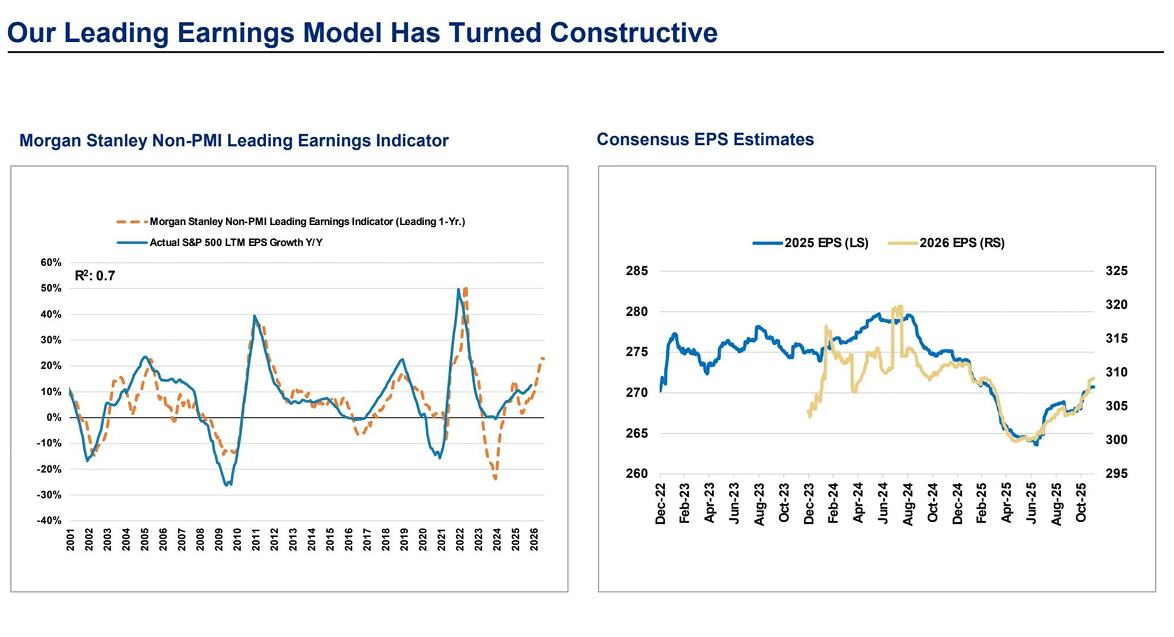
Core Viewpoint - Morgan Stanley's latest report led by top strategist Michael Wilson indicates that market consensus is significantly underestimating multiple bullish catalysts that will positively impact risk appetite and valuations as the market approaches 2026 [1][2] Group 1: Market Outlook - Morgan Stanley sets a target for the S&P 500 index at 7800 points by the end of 2026, defining this period as a "broad market bull market under rolling recovery" [2] - The firm anticipates a shift in market leadership from large-cap tech stocks benefiting from AI to mid-cap and cyclical core industries [2][6] - The report emphasizes that the current market consensus is underestimating several bullish catalysts, including deregulation, operational leverage, and accommodative monetary and fiscal policies [2][3] Group 2: Earnings Growth and Economic Factors - Morgan Stanley's model predicts that earnings per share (EPS) growth could reach 15% to 20% by late 2026, driven by declining expense growth and stronger pricing power [2][3] - The firm expects a significant acceleration in AI adoption this year, contributing to a 40 basis point expansion in net margins for the S&P 500 [2] - The anticipated deregulation in the financial sector is expected to unlock significant capital productivity, leading to strong growth in commercial and industrial loans [3] Group 3: Monetary Policy and Consumer Trends - Morgan Stanley economists forecast further interest rate cuts by the Federal Reserve in early 2026, along with monthly purchases of $40 billion in short-term Treasury bonds to enhance market liquidity [3] - The report highlights a shift in consumer spending from services to goods, with stronger pricing power in goods expected to benefit overall consumer spending [4] - The anticipated impact of the "Big and Beautiful" Act (OBBBA) is projected to increase U.S. personal income by approximately $65 billion by 2026 [4] Group 4: Economic Environment - The report describes a "Goldilocks" economic environment for the U.S. in 2026, characterized by moderate growth and stable inflation, with a downward trajectory for benchmark interest rates [5] - Morgan Stanley asserts that the U.S. stock market has transitioned from a "rolling recession" to a "rolling recovery," supported by improved cost structures and strong earnings revisions [6] - The firm defines the current situation as a "second-phase bull market under rolling recovery," emphasizing the return of risk appetite and investment breadth in financial markets [6]
?大摩:市场低估美股牛市 六大催化剂将点燃风险偏好
Zhi Tong Cai Jing· 2026-01-06 14:44
Core Viewpoint - Morgan Stanley's latest report led by top strategist Michael Wilson indicates that market consensus is significantly underestimating the positive impact of multiple bullish catalysts on risk appetite and valuations as the market approaches 2026 [1] Group 1: Market Outlook - Morgan Stanley sets a target for the S&P 500 index at 7800 points by the end of 2026, suggesting a broad-based stock market bull market driven by a rolling recovery [2] - The firm anticipates a shift in market leadership from large-cap tech stocks benefiting from AI to mid-cap and cyclical core industries by 2026 [2] - The report emphasizes that the current market consensus is underestimating several bullish catalysts, including deregulation, operational leverage, and accommodative monetary and fiscal policies [2] Group 2: Key Catalysts - Earnings growth trajectory is projected to reach 15-20% by late 2026, driven by declining expense growth and improved pricing power, with an expected net margin expansion of 40 basis points for the S&P 500 due to accelerated AI adoption [3] - Deregulation in the financial sector is expected to significantly enhance bank capital productivity, leading to strong growth in commercial and industrial loans [3] - Monetary policy is anticipated to include further interest rate cuts in early 2026, with the Federal Reserve expected to purchase $40 billion in short-term Treasury bonds monthly, enhancing market liquidity [3] Group 3: Economic Environment - The report highlights a potential acceleration in U.S. manufacturing activity due to the return of high-end manufacturing and favorable interest rates [4] - The "wallet share" shift from services to goods is ongoing, with improved pricing power for goods expected to boost consumer spending [4] - A weaker dollar and low gasoline prices are projected to support overall earnings growth for the S&P 500, providing a positive buffer for consumers [5] Group 4: Economic Growth Expectations - The "Goldilocks" scenario for the U.S. economy is anticipated, characterized by moderate growth and stable inflation, with the economy expected to transition to a favorable growth trajectory by 2026 [6] - Morgan Stanley defines the current phase as a "rolling recovery," marking the end of a three-year rolling recession, with a focus on earnings expansion and cyclical industry rotation [7] - The firm recommends an investment strategy of overweighting cyclical sectors such as financials, industrials, healthcare, and consumer discretionary while underweighting defensive sectors like consumer staples and real estate [7]
大摩:市场低估美股牛市 六大催化剂将点燃风险偏好
智通财经网· 2026-01-06 14:31
Core Viewpoint - Morgan Stanley's top strategist Michael Wilson leads a team that believes market consensus is significantly underestimating multiple bullish catalysts that will positively impact risk appetite and valuations as the market approaches 2026 [1][2] Group 1: Market Outlook - Morgan Stanley sets a target for the S&P 500 index at 7800 points by the end of 2026, indicating a broad-based stock market bull market driven by a rolling recovery [2] - The firm anticipates that the leadership in the U.S. stock market will expand from large-cap tech stocks benefiting from AI to include mid-cap and cyclical core industries [2][6] - The current stock market is viewed as being at the beginning of a new earnings cycle and structural bull market, with cyclical stocks expected to outperform past averages [2][6] Group 2: Key Catalysts - Earnings growth trajectory is projected to reach a high of 15-20% by late 2026, driven by declining expense growth and improved pricing power [3] - Regulatory easing is expected to benefit the financial sector, with significant releases in bank capital productivity anticipated from finalized eSLR rules [3] - Monetary policy is projected to see further interest rate cuts in early 2026, with the Federal Reserve expected to purchase $40 billion in short-term Treasury bonds monthly, enhancing market liquidity [3] Group 3: Economic Factors - The ISM cycle indicates a rebound in U.S. manufacturing activity, supported by low interest rates and a broadening of earnings upgrades [4] - Consumer spending is shifting from services to goods, with the "Big and Beautiful" Act expected to increase U.S. personal income by approximately $65 billion in 2026 [4] - A weaker dollar and low gasoline prices are expected to support overall earnings upgrades for the S&P 500 [4] Group 4: Economic Environment - The U.S. economy is anticipated to experience a "Goldilocks" scenario, characterized by moderate growth and stable inflation, as various economic policies take effect [5] - Morgan Stanley defines the current phase as a "rolling recovery," with a return to a typical early-cycle environment marked by improved corporate profitability and investment [6] - The firm recommends an investment strategy of overweighting cyclical sectors while underweighting defensive sectors, suggesting a focus on financials, industrials, healthcare, and discretionary consumption [6]
2026年美股还值得买吗?
Guo Ji Jin Rong Bao· 2025-12-25 11:44
Core Viewpoint - The U.S. stock market is at a threshold where it is no longer solely driven by "rate cut narratives," facing a complex combination of variables as it approaches 2026 [1] Group 1: Market Performance and Trends - In 2025, the S&P 500 index experienced significant volatility, initially dropping near bear market territory due to tariff threats but rebounding due to policy concessions and AI momentum, resulting in a year-to-date total return of approximately 18%-19% by year-end [2] - The S&P 500 index reached its 38th historical high on December 23, reflecting market confidence in the resilience of the U.S. economy and corporate earnings [3] - The VIX index, a measure of market volatility, closed at 14 points on December 23, the lowest since December 2024, indicating reduced market tension [3] Group 2: Economic Outlook and Influencing Factors - Analysts are focused on whether the U.S. stock market will continue its bull run or face systemic risks in 2026, with key determinants being economic stability, Federal Reserve policy direction, and whether current stock prices are supported by economic fundamentals [4] - The U.S. economy showed no signs of significant recession in 2025, with GDP expanding at its fastest pace in two years, reinforcing expectations of a "soft landing" [4] - The OBBBA tax cut legislation is expected to boost economic growth starting in 2026, alongside a gradual decline in inflation, contributing to a favorable macroeconomic environment [5] Group 3: Federal Reserve and Interest Rates - If inflation continues to cool, the Federal Reserve may begin to lower interest rates in 2026, which could help maintain high stock prices despite elevated valuations [6] - Current market sentiment indicates a 19.9% probability of a 25 basis point rate cut in January 2026, with a 47.1% chance of maintaining current rates [6] Group 4: Sector Performance and Investment Focus - Wall Street strategists expect 2026 to be a strong year for the U.S. stock market, with optimistic projections for the S&P 500 index reaching between 7,000 and 8,100 points by year-end [8] - Investment focus is shifting from technology stocks to cyclical stocks, which are closely tied to economic cycles, with notable performance improvements in sectors like real estate, steel, and automotive [9] - Cyclical stocks have outperformed defensive stocks, with a 9.3% increase in a recent month, indicating a growing investor interest in sectors benefiting from economic recovery [9]

美股从AI一枝独秀到“周期群舞”! 大摩押注2026年踏向滚动式复苏 周期股领衔第二阶段牛市
智通财经网· 2025-12-08 10:30
Core Viewpoint - Morgan Stanley predicts a strong economic growth effect from the "One Big Beautiful Bill" (OBBBA) passed by the Trump administration in 2025, starting in 2026, leading to a "Goldilocks" macroeconomic environment in the U.S. with moderate growth and inflation [1][8]. Economic Outlook - The U.S. stock market has transitioned from a three-year "rolling recession" to a "rolling recovery," characterized by improved cost structures, strong earnings revisions, and released pent-up demand, creating a typical early-cycle environment [2]. - The Federal Reserve's anticipated interest rate cuts are expected to initiate a new capital expenditure cycle, with corporate investments, particularly in AI and manufacturing, becoming new growth engines [2]. Market Dynamics - The "Magnificent Seven" tech giants, including Nvidia and Google, will continue to lead earnings revisions in 2025, with expectations spreading to the S&P 493 constituents, particularly in industrial and financial sectors [6]. - Morgan Stanley defines the current situation as a "second phase bull market under rolling recovery," emphasizing a return of market risk appetite and broadening investment opportunities across various sectors [6][15]. Investment Strategy - Morgan Stanley recommends an "overweight" position in cyclical sectors such as financials, industrials, healthcare, and consumer discretionary goods, while suggesting a "low weight" in staples and real estate [13][14]. - The firm anticipates that the S&P 500 index could reach 9,000 points by 2026, driven by strong corporate earnings growth and AI-related capital expenditures [11]. Broader Market Trends - The market is expected to shift focus from defensive to offensive strategies, with AI remaining a key investment theme but not the sole driver of the upcoming bull market [9]. - The anticipated "risk reboot year" in 2026 will see a significant focus on microeconomic factors, with a unique combination of fiscal, monetary, and regulatory policies providing a strong boost to risk markets [11][14].

降息预期再获提振!美国9月零售增速放缓 市场焦点转向感恩节+黑五购物季
Sou Hu Cai Jing· 2025-11-25 15:12
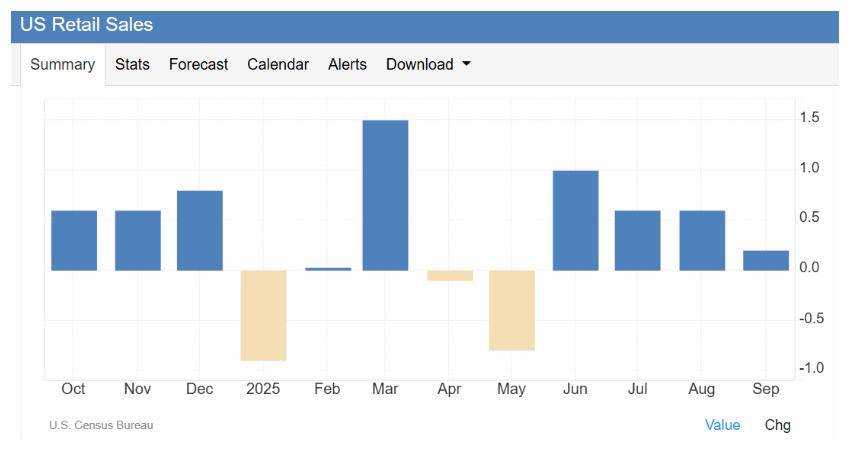
Core Viewpoint - The unexpected slowdown in U.S. retail sales growth highlights a decrease in consumer spending amid a weakening labor market and temporary inflation caused by tariffs, yet the resilience in retail sales supports the narrative of a "Goldilocks" economic environment in the U.S. [1] Retail Sales Data - In September, U.S. retail sales showed a modest increase of 0.2% month-over-month, falling short of the expected 0.4% growth, following a strong 0.6% increase in August. Excluding autos and gas, sales rose only 0.1% [5][6] - Among 13 categories, 8 recorded growth, primarily in gas stations and personal care stores, while auto sales declined for the first time in four months, and spending on electronics, clothing, and sports goods also decreased [6][8] Consumer Behavior - The data indicates that middle and low-income consumers are becoming more cautious due to rising inflation and employment challenges, leading to a pause in spending [5][7] - Retailers like Walmart and TJX have noted that shoppers are increasingly seeking discounts and essential goods, while Home Depot has warned of delayed large home purchases [7] Economic Outlook - Morgan Stanley economists predict that the OBBBA tax cuts from the Trump administration will significantly boost economic growth starting in 2026, alongside the temporary nature of inflation from tariffs and ongoing AI infrastructure investments by tech giants [1] - The NRF forecasts a record number of shoppers during the upcoming Thanksgiving and Black Friday shopping weekend, which could provide a significant boost to the U.S. economy in Q4 and 2026, as consumer spending accounts for 60%-70% of GDP [9][10] Federal Reserve and Interest Rates - Following the retail data release, expectations for a Federal Reserve rate cut in December have increased, with an 80% probability of a rate cut according to CME FedWatch Tool [3][4][7] - There is a notable division among Federal Reserve officials regarding the decision to cut rates, reflecting concerns over consumer affordability [7]
降息预期再获提振! 美国9月零售增速放缓 市场焦点转向感恩节+黑五购物季
智通财经网· 2025-11-25 14:32
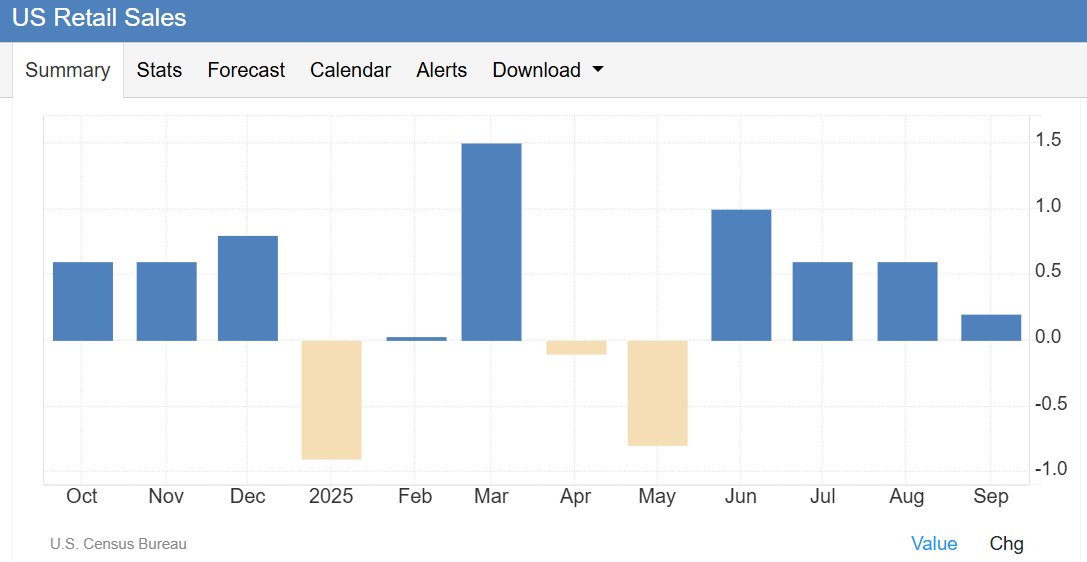
Core Viewpoint - The unexpected slowdown in U.S. retail sales growth highlights a cautious consumer spending environment amid a weakening labor market and temporary inflation due to tariffs, reinforcing the narrative of a "Goldilocks" soft landing for the economy [1][5][9] Retail Sales Data - In September, U.S. retail sales rose by only 0.2% month-over-month, falling short of the expected 0.4% increase, following a strong 0.6% growth in August [5][6] - Excluding autos and gas, sales increased by just 0.1%, indicating a slowdown in consumer spending momentum [5][6] - The "control group" sales, a key indicator for GDP calculations, declined by 0.1%, marking the first drop in five months [8] Consumer Behavior - The data suggests that middle and low-income consumers are feeling the pressure from inflation and employment challenges, leading to more cautious spending [5][7] - High-income consumers continue to support overall spending, but there are signs of strain among lower-income shoppers, with many seeking discounts and essential goods [7][9] Economic Outlook - Morgan Stanley economists predict that the OBBBA tax cuts and the temporary nature of inflation from tariffs will contribute to a strong economic growth effect starting in 2026, supporting the "Goldilocks" narrative [1] - The upcoming Thanksgiving and Black Friday shopping events are expected to significantly boost consumer spending, which accounts for 60%-70% of U.S. GDP [9][10] Federal Reserve and Interest Rates - Following the retail data release, expectations for a Federal Reserve rate cut in December have increased, with an 80% probability of a cut according to CME FedWatch Tool [3][4][7] - There is a notable division among Federal Reserve officials regarding the decision to cut rates, reflecting concerns over consumer affordability [7]

州级申领显示初请失业金数意外回落 美国劳动力市场在逆风中彰显韧性
智通财经网· 2025-11-01 03:13
Group 1 - The core viewpoint of the articles indicates that despite a cooling labor market, the resilience of the U.S. job market is evident as initial unemployment claims unexpectedly decreased, suggesting it has not entered a phase of sustained negative growth [1][2] - Private statistical agencies reported that initial unemployment claims fell significantly from a revised 231,000 to approximately 218,000 for the week ending October 25, indicating a positive trend in the labor market [1] - The number of continuing unemployment claims is projected to slightly increase from 1.94 million to 1.95 million for the week ending October 18, reflecting ongoing support for those receiving unemployment benefits [1] Group 2 - The number of new initial claims for federal employee unemployment compensation (UCFE) was reported at 8,865 for the week ending October 25, indicating a decline but still at a high level [2] - Continuing claims for federal employees are expected to rise significantly to 20,594, marking the highest level since the last federal government shutdown ended [2] - Despite a slowdown in hiring activities compared to previous hot labor market conditions, there remains a resilient slight growth trend, with expectations for a "Goldilocks" scenario in the U.S. economy, characterized by moderate growth and low inflation [2][3]
美联储降息叙事生变! 市场削减12月降息押注 “全球资产定价之锚”再度站稳4%上方
智通财经网· 2025-11-01 01:07
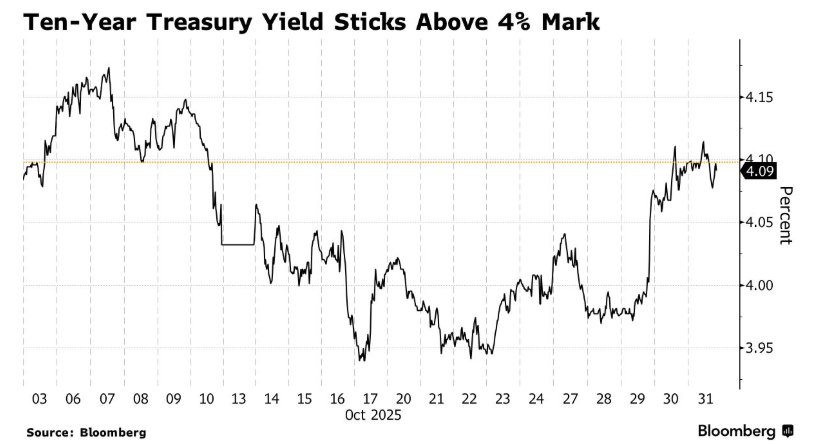
Core Viewpoint - The unexpected rise in U.S. Treasury yields this week is attributed to traders significantly reducing their interest rate cut bets following hawkish signals from Federal Reserve Chairman Jerome Powell and resilient macroeconomic data, leading to a cooling of previously high expectations for rate cuts in December and 2026 [1][4]. Group 1: U.S. Treasury Yields and Market Sentiment - The 10-year U.S. Treasury yield has stabilized above 4%, closing at 4.09% on Friday after dipping below 4% earlier in the week, reflecting a sudden shift in market sentiment [1]. - Market expectations for a December rate cut have dropped to approximately 50%, down from over 90% prior to Powell's hawkish comments [1][4]. - The ongoing U.S. government budget deficit and rising debt outlook have pressured bond traders to demand higher term premiums, keeping the 10-year yield around 4% to 4.5% [3]. Group 2: Economic Data and Labor Market - Despite a slowdown in the labor market, economic growth remains balanced, and inflation is still above the Fed's 2% target, leading to a cautious stance on further rate cuts [5][8]. - Recent employment data indicates a significant slowdown in hiring activity, yet it still shows resilience with slight growth, suggesting that the economy has not entered a phase of sustained negative growth [4][6]. Group 3: Federal Reserve's Stance - Hawkish comments from Fed officials, including Kansas City Fed President Schmid, emphasize the appropriateness of maintaining current policy rates due to persistent inflation concerns [5][8]. - The internal division among Fed officials regarding the timing of monetary policy easing is evident, with some advocating for continued rate cuts while others stress the need for caution [8][9]. Group 4: Corporate Bond Market and AI Investments - Meta Platforms Inc. issued up to $30 billion in bonds, indicating strong AI spending among U.S. tech giants, which is expected to enhance revenue generation [6]. - The upcoming bond issuance is likely to exert pressure on Treasury prices, contributing to higher long-term yields as investors adjust to new supply [6][7].
纽约联储服务业指数创四年新低!即便非农与CPI缺席 降息预期仍在升温
智通财经网· 2025-10-16 14:08
Core Insights - The latest economic data indicates a significant contraction in service sector activity in the New York region, marking the steepest decline in over four years, which reflects a broader downturn in U.S. business activity and employment levels [1][2] - Following the unexpected weakness in the New York Fed's service sector activity index, the futures market has rapidly increased expectations for interest rate cuts by the Federal Reserve, pricing in two consecutive 25 basis point cuts [1][5] - The New York Fed's service sector data is crucial for investors to gauge the U.S. economy and the market's expectations for Fed rate cuts, especially during a period of data delays due to the federal government shutdown [1][2] Group 1: Service Sector Activity - The New York Fed's composite index for service sector activity fell by 4.2 points to -23.6, the lowest reading since January 2021, indicating ongoing contraction in business activity [2] - Employment indicators within the survey have contracted for two consecutive months, suggesting a deteriorating view of the business environment [2] - Despite rising input costs reported by businesses, service price growth is slowing, and the outlook for the next six months remains subdued [2] Group 2: Broader Economic Context - The slowdown in the U.S. labor market has become a consensus view, with hiring activities reported to be slowing, yet the economy has not entered a phase of sustained negative growth [4] - Recent consumer spending data, along with PCE and GDP revisions, suggest that the labor market has not significantly worsened, supporting the notion of a "Goldilocks" economic scenario [5] - The expectation of further rate cuts by the Fed is bolstered by high-frequency data indicating a sharp decline in service sector sentiment and ongoing challenges in the manufacturing sector [5][6]