硬折扣赛道

Search documents
京东折扣超市北京首秀 硬折扣赛道迎变
Bei Jing Shang Bao· 2025-12-17 15:42
Core Viewpoint - The e-commerce industry is shifting from scale expansion to efficiency and sustainability as major players like JD.com, Meituan, and Alibaba compete in the "minute-level fulfillment" space, focusing on hard discounts and local life increments [1] Group 1: Competitive Landscape - JD.com opened its first discount supermarket in Beijing's Mentougou district, featuring over 5,000 SKUs and local specialties to attract consumers [3][6] - Meituan's Happy Monkey supermarket, located just 5 minutes away from JD's new store, is facing pressure as both companies compete for foot traffic in overlapping product categories [3][4] - Despite having smaller store sizes, Meituan is rapidly expanding its discount format, with plans for a third store opening soon [4][5] Group 2: Supply Chain and Logistics - JD.com emphasizes the importance of logistics infrastructure in its store locations, allowing for quick replenishment and fresh product availability [6][10] - The discount supermarkets are designed to cater to family consumers who prioritize price and quality, with a focus on essential goods [7][8] - Both JD.com and Meituan are adopting strategies that include self-owned brands and hard discount pricing to meet consumer demand for quality-price ratios [8][9] Group 3: Industry Trends - The discount format has become a hot trend among internet giants, with companies like JD.com and Meituan entering the market to capture offline growth opportunities [8][9] - There is a renewed interest in physical retail among internet companies, reminiscent of the "new retail" era, as they seek to optimize operational efficiency and resource collaboration [9] - The supply chain systems for e-commerce discount formats are expected to upgrade significantly in the coming year, with increased investment in self-owned brand development [9]



零售行业竞争升级 盒马如何“杀出一条血路”?
Mei Ri Jing Ji Xin Wen· 2025-11-25 14:28
Core Insights - The article discusses the competitive landscape in the retail sector, focusing on Hema's new franchise model for its budget community supermarket, Chaohe Suan NB, which aims to expand rapidly in response to increasing competition [1][2][5]. Expansion Strategy - Chaohe Suan NB has opened its first franchise locations in Shanghai, Hangzhou, Jiaxing, and Huzhou, with an annual franchise fee of 50,000 yuan, excluding additional costs for store renovation, equipment, and deposits [1][2]. - The franchise model has a high entry barrier, requiring a total investment of approximately 2.65 million yuan for a standard 600-square-meter store, which includes various fees and guarantees [2]. - Since its rebranding in August, Chaohe Suan NB has opened over 350 stores, with plans to continue expanding at a rate of more than 20 new stores per month [2][3]. Target Market and Product Offering - The supermarket targets "practical consumers" with a limited selection of over 1,500 essential products, focusing on low prices and high-frequency items for various consumer needs [3]. - Nearly 60% of the products are private label items, indicating a strategy to enhance brand control and profitability [3]. Support for Franchisees - Chaohe Suan NB offers franchisees support in site selection, construction, and training, ensuring that stores are located in residential communities or established commercial areas [3]. - Franchisees are required to adhere to pricing and promotional strategies set by the brand, which helps maintain consistency across locations [3]. Competitive Landscape - The retail market is becoming increasingly competitive, with major players like JD and Meituan entering the discount sector, prompting Hema to accelerate its expansion efforts [2][5]. - Hema's CEO has indicated a strong ambition for market growth, with a focus on both Hema Fresh and Chaohe Suan NB, aiming to replicate successful business models and innovate [6]. Challenges and Considerations - As the number of franchise stores increases, maintaining quality control and service standards will be a significant challenge for Chaohe Suan NB [4]. - The company must leverage its supply chain and digital capabilities to reduce costs and enhance profitability as it scales [6][7].
实探中百集团硬折扣店:51家同步开业 自有品牌占比近40%
Zheng Quan Shi Bao Wang· 2025-09-26 14:16
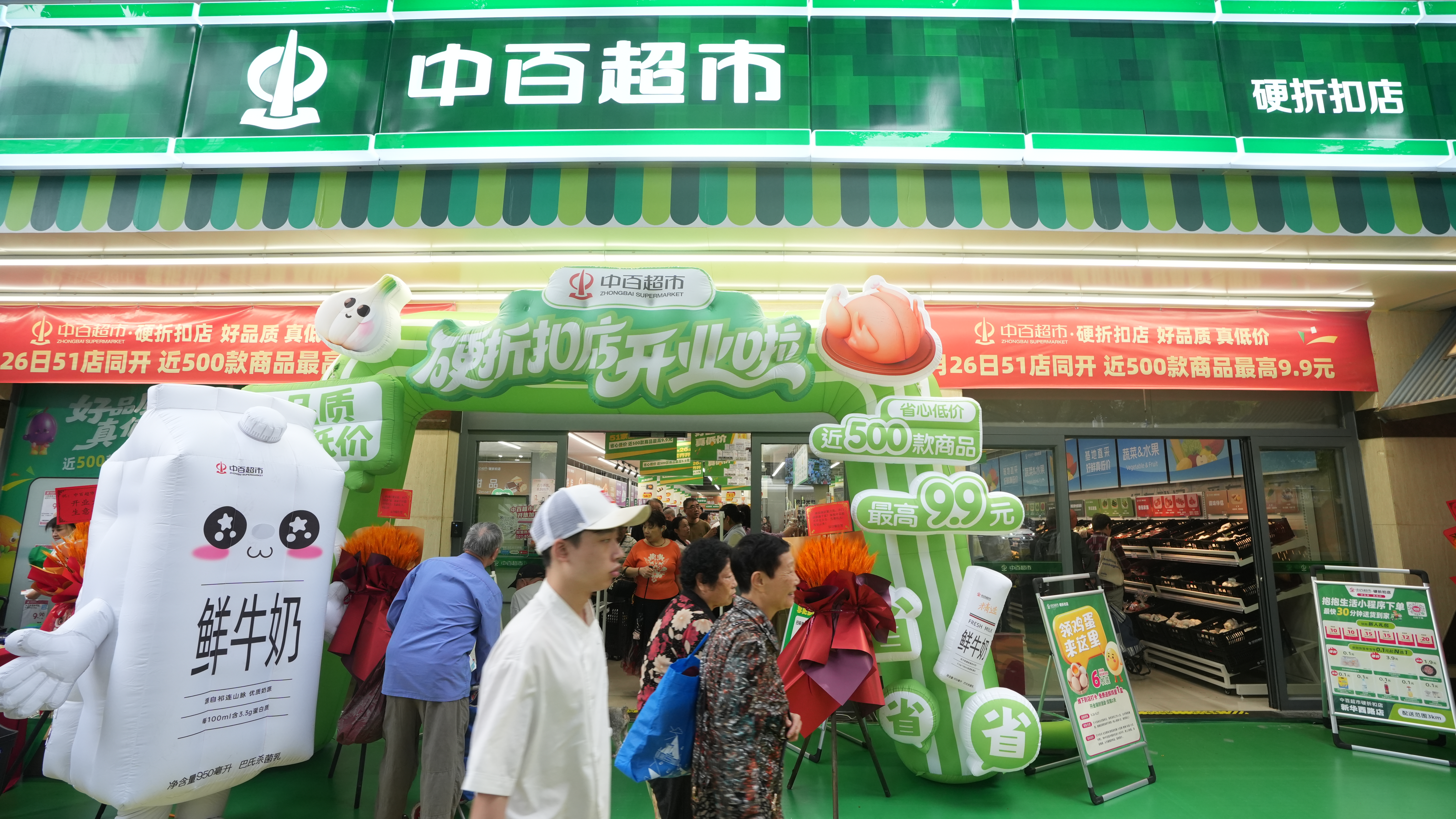
Core Viewpoint - Zhongbai Group is actively transforming its retail strategy by launching 51 hard discount stores, focusing on essential consumer goods with significant price reductions, aiming to enhance competitiveness in a rapidly evolving retail landscape [2][3][4]. Group 1: Store Launch and Strategy - Zhongbai Group opened 51 hard discount stores, covering key areas in Wuhan and Huangshi, with an overall price reduction of 20% and some items reduced by over 35% [2]. - The number of SKUs in the stores was reduced from over 3,000 to 1,400, focusing on high-turnover fast-moving consumer goods such as fresh produce and frozen foods [2][3]. - The introduction of private label products accounts for nearly 40% of the offerings, with significant price advantages compared to branded products [2][3]. Group 2: Private Label Development - The private label brands include "Zhongbai Supermarket Selection" and "Baiyu Sen," targeting different market segments with a focus on quality and affordability [3]. - Nearly 60 new private label manufacturing partners have been added, with about 80% being first-tier brand factories, ensuring quality control alongside competitive pricing [3]. Group 3: Competitive Landscape - The hard discount sector is highly competitive, with major players like JD, Alibaba, and Meituan entering the market, which currently has a penetration rate of only 8% in China compared to 42% in Germany and 31% in Japan [3][4]. - Zhongbai Group's strategy includes a "store update plan" to enhance community retail through small-format stores, precise product offerings, and improved customer experiences [3][4]. Group 4: Future Plans and Innovations - Zhongbai Group plans to open an additional 49 hard discount stores and 30 soft discount stores by the end of the year, aiming for a total of 130 discount stores [3][4]. - The company is also launching new store formats, including discount stores and 24-hour instant retail services, to cater to diverse consumer needs [4][5]. - The chairman emphasized the importance of closing unprofitable stores and expanding small formats to achieve profitability by 2027 [4][5].

实探中百集团硬折扣店:51家同步开业,自有品牌占比近40%
Zheng Quan Shi Bao Wang· 2025-09-26 14:09
Core Insights - Zhongbai Group has opened 51 hard discount stores, significantly enhancing its presence in key areas such as Wuhan and Huangshi, with an overall price reduction of 20% on essential goods, and some items seeing price cuts exceeding 35% [1][5] Group 1: Store Strategy and Product Offering - The number of SKUs in the hard discount stores has been reduced from over 3,000 to 1,400, focusing on high-turnover fast-moving consumer goods like fresh produce and frozen foods [5] - Private label products account for nearly 40% of the offerings in hard discount stores, with significant price advantages over branded items, exemplified by the "Baiyusen" brand's beef noodles priced at 10.8 yuan for a pack of seven, compared to over 5 yuan for a single branded item [5] - The company has established partnerships with nearly 60 private label factories, with about 80% being first-tier brand manufacturers, ensuring quality control despite competitive pricing [5] Group 2: Market Position and Competitive Landscape - The hard discount sector is highly competitive, with major players like JD, Alibaba, and Meituan also entering the market; the current market penetration in China is only 8%, significantly lower than Germany's 42% and Japan's 31% [5] - Zhongbai Group's recent openings represent a strategic attempt to adapt to the evolving retail landscape, with plans to continue expanding its discount store format [6] Group 3: Future Expansion Plans - The company plans to open an additional 49 hard discount stores and 30 soft discount stores in the fourth quarter, aiming for a total of 130 discount stores by the end of the year [6] - Zhongbai Group is focusing on small-format stores and digital transformation to achieve profitability by 2027, while enhancing community service offerings [7]
京东折扣超市宿迁开业打造现象级场景 四店首日客流超30万
2 1 Shi Ji Jing Ji Bao Dao· 2025-08-31 08:35
Core Insights - JD's discount supermarket opened four stores in Suqian, Jiangsu, attracting over 300,000 customers on the first day, significantly surpassing the opening of its first store in Zhuozhou [1][5][14] - The stores demonstrated strong consumer interest, with sales exceeding expectations and many products sold out, setting a new record for first-day sales in JD's discount format [5][14] Store Performance - The opening day saw customer queues extending from the entrance to the street, with overall foot traffic at the Suqian Central Mall nearly four times that of a typical weekend [3][5] - The stores, each over 5,000 square meters, featured a wide range of over 5,000 high-cost performance products across various categories, including food, household items, and personal care [7][14] Product Highlights - Popular items included fresh chicken eggs priced at 9.9 yuan for 30 pieces, which sold out quickly, and various fresh produce such as watermelons and grapes, which were well-received due to their high cost performance [10][12] - JD's private label products, such as the Seven Fresh juices and specially customized local liquor, became top sellers, indicating strong brand recognition and consumer trust [12][14] Service and Logistics - JD's omnichannel advantage was evident, with staff available for product inquiries and a quick delivery service through the JD app, allowing customers to receive orders within 30 minutes [14] - The successful opening of these stores not only expands JD's presence in the discount retail sector but also showcases its robust supply chain capabilities, enhancing the local retail landscape [14]
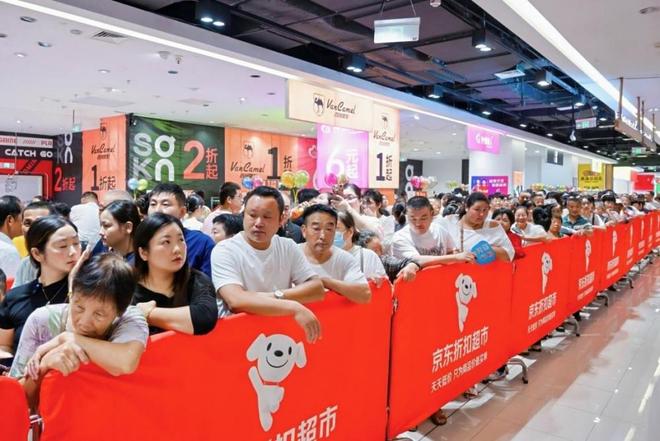
京东(09618)折扣超市宿迁四店齐开,首日客流超30万 为商场引客超日常3-4倍
智通财经网· 2025-08-31 04:45
Core Insights - JD's discount supermarket opened four stores in Suqian, Jiangsu, attracting over 300,000 customers on the first day, significantly surpassing the opening of its first store in Zhuozhou [1][4] - The stores demonstrated strong consumer interest, with sales exceeding expectations and many products sold out, setting a new record for first-day sales in JD's discount format [4][6] Group 1: Store Performance - The opening day saw customer queues extending from the mall entrance to the street, with overall foot traffic nearly four times that of a typical weekend [3] - The stores maintained a large average area of over 5,000 square meters each, featuring more than 5,000 high-cost performance products across various categories [4] Group 2: Product Popularity - Fresh chicken eggs priced at 9.9 yuan for 30 pieces quickly sold out, becoming a hot-selling item, with consumers waiting for restocks [6] - Other popular items included directly sourced fruits and seafood, such as watermelon and crab, which attracted significant consumer attention [6] Group 3: Local Engagement - The stores featured local products, including "Dong Ge's same style" beer and specially customized bottles from Yanghe, which became top sellers on the opening day [8] - JD's strong supply chain capabilities allowed for direct sourcing, enabling competitive pricing and enhancing the shopping experience for local consumers [10] Group 4: Service and Convenience - JD's omnichannel advantage was evident, with staff available for product inquiries and a quick delivery service through the JD app, allowing customers to receive orders within 30 minutes [10] - The successful opening of the four stores not only expanded JD's presence in the discount sector but also revitalized the local retail market [10]
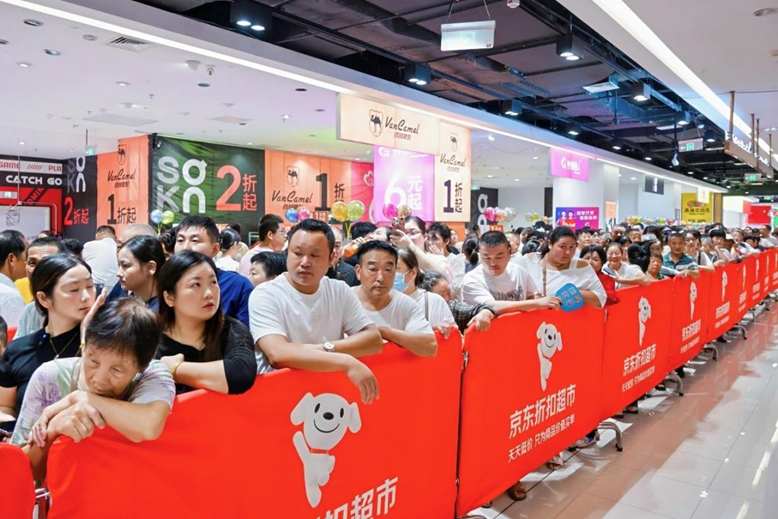
京东折扣超市宿迁四店齐开,首日客流超30万 为商场引客超日常3-4倍
Zhi Tong Cai Jing· 2025-08-31 04:44
Core Viewpoint - JD's discount supermarket opened four stores in Suqian, Jiangsu, showcasing strong consumer interest with over 300,000 visitors on the first day, significantly boosting foot traffic in the malls [1][4][10] Group 1: Store Performance - The opening day saw a customer influx exceeding 300,000, surpassing the previous record set by the first store in Zhuozhou [4] - The stores maintained a large average area of over 5,000 square meters each, featuring more than 5,000 high-cost performance products across various categories [4] - The overall customer flow at the Suqian Central Mall was nearly four times that of a typical weekend, indicating a strong market response [3] Group 2: Product Popularity - Fresh chicken eggs priced at 9.9 yuan for 30 pieces quickly sold out, becoming a hot-selling item, with consumers waiting for restocks [6] - High-quality fresh produce, including watermelons and grapes, attracted significant attention, contributing to strong sales [6] - JD's private label products, such as 100% fruit juice, gained popularity among consumers, highlighting the brand's appeal [6] Group 3: Local Market Integration - The stores featured locally tailored products, including specially designed beers from Yanghe Co., which became top sellers on opening day [8] - The integration of local culture and products into the store offerings reflects JD's strategy to resonate with the community [8] Group 4: Service and Delivery - JD's omnichannel advantage was evident, with staff available for in-store assistance and a rapid delivery service through the JD app, enhancing customer convenience [10] - Customers reported satisfaction with the quick delivery service, receiving orders within 30 minutes, which underscores JD's efficient supply chain capabilities [10]
京东开折扣超市,醉翁之意不在酒?
3 6 Ke· 2025-08-27 03:51
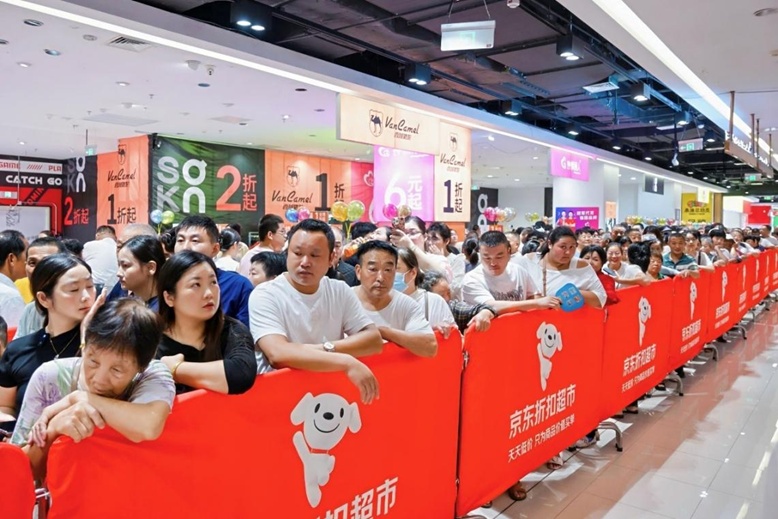
Core Insights - JD.com has officially launched its first discount supermarket, attracting nearly 60,000 visitors on opening day, indicating strong consumer interest in the discount retail sector [1][2] - The discount supermarket model is becoming increasingly crowded, with competitors like Wumart, Meituan, and international players such as Aldi entering the market [1][6] - The competition in the discount sector is driven by the pursuit of cost-effective supply chains, which are essential for maintaining low prices and high product quality [1][13] Company Developments - JD.com's first discount supermarket spans over 5,000 square meters and offers more than 5,000 products, focusing on high-quality, low-priced items [2][4] - The company plans to open four additional stores in Suqian, Jiangsu, by the end of August and a second store in Hebei in September, indicating a rapid expansion strategy [4][8] - JD.com has previously entered the discount market through the acquisition of Huaguan Supermarket, which will be transformed into discount stores by mid-2024 [4][16] Market Trends - The discount retail market is experiencing significant growth, with a projected increase in global discount sales of $6.11 billion and an 8.2% year-on-year growth rate, making it one of the fastest-growing retail channels [8][9] - In China, the hard discount market is expected to exceed 200 billion yuan, with a current penetration rate of only 8%, compared to 31% in Japan and 42% in Germany, suggesting substantial room for growth [8][9] - The shift in consumer behavior towards value-for-money products is driving the popularity of discount supermarkets, as consumers prioritize quality and price over brand loyalty [7][8] Competitive Landscape - Competitors in the discount sector include Wumart's "Wumart Super Value," which has opened multiple stores in Beijing, and Meituan's "Happy Monkey," aiming for a thousand-store scale [6][9] - Aldi, a German discount supermarket chain, is expanding its presence in China, having opened over 70 stores in Shanghai and surrounding areas [6][9] - The competitive advantage in the discount market is increasingly linked to supply chain efficiency, with companies focusing on direct sourcing and reduced SKU counts to lower costs [13][16] Supply Chain Dynamics - The success of discount supermarkets hinges on effective supply chain management, which allows for lower prices without compromising product quality [13][18] - JD.com emphasizes its supply chain capabilities, which include direct sourcing and partnerships with suppliers to enhance product offerings and maintain competitive pricing [15][16] - The ongoing competition for supply chain dominance among major players like JD.com and Meituan is expected to lead to further innovations and strategic moves in the discount retail space [17][18]
全渠道数据复盘:2025上半年消费市场底层变化与增长变量
3 6 Ke· 2025-07-24 04:02
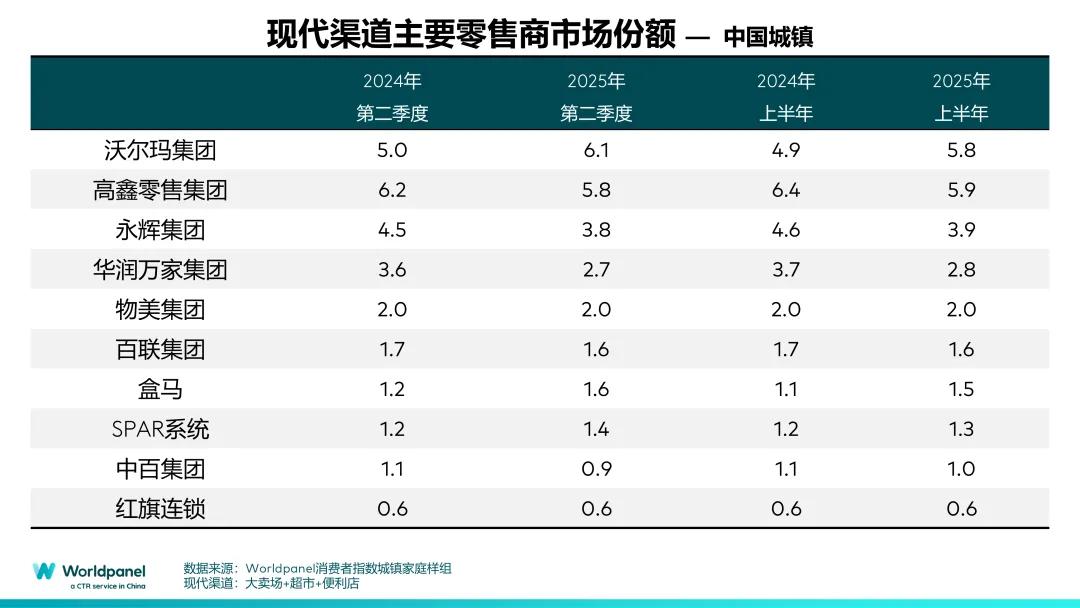
Group 1: Market Overview - The consumer goods market in urban China is expected to grow by 2.5% year-on-year in the first half of 2025, indicating a stable upward trend [1] - Beverage sales remain the main driver of the fast-moving consumer goods market, with a year-on-year growth of 5.6%, particularly in juice and functional drinks [1] - The retail sales of consumer goods increased by 5.0% year-on-year in the first half of this year, with final consumption expenditure contributing over 50% [1] Group 2: Out-of-Home Consumption - The out-of-home consumption market saw a year-on-year increase of 8.7% in customer traffic across cities [2] - The demand for emotional value, social needs, and entertainment experiences is driving the rapid adoption of new scenarios and technologies [2] Group 3: Offline Channels - Convenience store sales decreased by 3.6% year-on-year, while small supermarkets grew by 7.3%, indicating a stable performance in modern channels [3] - Major retailers showed a mixed performance, with Walmart leading in the second quarter, while the top ten retailers' market share declined by 1.1 percentage points [4][7] Group 4: Membership Stores - Membership stores have seen a year-on-year penetration rate increase of 3.6%, with Sam's Club showing significant growth in the East and South regions [8] - Sam's Club plans to open its largest store in Beijing by the end of 2025, aiming to attract customers with a "shopping + micro-vacation" model [8] Group 5: Discount Retail - Discount retailers are exploring new formats, with a focus on leisure food stores achieving a penetration rate exceeding 25% [10] - Traditional supermarkets are accelerating their transformation into hard discount formats, with regional players like "小百惠" and "家家悦" showing rapid growth [11] Group 6: Online Channels - E-commerce sales grew by 6.9% year-on-year in the first half of 2025, with Douyin's penetration rate increasing by 5.6 percentage points [12] - The 618 shopping festival saw a 2.9 percentage point increase in online channel penetration, with Douyin performing particularly well [14] Group 7: Conclusion - The fast-moving consumer goods market is experiencing a mild recovery, with consumers being price-sensitive while also valuing experiential and quality aspects [15] - The integration of online and offline channels is reshaping the consumer landscape, with a focus on product value, experiential value, and brand differentiation [16]