
美联储政策走向

Search documents
春节消费数据强劲中国制造业绿色转型取得显著成效,投资者需密切关注美伊谈判进展26日下一轮美联储政策走向以及关税政策的后续法律挑战
Sou Hu Cai Jing· 2026-02-26 14:55
Group 1 - The Chinese consumer market showed unprecedented vitality during the Spring Festival, with strong consumption growth indicating the resilience of the Chinese economy and the immense potential of the consumer market [1] - The green transformation of China's manufacturing industry has achieved significant results, driven by the increasing demand for green products during the Spring Festival, which provides strong momentum for the manufacturing sector [1] Group 2 - Investors need to closely monitor the progress of negotiations between the United States and Iran, as the outcomes will significantly impact the global oil market and the global economy [2] - The direction of the Federal Reserve's policies is crucial for global financial markets, and the subsequent legal challenges to tariff policies will also affect global trade patterns and the economy [2]
黄金盘整憋大招?静候CPI引爆
Jin Tou Wang· 2026-02-12 06:09
Core Viewpoint - The current gold price is experiencing a mild pullback after a significant surge, with the market awaiting the next catalyst for movement [1][2]. Group 1: Market Performance - On Wednesday, the spot gold price surged, with an increase of $59.13, representing a 1.18% rise, closing at $5084.34 per ounce [2]. - Despite strong U.S. non-farm employment data exceeding market expectations, gold managed to regain upward momentum due to robust long-term buying support [1][2]. Group 2: Economic Indicators - Investors are focused on the upcoming U.S. January Consumer Price Index (CPI) data, with expectations that overall and core inflation rates will decline to 2.5% from 2.7% and 2.6%, respectively [2]. - The CPI data is seen as a critical indicator for the Federal Reserve's policy direction in the coming months, particularly for the new chair, Kevin Walsh, who may face challenges if inflation exceeds expectations [2]. Group 3: Technical Analysis - The 4-hour chart indicates a strong return of buying power, with the 20-period Simple Moving Average (SMA) successfully crossing above the 100 and 200-period SMAs, establishing a bullish short-term trend [3]. - Key support is identified at approximately $5035.86 per ounce, while immediate resistance levels are at $5092.00 and $5598.25 per ounce [3]. - The daily chart shows that while gold briefly surpassed $5092 per ounce, it has not achieved a sustained breakout, although the overall trend remains positive with prices above all moving averages [3].
多空激战5000美元!黄金连涨后回调蓄势 静候非农数据定乾坤
Jin Tou Wang· 2026-02-11 04:13
Core Viewpoint - Gold prices experienced a slight pullback after two consecutive days of gains, closing at $5025.21 per ounce, down $32.68, with a decline of nearly 0.7%, while still maintaining above the psychological level of $5000 [1][2] Group 1: Economic Data and Market Sentiment - The market is focused on the upcoming U.S. non-farm payroll data for February, which is expected to provide insights into the labor market's resilience or potential softening, influencing Federal Reserve policy direction [1][2] - The consensus forecast for January's non-farm payrolls is an addition of 70,000 jobs, with the unemployment rate expected to remain at 4.4% [2] - Recent retail sales data for December showed unexpected stagnation, raising concerns about consumer spending and economic growth, thereby strengthening expectations for interest rate cuts by the Federal Reserve [2] Group 2: Gold Price Dynamics - Gold prices are fluctuating within the range of $5000 to $5100 per ounce, with traders awaiting new catalysts to break through this range [3] - If gold prices surpass $5100 per ounce, there is potential for further increases towards $5200 per ounce, and possibly reaching the January 30 high of $5451 per ounce, and approaching the historical high near $5600 per ounce [3] - Conversely, if gold prices fall below $5000 per ounce, they may test the 20-day simple moving average at $4910 per ounce, with further declines potentially targeting $4800 per ounce and the February 2 low of $4402 per ounce [3] Group 3: Market Influences - Support for gold prices is attributed to a weak dollar, geopolitical tensions, and expectations of interest rate cuts, alongside the psychological support at the $5000 level [2] - The dollar index remained stable at 96.87, indicating a lack of significant movement in the currency market [2] - There has been a notable influx of investment into gold ETFs from Indian investors, surpassing flows into stock funds for the first time [2]
金价升至每盎司5000美元上方 抄底买家重返市场
Xin Lang Cai Jing· 2026-02-09 00:32
Core Viewpoint - The precious metals market has experienced significant volatility, with buying interest returning and gold prices rising above $5,000 per ounce, influenced by Japan's political developments and expectations of loose fiscal policy [1][2]. Group 1: Gold Market Dynamics - Gold prices increased by 1.6% in early trading, supported by the victory of Japan's Prime Minister Fumio Kishida in the House of Representatives election, which bolstered expectations for a loose fiscal policy and continued pressure on the yen, typically favorable for gold [1][2]. - As of the last Friday's close, gold prices had retreated approximately 11% from the historical high of January 29 but still showed a year-to-date increase of 15% [1][2]. Group 2: Market Sentiment and Economic Indicators - Traders are closely monitoring upcoming U.S. economic data to better assess the Federal Reserve's policy direction, with the January employment report expected to indicate stabilization in the labor market, and inflation data set to be released later in the week [1][2]. - As of 8:20 AM Singapore time, gold prices rose by 1.4% to $5,034.67 per ounce, while silver increased by 2.2% to $79.52 per ounce, with platinum and palladium also showing gains [1][2].
机构:金价重返5000美元上方 投资者逢低买入
Sou Hu Cai Jing· 2026-02-09 00:25
Core Viewpoint - Spot gold has surpassed the $5,000 per ounce mark, driven by buyers returning to the market after a week of significant volatility, supported by the overwhelming election victory of Japanese Prime Minister Fumio Kishida, which has bolstered expectations for loose fiscal policies [1] Group 1: Market Reactions - Spot gold rose by 1.6% during early trading, reflecting positive market sentiment [1] - The election results have put continued pressure on the yen, which in turn benefits gold prices [1] Group 2: Price Movements - As of last Friday's close, gold prices have decreased by approximately 11% from the historical high reached on January 29, but have still seen a year-to-date increase of 15% [1] Group 3: Economic Data Monitoring - Traders are closely watching upcoming U.S. economic data to better assess the Federal Reserve's policy direction [1] - The January non-farm payroll report, expected to show signs of stabilization in the labor market, is set to be released on Wednesday, while inflation data is scheduled for Friday [1]
美国1月劳动力市场现分化 就业增长大幅降温
Xin Hua Cai Jing· 2026-02-04 14:15
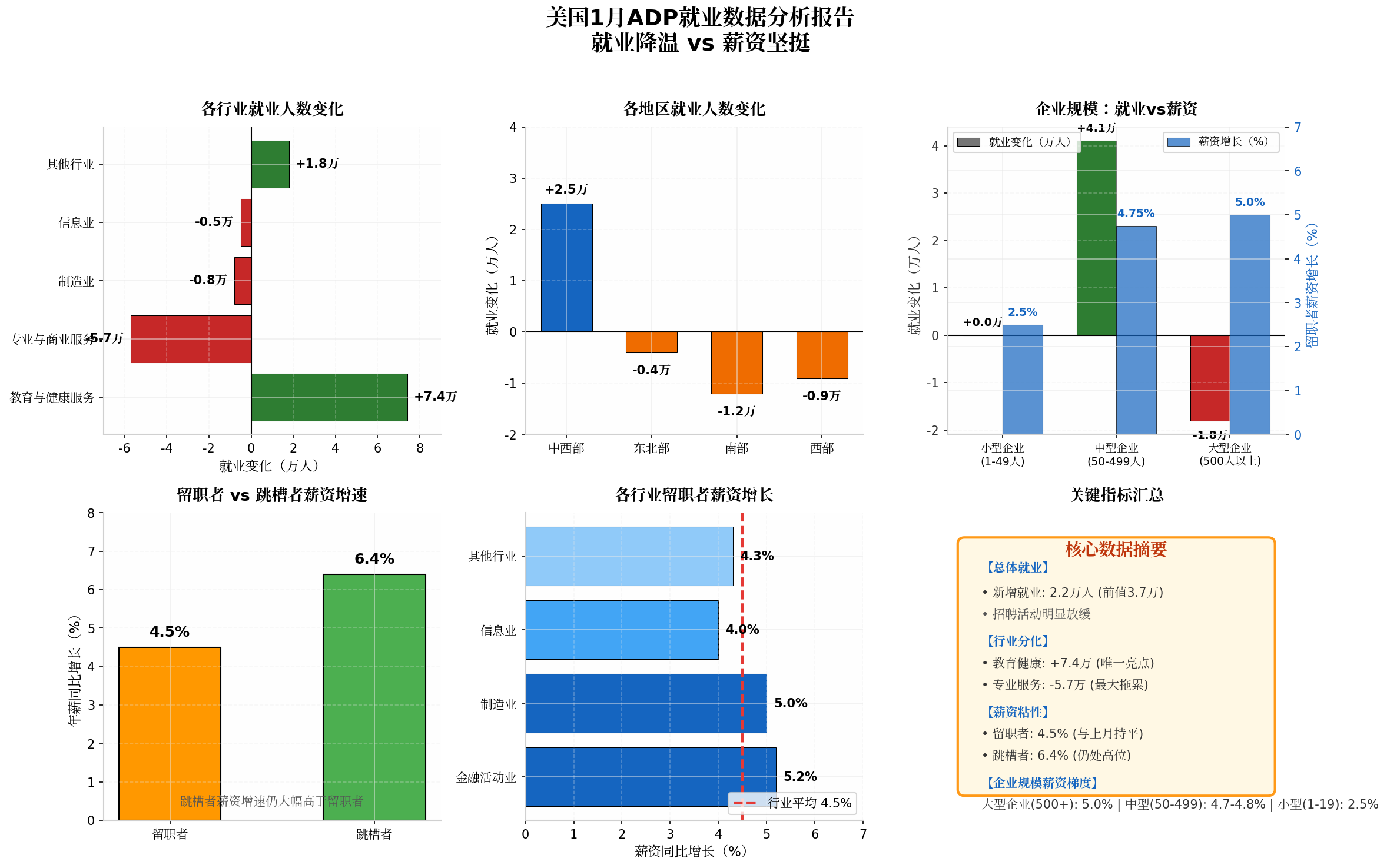
Group 1 - The core point of the article highlights a notable divergence in the U.S. labor market, with a slowdown in job growth but resilient wage increases, indicating structural differences across industries, regions, and company sizes [1][2][3] Group 2 - In January, the U.S. private sector added only 22,000 jobs, a significant slowdown from the revised previous value of 37,000 [2] - The education and health services sector saw a notable increase of 74,000 jobs, while professional and business services, manufacturing, and information sectors experienced declines of 57,000, 8,000, and 5,000 jobs respectively [2] - The Midwest region showed the strongest growth with an increase of 25,000 jobs, while the South and West regions combined saw a decrease of 21,000 jobs [2] - Medium-sized enterprises (50-499 employees) were the only contributors to job growth, adding 41,000 jobs, while large enterprises (500+ employees) cut 18,000 jobs, and small enterprises saw no net growth [2] Group 3 - Wage resilience is evident, with the median annual salary for job stayers increasing by 4.5% year-on-year, maintaining the same growth rate as the previous month [2] - Salary growth for job switchers slightly slowed to 6.4%, but remains significantly higher than for job stayers, indicating ongoing opportunities for wage increases through job changes [2] - Salary growth is relatively balanced across industries, with financial activities and manufacturing leading with increases over 5%, while information sector growth remains above 4% [2] - Company size is a key factor in salary growth, with large enterprises seeing a 5.0% increase for job stayers, medium enterprises at 4.7%-4.8%, and the smallest enterprises (1-19 employees) at only 2.5% [2] Group 4 - Market analysis indicates a shift in the U.S. labor market from a "quantity shortage" to "cost pressure," with persistent wage pressures despite the slowdown in job growth [3] - The rigidity of wages in large enterprises may support core service inflation, leading to mixed market expectations regarding the Federal Reserve's policy direction [3] - Stable wage growth could delay interest rate cuts, while weak job growth raises concerns about economic slowdown [3]

Vatee外汇:美联储短期降息不易,政策走向还看通胀与共识
Sou Hu Cai Jing· 2026-02-03 04:56
Group 1 - The recent comments from Atlanta Fed President Bostic have shifted attention back to the direction of Federal Reserve policy and its decision-making process [1] - Bostic emphasized that the Fed's decisions are not solely dependent on the chair but require building trust and demonstrating leadership to unify committee opinions, which often takes time [1] - The collective nature of the Fed's decision-making process is often overlooked by the market, suggesting that personnel changes may not directly lead to policy shifts [1] Group 2 - Bostic clearly opposes recent interest rate cuts, arguing that inflation risks are not fully resolved and the current economy shows resilience, with a stable labor market [3] - He warned that prematurely loosening monetary policy could hinder the return of inflation to the 2% target, aligning with the recent FOMC decision to maintain interest rates [3] - Market expectations have shifted towards maintaining high interest rates, with futures data indicating a decreased probability of rate cuts in March, reflecting investor digestion of the Fed's signals [3] Group 3 - Regardless of the next chair's selection, the threshold for the Fed to shift towards rate cuts in the short term remains high [4] - The direction of policy will depend on the evolution of inflation data and economic performance, as well as the ability of the FOMC to reach a consensus [4] - The Fed's decision-making mechanism indicates that policy adjustments often lag behind data changes and must balance multiple viewpoints, particularly during inflation management [4]
IC平台:美联储主席人事变动 市场重新审视利率前景
Sou Hu Cai Jing· 2026-02-02 01:44
Group 1 - The nomination of Kevin Warsh as the new Federal Reserve Chairman has led to significant volatility in the U.S. financial markets, with major stock indices declining and gold and silver experiencing their largest single-day drops since 1980, at 11% and 31% respectively [2] - Investors have mixed expectations regarding Warsh's policy stance, with some viewing his previous experience at the Federal Reserve as a sign of a potential inclination towards tightening monetary policy, which could strengthen the dollar and pressure precious metal prices [2][3] - Warsh's shift in policy stance has increased uncertainty on Wall Street, as he has previously been labeled as an inflation "hawk" but has recently aligned with President Trump's cost-cutting policies, raising concerns about his ability to navigate complex economic conditions [3] Group 2 - The independence of the Federal Reserve is a central topic of discussion regarding Warsh's nomination, with concerns about government interference in central bank decisions being amplified by his alignment with Trump [3] - The Senate has expressed concerns about Warsh's nomination, with Senator Elizabeth Warren emphasizing the need for the Federal Reserve Chairman to maintain independence from political pressures [4] - Even if confirmed, Warsh faces challenges in implementing his proposed reforms, as translating his ideas into actionable policies will require approval from the Federal Reserve Board, the President, and Congress, complicating the process [4]
避险支撑短线走强 美元中长期仍承压
Jin Tou Wang· 2026-01-06 01:57
Core Viewpoint - The recent performance of the US dollar shows a "short-term strong, long-term weak" divergence, supported by geopolitical risk aversion but constrained by fundamental pressures [1][2]. Group 1: Federal Reserve Policy - The Federal Reserve's policy direction is the main anchor for dollar fluctuations, with a cumulative rate cut of 75 basis points in 2025, bringing the current federal funds rate to a range of 3.50%-3.75% [1]. - The December meeting indicated a potential further rate cut in 2026, but recent statements from officials reveal a division, with some suggesting the Fed is close to halting rate cuts [1][2]. Group 2: Geopolitical and Economic Factors - The US military action against Venezuela has heightened global risk aversion, leading to a short-term inflow of funds into dollar assets, which has been a key driver for the recent dollar rebound [2]. - However, analysts believe that a single geopolitical event is unlikely to reverse the long-term trend, as the dollar index fell by 9.41% in 2025, marking its worst annual performance since 2017 due to weakening US economic conditions and "de-dollarization" trends [2]. Group 3: Technical Analysis - The dollar index is currently in a short-term oscillation pattern, with resistance at the 100 level and support around 97.50, indicating a temporary balance between bullish and bearish forces [2]. - Technical indicators show limited momentum, with the short-term moving average system not providing a clear trend signal, and the RSI not entering the strong buy zone [2]. Group 4: Future Outlook - The dollar is expected to remain in a tug-of-war between bullish and bearish forces, with short-term support from geopolitical tensions and hawkish Fed statements [3]. - Long-term downward pressures persist due to the continuation of the Fed's rate cut cycle, weakening US economic resilience, and ongoing issues related to the twin deficits and global central bank diversification [3].
非农分化+零售核心强劲 黄金冲高受阻短线偏多
Jin Tou Wang· 2025-12-17 02:10
Group 1 - The core viewpoint of the news highlights the mixed signals from recent economic data, particularly the non-farm payrolls and retail sales, which are crucial for assessing the U.S. economic momentum and predicting Federal Reserve policy direction [2] - The non-farm payroll data for November showed an increase of 64,000 jobs, exceeding market expectations, indicating a temporary recovery in the job market, while the October data was revised down to 105,000, reflecting pressure on employment [2] - The unemployment rate rose to 4.6% in November, the highest since September 2021, suggesting a deepening of labor market slack and an imbalance in supply and demand [2] Group 2 - Retail sales data showed a mixed performance, with overall retail sales remaining flat month-on-month in October, failing to meet market expectations, indicating a lack of vitality in consumer spending [2] - However, the core control group retail sales, excluding certain items, increased by 0.8% month-on-month, significantly surpassing expectations, indicating stable consumer spending in core areas, which is crucial for economic growth [2] - In the gold market, prices faced resistance despite positive non-farm data, with gold prices peaking near $4,440 before dropping to around $4,293, indicating a lack of bullish momentum [3]