
行业去产能

Search documents
白羽肉鸭迎来行业极寒 益客食品预计2025年亏损2.6亿-2.9亿元
Xin Lang Cai Jing· 2026-01-20 10:37
Group 1 - The core viewpoint of the article highlights the significant financial losses faced by Yike Foods due to the ongoing downturn in the white feather duck industry and the historical low prices of duck products [1] - Yike Foods anticipates a net loss of 260 to 290 million yuan for the year 2025, representing a year-on-year decrease of 359.56% to 389.51% [1] - The company's revenue is expected to decline by approximately 9% year-on-year, primarily due to falling sales prices of key products such as duck and chicken [1] Group 2 - The white feather duck market is experiencing extreme low prices, with the price of small white strip ducks dropping below 4000 yuan per ton in June 2025, leading to widespread losses among industry players [1] - In November, duck down prices initially rose, allowing processing plants to return to profitability, but by December, prices fell from 1.8 yuan per kilogram to as low as 1.3 yuan, causing further losses [2] - The industry is facing an oversupply situation, with approximately 10 million breeding ducks under construction, which is about one-third of the normal production capacity, indicating a challenging future for capacity reduction [2]

“一年少了300多人”
3 6 Ke· 2025-12-28 23:28
Core Insights - The investment banking industry in China is experiencing a structural adjustment, with a notable decrease in the number of registered representatives, indicating a "clearing out" phase despite a recovery in IPOs and listings [1][2] - There is a significant shift of investment banking professionals towards the real economy, particularly in mergers and acquisitions and overseas listings, reflecting a demand for talent with investment banking backgrounds [1][3] - The industry is facing a paradox of layoffs alongside aggressive recruitment, highlighting a mismatch in talent supply and demand, with a need for high-end professionals who can understand client needs more comprehensively [1][4] Group 1 - As of December 27, the total number of registered representatives in the industry has decreased to 8,493 from 8,800 at the beginning of the year, a reduction of 307 [1] - The trend of investment banking professionals moving to the real economy is expected to become more pronounced by 2025, driven by increased demand from industrial capital for talent in capital operations [1][2] - The industry is undergoing a "capacity reduction" process that is still in its early stages, with many professionals remaining in a state of observation [2][3] Group 2 - A significant number of investment bankers are transitioning to roles in large state-owned enterprises, with motivations including a reevaluation of career value and dissatisfaction with the current state of the investment banking sector [2][3] - The tightening of policies prior to the recent recovery has led to a perception that the previous boom was not sustainable, resulting in overcapacity in the industry [2][3] - The number of investment bankers moving to listed companies has accelerated, with nearly a hundred professionals making the switch since 2025 [3] Group 3 - Despite the overall reduction in workforce, there is a simultaneous "war for talent" as firms seek to adapt to changing market conditions and explore new business opportunities [5][6] - Some firms are focusing on specific sectors and regions to differentiate themselves, with notable recruitment efforts in areas like aerospace and robotics [5][6] - The Hong Kong market is becoming increasingly important for investment banks, with projections indicating that A+H share listings will contribute significantly to the IPO market [6][7] Group 4 - The net income of listed securities firms' investment banking divisions reached 25.2 billion yuan in the first three quarters of 2025, a year-on-year increase of 23.46%, with A-share and H-share IPO volumes growing by 61% and 237% respectively [7][8] - The market share of the top five investment banking firms has risen to 52%, an increase of 8 percentage points compared to the previous year [7] - The future landscape of investment banking is expected to be characterized by a concentration of top firms alongside regional specialization, as firms adapt to competitive pressures [7][8]
关注冬季动物疫病变化,看好牧业大周期
SINOLINK SECURITIES· 2025-12-14 12:39
Investment Rating - The report indicates a neutral investment rating for the agricultural sector, with expectations of limited price fluctuations in the near term [2][13]. Core Insights - The agricultural sector is currently experiencing a mixed performance, with the agricultural index underperforming compared to the Shanghai Composite Index [2][13]. - The pig farming industry is facing a downward price trend, with the average pig price at 11.48 yuan/kg, indicating a continued loss across the sector [21][22]. - Poultry farming shows signs of stabilization, with white feather chicken prices at 7.33 yuan/kg, reflecting a slight increase, while yellow feather chicken prices are improving due to better demand [28][31]. - The beef market is expected to see price increases as it enters the consumption peak season, with live cattle prices at 26.68 yuan/kg [33]. - The planting sector is experiencing tight supply conditions, with corn prices rising to 2238.57 yuan/ton, indicating potential for price increases if crop yields decline [37][38]. - Feed prices are stabilizing, with pig feed prices at 3.32 yuan/kg, while aquatic product prices are showing upward trends [51][55]. Summary by Sections 1. Swine Farming - The average weight of pigs at market is 129.63 kg, with prices expected to continue declining due to excess supply and ongoing losses in the industry [22][21]. - The report suggests focusing on low-cost, high-quality enterprises such as Muyuan Foods and Wens Foodstuffs [22][24]. 2. Poultry Farming - The white feather chicken market is under pressure, but yellow feather chicken prices are improving due to better demand and reduced supply [28][31]. - The overall profitability in poultry farming is expected to improve if consumer demand recovers [28][31]. 3. Livestock - The beef market is anticipated to rise as it enters the peak consumption season, with live cattle prices showing a year-on-year increase [33]. - The dairy sector is experiencing a reduction in stock, with raw milk prices expected to stabilize in the coming year [33]. 4. Planting Chain - Corn prices are on the rise, with a current price of 2238.57 yuan/ton, indicating a tightening supply situation [37][38]. - The planting sector is expected to improve if there are significant reductions in crop yields due to adverse weather conditions [37][38]. 5. Feed & Aquatic Products - Feed prices are stabilizing, with pig feed prices at 3.32 yuan/kg, while aquatic product prices are showing positive trends [51][55]. - The report highlights the importance of monitoring price movements in the feed and aquatic sectors for investment opportunities [51][55].


养殖ETF(159865)流入2100万份,近10日净流入超12亿元,资金积极布局“含猪量”约60%的养殖ETF
Mei Ri Jing Ji Xin Wen· 2025-10-28 06:52
Core Insights - The livestock ETF (159865) has seen significant inflows, with 21 million shares flowing in and a net inflow of 19 million shares, indicating strong capital interest in livestock assets [1] - Dongfang Securities highlights that the pig farming industry is likely to undergo a capacity reduction, driven by weak current and expected pig prices, alongside policy support, which may initiate market-driven capacity reduction [1] - The livestock ETF tracks the CSI Livestock Index (930707), which includes listed companies involved in livestock farming, feed processing, and related sectors, reflecting the overall performance of the livestock industry [1] Industry Summary - The pig prices have reached a low point for the year, and there is a possibility of further decline, suggesting that the industry is likely to start market-driven capacity reduction [1] - Policy measures are increasingly restricting the production capacity of leading firms, which, combined with market conditions, is expected to restart overall capacity reduction in the industry, potentially supporting long-term price increases for pigs [1] - The CSI Livestock Index covers various sub-sectors, including livestock farming, feed, and animal health, demonstrating strong industry representation [1]
资金面逐步发力,C端建材拐点或现
HTSC· 2025-10-20 12:08
Investment Rating - The report maintains an "Overweight" rating for the construction and building materials industry [6]. Core Views - The funding environment is gradually improving, with expectations for increased fiscal support in the fourth quarter, particularly benefiting the real estate sector [1]. - The report highlights a potential turning point for consumer building materials revenue due to improving demand and a decrease in price pressures in 2025 [2]. - The cement industry is experiencing a push for price increases, but demand support remains weak, leading to price fluctuations [3]. - The flat glass market shows signs of price stabilization, but supply-side improvements are still needed [4]. Summary by Sections Investment Environment - Infrastructure, real estate, and manufacturing investments in China showed mixed results, with infrastructure investment up by 1.1% year-on-year, real estate down by 13.9%, and manufacturing up by 4.0% [1]. - The central government has allocated an additional 500 billion yuan to local governments, indicating a proactive fiscal approach [1]. Real Estate Market - From January to September 2025, real estate sales, new starts, and completion areas decreased by 5.5%, 18.9%, and 15.3% year-on-year, respectively [2]. - September saw a positive turn in monthly housing completion area, suggesting a potential recovery in the sector [2]. Cement Industry - Cement production from January to September 2025 was 1.259 billion tons, down 5.2% year-on-year, with a notable price increase in September [3]. - The average cement price in September was 351 yuan per ton, reflecting a 1.4% month-on-month increase [3]. Glass Industry - The flat glass production for the first nine months of 2025 was 729 million weight cases, down 5.2% year-on-year, with prices stabilizing in September [4]. - The photovoltaic glass market showed better performance with a price increase of 19% month-on-month [4]. Recommended Stocks - The report recommends several stocks with a "Buy" rating, including China Liansu (2128 HK), Sichuan Road and Bridge (600039 CH), Yaxiang Integration (603929 CH), Sankeshu (603737 CH), Tubaobao (002043 CH), and Dongfang Yuhong (002271 CH) [7][29].


养殖ETF(159865)流入超2.4亿份,盘中小幅回调,资金低位布局“含猪量”约60%的养殖ETF
Mei Ri Jing Ji Xin Wen· 2025-10-17 08:01
Group 1 - The core viewpoint of the article highlights a significant inflow of funds into the breeding ETF (159865), with a net inflow of 151 million shares, indicating strong market interest in breeding assets [1] - In the third quarter, pig prices experienced weak fluctuations primarily due to the release of production capacity from the first half of the year, leading to an increase in supply [1] - Forward indicators such as the number of breeding sows and piglets suggest that supply will continue to grow year-on-year by approximately 10% to 16% in the third and fourth quarters [1] Group 2 - The overall profitability of the industry has narrowed in the third quarter due to high prices of piglets and delayed feed costs from the first half of the year, resulting in a decline in self-breeding and continuous losses in external purchases [1] - Some regions have reported a decrease in the slaughter weight of commercial pigs, reflecting the initial effects of policy adjustments [1] - The Ministry of Agriculture and Rural Affairs has proposed controlling the number of breeding sows to 39.5 million and the slaughter weight to around 120 kg, indicating the potential onset of a capacity reduction cycle in the industry [1] Group 3 - It is anticipated that pig prices will stabilize at the bottom in the fourth quarter, with worsening industry losses, although the supply-demand structure is expected to improve [1] - The breeding ETF (159865) tracks the CSI Livestock Index (930707), which selects listed companies involved in livestock breeding and feed processing to reflect the overall performance of the livestock industry [1] - The CSI Livestock Index covers various sub-sectors, including livestock breeding, feed, and animal health, demonstrating strong industry representation [1]
国投期货农产品日报-20251014
Guo Tou Qi Huo· 2025-10-14 12:55
Report Industry Investment Ratings - Soybeans (Domestic): ★☆☆, indicating a slight bullish bias but limited operability on the trading floor [1] - Soybean Meal: ★★★, suggesting a clear bullish trend and relatively appropriate investment opportunities [1] - Soybean Oil: ★★★, implying a clear bullish trend and relatively appropriate investment opportunities [1] - Palm Oil: ★★★, indicating a clear bullish trend and relatively appropriate investment opportunities [1] - Rapeseed Meal: ★☆☆, showing a slight bullish bias but limited operability on the trading floor [1] - Rapeseed Oil: ★★★, suggesting a clear bullish trend and relatively appropriate investment opportunities [1] - Corn: ★☆☆, indicating a slight bullish bias but limited operability on the trading floor [1] - Live Pigs: ★★★, implying a clear bullish trend and relatively appropriate investment opportunities [1] - Eggs: ★☆☆, showing a slight bullish bias but limited operability on the trading floor [1] Core Viewpoints - Overall, the report analyzes the market conditions of various agricultural products, including soybeans, soybean meal, soybean oil, palm oil, rapeseed meal, rapeseed oil, corn, live pigs, and eggs. It provides insights into supply, demand, price trends, and investment strategies for each product [2][3][4] - The report suggests that while some products face supply and demand challenges, others show potential for price increases or are in a state of weak oscillation. Investors are advised to pay attention to policy changes, international trade relations, and seasonal factors [6][7][8] Summary by Product Soybeans - Domestic soybeans are in a consolidation state after a rebound. The recent auction had a 66.3%成交 rate with an average price of 3900 yuan/ton. Domestic soybeans are stronger than imported ones, and the price difference is widening. Concerns about US soybean export demand may pressure US soybean prices [2] Soybean & Soybean Meal - The main contract of domestic soybean meal futures decreased by 1.16% today. As of October 10, the inventory of imported soybeans in major domestic oil mills was 812 million tons, showing an increase. Domestic soybean supply in the fourth quarter is generally stable, but there may be a shortage in the first quarter of next year if Sino - US trade relations worsen. US soybean sales are slow, and relevant policies are delayed. It is advisable to wait and observe [3] Soybean Oil & Palm Oil - Both soybean oil and palm oil followed the general decline of most commodities today. However, from the perspective of the oil - meal ratio, oils are still stronger than meals. The US soybean price is expected to be pressured by weak demand. The Malaysian palm oil market has weak demand and inventory pressure, while the Indonesian market is more resilient. It is recommended to buy oils at low prices after the price bottoms out [4][5] Rapeseed Meal & Rapeseed Oil - Rapeseed futures declined today and were among the top decliners in the oil - seed sector. The macro - economic sentiment has a greater impact than the fundamentals. Domestic rapeseed and rapeseed oil supply is abundant, and rapeseed is not cost - effective in the demand side. It is recommended to use rapeseed as a short - position in cross - competitor strategies. Canadian rapeseed prices are expected to be under pressure in the short term, and the domestic rapeseed market will likely oscillate weakly [6] Corn - Dalian corn futures are oscillating widely at the bottom. The new corn harvest in the northeast may lead to a price decline, but the winter wheat price increase may have an impact. The corn price is currently weak at the bottom, and a policy - based bottom is approaching [7] Live Pigs - The live pig futures market rebounded with increased positions. The decline of the spot price has slowed down, and some areas have seen a price rebound. Although the current price is at the bottom historically, there are no obvious bullish factors in the fundamentals. The industry is in the process of capacity reduction, which will support the futures contracts of the second half of next year [8] Eggs - The spot price of eggs has mixed trends, with some areas rising and others falling. The futures market shows a rebound in the near - term contracts and a decline in the far - term contracts. The mid - term egg price bottom has not been determined, and the industry needs to accelerate the elimination of old hens. It is recommended to hold a short position in the near - term contracts and a long position in the far - term contracts [9]
中邮证券-石化行业周报:油价基本面驱动不足,石化继续调整-250921
Xin Lang Cai Jing· 2025-09-21 14:43
Group 1 - The petrochemical industry continues to adjust, with ongoing attention to the progress of eliminating outdated facilities and upgrading [1] - The oil and petrochemical index fell by 1.99% this week, while the best-performing segment was oil product sales and storage, which only declined by 0.46% [1] - Crude oil prices decreased, with an increase in US crude oil inventories and a reduction in gasoline inventories [1] Group 2 - Polyester filament prices and price spreads have decreased, with an increase in inventory days for polyester filament in Jiangsu and Zhejiang, and a decline in weaving machine operating rates [1] - The sample prices of polyolefins remained stable, with inventory depletion observed [1] - If demand improves and there is progress in eliminating backward production capacity, it would be beneficial for the midstream refining sector [2]
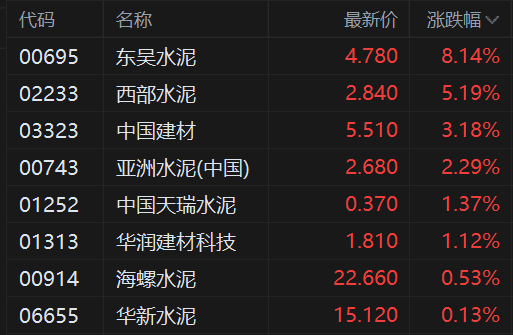
港股异动丨建材水泥股反弹 东吴水泥涨超8%止步4连跌
Ge Long Hui· 2025-09-19 03:27
Group 1 - Cement stocks have rebounded after a continuous decline, with Dongwu Cement rising over 8%, Western Cement up over 5%, China National Building Material increasing over 3%, and Asia Cement up over 2% [1] - According to a report from China Galaxy Securities, cement demand remains weak in August due to seasonal factors, high temperatures, and rainy weather affecting downstream construction, leading to a decrease in operating load of cement mills [1] - The average price of cement in August was 271.67 yuan per ton, showing a month-on-month decline [1] Group 2 - The clinker inventory has shifted from an increase to a decrease, but the issue of oversupply in the industry still exists [1] - Looking ahead, demand is expected to seasonally improve from September to November, combined with accelerated capacity reduction in the industry, which may help ease supply and demand pressures and support cement prices [1]

中国银河证券:季节性旺季来临有望推动水泥价格上调
Xin Lang Cai Jing· 2025-09-18 00:38
Core Viewpoint - The cement industry in China is currently experiencing a seasonal downturn in demand due to high temperatures and rainy weather, leading to decreased operational load of cement mills and a high clinker kiln shutdown rate [1] Industry Summary - In August, the average price of cement was 271.67 yuan per ton, reflecting a month-on-month decline [1] - The demand for cement remains weak, and the industry is facing an oversupply issue despite a decrease in clinker inventory [1] - A seasonal recovery in demand is expected from September to November, which, combined with accelerated capacity reduction efforts, may help balance supply and demand, potentially driving up cement prices [1]
