
非农数据修正

Search documents
民生证券:市场降息预期“过热” 美联储或为乐观预期降温
Zhi Tong Cai Jing· 2025-09-28 23:54
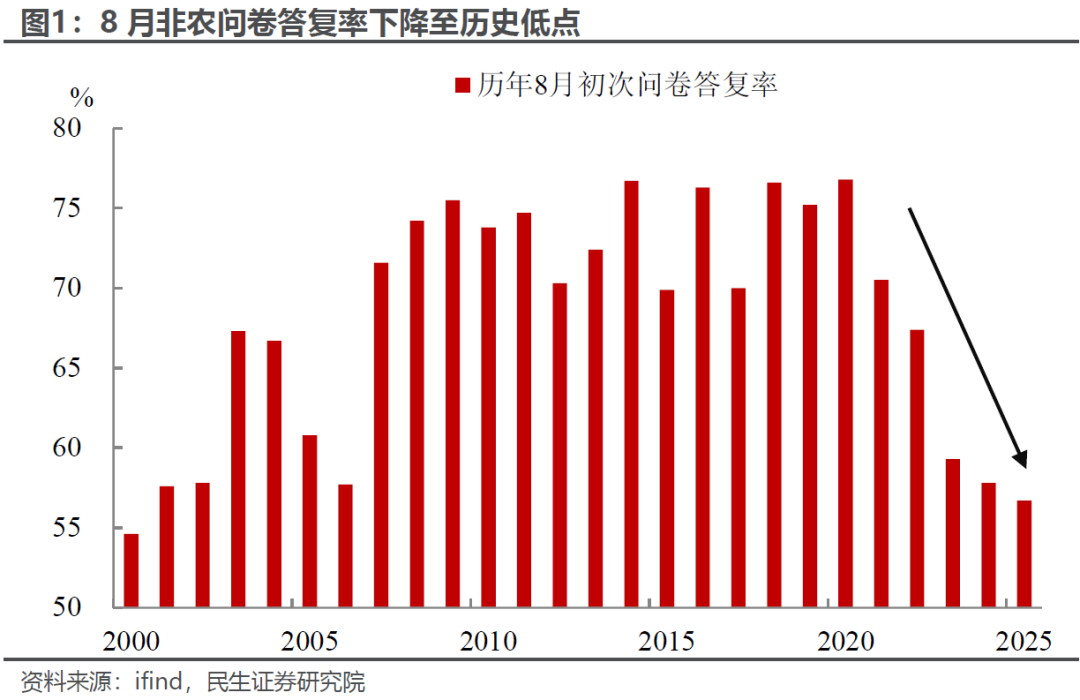
Core Viewpoint - The report from Minsheng Securities emphasizes the need for continued observation of interest rate cut expectations, suggesting that the market's current optimism may be overly aggressive and neglecting potential volatility risks [1][19]. Employment Data Analysis - The report focuses on employment as a key variable that could potentially reverse the interest rate cut expectations if upward revisions occur [2]. - Non-farm payroll data has been increasingly noisy this year due to factors like declining response rates and data collection issues, raising concerns about its accuracy [2][5]. - Historical data indicates that the initial value of non-farm payrolls for August is often revised upward in October, with an 80% probability of upward revision based on the last 20 years [7]. Seasonal Adjustment Mechanism - The seasonal adjustment mechanism used by the Labor Department can amplify short-term fluctuations in non-farm payroll data, particularly during the high volatility months of July and August [5][12]. - The downward adjustment of the overall trend in the CES model after the September annual benchmark revision may limit the downward revision space for the August non-farm payroll data [12]. Comparison with Other Labor Market Indicators - Other labor market indicators, such as ADP employment and PMI employment indices, suggest that the August non-farm payroll may have been underestimated, as these indicators did not show a significant decline [15][16]. Market Implications - The potential upward revision of August non-farm payrolls could significantly influence interest rate cut expectations, similar to the scenario before the Fed's first rate cut last year [19]. - The report warns that if any contrary signals arise, such as rapid inflation or revisions in non-farm data, market volatility could increase, affecting sensitive sectors like growth and cyclical stocks [1][19].

周五非农难阻9月降息?美银美林:关键在于失业率和前值修正
Hua Er Jie Jian Wen· 2025-09-03 07:01
Core Viewpoint - The upcoming U.S. employment report is expected to show a moderate recovery in the labor market, but this may not significantly alter the Federal Reserve's expectations for interest rate cuts [1] Group 1: Employment Growth Expectations - Bank of America predicts that the U.S. non-farm payrolls for August will increase by 90,000, surpassing July's 73,000 and the market consensus of 75,000 [1] - The report highlights that the four-week average of initial jobless claims remains at a moderate level, while continuing claims have decreased, supporting the view of a slight acceleration in employment growth [1] Group 2: Risks of Data Revision - There is a significant risk of downward revision for July's non-farm payrolls, which could indicate more persistent labor market weakness than previously expected [2] - The initial response rate for the July survey was only 57.6%, much lower than the 68.4% in May and 59.5% in June, raising concerns about the reliability of the data [2] Group 3: Federal Reserve's Rate Cut Threshold - The threshold for preventing a rate cut has been raised, with the need for strong data to justify maintaining interest rates [3] - A report that could lead the Federal Reserve to keep rates unchanged would require an unemployment rate of 4.2% or lower, job growth exceeding 70,000, and minimal revisions to July's data [3] Group 4: Sector-Specific Employment Trends - The employment market in August is expected to show structural differentiation, with some sectors experiencing growth while others remain weak [5] - Government employment is projected to increase by 5,000 jobs in August after a decrease of 10,000 in July, and the tourism and hospitality sectors are expected to see a slight recovery [5][6] - However, professional and business services may continue to face hiring challenges due to AI adoption and a low liquidity labor market, while manufacturing employment is expected to remain weak due to labor supply shocks and tariff uncertainties [6] Group 5: Wage and Hour Stability - Bank of America anticipates that average hourly earnings will grow by 0.3% month-over-month in August, with average weekly hours remaining stable at 34.3 hours [6]
宏观:如何理解美国就业数据的大幅修订?
HTSC· 2025-08-22 09:29
Group 1: Employment Data Revision Insights - The July non-farm payroll report revised the employment data for May and June down by 258,000, raising concerns about the accuracy of U.S. employment data[4] - Since 1979, the probability of downward revisions in non-farm payrolls has increased during economic slowdowns, with a current downward revision probability of 72.4% since 2023[10] - The average downward revision magnitude has widened to -12.8% in 2023, compared to a historical average of -8.4%[10] Group 2: Factors Contributing to Data Volatility - Four main factors have contributed to increased volatility in U.S. employment data post-pandemic: decreased response rates in non-farm surveys, increased immigration complicating data collection, seasonal disruptions, and larger errors in the Birth-Death Model[6] - The response rate for non-farm surveys has dropped from 59% pre-pandemic to 42.9% in May 2025, indicating a significant reduction in sample size[19] - The Birth-Death Model has led to an estimated overestimation of employment levels by approximately 440,000 jobs due to structural changes in new business formations[21] Group 3: Upcoming Employment Data Revisions - Attention is drawn to the upcoming benchmark revision of non-farm employment data scheduled for September 9, 2025, which may lead to further downward adjustments[7] - The QCEW data, which covers over 95% of employment, is expected to provide a more accurate reflection of employment levels compared to the non-farm payrolls, which cover only about one-third[44] - Historical trends suggest that the upcoming benchmark revision may result in a downward adjustment similar to the previous year's initial revision of 818,000 jobs[52]

Vatee万腾:美国非农数据回头看遭大幅下修,就业强劲表象松动?
Sou Hu Cai Jing· 2025-08-06 10:20
Core Insights - The recent employment data signals a potential weakening in the U.S. labor market, contrary to the prevailing perception of strength [1][3] - Goldman Sachs has revised down the non-farm employment numbers for May and June by a total of 258,000, marking the largest two-month adjustment since 1968 [1][3] - A significant downward revision of 550,000 to 950,000 is anticipated in the upcoming annual benchmark revision, which could reshape market views on labor market strength [1][4] Employment Data Adjustments - The monthly adjustment of 258,000 alters the market's assessment of employment growth for May and June, revealing cracks in the narrative of continuous job expansion [3][4] - The scale of the upcoming benchmark revision is expected to be unprecedented, potentially ten times larger than the previous adjustment of 50,000 in January 2023 [4] Diverging Indicators - Other employment-related indicators, such as the NFIB small business survey, JOLTS job openings data, and the ECI employment cost index, are showing signs of fatigue, indicating a slowdown in hiring and job demand [5] - This inconsistency in data is raising concerns in the market regarding the robustness of the labor market [5] Implications for Federal Reserve Policy - The Federal Reserve has previously relied on the narrative of a strong labor market to justify maintaining high interest rates; however, if the downward revisions are confirmed, it may necessitate a reassessment of economic resilience [5][6] - Current market expectations suggest a high probability (over 90%) that the Federal Reserve will begin to cut interest rates in September, which could accelerate if the labor market is found to be overestimated [6] Economic Outlook - The lagging effects of consecutive interest rate hikes over the past two years may be starting to manifest in the labor market, potentially leading to more dovish sentiments [7] - The downward revision of non-farm data challenges market consensus and could exert pressure on expectations for a soft landing of the U.S. economy, adding complexity to future Federal Reserve policy decisions [7]


金十回顾:美国劳工部将修正4月非农数据
news flash· 2025-06-06 12:32
Core Viewpoint - The U.S. Bureau of Labor Statistics (BLS) will revise April's non-farm payroll data due to minor discrepancies, but this revision will not affect key labor market indicators such as the unemployment rate [1] Group 1 - The BLS announced that it will correct the April non-farm payroll data when releasing May's data on Friday [1] - The revision is attributed to slight errors in weights related to the redesigned Current Population Survey (CPS) sample [1] - Key labor market indicators, including the unemployment rate, labor force participation rate, and employment-population ratio, remain unaffected by this revision [1] Group 2 - The BLS typically revises the non-farm payroll data for the previous two months, and the extent of these revisions is of significant interest to the market [1]