A股春季行情

Search documents
科技+资源品A股春季行情主线渐明
Zhong Guo Zheng Quan Bao· 2026-02-25 20:22
Core Viewpoint - The article discusses the evolving landscape of asset management, highlighting the increasing importance of technology and innovation in driving growth and efficiency within the industry [1] Group 1: Industry Trends - The asset management industry is experiencing significant transformation due to advancements in technology, which are reshaping investment strategies and client engagement [1] - There is a growing emphasis on sustainable investing, with firms increasingly integrating environmental, social, and governance (ESG) factors into their investment processes [1] - The competition among asset managers is intensifying, leading to a focus on differentiation through specialized products and services [1] Group 2: Company Strategies - Companies are investing heavily in digital platforms to enhance operational efficiency and improve client experiences [1] - There is a trend towards consolidation in the industry, with mergers and acquisitions being utilized as a strategy to gain market share and expand capabilities [1] - Firms are prioritizing data analytics and artificial intelligence to better understand market trends and client needs, thereby enhancing decision-making processes [1]
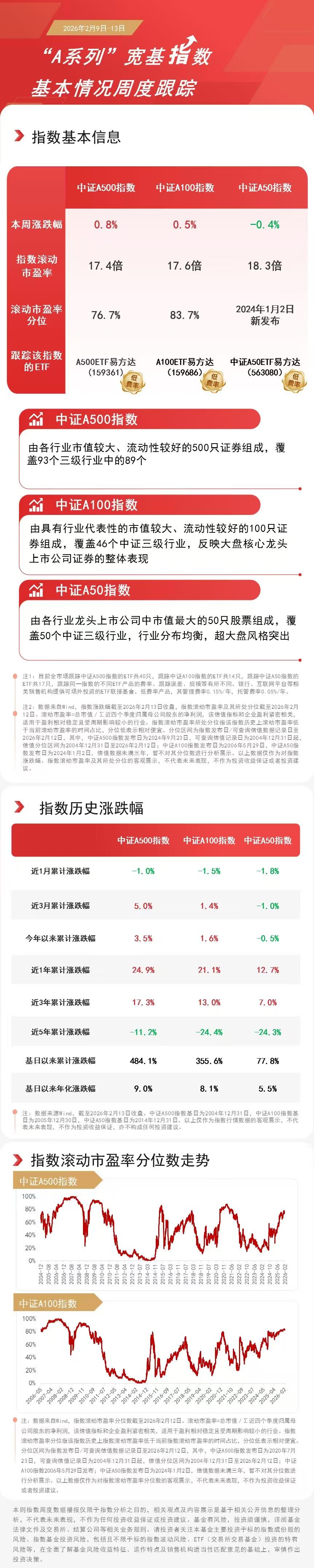
A500指数本周涨0.8%,机构称春季行情有望延续,A500ETF易方达(159361)助力布局A股核心资产
Mei Ri Jing Ji Xin Wen· 2026-02-13 10:06
Group 1 - The core viewpoint of the article indicates that the recent A-share spring market is undergoing a phase adjustment, primarily driven by internal factors with external factors acting as catalysts. However, external disturbances have not caused substantial impacts on China's industrial fundamentals, and the concentrated cooling operations have ended, suggesting that market sentiment has been fully released. A continuation of the spring market after the Spring Festival is anticipated, and holding stocks during the holiday is recommended [1][3]. Group 2 - The weekly performance of the indices shows that the CSI A500 index increased by 0.8%, the CSI A100 index rose by 0.5%, while the CSI A50 index decreased by 0.4% [1][3]. - The rolling price-to-earnings (P/E) ratios for the indices are as follows: CSI A500 at 17.4 times, CSI A100 at 17.6 times, and CSI A50 at 18.3 times [3]. - The CSI A500 index consists of 500 securities with large market capitalization and good liquidity, covering 89 of the 93 three-level industries. The CSI A100 index includes 100 representative securities, covering 46 three-level industries, while the CSI A50 index comprises the 50 largest stocks from leading companies across 50 industries [4].

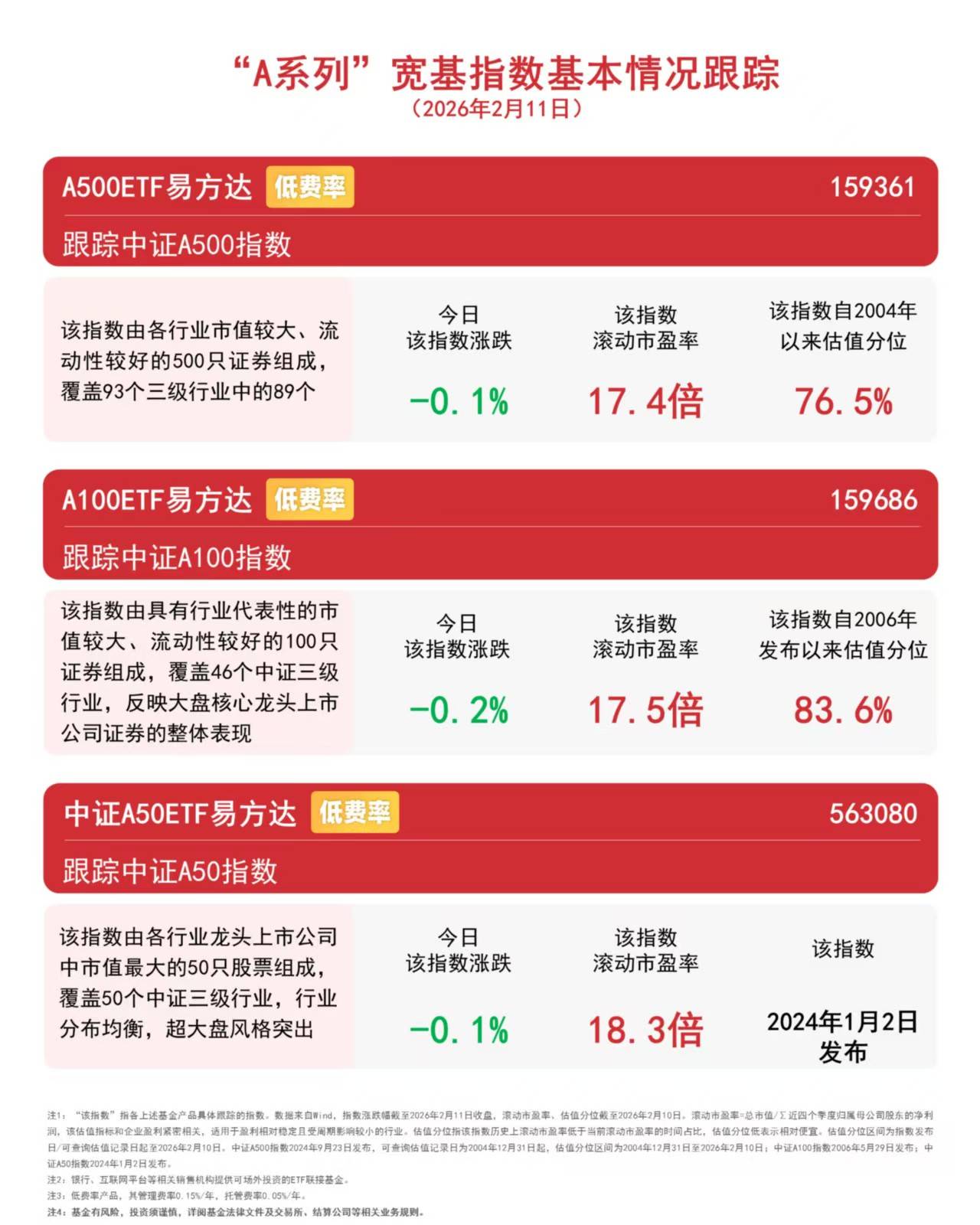
机构称春节后春季行情有望延续,A500ETF易方达(159361)等产品助力布局A股核心资产
Sou Hu Cai Jing· 2026-02-11 10:33
Group 1 - The core viewpoint is that the recent A-share spring market is undergoing a phase adjustment, primarily driven by internal factors with external factors acting as catalysts. However, external disturbances have not caused substantial impacts on China's industrial fundamentals, and the concentrated cooling operations have ended, leading to a sufficient release of market sentiment. The adjustment is considered relatively complete, and the spring market is expected to continue after the Spring Festival, suggesting holding stocks through the holiday [1][4]. Group 2 - The CSI A500 Index and CSI A50 Index both fell by 0.1%, while the CSI A100 Index decreased by 0.2% [1]. - The CSI A500 Index consists of 500 securities with large market capitalization and good liquidity, covering 89 out of 93 sub-industries. Its rolling price-to-earnings ratio is 17.4 times [3]. - The CSI A100 Index includes 100 representative securities with large market capitalization and good liquidity, covering 46 sub-industries. Its rolling price-to-earnings ratio is 17.5 times [3]. - The CSI A50 Index is composed of the 50 largest stocks from various industries, with a balanced distribution across 50 sub-industries. Its rolling price-to-earnings ratio is 18.3 times [3].

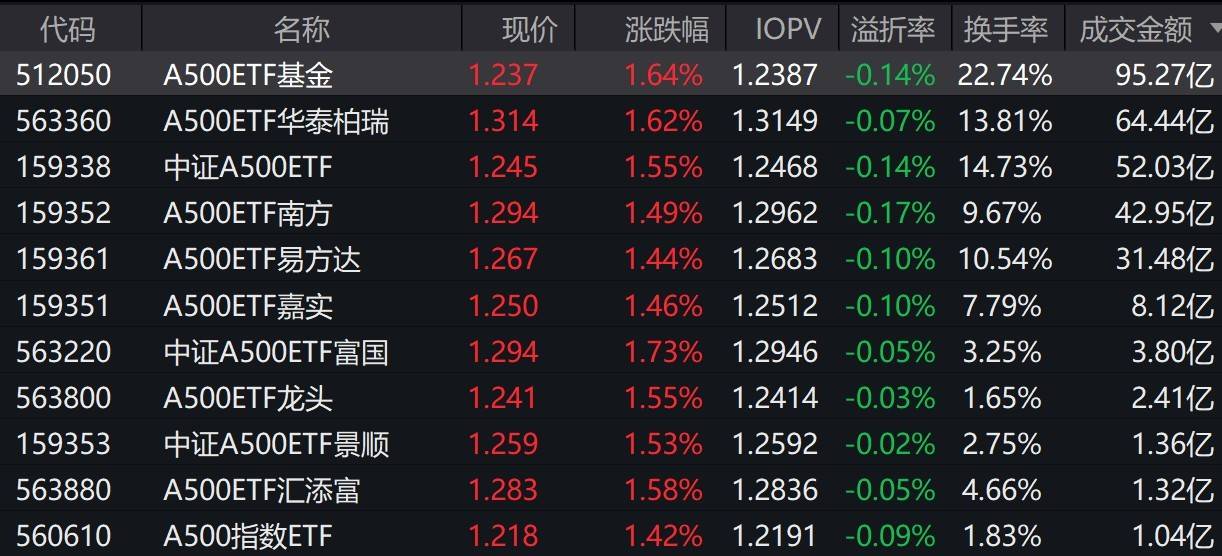
市场早盘高开高走,中证A500指数上涨1.63%,2只中证A500相关ETF成交额超64亿元
Sou Hu Cai Jing· 2026-02-09 03:59
Market Performance - The market opened higher with the Shanghai Composite Index rising over 1% and the CSI 500 Index increasing by 1.63% [1] - The photovoltaic sector experienced a significant surge, while computing hardware concepts collectively strengthened, and AI applications and the chemical sector showed active performance [1] - Conversely, oil and gas stocks exhibited weaker performance [1] ETF Trading Activity - Multiple ETFs tracking the CSI 500 Index saw gains of over 1%, with 11 ETFs having transaction volumes exceeding 100 million yuan, and 2 surpassing 6.4 billion yuan [1] - The A500 ETF Fund and A500 ETF Huatai Baichuan recorded transaction volumes of 9.527 billion yuan and 6.444 billion yuan, respectively [1] Market Sentiment and Outlook - Some brokerages indicated that external disturbances have not substantially impacted the fundamentals of Chinese industries, and the concentrated cooling operations have concluded [1] - Market sentiment has been fully released, and adjustments are considered adequate, suggesting that the A-share spring market rally may continue after the Spring Festival [1]
【中信建投:春节后春季行情有望延续 建议持股过节】中信建投证券研报认为,近期A股春季行情呈现阶段性调整,核心是内因主导、外因催化。内因为主动降温、宽基ETF遭遇抛售潮;外因包括特朗普政治行为、美联储主席换届、伊朗地缘冲突、Anthropic新工具引发全球科网股下跌等多重扰动。当前外部扰动未...
Sou Hu Cai Jing· 2026-02-08 11:44
Core Viewpoint - The report from CITIC Securities suggests that the recent adjustments in the A-share spring market are primarily driven by internal factors, with external factors acting as catalysts. It anticipates that the spring market rally will continue after the Spring Festival, recommending investors to hold stocks during the holiday [1] Group 1: Internal Factors - The internal factors influencing the market include proactive cooling measures and a wave of selling in broad-based ETFs [1] - The market sentiment has been sufficiently released, indicating that the adjustments have been relatively adequate [1] Group 2: External Factors - External factors contributing to market volatility include political actions by Trump, the change in the Federal Reserve Chair, geopolitical tensions in Iran, and the global decline in tech stocks triggered by new tools from Anthropic [1] - Despite these external disturbances, there has been no substantial impact on the fundamental aspects of the Chinese industry [1]
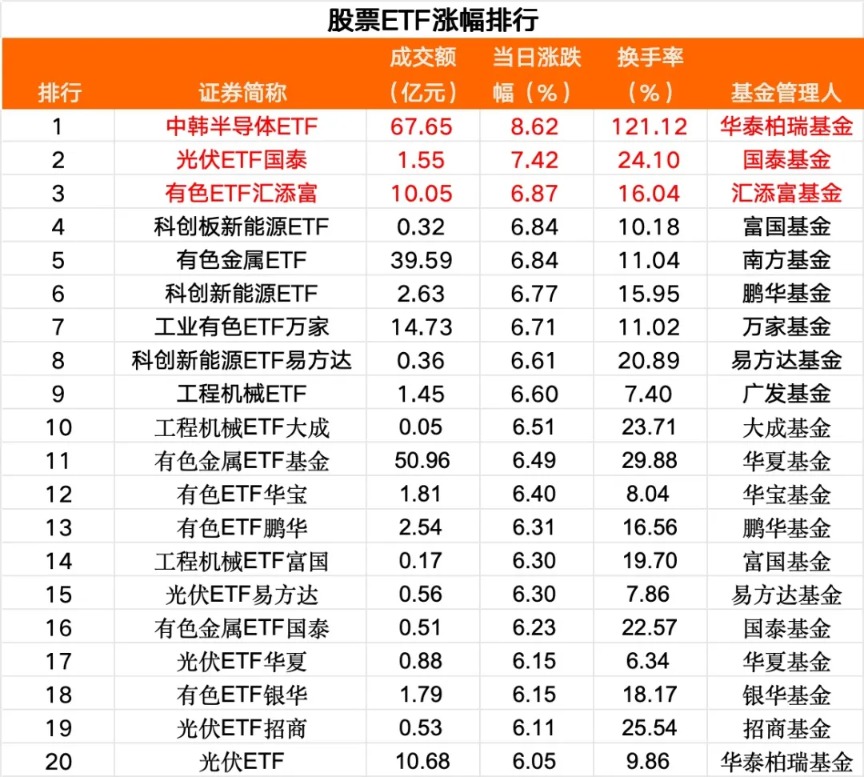
大逆转!本周二股票ETF资金净流入接近百亿元
Zhong Guo Ji Jin Bao· 2026-02-04 05:48
Core Viewpoint - After several days of net capital outflow, the A-share market saw a reversal with significant capital inflow on February 3, 2026, as all three major indices closed higher, with a trading volume exceeding 2.5 trillion yuan [1]. Group 1: Market Performance - On February 3, the total scale of all stock ETFs reached 4.15 trillion yuan, with a trading volume of 298.75 billion yuan, a decrease of nearly 20 billion yuan from the previous trading day [2]. - The top-performing sectors included new energy and non-ferrous metals, with four of the top ten ETFs by increase belonging to the new energy sector [2]. - The worst-performing ETFs included those related to brokerage and banking, with declines around 1% to nearly 7% [2]. Group 2: Capital Inflow and Outflow - On February 3, the net inflow of capital into stock ETFs was approximately 97.52 billion yuan, with 56 ETFs seeing inflows exceeding 100 million yuan [4]. - The net inflow for the entire market was 14.9 billion yuan, with broad-based ETFs and Hong Kong market ETFs leading the inflows at 112.49 billion yuan and 23.6 billion yuan, respectively [4]. - The net inflow for the CSI 500 index was 38.01 billion yuan, while the SGE Gold 9999 index saw a net outflow of 68.46 billion yuan [4]. Group 3: ETF Performance Rankings - The top three ETFs by net inflow were the CSI 500 ETF (35.66 billion yuan), the Securities ETF (11.17 billion yuan), and the A500 ETF (9.73 billion yuan) [5]. - The leading ETFs by trading volume included the CSI 500 ETF with 142.18 billion yuan, followed by the A500 ETF with over 100 billion yuan [2]. - A total of 26 ETFs experienced net outflows exceeding 1 billion yuan, with non-ferrous metals and photovoltaic industry ETFs being the most affected [5]. Group 4: Fund Management Insights - Major fund companies like E Fund and Huaxia Fund reported significant net inflows into their ETFs, with E Fund's total ETF scale reaching 652.35 billion yuan, an increase of 96.4 billion yuan [7]. - Fund managers expressed optimism about the A-share market, anticipating a potential spring rally in Q1 2026, particularly in sectors like securities, new energy, semiconductors, and consumer services [7].
春季行情未完,调整是布局机会
Huajin Securities· 2026-02-03 00:50
Market Overview - On February 2, 2026, the Shanghai Composite Index fell by nearly 2.5%[1] - The decline was attributed to expectations of tightening overseas liquidity and adjustments in cyclical sectors[6] Market Trends - The spring market rally is not over; adjustments present opportunities for low-cost positioning[11] - Short-term policy expectations remain positive, with limited external risks anticipated[11] Industry Insights - Adjustments in technology growth and certain cyclical sectors are expected to outperform in the near term[12] - From January 30, 2026, the declines in cyclical sectors included a 14.8% drop in non-ferrous metals and an 8.6% drop in steel[13] Performance Forecasts - High growth rates are projected for sectors such as beauty care (451.0%), non-bank financials (271.2%), and defense industry (140.3%) for 2025[17] - The transportation sector and non-ferrous metals are expected to see significant year-on-year profit growth of 31.2% and 22.6%, respectively[19] Risk Factors - Historical experiences may not apply to future market conditions, and unexpected policy changes could impact investment decisions[33] - Economic recovery may not meet expectations due to external disruptions or unforeseen events[33]
光控资本:A股春季行情仍有望延续 整体将以结构性行情为主
Sou Hu Cai Jing· 2026-01-29 06:31
Group 1 - The A-share market experienced narrow fluctuations, with a focus on potential interest rate cuts by the Federal Reserve and the possibility of a reserve requirement ratio reduction in China [1][4] - The macroeconomic improvement and rising corporate earnings are seen as the main drivers for the market's mid-term upward trend, although a comprehensive bull market requires solid fundamental support [1][4] - The recent regulatory measures aim to temper speculative sentiment in the market, promoting a healthier and more sustainable "slow bull" market [4][5] Group 2 - The A-share market showed significant sector rotation, with resource-related cyclical stocks rising while technology-focused stocks experienced a decline [5] - The market is expected to maintain a small upward trend, with investors advised to closely monitor macroeconomic data and changes in overseas liquidity [4][5] - There are structural opportunities in the market despite the rapid rotation, and a cautious approach is recommended when the index rises too quickly or approaches support levels [5]

午评:沪指涨0.49%,石油、半导体等板块拉升,黄金概念活跃
Sou Hu Cai Jing· 2026-01-28 04:09
Core Viewpoint - The A-share market is experiencing fluctuations, with over 3,500 stocks in the red, while the Shanghai Composite Index shows a slight increase, indicating a mixed market sentiment [1] Market Performance - As of the midday close, the Shanghai Composite Index rose by 0.49%, and the Shenzhen Component Index increased by 0.09%. In contrast, the ChiNext Index fell by 0.37%, and the STAR Market 50 Index decreased by 0.73% [1] - The total trading volume across the Shanghai, Shenzhen, and Beijing markets reached approximately 1.93 trillion yuan [1] Sector Analysis - The pharmaceutical, automotive, and retail sectors experienced declines, while the oil, non-ferrous metals, coal, semiconductor, and brokerage sectors saw gains. Additionally, gold and disperse dye concepts were active [1] Investment Strategy - Dongguan Securities suggests that short-term indices may continue to fluctuate around moving averages, with an accelerated rotation of sectors. However, the spring market for A-shares is expected to continue, primarily characterized by structural trends [1] - Recommended investment strategies include balanced allocation, focusing on undervalued assets with stable earnings, technology sectors leading new productivity, and domestic demand expansion under the backdrop of a strong domestic market [1]
国信证券:A股春季行情结束的信号出现了吗?
Xin Lang Cai Jing· 2026-01-25 06:19
Core Conclusion - This week, broad-based ETFs experienced concentrated redemptions, and the inflow of leveraged funds slowed down, leading the market into a phase of volatility and consolidation [1][5] - Historically, signals indicating the end of spring rallies often include substantial policy tightening, unexpected external shocks, and deteriorating fundamentals [2][6] - Current policies aim to support market stability and growth, suggesting that the spring rally is not over, with a balanced structural allocation recommended, particularly favoring technology and AI applications, while also paying attention to cyclical sectors, real estate, and consumer services [1][5][7] Market Liquidity and ETF Redemptions - Recent changes in A-share liquidity show marginal shifts, with the minimum margin requirement for financing raised from 80% to 100%, resulting in a slowdown of leveraged fund inflows [1][6] - Broad-based ETFs have seen significant net redemptions, totaling over 500 billion since mid-January, with the CSI 300 index ETF experiencing net redemptions of 325.9 billion and the CSI 1000 index ETF seeing 81.9 billion in redemptions [1][6] Historical Context of Spring Rallies - The end of spring rallies is often signaled by substantial policy tightening, as seen in historical examples such as the increase in stamp duty in May 2007 and regulatory changes in March 2017 [2][6] - External shocks, such as the 2008 subprime mortgage crisis and the recent COVID-19 pandemic, have also led to abrupt market declines [2][6] - Deteriorating fundamentals, such as lower-than-expected economic targets or industrial profit growth, can contribute to the end of spring rallies [2][6] Future Market Outlook - Current policies remain supportive, with liquidity still relatively abundant, and industry and thematic ETF subscriptions remain active despite the increase in margin requirements [7] - The ongoing spring rally is viewed as part of a broader bull market that began in 2024, with expectations for further policy support to boost macroeconomic performance [3][7] - The technology sector, particularly driven by AI applications, is expected to remain a key focus, with opportunities also present in value sectors such as resources and real estate [3][7]