AI商业模式

Search documents
荣耀前CEO赵明加入千里科技董事会
第一财经· 2026-02-12 08:47
Core Viewpoint - Zhao Ming, the former CEO of Honor, will join the board of Qianli Technology, indicating a strategic partnership aimed at enhancing AI technology development and commercial models [1]. Group 1 - Zhao Ming's role will complement Qianli Technology's chairman, Yin Qi, who focuses on AI technology strategy [1]. - The collaboration aims to create a closed-loop business model for AI [1]. - Qianli Technology has stated that information will be based on official announcements [2].


平安基金林清源:2026年或是AI商业模式的“大考之年”
Zhong Zheng Wang· 2026-01-22 14:43
Core Viewpoint - The year 2026 is anticipated to be a critical year for AI business models, shifting investment focus from CAPEX to Revenue and DAU [1] Group 1: Investment Focus - Investment priorities will be directed towards sectors with high earnings certainty, including computing infrastructure, power equipment, and leading semiconductor companies [1] - The market's discussion on AI bubble theories suggests that while some bubbles may exist, it is crucial to be cautious of companies that lack performance support [1] Group 2: AI Market Dynamics - The penetration speed of AI is faster than previous internet industry transformations, requiring higher standards for companies' competitive advantages [1] - In the AI era, possessing proprietary data and a deep understanding of vertical scenarios may represent the true barriers to entry, contrasting with the previous reliance on traffic for competitive advantage [1]
算力越高收入越多!OpenAI率先验证AI商业Scaling Law:最新收入200亿美元
量子位· 2026-01-20 01:34
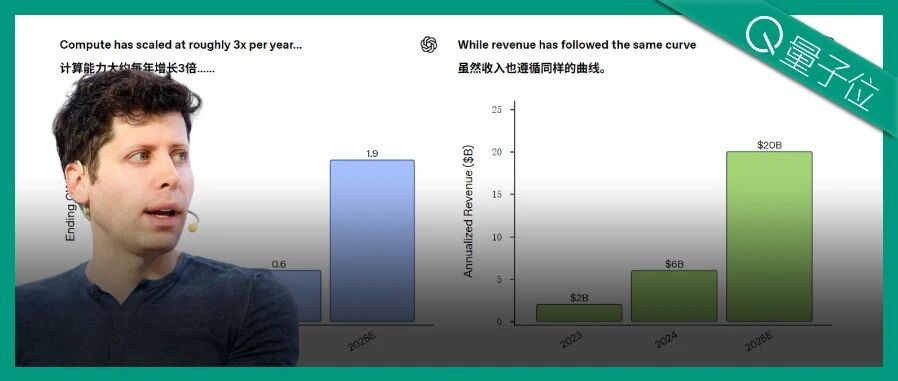
Core Viewpoint - OpenAI's revenue has significantly increased, with annual recurring revenue (ARR) rising from $2 billion to $20 billion over two years, indicating a strong growth trajectory despite high operational costs [2][12]. Revenue and Growth - OpenAI's ARR has surged to $20 billion, reflecting a tenfold increase in revenue projected from 2023 to 2025, alongside a 9.5-fold increase in computing power [2][13]. - The relationship between computing power and revenue is emphasized, where increased investment in computing drives research and model capabilities, leading to higher revenue, which in turn supports further investment [9][12]. Comparison with Competitors - In comparison to a competitor (Claude's parent company), OpenAI's computing power and ARR are significantly larger, with projections showing a growth from 0.2 GW and $2 billion in 2023 to 1.9 GW and over $20 billion by 2025 [14][17]. Operational Costs - OpenAI's operational costs are substantial, with an estimated $7 billion spent on computing resources in 2024, primarily through cloud services from Microsoft [21][22]. - The company is also investing heavily in building its own AI data centers, indicating a long-term strategy to manage costs and enhance capabilities [18][19]. Business Model and Future Plans - OpenAI's business model is evolving, with the introduction of advertising aimed at providing decision support in commercial scenarios, alongside subscription services and API usage [27][30]. - The company plans to launch its first hardware product in the second half of 2026, which is expected to further integrate into its revenue-computing cycle [33][34].
备受关注的“AI商业模式”:谷歌率先在Gemini中引入广告
Hua Er Jie Jian Wen· 2026-01-12 01:17
Core Insights - Google is introducing new personalized advertising features in its AI shopping tool, marking a significant step in the monetization of AI [1] - The initiative allows advertisers to offer exclusive deals to consumers preparing to purchase through Google's AI model, driven by the Gemini model [1][2] - This move represents a major shift from Google's traditional advertising model, aiming to provide value to retailers at critical moments to facilitate transactions [1][2] Group 1: New Advertising Features - The new advertising functionality enables brands to deliver highly personalized ads, such as discount codes, through its chatbot, advancing Google's position against AI competitors [2] - Retailers can set desired offers, with Google using AI to determine the optimal timing for displaying these deals to potential customers [2] - Initial focus during the pilot phase is on discounts, with plans to expand to other types of offers, such as bundled sales and free shipping [2] Group 2: Competitive Landscape - Google is leveraging its significant market share in online search to showcase its AI model to billions of users, despite its Gemini chatbot lagging behind ChatGPT in popularity [3] - Competitors like OpenAI, Microsoft, and Perplexity are racing to introduce e-commerce features in their chatbots to generate revenue from their costly AI products [3] - OpenAI has paused internal discussions on advertising products due to concerns about competitors narrowing the technological lead [3] Group 3: Industry Trends - Microsoft has launched Copilot Checkout, which provides recommendations and checkout services in its AI chat, resulting in a 53% increase in purchases within 30 minutes for users utilizing the feature [4] - Google’s CEO Sundar Pichai emphasized the need for collaboration in this transformative period for the industry, suggesting significant growth potential if executed well [4] Group 4: General Business Agreement - Google has introduced a "Universal Commerce Agreement" that allows shopping agents to research products and complete purchases without leaving its platform, developed in collaboration with major retailers like Walmart, Target, and Shopify [5]

A股三大指数收跌 碳酸锂期货合约大涨
Qi Huo Ri Bao Wang· 2025-11-17 14:28
Market Overview - The A-share market experienced a decline with the Shanghai Composite Index down by 0.46%, Shenzhen Component down by 0.11%, and ChiNext down by 0.20%, while the North China 50 index increased by 0.81% [1] - The total trading volume in the Shanghai and Shenzhen markets was 19,303 billion yuan, a decrease of 501 billion yuan from the previous day, with over 2,500 stocks rising [1] Structural Market Analysis - The overall market is maintaining a structural trend under index fluctuations, influenced by concerns over tightening liquidity in overseas markets and the AI business model [1] - The Shanghai Composite Index is near the 4,000-point mark for the first time in 10 years, representing a significant technical and psychological barrier that requires further consolidation [1] - The fourth quarter is a critical period for institutional "high-low switching" adjustments, with a strong momentum for market style rebalancing following a previously dominant tech style [1] Lithium Market Insights - Carbonate lithium futures surged, with prices exceeding 95,200 yuan per ton, marking a 9% increase, leading to a wave of stock price increases in the lithium battery sector [1] - Notable stocks such as Rongbai Technology, Tianhua New Energy, and others saw price limits or increases exceeding 10% [1] - Morgan Stanley upgraded the ratings of Ganfeng Lithium and Tianqi Lithium to neutral [1] Supply and Demand Dynamics - The lithium supply side is facing incremental bottlenecks, while terminal demand remains strong, contributing to a positive fundamental outlook [2] - The continuous reduction of inventory and strong policy guidance, along with large industry orders, are enhancing expectations for energy storage demand [2] - Since Q3, carbonate lithium futures prices have emerged from the year's bottom range, with energy storage demand growth being a significant driver for Q4 pricing [2] - Future developments in long-duration energy storage could lead to a more pronounced increase in carbonate lithium demand [2]
【机构策略】A股市场总体上维持着结构性行情
Zheng Quan Shi Bao Wang· 2025-11-17 00:59
Core Viewpoint - The A-share market is experiencing a period of oscillation around the 4000-point mark on the Shanghai Composite Index, influenced by various factors including changes in US-China relations and liquidity concerns in overseas markets [1][2] Group 1: Market Conditions - The Shanghai Composite Index is currently in a consolidation phase, primarily due to short-term profit-taking pressures from funds and a lack of consensus among market participants [1] - The market is characterized by a structural performance under the index's oscillation, with rapid rotation among various sectors [2] - The current environment is conducive to "small-cap + thematic investment" strategies, as the market is in a performance vacuum with weak fundamental guidance [1] Group 2: Influencing Factors - Recent concerns over tightening overseas liquidity and fears surrounding AI business models have dampened market risk appetite [2] - The 4000-point level on the Shanghai Composite Index serves as both a technical and psychological barrier, necessitating repeated oscillation to digest this level [2] - The fourth quarter is a critical period for institutional portfolio rebalancing, particularly following a dominant tech style in the market [2] Group 3: Future Outlook - The market is expected to maintain its current state, with a focus on new leading themes as funds may shift towards more aggressive strategies [1] - Attention is drawn to upcoming US economic data and potential changes in interest rate expectations, which could further influence market dynamics [1]
财信证券晨会纪要-20251117
Caixin Securities· 2025-11-16 23:30
Market Overview - The A-share market is experiencing a structural adjustment with the Shanghai Composite Index closing at 3990.49, down 0.97%, and the Shenzhen Component Index down 1.93% at 13216.03 [7][9] - The overall market sentiment is influenced by external factors such as tightening liquidity in overseas markets and concerns over AI business models, leading to a general decline in risk appetite [9] Economic Data - In October, the average selling prices of commercial residential properties in 70 major cities showed a month-on-month decline, with first-tier cities experiencing a 0.3% drop in new residential prices [16] - The industrial added value for October grew by 4.9% year-on-year, slightly below expectations, while retail sales increased by 2.9% [18] Industry Dynamics - The power industry reported a 7.9% year-on-year increase in industrial power generation in October, with total generation reaching 800.2 billion kWh [26] - The financial sector is being urged to avoid "involutionary competition" to maintain reasonable profit margins, which is expected to stabilize net interest margins for banks [27] Company Updates - Zejing Pharmaceutical (688266.SH) received FDA orphan drug designation for its investigational product ZG006, aimed at treating neuroendocrine cancer, marking a significant milestone in its development pipeline [32] - Huakang Clean (301235.SZ) has been awarded a contract for the Wuyishan New District Comprehensive Hospital project, indicating growth in its project portfolio [34] Regional Economic Developments - New Five Feng (600975.SH) has completed the registration of its subsidiary, which will focus on joint breeding projects with a French partner, enhancing its position in the agricultural sector [37] - The Hunan Cuisine Ingredient Industry Alliance has been established to strengthen the food industry in Hunan, aiming to elevate its status in the national market [39]
谁在争先恐后喂养OpenAI这只“巨兽”
虎嗅APP· 2025-11-02 09:21
Core Insights - The article discusses the significant impact of AI on business models, highlighting that over 30 companies have consumed more than 1 trillion tokens each, indicating deep integration of AI into their operations [4][5]. - OpenAI's top 100 clients have generated over $100 million in revenue, with 30 companies alone contributing over $60 million each through token consumption [4][5]. Token Consumption and Business Integration - The consumption of 1 trillion tokens is equivalent to a massive amount of written content, illustrating the extensive use of AI in various business scenarios [4]. - Companies utilizing AI are not necessarily more technologically advanced but show that AI has become an essential infrastructure for their operations [4]. Key Players and Industries - Among the top 30 clients, AI-native startups outnumber traditional mature companies, indicating a shift towards businesses that integrate AI from inception [9]. - Notable companies include Duolingo, Salesforce, and various AI-focused startups like Cognition and Genspark, which are leveraging AI for coding and other applications [7][10]. Vertical and Horizontal Market Trends - The article identifies vertical AI applications in sectors like law and healthcare, with companies like Harvey and Decagon demonstrating rapid revenue growth [15]. - In contrast, mature companies are more likely to modularly integrate AI into existing workflows rather than embedding it deeply from the start [12]. Consumer-Focused AI Applications - Consumer-facing companies in the top 30 include Duolingo and Read AI, which focus on high-frequency usage and clear subscription models [17][18]. - Duolingo has effectively integrated AI to enhance personalized learning experiences, while Read AI provides efficient meeting summaries and knowledge management [17][18]. Challenges for Startups - Many startups face financial pressures due to high costs associated with using OpenAI and other AI models, which can consume a significant portion of their revenue [20]. - There is a growing concern among startups about the potential overlap with OpenAI's offerings, which could threaten their business models [21].

ChatGPT和Claude,已经不是同一条路上的玩家了
3 6 Ke· 2025-09-16 10:42
Core Insights - OpenAI and Anthropic have released user reports for ChatGPT and Claude, highlighting a significant trend in the AI industry where the two leading models are evolving along distinctly different paths, with notable differences in market positioning, core application scenarios, and user interaction models [1][3] Group 1: ChatGPT Overview - ChatGPT has established itself as a phenomenon, with over 700 million weekly active users projected by July 2025. The user base has expanded from primarily technical users to a more diverse group of highly educated professionals, with female users now comprising 52% [5] - The core functionalities of ChatGPT focus on practical guidance, information retrieval, and document writing, which together account for nearly 80% of total interactions. The use of ChatGPT for programming assistance has significantly decreased from 12% to 5% [5] - The strategic path for ChatGPT is to become a general-purpose AI assistant serving a broad user base, leveraging its large user base and the resulting network effects [5] Group 2: Claude Overview - Claude's user distribution is strongly correlated with the economic development level (GDP per capita), indicating its primary user base consists of knowledge workers and professionals in developed economies [6] - The main application area for Claude is software engineering, which consistently accounts for 36% to 40% of tasks across regions. In contrast to ChatGPT, Claude has seen a significant increase in "directive" automation tasks, rising from 27% to 39% over the past eight months [6] - Among enterprise API users, 77% of interactions are automated, with minimal human intervention, positioning Claude as a specialized productivity and automation tool deeply integrated into enterprise workflows [6] Group 3: Industry Insights - The divergence in programming applications between ChatGPT and Claude indicates a growing market for specialized AI tools that are deeply integrated into specific industry workflows, such as software development and financial analysis [8] - The 77% automation rate in enterprise APIs signals a shift in AI's role from human assistance to task execution, necessitating a reevaluation of AI's impact on productivity, organizational structure, and cost models [9] - The difference in collaboration and automation modes suggests an evolution in AI business models, where initial automation leads to more complex human-AI collaboration as users become more familiar with AI capabilities [10][13]

周鸿祎谈Manus:广告模式不work了,要向用户直接收费
Xin Lang Ke Ji· 2025-07-23 04:02
Core Insights - The discussion at the 2025 China Internet Conference highlighted the complexities surrounding Manus's decision to shift its domestic operations overseas, with implications for its business model in the context of AI advancements [1][3]. Group 1: Business Model Changes - The operational costs associated with AI are significantly higher than those of traditional internet models, leading to a shift from ad-based revenue to direct user charges [3]. - The traditional internet model relied on low operational costs and high user engagement to generate advertising revenue, which is no longer viable in the current AI landscape [3]. Group 2: Market Opportunities - There is a belief that the Chinese market still has substantial potential for AI applications, particularly in creating personalized intelligent agents for various user needs [4]. - The company aims to lower the cost of developing intelligent agents, making it accessible for individuals and small to medium enterprises, which could represent a significant market opportunity [4].