AI泡沫担忧

Search documents
观点与策略:国泰君安期货商品研究晨报-20260227
Guo Tai Jun An Qi Huo· 2026-02-27 01:46
Market Ratings - The report does not provide an overall investment rating for the industries. Core Views - The report provides short - term trend outlooks for various commodities, including precious metals, base metals, energy, agricultural products, and chemical products. Each commodity's outlook is based on its specific supply - demand situation, market sentiment, and macro - economic factors [2][4]. Summary by Commodity Category Precious Metals - **Gold**: Expected to oscillate upwards. The trend strength is 1. Gold prices are affected by factors such as geopolitical events and macro - economic data [2][7]. - **Silver**: In an oscillating pattern. The trend strength is 1. Silver prices are influenced by market sentiment and industrial demand [2][6]. - **Platinum**: In a box - shaped oscillation. The trend strength is 0. Platinum prices are affected by supply - demand balance and market sentiment [25][27]. - **Palladium**: High - frequency data is weak. The trend strength is 0. Palladium prices are influenced by automotive industry demand and supply factors [25][27]. Base Metals - **Copper**: Inventory is continuously increasing, which restricts price recovery. The trend strength is 0. Global supply - demand balance and geopolitical factors affect copper prices [2][10]. - **Zinc**: Attention should be paid to geopolitical disturbances. The trend strength is 0. Zinc prices are influenced by geopolitical events and supply - demand fundamentals [2][13]. - **Lead**: Lacks driving forces, and prices oscillate. The trend strength is 0. Lead prices are affected by supply - demand balance and market sentiment [2][16]. - **Tin**: Oscillates with a slightly upward trend. The trend strength is 1. Tin prices are influenced by supply - demand situation and market sentiment [2][19]. - **Aluminum**: In a range - bound oscillation. The trend strength is 0. Aluminum prices are affected by supply - demand balance and cost factors [23][24]. - **Alumina**: Supply pressure remains unrelieved. The trend strength is - 1. Alumina prices are influenced by supply - demand fundamentals and production costs [23][24]. - **Nickel**: Speculative sentiment in Shanghai nickel still exists, and continuous attention should be paid to nickel ore contradictions. The trend strength is 0. Nickel prices are affected by supply - demand balance and policy factors [29][34]. - **Stainless Steel**: The cost support center moves up, but off - season inventory accumulation restricts elasticity. The trend strength is 0. Stainless steel prices are influenced by cost and demand factors [29][34]. Energy - **Crude Oil**: Although not directly mentioned in the title, it affects related products. - **Fuel Oil**: Night - session prices declined, and weakness reappeared. The trend strength is - 1. Fuel oil prices are affected by crude oil prices and market demand [2][124]. - **Low - Sulfur Fuel Oil**: Narrow - range oscillation, and the spread between high - and low - sulfur fuels in the overseas spot market is temporarily stable. The trend strength is 0. Low - sulfur fuel oil prices are influenced by crude oil prices and regulatory policies [2][125]. - **Natural Gas**: Not specifically mentioned in the report. - **Coal**: - **Coking Coal**: Affected by warehouse - receipt disturbances, prices oscillate weakly. The trend strength is 0. Coking coal prices are influenced by supply - demand balance and market sentiment [2][54]. - **Coking Coke**: Oscillates weakly. The trend strength is 0. Coke prices are affected by coking coal prices and steel industry demand [2][53]. - **Steam Coal**: Upstream quotes are firm, and short - term coal prices are strong. The trend strength is 1. Steam coal prices are influenced by supply - demand balance and seasonal factors [2][59]. Agricultural Products - **Palm Oil**: Production cuts are realized, and a short - term buy - on - dips strategy is recommended. The trend strength is 1. Palm oil prices are affected by production, demand, and weather conditions [151][154]. - **Soybean Oil**: The US bio - diesel policy is gradually implemented, and US soybean oil shows a strong performance. The trend strength is 1. Soybean oil prices are influenced by US policies and global supply - demand balance [151][154]. - **Soybean Meal**: Overnight US soybeans slightly declined, and Dalian soybean meal may oscillate. The trend strength is 0. Soybean meal prices are affected by US soybean prices and domestic demand [155][157]. - **Soybean**: Spot prices are stable, and the futures market is strong. The trend strength is 0. Soybean prices are influenced by domestic supply - demand balance and international market conditions [155][157]. - **Corn**: Oscillates with a slightly upward trend. The trend strength is 0. Corn prices are affected by supply - demand balance and policy factors [158][161]. - **Sugar**: The price - increase sentiment is spreading. The trend strength is 1. Sugar prices are influenced by global supply - demand balance and policy factors [162][165]. - **Cotton**: Futures prices have回调. The trend strength is 1. Cotton prices are affected by domestic and international supply - demand balance and market sentiment [166][171]. - **Eggs**: Oscillate weakly. The trend strength is - 1. Egg prices are influenced by supply - demand balance and feed costs [172][173]. - **Hogs**: The futures market anticipates inventory accumulation in advance, but it is difficult to reduce inventory in the off - season. The trend strength is - 2. Hog prices are affected by supply - demand balance and market sentiment [175][177]. - **Peanuts**: Oscillate. The trend strength is 0. Peanut prices are influenced by supply - demand balance and market sentiment [179][181]. Chemical Products - **Para - Xylene (PX)**: Follows cost fluctuations and is in a range - bound market. The trend strength is 0. PX prices are affected by crude oil prices and supply - demand balance [65][70]. - **Purified Terephthalic Acid (PTA)**: Follows cost fluctuations and is in a range - bound market. The trend strength is 0. PTA prices are influenced by PX prices and downstream demand [65][70]. - **Ethylene Glycol (MEG)**: In a range - bound market, with a strategy of going long on PTA and short on MEG. The trend strength is 0. MEG prices are affected by supply - demand balance and cost factors [65][70]. - **Rubber**: Wide - range oscillation. The trend strength is 0. Rubber prices are influenced by supply - demand balance and macro - economic factors [73][74]. - **Synthetic Rubber**: Oscillates at a high level. The trend strength is 0. Synthetic rubber prices are affected by raw material prices and market demand [77][79]. - **Linear Low - Density Polyethylene (LLDPE)**: Crude oil risks need to be released, and its own supply - demand pattern is average. The trend strength is - 1. LLDPE prices are influenced by crude oil prices and supply - demand balance [80][83]. - **Polypropylene (PP)**: C3 raw materials are strong, and PDH maintenance is still high. The trend strength is 0. PP prices are affected by raw material prices and supply - demand balance [80][83]. - **Caustic Soda**: There is great pressure for near - month delivery, but costs still provide support. The trend strength is 0. Caustic soda prices are influenced by supply - demand balance and production costs [85][87]. - **Paper Pulp**: Oscillates. The trend strength is 0. Paper pulp prices are affected by supply - demand balance and market sentiment [90][92]. - **Glass**: The price of raw sheets is stable. The trend strength is 0. Glass prices are influenced by supply - demand balance and production costs [96][97]. - **Methanol**: Oscillates. The trend strength is 0. Methanol prices are affected by supply - demand balance and cost factors [99][103]. - **Urea**: Oscillates in the short term. The trend strength is 0. Urea prices are influenced by supply - demand balance and policy factors [104][106]. - **Styrene**: Oscillates with a slightly upward trend. The trend strength is 0. Styrene prices are affected by supply - demand balance and market sentiment [107][109]. - **Soda Ash**: The spot market has little change. The trend strength is 0. Soda ash prices are influenced by supply - demand balance and production costs [110]. - **Liquefied Petroleum Gas (LPG)**: Affected by Middle - East supply disturbances, waiting for the release of CP. The trend strength is 0. LPG prices are influenced by Middle - East supply and market sentiment [112][117]. - **Propylene**: Supply - demand remains tight, and spot prices are stable. The trend strength is 0. Propylene prices are affected by supply - demand balance and raw material prices [112][117]. - **Polyvinyl Chloride (PVC)**: Oscillates weakly. The trend strength is - 1. PVC prices are influenced by supply - demand balance and production costs [121][122]. Others - **Log**: Expectations are improving, and prices oscillate with a slightly upward trend. The trend strength is 1. Log prices are influenced by real - estate policies and market demand [62][64]. - **Container Freight Index (European Line)**: Adopt an oscillating approach. The trend strength is 0. The index is affected by supply - demand balance in the shipping market and geopolitical factors [127][138]. - **Short - Fiber**: Oscillates at a high level, and attention should be paid to geopolitical fluctuations. The trend strength is 0. Short - fiber prices are affected by raw material prices and market demand [139][140]. - **Bottle Chip**: Oscillates at a high level, and attention should be paid to geopolitical fluctuations. The trend strength is 0. Bottle - chip prices are influenced by raw material prices and market demand [139][140]. - **Offset Printing Paper**: Adopt a wait - and - see approach. The trend strength is 0. Offset printing paper prices are affected by supply - demand balance and market sentiment [142]. - **Pure Benzene**: Oscillates with a slightly upward trend. The trend strength is 0. Pure benzene prices are affected by supply - demand balance and market sentiment [147][149].
港股收盘 | 恒指收跌1.34% 科技股普遍承压 黄金、保险股逆市走高
Zhi Tong Cai Jing· 2025-12-15 08:53
Market Overview - The Hong Kong stock market faced downward pressure, with the Hang Seng Index and the Hang Seng China Enterprises Index both declining over 1%, and the Hang Seng Tech Index dropping over 2% [1] - The Hang Seng Index closed down 1.34% or 347.91 points at 25,628.88 points, with a total trading volume of HKD 204.29 billion [1] - Dongwu Securities believes that the Hong Kong stock market is still in the pre-rebound phase, indicating attractive long-term positioning despite ongoing risks [1] Blue-Chip Stocks Performance - Li Ning (02331) led the blue-chip stocks, rising 5.43% to HKD 18.64, contributing 3.53 points to the Hang Seng Index [2] - Other notable blue-chip performances included New Oriental-S (09901) up 2.81%, China Ping An (02318) up 2.35%, while Hansoh Pharmaceutical (03692) fell 7.58% and SMIC (00981) dropped 4.43% [2] Sector Performance - Major technology stocks generally declined, with Alibaba down 3.57% and Tencent down 2.11%, amid renewed concerns over an AI bubble following disappointing earnings from leading AI companies [3] - Gold stocks saw significant gains, with Zijin Mining (02259) up 7.76% and Chifeng Jilong Gold Mining (06693) up 5.59%, as international gold prices approached historical highs [3][4] - The insurance sector performed well, with China Ping An reaching a four-year high, supported by regulatory changes that allow for more long-term investment funds [5][6] Notable Stock Movements - Cloudtop New Horizon (01952) saw a rise of 4.55% to HKD 46.88, with significant share purchases by key executives [7] - Sanhua Intelligent Control (002050) faced pressure, dropping 7.25% to HKD 33.78, ahead of a significant cornerstone investor lock-up expiration [8]

突然“崩了”,20cm跌停!股民:离谱……
Zhong Guo Ji Jin Bao· 2025-12-15 03:04
Market Overview - On December 15, A-shares opened lower with the Shanghai Composite Index down 0.62%, Shenzhen Component down 0.81%, and ChiNext down 1.16% [1] - By the time of reporting, the market's decline had narrowed significantly [1] Consumer Sector Performance - The consumer sector showed signs of recovery on December 15, with strong performances in the food and beverage sector, particularly in dairy and liquor stocks [3] - Notable stocks included: - Huanlejia reached a 20% limit up - Huangtai Liquor, Huangshi Group, Yangguang Dairy, and Junyao Health also hit the limit up - Anji Food and several others saw significant gains [3][4] Retail Sector Strength - The retail sector also performed well, with Baida Group achieving three consecutive limit ups and Dongbai Group hitting the limit up [5] - Other rising stocks included: - Haizhi Wang and Aiying Room with increases of 7.56% and 5.85% respectively [5] Policy Support for Consumption - The Ministry of Commerce, the People's Bank of China, and the Financial Regulatory Bureau proposed 11 policy measures to boost consumption, focusing on key areas [5] - Measures include enhancing the consumer goods exchange service platform and encouraging businesses to issue consumption vouchers [5] CPO Sector Weakness - The CPO sector continued to weaken, with Changfei Fiber hitting the limit down on December 15 [7] - Other stocks in the sector, such as Shijia Photon, also experienced declines exceeding 9% [10] One-Pin Red Stock Performance - One-Pin Red opened significantly lower and quickly hit the 20% limit down, closing at 37.32 CNY per share, with a total market value dropping to 16.9 billion CNY [11][14] - The decline was attributed to the perceived inadequacy of the acquisition price for its stake in the U.S. company Arthrosi, which was announced to be acquired for 950 million USD (approximately 6.713 billion CNY) [14]



突然“崩了”,20cm跌停!网友:离谱......
中国基金报· 2025-12-15 02:40
Core Viewpoint - The A-share market is experiencing a recovery in the consumer sector, particularly in dairy and liquor stocks, while the CPO sector is weakening, highlighted by a significant drop in Yipin Hong's stock price [1][5][9]. Group 1: Consumer Sector Recovery - On December 15, the A-share consumer sector showed overall recovery, with strong performances in the food and beverage sector, particularly in dairy and liquor stocks [5][6]. - Notable stocks include: - Huanlejia, which reached a 20% increase, closing at 27.74 CNY, up 19.98% [6]. - Huangtai Liquor, Huangshi Group, and Yangguang Dairy also hit their daily limits [5][6]. - The retail sector also saw gains, with Baida Group achieving three consecutive trading limits and Dongbai Group hitting the daily limit [7]. Group 2: Policy Support for Consumption - Recent joint policy measures from the Ministry of Commerce, the People's Bank of China, and financial regulatory authorities aim to boost consumption in key areas, including the promotion of trade-in services and encouraging businesses to issue consumer vouchers [7][8]. Group 3: Weakness in CPO Sector - The CPO sector has been underperforming, with Changfei Fiber hitting its daily limit down [9][10]. - Other companies in the sector, such as Shijia Photon and Changxin Bochuang, also experienced significant declines [13][14]. Group 4: Yipin Hong's Stock Performance - Yipin Hong's stock opened significantly lower on December 15, quickly hitting a 20% limit down, closing at 37.32 CNY, with a total market value dropping to 16.9 billion CNY [18][21]. - The decline followed the announcement of the acquisition of its subsidiary, Arthrosi, by Sobi USA for a total of 950 million USD (approximately 6.713 billion CNY) [19][20].



股票私募仓位刷新年内新高 百亿私募超七成满仓
Zhong Guo Jing Ji Wang· 2025-11-24 02:57
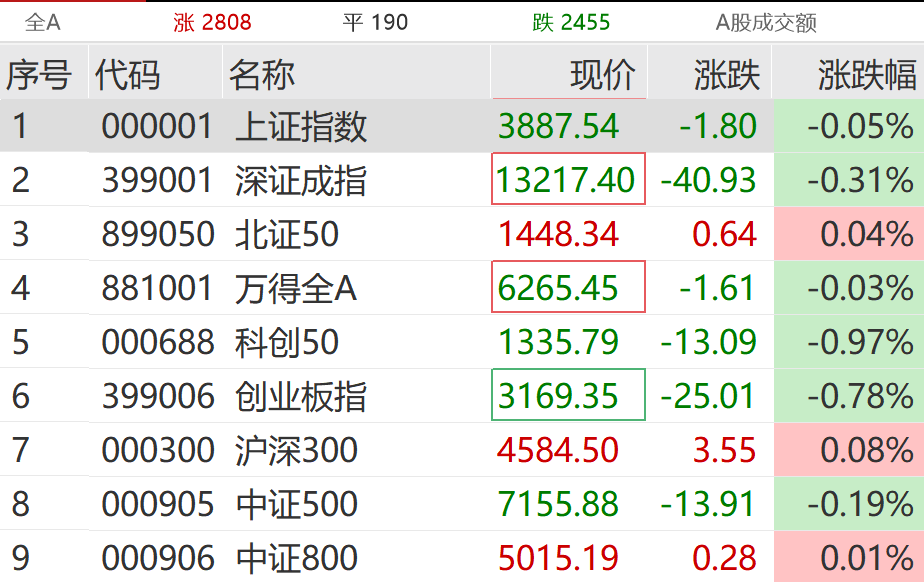
Group 1 - The stock private equity position index has reached a new high of 81.13% as of November 14, marking a significant increase of 1.05% from the previous week and achieving a peak not seen in 112 weeks [1] - The increase in private equity positions is primarily driven by a heightened willingness among medium-position private equity firms to increase their holdings, with full-position private equity now accounting for 65.90% [1] - The distribution of stock private equity positions varies by scale, with firms managing over 100 billion yuan showing a position index of 87.07%, indicating a strong trend among larger firms to increase their investments [1] Group 2 - Over 73.41% of large-cap stock private equity firms have moved to full positions, while the proportion of medium-position firms has decreased to 18.47%, indicating a significant shift towards full investment [2] - As of November 17, the total number of registered private equity securities investment funds has reached 10,608, reflecting a year-on-year growth of 100.76%, with stock strategies being the dominant approach [2] - Recent market fluctuations, including a 2.45% drop in the Shanghai Composite Index, are attributed to liquidity concerns stemming from the Federal Reserve's interest rate policies, presenting a potential opportunity for increased investment amid market uncertainty [2]
锌:结构≠方向
Xin Lang Cai Jing· 2025-11-17 11:45
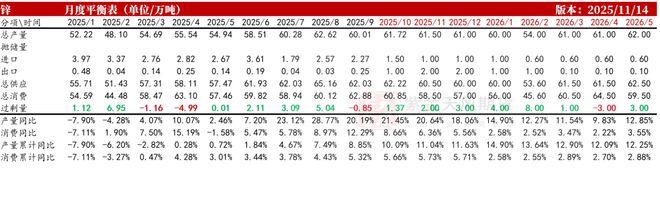
Group 1 - The core viewpoint indicates that the domestic smelting plants have limited production cuts this year, leading to persistent oversupply expectations, while seasonal demand is significantly declining, resulting in passive inventory accumulation [1][2] - The supply side shows that despite high production from domestic smelting plants, there is a shortage in the mining sector, with expectations of significant production cuts in the first quarter of next year due to low processing fees and winter storage [1][2] - The macroeconomic environment is characterized by mixed signals, with the U.S. ending a government shutdown and injecting liquidity, but facing hawkish Federal Reserve signals and concerns over AI bubble risks affecting market sentiment [1] Group 2 - The monthly balance sheet indicates that total production is expected to fluctuate, with a projected output of 52.22 million tons in January 2025, decreasing to 48.10 million tons in February, and then gradually increasing [3] - The overall consumption is projected to be 54.59 million tons in January 2025, with a slight increase in subsequent months, indicating a potential recovery in demand [3] - The production and consumption year-on-year comparisons show a decline in production by 7.90% in January 2025, but a recovery in consumption by 1.90% in the same month [3] Group 3 - Recent data from Peru shows a 13% month-on-month decrease in zinc concentrate production for September 2025, while year-to-date production has increased by 17.5% [9] - Domestic zinc concentrate production in October was reported at 330,800 tons, reflecting a 5.18% month-on-month increase and a 12.33% year-on-year increase, slightly above expectations [9] - The import and export dynamics indicate a significant increase in imports, with September 2025 imports reaching 505,400 tons, a 24.94% year-on-year increase [12] Group 4 - The weekly operational rates for downstream zinc processing enterprises are at a historical low of 47.38%, indicating weak demand and passive inventory accumulation [25] - The weekly operating rate for galvanizing enterprises has increased to 57.59%, but overall demand remains subdued, limiting recovery [28] - The overall inventory levels for zinc ingots are high, with a reported total of 100,900 tons as of November 14, indicating continued accumulation despite seasonal demand pressures [44]
英伟达投资人,很不开心
半导体芯闻· 2025-08-29 10:12
Core Viewpoint - Nvidia's second-quarter earnings exceeded Wall Street expectations, with revenue reaching $46.74 billion, a 56% year-over-year increase, and earnings per share of $1.08, but the stock price fell due to unmet optimistic forecasts for data center revenue [2][4][5] Group 1: Financial Performance - Nvidia reported a significant revenue increase of 56% year-over-year, reaching $46.74 billion, and a gross margin improvement from 61% to 72.4% [2] - Despite strong overall performance, the data center revenue slightly missed expectations, leading to a stock price decline of over 3% in after-hours trading [2][3] - The company projected next quarter's revenue to be $54 billion, which fell short of some analysts' expectations of $63 billion, causing concerns among traders [2][5] Group 2: Market Sentiment and Investor Behavior - Investors are increasingly sensitive to any signs of demand slowdown in the AI sector, especially amid concerns about a potential financial bubble [4][5] - The market has become accustomed to "exceeding expectations," and any performance that does not meet the high standards is viewed negatively [3][6] - There is a noticeable shift in investor sentiment, with heightened scrutiny on even minor revenue misses and geopolitical challenges affecting market confidence [5][6] Group 3: AI Market Dynamics - Nvidia is seen as a bellwether for the AI market, with its performance closely watched by investors amid concerns about the sustainability of AI spending [4][5] - The CEO of Nvidia projected that global AI infrastructure spending could reach $3 trillion to $4 trillion by the end of the decade, indicating ongoing demand in the sector [5] - Despite the concerns, Nvidia's latest earnings report did not show any signs of spending slowdown in the AI field [5] Group 4: Geopolitical and Regulatory Challenges - Nvidia faced significant challenges in the Chinese market, with regulatory uncertainties leading to no reported revenue from this region in the latest earnings [7][8] - The company has been negotiating with the U.S. government regarding export licenses for its H20 chips to China, which could potentially generate $2 billion to $5 billion in revenue if restrictions are lifted [7] - Local Chinese chip companies are increasing competition, and Nvidia warned that without regulatory approval, it could be substantially excluded from the Chinese data center market [8][9]