AI To C

Search documents
阿里巴巴-W:坚定投入以抓住AI时代机遇-20260320
HTSC· 2026-03-20 05:45
证券研究报告 阿里巴巴-W (9988 HK/BABA US) 港股通 坚定投入以抓住 AI 时代机遇 华泰研究 季报点评 2026 年 3 月 20 日│中国香港/美国 阿里巴巴 3QFY26 总收入 2,848 亿元,同增 1.7%,逊于 VA 一致预期(下同) /华泰预测的同增 4.0/3.5%,主因 CMR 客户管理收入和国际数字商业集团收 入略逊于预期;经调整 EBITA 为 234 亿元,同比-57.3%,经调整 EBITA 利 润率 8.2%,逊于一致预期/华泰预期的 11.0%/8.9%。管理层在 3QFY26 业绩 会上(下同)表示公司处于面向未来的再次创业和关键投入阶段,目标是抓 住 AI Agent 时代带来的指数级市场机遇,商业目标为包含 MaaS 在内的云和 AI 商业化年度收入在五年后突破 1000 亿美元(外部客户收入),对应年化 CAGR 达 40%。尽管短期的坚定投入或给公司盈利表现造成一定波动,但阿 里作为国内 AI 基建的领头羊,我们认为其有望逐步将早期投入转化为利润成 果,推动阿里云利润率进一步向海外云厂商靠拢,稳态下或达到 20%水平。 建议持续关注阿里云收入增速及利 ...

百度的窄门:当AI To C需要超级入口
3 6 Ke· 2026-02-06 12:53
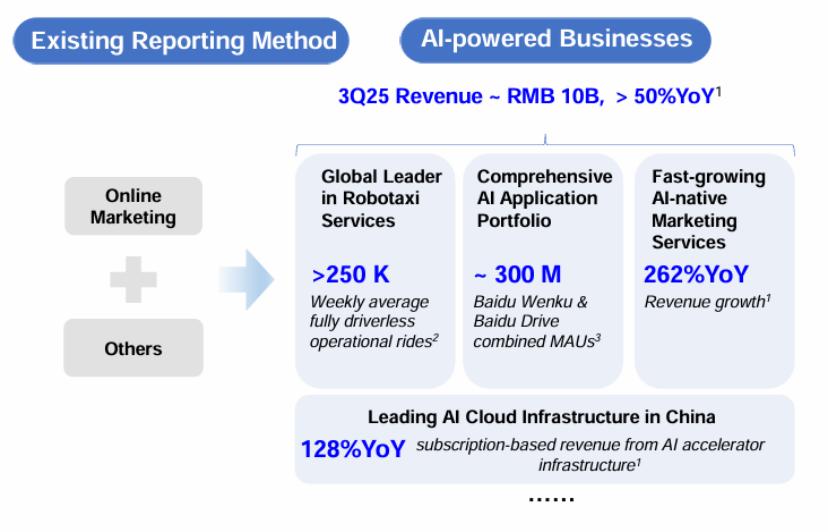
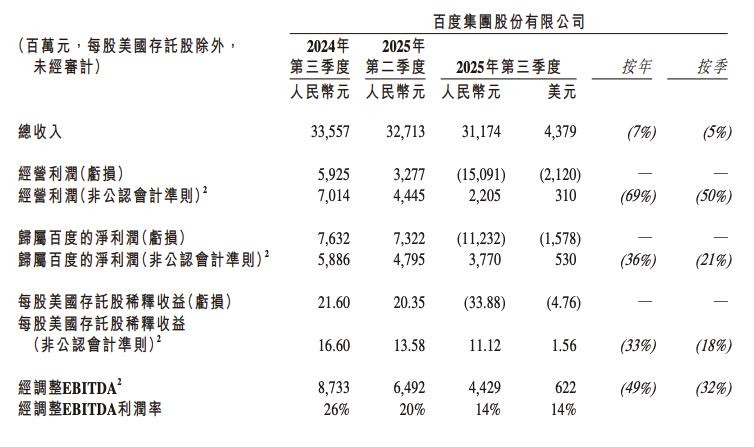
Core Insights - Baidu is facing significant pressure as its core online marketing revenue dropped by 18% in Q3 2025, while new business segments like AI, cloud, and autonomous driving are growing but not enough to create a reliable growth curve [1][2] - The establishment of the Personal Super Intelligent Group (PSIG) aims to integrate key AI assets like Baidu Wenku (Baidu Library) and Baidu Wangpan (Baidu Cloud) to enhance their commercial potential and address growth bottlenecks [1][3] Business Performance - AI cloud revenue reached 6.2 billion yuan, a 21% year-on-year increase, while AI application revenue was 2.6 billion yuan, accounting for over 25% of AI-driven business [5][8] - Baidu Wenku and Baidu Wangpan combined have approximately 300 million monthly active users, with Wenku's AI features achieving a 60% year-on-year growth in paid users [5][8] - AI native marketing services generated 2.8 billion yuan, a 262% increase year-on-year, now representing 18% of Baidu's core online marketing revenue, up from 4% a year ago [5][8] Strategic Developments - The integration of Baidu Wenku and Baidu Wangpan is expected to create a synergistic effect, enhancing user engagement and monetization through AI capabilities [9][10] - The launch of the Cangzhou OS and GenFlow tools indicates a strategic shift towards creating a comprehensive content operation system that enhances user productivity [9][10] - The PSIG's leadership under Wang Ying is seen as a strategic move to leverage the successful performance of Wenku and Wangpan, focusing on long-term growth potential [12][18] Competitive Landscape - Baidu's ambition to establish an "AI super entrance" faces challenges due to structural disadvantages compared to competitors like Tencent and Alibaba, which have more integrated ecosystems [19][23] - The lack of a robust transaction ecosystem and social engagement limits Baidu's ability to capture user behavior effectively, making it difficult to establish a "national-level entrance" in the AI To C market [23][25] - Baidu's AI journey has been complicated by missed opportunities in the mobile internet era, leading to a need for a balanced approach between B2B and B2C strategies [26][27]


阿里多业务春节前赶工,要到千问App上“包饺子”
经济观察报· 2026-02-02 13:20
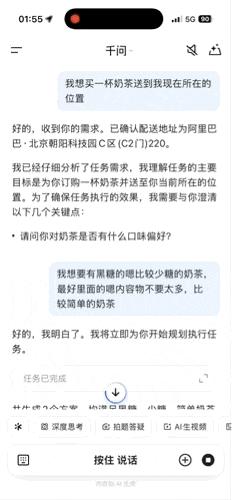
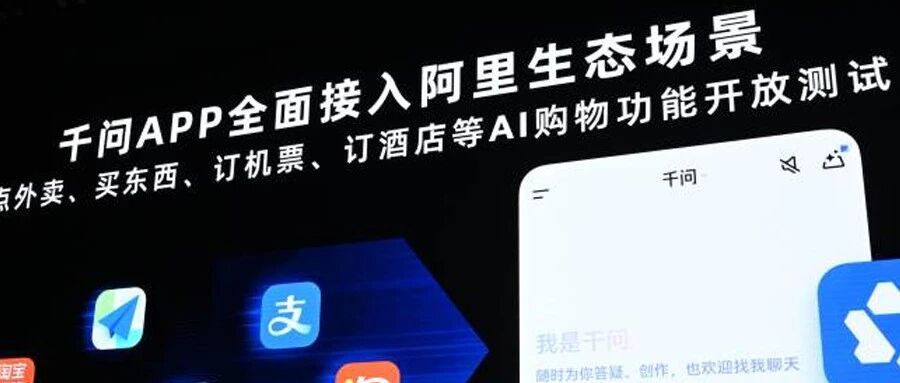
各业务要融入千问,除了技术上须解决秒付等交易支付通路, 更深层的问题是阿里内部能否统一业务规则。尤其是如果千问 App负责交互层与流量入口,其他生态业务变成提供数据与供 应链支持的一方,那集团内部将如何考核各业务的交易流水、 用户增长以及活跃度等。 作者:钱玉娟 封图:图虫创意 2月2日,阿里巴巴旗下AI应用千问App宣布投入30亿元,启动"春节请客计划",将联合淘宝、飞 猪、大麦、盒马、闪购、高德等阿里生态业务,服务并拓展用户。 从2月6日开始,用户在千问App发起需求,例如"AI购物""AI买电影票""AI订酒店"等,有机会抽 取大额现金红包,幸运者还能直接免单。 当日,经济观察报记者实测千问App,借助AI可以直接点咖啡、奶茶等外卖。不过如果用户想让AI 在淘宝买纸巾、高德上打车、飞猪上订酒店等,千问会以信息卡片的形式提供商品搜索、出行建 议、比价等服务,引导用户跳转至淘宝、高德、飞猪等完成结算。 一位接近千问App人士透露,千问内部正在对AI买电影票等功能进行灰度测试。届时用户在千问 App主对话页面,通过自然语言发出"想看电影"的指令后,AI助手就会自动调取大麦网数据,展示 附近影院排片、座位图及价 ...

阿里多业务春节前赶工,要到千问App上“包饺子”
Jing Ji Guan Cha Bao· 2026-02-02 13:05
经济观察报 记者 钱玉娟 2月2日,阿里巴巴旗下AI应用千问App宣布投入30亿元,启动"春节请客计划",将联合淘宝、飞猪、大 麦、盒马、闪购、高德等阿里生态业务,服务并拓展用户。 从2月6日开始,用户在千问App发起需求,例如"AI购物""AI买电影票""AI订酒店"等,有机会抽取大额 现金红包,幸运者还能直接免单。 当日,经济观察报记者实测千问App,借助AI可以直接点咖啡、奶茶等外卖。不过如果用户想让AI在淘 宝买纸巾、高德上打车、飞猪上订酒店等,千问会以信息卡片的形式提供商品搜索、出行建议、比价等 服务,引导用户跳转至淘宝、高德、飞猪等完成结算。 一位接近千问App人士透露,千问内部正在对AI买电影票等功能进行灰度测试。届时用户在千问App主 对话页面,通过自然语言发出"想看电影"的指令后,AI助手就会自动调取大麦网数据,展示附近影院排 片、座位图及价格。用户在千问端内就能完成选片、选座、支付全流程,无需跳转至外部应用。 "上层应用团队一直在封闭开发。"上述千问App产品经理称,AI应用从信息交互向交易闭环延伸,需要 阿里巴巴旗下多个独立生态业务的配合。他在阿里巴巴杭州西溪园区C区的封闭区内,不常见到 ...

百度成立PSIG事业群组,副总裁王颖挂帅,向李彦宏汇报
3 6 Ke· 2026-01-29 04:18
此次调整后,百度也将正式进入四大事业群组时代,分别是移动生态事业群组(MEG)、智能云事业群组(ACG)、智能驾驶事业群组(IDG)和新成 立的个人超级智能事业群组(PSIG)。 实际上,王颖也是文库事业部和网盘事业部的原负责人,这两个事业部原归属于移动生态事业群组(MEG)。 百度加速打造AI时代新增长引擎。 近日,据《财经》报道,百度已于近期正式成立个人超级智能事业群组(PSIG,personal super intelligence business group),该群组由百度网盘、百度文 库整合而来,由百度副总裁王颖挂帅,并直接向百度董事长兼CEO李彦宏汇报。 《节点AI》认为,此次百度将文库、网盘事业部单独组建为全新的PSIG事业群组,意味着百度看到了AI时代个人智能服务领域的增长机会,通过快速的 组织调整,进一步增加这两项业务的造血能力,成为百度新的增长曲线。 PSIG,百度AI To C的新武器 百度传统的两大优势业务信息流和搜索广告正面临着重重压力。 百度2025年三季度财报电话会披露的核心数据,百度网盘与百度文库合计月活跃用户(MAU)接近3亿,构成了庞大的用户基本盘。2025年11月百度文 ...
千问诞生后,负责人吴嘉首次回应15个关键问题
3 6 Ke· 2026-01-16 02:30
Core Insights - The AI assistant market is shifting from chat-based interactions to agent-based functionalities, marking a new phase in competition among major tech companies [1][2][11] - Alibaba's AI assistant, Qianwen, aims to integrate various services within its ecosystem, enhancing user experience and operational efficiency [3][4][10] Group 1: Product Development and Features - Qianwen has achieved over 100 million monthly active users within two months of launch, showcasing rapid adoption [4] - The latest version, Qianwen 6.0, includes over 400 new features and integrates with multiple Alibaba services such as Taobao and Alipay [4][6] - The assistant focuses on practical applications in daily life, such as ordering food and managing administrative tasks, aiming for a seamless user experience [6][8][10] Group 2: Strategic Positioning - Qianwen is positioned as a more personalized AI assistant compared to Quark, which serves as an AI browser and search tool [31][32] - The integration of Qianwen with Alibaba's extensive ecosystem allows it to leverage high-frequency services, enhancing its competitive edge [10][12] - The company emphasizes the importance of user satisfaction and innovative experiences over mere user growth metrics [42] Group 3: Competitive Landscape - The AI assistant market is becoming increasingly competitive, with major players like Google and OpenAI focusing on different service integrations [10][48] - Alibaba's strategy involves not just competing on technology but also on effectively utilizing its vast resources and ecosystem to deliver superior AI capabilities [11][48] - The future of AI assistants will likely see a consolidation of services, with fewer but more capable platforms emerging [52][53]
千问诞生后,负责人吴嘉首次回应15个关键问题
36氪· 2026-01-15 23:55
Core Insights - The article discusses Alibaba's strategic shift towards AI with the launch of its AI assistant, Qianwen, emphasizing the need for a significant victory in the competitive landscape of AI tools [4][10][21]. Group 1: Product Development and Features - Qianwen has achieved over 100 million monthly active users within two months of its launch, showcasing rapid adoption [8]. - The latest version, Qianwen 6.0, integrates multiple Alibaba services such as Taobao, Alipay, and Fliggy, enhancing its functionality [9]. - The AI assistant aims to streamline tasks across various scenarios, including shopping and administrative functions, with a focus on efficiency and user experience [17][18]. Group 2: Competitive Landscape - The AI assistant market is evolving, with major players like ByteDance and Tencent also competing for dominance [10][20]. - Alibaba's approach differs from international competitors by leveraging its extensive ecosystem, which includes e-commerce, payment, and navigation services [20][21]. - The competition is not just about technology but also about effectively integrating diverse business resources into a cohesive AI assistant [22][23]. Group 3: Future Plans and Strategy - Alibaba plans to continue enhancing Qianwen's capabilities by integrating more of its ecosystem and focusing on high-frequency user needs [26][37]. - The company aims to balance between AI's generative capabilities and precise task execution, ensuring user satisfaction remains a priority [29][33]. - Future updates will focus on personalization and expanding the assistant's operational boundaries, particularly in office and educational settings [27][45]. Group 4: User Experience and Engagement - Qianwen's design philosophy emphasizes a conversational approach, allowing users to interact naturally, similar to human communication [50][51]. - The assistant is expected to evolve based on user feedback and engagement, with a focus on enhancing the overall experience rather than merely increasing interaction frequency [34][36]. - The integration of user preferences and context will play a crucial role in future developments, aiming for a more tailored user experience [48][79].
千问一周破千万,阿里敲开“AI时代终极入口”之门
第一财经· 2025-11-24 12:36
Core Viewpoint - Alibaba's AI assistant Qianwen App has achieved over 10 million downloads within a week of its public release, surpassing competitors like ChatGPT, marking it as the fastest-growing AI application in history [1][3] Group 1: Strategic Importance - The rapid growth of Qianwen reflects Alibaba's progress in its AI To C strategy, which is seen as a critical move in the "future battle of the AI era" [3] - Alibaba aims to capture the "super entrance" of the AI era, leveraging its open-source models and technology to innovate and connect within the application ecosystem [3][4] - The international version of Qianwen App is set to launch soon, aiming to compete directly with ChatGPT for global users [3] Group 2: Financial Performance - Alibaba's stock price has surged by 91.5% in Hong Kong and 83% in the US this year, driven by advancements in AI and the success of the Qianwen App [3] Group 3: Model Development - Since its full open-source release in 2023, the Qwen model has achieved over 600 million downloads globally, with the flagship Qwen3-Max model outperforming top international models like GPT-4 and Claude 3 Opus [4][5] - Alibaba has open-sourced over 300 models, creating a significant impact in the AI landscape and demonstrating the success of its open-source strategy through Qianwen [5] Group 4: Application and Ecosystem - Qianwen aims to be a personal AI assistant capable of performing complex tasks, such as generating presentations and translating labels, while integrating various life scenarios like maps and food delivery [5][6] - The competition in AI applications is shifting towards user experience and ecological value, with Qianwen potentially marking a new phase in China's AI application landscape [6] Group 5: Future Outlook - Questions remain about how Qianwen will expand its capabilities and deepen its integration with Alibaba's business, as the company invests 380 billion in AI infrastructure [7] - Alibaba's AI strategy is evolving from mere technical competition to integrating general artificial intelligence into business practices, positioning itself strategically in the global tech landscape [7]
阿里官宣“千问”C端之战
Jing Ji Guan Cha Bao· 2025-11-17 04:29
Core Insights - Alibaba officially launched the "Qianwen" project on November 17, aiming to enter the AI to C market and compete directly with ChatGPT, marking its entry into the global AI application race [1][2] - According to McKinsey, the global AI to C market is projected to reach $1.3 trillion by 2030, with an annual growth rate exceeding 35%, making it a critical area for technology companies [4][5] Group 1: Project Launch and Features - The Qianwen app is now available for free, designed to serve as a personal AI assistant capable of engaging in conversations and performing tasks for users across various life scenarios such as work, navigation, health, and shopping [2][3] - The app's public beta version has been launched on major app stores, with web and PC versions also available, reflecting Alibaba's ambition to establish a strong presence in the AI consumer market [2][3] Group 2: Strategic Positioning and Market Insights - Alibaba has previously invested 380 billion yuan in AI infrastructure and aims to increase its cloud data center energy efficiency tenfold by 2032, indicating a long-term commitment to AI development [2][4] - The company has shifted focus from B2B to B2C AI markets, recognizing the importance of consumer data for technological advancement and competitive positioning [4][5] Group 3: Competitive Landscape - The international version of the Qianwen app is under development, utilizing the Qwen model to compete with ChatGPT for overseas users, employing a dual strategy of "open source + closed source" to build technological barriers [3][4] - Alibaba's Qwen model has achieved significant recognition, with over 600 million downloads and more than 170,000 derivative models, establishing it as a leading open-source model globally [3][4] Group 4: Market Share and Future Outlook - In the first half of 2025, Alibaba is projected to hold a 17.7% share of the enterprise-level large model market in China, and a 35.8% share of the AI cloud market, surpassing the combined share of its closest competitors [4][5] - Industry experts predict that the C-end market could potentially be ten times larger than the B-end market, emphasizing the necessity for Alibaba to expand its consumer-facing AI services [4][5]
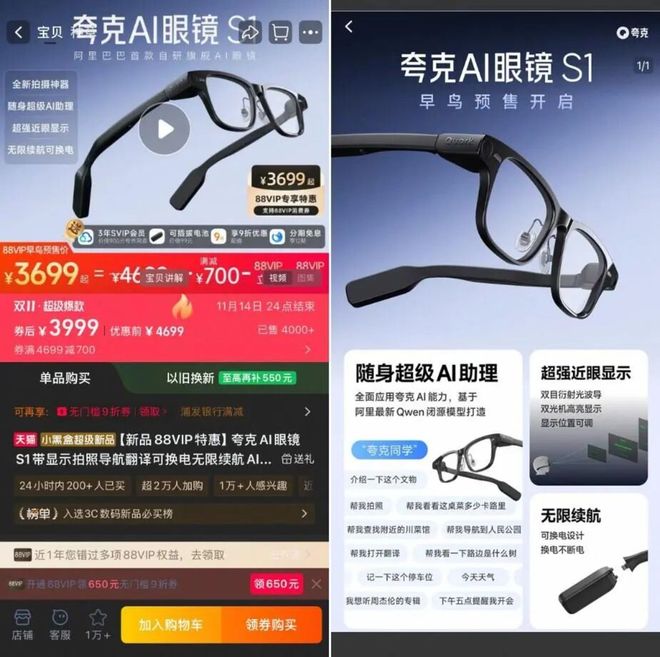
夸克 AI 眼镜成阿里 AI To C 船票,马云看走眼了吗?
Tai Mei Ti A P P· 2025-11-04 05:09
Core Insights - The article highlights the growing consensus in the industry that embracing AI is no longer optional, as exemplified by Nvidia's soaring market value and Alibaba's proactive AI strategy [1][2] - Alibaba's Quark is positioned as a key player in the "AI to C" strategy, with significant investments and product launches aimed at integrating AI into consumer applications [3][4] Alibaba's AI Strategy - Alibaba plans to invest 380 billion yuan in AI infrastructure over the next three years, with CEO Wu Yongming emphasizing the importance of large models as the next-generation operating system [1][2] - The Quark AI glasses, priced starting at 3,999 yuan, represent a significant hardware initiative for Alibaba, showcasing its commitment to integrating AI with consumer technology [3][4][5] Quark AI Glasses - The Quark AI glasses feature advanced specifications, including dual Micro-LED displays and a Qualcomm Snapdragon AR1 processor, aimed at enhancing user experience [4][5] - The glasses support various applications such as real-time translation and navigation, leveraging the Qwen closed-source model for improved functionality [5][7] Market Position and Competition - Quark's pricing is higher than competitors like Rokid Glasses, which may impact its market penetration despite being the first to combine self-developed models with proprietary hardware [7][8] - The AI glasses market is projected to grow significantly, with an expected shipment of over 2 million units in 2025, indicating a competitive landscape [7][8] Quark App Dynamics - The Quark App serves as a critical interface for consumers, but it faces challenges in defining its role amidst competition from other AI applications [9][10] - The app has integrated an AI assistant feature, enhancing its functionality and user engagement, but still struggles with market visibility compared to competitors [10][12] User Engagement and Growth - Quark's monthly active users (MAU) are approximately 96.1 million, significantly lower than leading competitors, indicating a need for improved market strategies [17][18] - The company has invested over 1 billion yuan in user acquisition, reflecting its aggressive approach to grow its user base [18][20] Future Outlook - Alibaba's ambition to transform into an AI-driven enterprise hinges on the success of Quark and its ability to attract a stable consumer base beyond e-commerce [21] - The performance of the Quark AI glasses may serve as a pivotal factor in determining the future trajectory of Alibaba's AI initiatives [21]