
互联网和相关服务业

Search documents
锐财经|促进有效投资,更多举措落地
Ren Min Ri Bao Hai Wai Ban· 2026-02-10 06:31
Group 1 - The State Council's recent meeting emphasized the need to innovate and improve policies to promote effective investment, utilizing various financial tools such as central budget investments, ultra-long-term special bonds, and local government special bonds [1] - A series of policy measures aimed at promoting effective investment have been implemented, which are expected to stabilize investment and enhance its role in expanding domestic demand, optimizing supply, and benefiting people's livelihoods [1] Group 2 - In 2025, national fixed asset investment (excluding rural households) reached 48,518.6 billion yuan, a decrease of 3.8% from the previous year, indicating downward pressure on fixed asset investment due to local government debt and economic transition factors [2] - Investment in key sectors showed faster growth, with industrial investment increasing by 2.6%, contributing 0.9 percentage points to overall investment growth [2] Group 3 - In infrastructure investment, pipeline transportation investment grew by 36.0%, internet and related services investment increased by 23.8%, and multimodal transport and agency services investment rose by 22.9% in 2025 [3] - Private investment in infrastructure grew by 1.7%, accounting for 21.0% of total infrastructure investment, with significant growth in water management and road transport sectors [3] Group 4 - Equipment and tool purchase investment increased by 11.8% in 2025, contributing 1.8 percentage points to overall investment growth, with a focus on supporting over 8,400 equipment renewal projects through ultra-long-term special bonds [4] - The first batch of 936 billion yuan in ultra-long-term special bonds for 2026 has been allocated to support approximately 4,500 projects across various sectors, driving total investment exceeding 460 billion yuan [4] Group 5 - The National Development and Reform Commission (NDRC) is optimizing the implementation of "two new" policies to support equipment renewal by lowering investment thresholds and enhancing project review standards [5] - The NDRC aims to strengthen the management of equipment renewal projects and improve the efficiency of fund utilization through better coordination and monitoring [5] Group 6 - The NDRC highlighted the importance of effective government investment to avoid inefficient and redundant construction, focusing on improving project quality and maturity for central budget investments and special bonds [7] - The recent fiscal and financial policies aim to stimulate private investment, with measures including credit support, interest subsidies, and guarantees to lower financing costs and barriers for private enterprises [8]
促进有效投资,更多举措落地
Ren Min Ri Bao Hai Wai Ban· 2026-02-10 03:56
Group 1 - The core viewpoint of the article emphasizes the need for innovative and effective investment policies to stabilize and promote investment, particularly through the use of central budget investments, special bonds, and new policy financial tools [2][7]. - In 2025, national fixed asset investment (excluding rural households) reached 48,518.6 billion yuan, a decrease of 3.8% from the previous year, indicating downward pressure on fixed asset investment due to various factors [3]. - Key sectors such as industrial investment grew by 2.6%, contributing 0.9 percentage points to overall investment growth, with significant increases in electricity, heat, gas, and water supply sectors, which saw a 9.1% increase [3][4]. Group 2 - Infrastructure investment in key areas showed robust growth, with pipeline transportation investment increasing by 36.0% and internet-related services growing by 23.8% in 2025 [4]. - Equipment and tool purchase investment rose by 11.8%, contributing 1.8 percentage points to total investment growth, with a focus on supporting over 8,400 equipment renewal projects through special bonds [5][6]. - The government aims to enhance the effectiveness of investment by optimizing the structure of government investments, particularly in social welfare projects, and by utilizing new policy financial tools to stimulate private investment [8].

加力提效用好相关资金和新型政策性金融工具——促进有效投资,更多举措落地
Sou Hu Cai Jing· 2026-02-10 01:20
Core Viewpoint - The recent State Council meeting emphasized the need to innovate and improve policy measures to promote effective investment, aiming to stabilize investment and enhance its role in expanding domestic demand, optimizing supply, and benefiting people's livelihoods [3]. Investment Trends - In 2025, China's fixed asset investment (excluding rural households) reached 48,518.6 billion yuan, a decrease of 3.8% from the previous year, indicating downward pressure on investment due to local government debt and economic transition factors [4]. - Key sectors showed rapid investment growth, with industrial investment increasing by 2.6%, contributing 0.9 percentage points to overall investment growth [4]. - Infrastructure investment in key areas saw significant increases, such as pipeline transportation investment growing by 36.0% and internet-related services investment increasing by 23.8% [5]. Equipment Investment - Equipment and tool purchase investment rose by 11.8% in 2025, contributing 1.8 percentage points to total investment growth, with a focus on supporting over 8,400 equipment renewal projects through special bonds [6]. - The government plans to continue large-scale equipment renewal policies into 2026, with an initial allocation of 93.6 billion yuan in special bonds for various sectors [7]. Government Investment Strategy - The State Council meeting highlighted the importance of precise government investment to avoid inefficient and redundant construction, emphasizing the need for high-quality project planning and collaboration between investment, fiscal, and financial policies [8]. - The government aims to enhance support for private investment through a comprehensive policy package, addressing financing costs and barriers for private enterprises [9]. - The focus will be on increasing government investment in livelihood projects and utilizing new policy financial tools to attract more private and social capital [9].
促进有效投资,更多举措落地(锐财经)
Ren Min Ri Bao Hai Wai Ban· 2026-02-09 22:48
Group 1 - The core viewpoint of the article emphasizes the need for innovative and effective investment policies to stabilize and promote investment growth in China, particularly through the use of central budget investments, special bonds, and new financial tools [2][7] - The State Council's recent meeting highlighted the importance of optimizing government investment to avoid inefficient and redundant construction, focusing on improving project quality and readiness [7][8] - The article notes that private investment is crucial for economic growth, with new policies aimed at reducing financing costs and barriers for private enterprises [8] Group 2 - In 2025, China's fixed asset investment (excluding rural households) was reported at 48.5186 trillion yuan, a decrease of 3.8% from the previous year, indicating downward pressure on investment [3] - Industrial investment grew by 2.6% in 2025, contributing 0.9 percentage points to overall investment growth, with significant increases in sectors such as electricity and water supply [3][4] - Infrastructure investment in key areas showed rapid growth, with pipeline transportation investment increasing by 36.0% and internet services by 23.8% in 2025 [4] Group 3 - Equipment and tool investment saw an 11.8% increase in 2025, contributing 1.8 percentage points to total investment growth, highlighting its importance in driving overall investment [5][6] - The government plans to support approximately 8,400 equipment renewal projects with over 1 trillion yuan in total investment, indicating a strong push for modernization [6] - The implementation of policies to lower investment thresholds and enhance project management is aimed at improving the efficiency of equipment renewal projects [6]
人民日报头版头条:广东力促服务业优质高效发展
2 1 Shi Ji Jing Ji Bao Dao· 2026-02-07 07:31
Core Viewpoint - Guangdong Province is actively promoting the high-quality and efficient development of the service industry, with a target of achieving a 4.7% year-on-year growth in service industry added value by 2025, an increase of 1.9 percentage points compared to the previous year [1] Group 1: Service Industry Growth - The internet and related services are projected to grow by 12.2%, while the software and information technology service sectors are expected to see a growth of 9.5% by 2025 [1] - The service industry in Guangdong is supported by nine trillion-yuan industrial clusters and 18 Fortune Global 500 companies, which significantly bolster the development of productive services [1] Group 2: Market Scale and Consumer Spending - Guangdong has over 19 million registered business entities and a real-time population of 150 million, providing a substantial market scale that lays a solid foundation for the high-quality development of the life service industry [1] - By 2025, the total retail sales of consumer goods in Guangdong are expected to reach 4.6 trillion yuan, indicating a strong consumer market [1]
成形起势提质效
Xin Lang Cai Jing· 2026-01-25 21:22
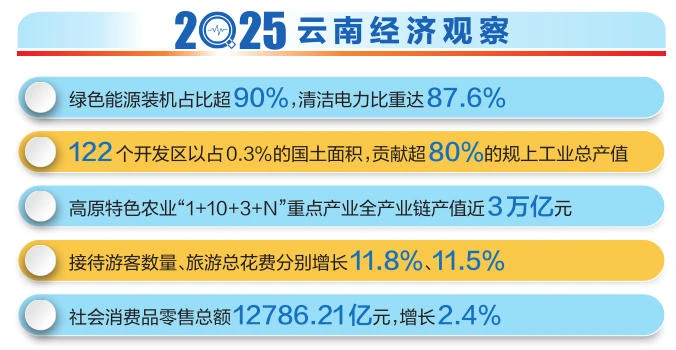
Core Viewpoint - The economic development of Yunnan is projected to achieve a GDP of over 3.27 trillion yuan with a growth rate of 4.1% by 2025, emphasizing structural optimization and quality improvement in development [3]. Investment and Economic Structure - Yunnan's investment strategy has shifted towards precision, focusing on key sectors rather than widespread investment, with over 10,000 major industrial projects initiated and nearly 1 trillion yuan invested [4]. - The proportion of industrial investment in total investment continues to rise, with private investment becoming increasingly active [4]. - The non-ferrous metal mining industry is expected to see a 20.8% increase in investment, with aluminum smelting and processing investments growing by 16.1% and 7.9% respectively [4]. Business Environment and Growth - Yunnan has made significant strides in improving the business environment, resulting in a 1.7% year-on-year increase in the number of operating entities, totaling 6.878 million, with a 3.8% increase in the number of enterprises [5]. - The province has implemented various measures to reduce institutional transaction costs and stimulate internal motivation, enhancing administrative efficiency [5][6]. Economic Pillars and Strategic Layout - Yunnan's economic structure is supported by three main pillars: resource economy, park economy, and port economy, which are crucial for high-quality development [7]. - The province's green energy capacity exceeds 90%, with clean electricity accounting for 87.6%, attracting industries due to its low carbon emissions [7]. - The agricultural sector has developed a comprehensive industry chain with a total output value nearing 3 trillion yuan, focusing on highland specialty products [7]. Tourism and Consumption - Yunnan's tourism sector is experiencing significant growth, with a projected 11.8% increase in tourist numbers and a 11.5% rise in total tourism expenditure by 2025 [9]. - The province's consumption market is also evolving, with a total retail sales of consumer goods reaching 12.786 trillion yuan, reflecting a 2.4% year-on-year growth [10]. - Rural consumption is growing at a rate of 3.1%, outpacing urban growth, indicating a broader release of domestic demand potential [10].
高技术制造业引领经济增长,湖北2025年GDP站稳6万亿元台阶
Chang Jiang Ri Bao· 2026-01-24 00:56
Economic Overview - In 2025, Hubei Province achieved a GDP of 62,660.90 billion yuan, growing by 5.5% year-on-year at constant prices [1] - The primary industry added value was 5,380.66 billion yuan, growing by 3.5%; the secondary industry added value was 21,865.90 billion yuan, growing by 5.1%; and the tertiary industry added value was 35,414.34 billion yuan, growing by 6.0% [1] Growth Drivers - High-tech manufacturing led economic growth with an added value increase of 15.5%, contributing 35.6% to the growth of industrial enterprises above designated size [2] - Key products in high-tech sectors saw significant production increases: new energy vehicles (33.3%), complete computers (46.0%), integrated circuit wafers (21.9%), lithium-ion batteries (18.8%), and smartphones (16.5%) [2] - Domestic and foreign demand worked in tandem, with total retail sales of consumer goods growing by 2.7% and online retail sales increasing by 9.6% [2] Employment and Income - In 2025, urban employment increased by 939,100, and per capita disposable income reached 38,881 yuan, growing by 5.2% [2] - The Consumer Price Index (CPI) rose by 0.1% year-on-year, indicating stable inflation [2] Future Outlook - The provincial statistics bureau emphasized the need for steady progress, quality improvement, and expansion of domestic demand to achieve effective qualitative and reasonable quantitative growth in the upcoming "15th Five-Year Plan" [3]
中经评论:10万亿千瓦时的信心与动力
Jing Ji Ri Bao· 2026-01-22 00:10
Group 1 - The core point of the article highlights that in 2025, China's total electricity consumption will exceed 10 trillion kilowatt-hours for the first time, reaching 10.4 trillion kilowatt-hours, marking a 5% year-on-year increase, and solidifying China's position as the world's largest electricity consumer [1][2][3] - This electricity consumption level is approximately double that of China's total consumption in 2015 and more than double that of the United States, surpassing the combined annual consumption of the EU, Russia, India, and Japan [1][2] - The growth in electricity demand reflects the robust vitality and quality of China's economy, driven by industrial activities and residential needs, with a significant contribution from high-end manufacturing and emerging technologies [2][3] Group 2 - The increase in electricity consumption is achieved alongside a continuous decline in energy consumption per unit of GDP, indicating more efficient production and higher quality development outcomes [2] - The optimization of industrial structure is evident, with high-end manufacturing sectors such as new energy vehicles and wind power equipment experiencing growth rates exceeding 20% and 30%, respectively [2] - The rapid development of the digital economy and new technologies has led to a surge in electricity demand, particularly in sectors like internet services and charging infrastructure, with year-on-year growth rates exceeding 30% and nearly 50% respectively [2][3] Group 3 - The article emphasizes that the growth in electricity demand does not exacerbate reliance on fossil fuels, as non-fossil energy sources account for over 60% of installed capacity, with wind and solar power leading globally [3] - The trend of decoupling electricity consumption growth from carbon emissions is becoming apparent, with one-third of electricity consumption being green energy [3] - The construction of a new power system is addressing challenges related to the integration of renewable energy sources, supporting China's commitment to carbon neutrality [3] Group 4 - The substantial electricity demand poses challenges for the planning, construction, scheduling, and supply capabilities of the power system, necessitating a robust national energy production and transmission network [4] - Despite the progress, disparities in per capita electricity consumption and regional differences remain, indicating ongoing challenges in achieving balanced development [4] - The article stresses the importance of technological empowerment in addressing these challenges, including advancements in clean energy technologies, energy storage, and smart grid innovations [4]
10万亿千瓦时的信心与动力
Xin Lang Cai Jing· 2026-01-21 22:38
Core Insights - In 2025, China's total electricity consumption is projected to exceed 10 trillion kilowatt-hours for the first time, reaching 10.4 trillion kilowatt-hours, marking a 5% year-on-year increase, solidifying China's position as the world's largest electricity consumer [2][3] - This significant electricity demand reflects the robust growth of China's economy, industrial activities, and the increasing energy needs of its population, showcasing the country's manufacturing strength and market potential [3][4] Electricity Demand and Economic Growth - The electricity consumption growth is achieved alongside a decline in energy consumption per unit of GDP, indicating more efficient production and higher quality development outcomes [3] - The optimization of industrial structure is evident, with high-end manufacturing sectors such as new energy vehicles and wind power equipment experiencing growth rates exceeding 20% and 30% respectively [3] - The rapid development of the digital economy and emerging technologies has led to a surge in electricity demand, particularly in new infrastructure like charging stations and 5G base stations, with related sectors seeing over 30% growth in electricity consumption [3] Green Energy Transition - Concerns about increased fossil fuel dependency due to rising electricity demand have been addressed, as non-fossil energy sources now account for over 60% of installed capacity, with wind and solar power leading globally [4] - One-third of the total electricity consumed is now green energy, indicating a decoupling trend between electricity consumption growth and carbon emissions [4] Social and Economic Implications - Urban and rural residential electricity consumption is projected to grow by 6.3%, with the tertiary sector and residential use contributing to 50% of the overall electricity consumption increase [4] - Continuous upgrades to rural power grids and the proliferation of household appliances are enhancing the quality of life, while new electricity demands from electric vehicles and smart homes are emerging [4] Challenges and Technological Empowerment - The substantial electricity demand poses challenges for the planning, construction, scheduling, and supply capabilities of the electricity system [5] - A national energy production and transmission network has been established to ensure stable and reliable electricity supply, which is crucial for optimizing the business environment and supporting industrial supply chains [5] - Addressing the imbalances in electricity consumption across regions and ensuring the electricity system meets the dual carbon goals while maintaining supply and economic efficiency remains a long-term challenge [5] - Technological advancements in clean energy, energy storage, smart grids, and energy pricing mechanisms are essential for optimizing energy resource allocation nationwide [5]
投资结构不断优化
Jing Ji Ri Bao· 2026-01-19 22:23
Group 1 - In 2025, fixed asset investment (excluding farmers) reached 48,518.6 billion yuan, driven by large-scale equipment upgrades and the replacement of consumer goods [1] - Industrial investment grew by 2.6% year-on-year, contributing 0.9 percentage points to overall investment growth, with mining investment up by 2.5%, manufacturing investment up by 0.6%, and electricity, heat, gas, and water production and supply investment up by 9.1% [1] - Infrastructure investment in key areas saw significant growth, with pipeline transportation investment increasing by 36.0%, internet and related services investment up by 23.8%, and multimodal transport and agency investment rising by 22.9% [1] Group 2 - Equipment and tool purchase investment grew by 11.8% year-on-year, contributing 1.8 percentage points to overall investment growth, and accounted for 18.0% of total investment, an increase of 2.5 percentage points from the previous year [1] - High-tech service industry investment increased by 3.5% year-on-year, representing 5.6% of total service industry investment, up by 0.6 percentage points from the previous year [2] Group 3 - Investment in forestry rose by 28.5%, fisheries investment increased by 12.4%, and investment in electricity and heat production and supply grew by 11.1% [3] - The investment in agricultural and sideline food processing increased by 9.2%, while wholesale and retail investment grew by 5.6%, and accommodation and catering investment rose by 5.5% [3]