美妆护肤

Search documents
从盲种到「精种」,阿里妈妈用AI打开更大增长空间
36氪· 2026-03-02 13:50
流量不涨了,增长怎么涨? 一场关于"精种"的开年答案。 在流量趋稳的春天 2026年伊始,迎来了一个AI与科技的暖春。 从另类的红包大战,到各类春晚的轮番呈现,各大平台的AI竞赛几乎成为节日期间的"第二主线"。与之对应的,搜索、对话、内容生成、健康服务、智能助 手……AI正以前所未有的速度渗入日常生活,悄然改变消费者的决策方式。 当消费侧已经明显加速,经营侧是否同步进化? 对于品牌来说,曾经的商业世界本质是流量赛跑。大促节点意味着资源集中、预算加码,声量与销量在短时间内被拉升。规模是最直观的指标,抢位是最常 见的策略。 然而在如今的大环境下,市场氛围早已悄然改变:品牌对"规模"的兴奋感在下降,对"效率"与"确定性"的焦虑在上升。 这与需求端的变化同步。消费者在内容平台种草,在搜索场景确认,在直播间完成临门一脚,路径越来越网状,预算却越来越克制。品牌开始意识到,单纯 扩大覆盖,很难带来稳定回报。 在这样的背景下,38节作为消费节点的意义被重新抬高。 它是春节后的第一场大促,也是全年经营节奏的起点。阿里妈妈此前披露过一组数据,38活动期间蓄水用户,在后续618中完成转化的比例极高,而618成交 用户中相当一部分来 ...



2025中国出海新锐消费品牌榜单报告-飞书点跃&益普索
飞书点跃&益普索· 2026-02-27 06:35
Investment Rating - The report does not explicitly state an investment rating for the industry Core Insights - The industry is transitioning from a "selling" model to a "branding" model, with supply chain stability, compliance capabilities, and AI applications becoming new thresholds for entry [6] - Consumer perception of Chinese brands is mixed, with 45% of global respondents reporting improved impressions and 61% including them in their top 5 preferences, although trust barriers remain, especially in high-risk categories [6] - The D-MES model reveals that leading brands are building systematic capabilities across digitalization, mental influence, product innovation, and commercialization, rather than relying solely on single hit products [6] - Categories are showing varied performance, with "powered" categories (consumer electronics, home appliances) accounting for nearly half, while scenario-based categories (sports and outdoor) are rising, and trend-based categories (beauty and fashion) are declining [6] - Emerging markets are becoming growth engines, with 80% of Latin American consumers and 73% of Middle Eastern and African consumers favoring Chinese brands, significantly higher than the 62% in the U.S. [6] - AI is deeply integrated into business operations, with leading brands achieving a 15% increase in click-through rates, a 10% increase in conversion rates, and a 30% reduction in defect rates through AI applications [6] Summary by Relevant Sections Research Background - The report is a collaboration between Meetsocial and Ipsos, leveraging diverse data sources including consumer surveys, e-commerce platform data, and social media sentiment [3] - The methodology includes the D-MES model, assessing brand capabilities across four dimensions [3] Scope and Boundaries - The focus is on consumer brands going global, particularly in sectors like consumer electronics, home appliances, personal care devices, sports and outdoor, beauty and skincare, fashion, and home goods [4][5] - The geographical analysis includes both mature markets (North America, Europe) and emerging markets (Latin America, Middle East and Africa, Southeast Asia) [5] Key Data Highlights - 45% of global respondents reported an improved impression of Chinese brands [9] - 61% of global respondents included Chinese brands in their top 5 preferences [9] - 80% of Latin American consumers favor Chinese brands [9] - 73% of Middle Eastern and African consumers favor Chinese brands [9] - Nearly 50% of top brands are in high-ticket categories like consumer electronics and home appliances [10] - A 30% reduction in defect rates was achieved through AI quality inspection [10]
招银国际:26年春节消费景气度符合预期 品类分化持续
Zhi Tong Cai Jing· 2026-02-26 08:01
Group 1: Tourism and Travel - The tourism sector shows resilience with long-distance travel and family-oriented trips as key trends, with 596 million domestic trips taken during the 2026 Spring Festival, generating a total expenditure of 803.48 billion yuan, reflecting a year-on-year increase of 5.7% in daily travel volume and 5.5% in daily spending [2] - Long-distance travel orders accounted for 59.6% of bookings, with an average travel duration of 6.4 days, an increase of 0.5 days year-on-year [2] - Domestic travel orders on the Fliggy platform increased by 80% year-on-year, with average booking amounts rising by approximately 10% [2] Group 2: Offline Consumption - Key retail and catering enterprises saw a daily sales increase of 5.7% compared to the same period in 2025, with a 1.6 percentage point acceleration from the previous year's growth rate [3] - Foot traffic and sales in 78 key pedestrian streets increased by 6.7% and 7.5% year-on-year, respectively, showing an acceleration compared to the 2025 National Day holiday [3] Group 3: Online Consumption - The performance of beauty and skincare brands during the Spring Festival was mixed, with total sales on Douyin ranging from 250 million to 378 million yuan, reflecting a year-on-year growth of about 12%, but a daily sales figure that remained nearly flat [4] - Notable brand performances included a 114.3% increase for Maogeping, driven by category expansion, and a 58.6% increase for Proya, attributed to strong brand performance [4] Group 4: Jewelry Sector - The jewelry sector experienced a decline in sales, with total sales dropping to a range of 260 million to 309 million yuan, a year-on-year decrease of 8.5%, primarily due to high sales bases from the previous year and fluctuating gold prices [5] - Brands like Chow Tai Fook and Luk Fook achieved good growth rates of 100% and 66.7%, respectively, while mass-market brands saw significant declines [5] Group 5: Investment Recommendations - The company maintains a positive outlook on service-oriented and emotional consumption, particularly in travel and beauty sectors, recommending attention to companies like Trip.com and Tongcheng [6] - In the beauty sector, companies with superior category matrix layouts, such as Ying Tong Holdings, are highlighted for potential investment [6]



春节消费观察:景气度符合预期,品类分化持续
Zhao Yin Guo Ji· 2026-02-26 03:46
2026 年 2 月 26 日 招银国际环球市场 | 策略报告 | 行业观察 春节消费观察 Market Strategy - 景气度符合预期,品类分化持续 马年春节期间,在为期九天的超长假期及节前九部委联合政策推动下,消费市 场得到一定提振。我们认为,整体趋势符合预期,结构上延续了物质消费与服 务消费分化、以"悦己"为代表的情绪型消费更具韧性等特征。从我们跟踪的 重点板块来看:1)旅游:整体旅游消费增长具备韧性且符合市场预期,"长途 游"和"家庭化"是关键词;2)线下消费:全国重点零售和餐饮企业日均销售 额及重点步行街(商圈)营业额增速环比及同比均有所提振;3)线上消费:由 于品牌在春节期间的营销投放力度显著弱于 618、双 11 等大型电商促销节点, 整体销售表现相对平淡。 线上消费:品牌营销投放力度显著弱于 618 和双 11,故销售表现平淡。 1)美妆护肤:根据蝉妈妈数据,2026 年春节假期期间,重点品牌在抖音 平台的合计销售额区间从去年的 2.12 亿-3.48 亿元上升至今年的 2.50 亿- 3.78 亿元,同比增速约为 12.0%(图 2);若以区间中位数计算日均销售 额,同比-0.4%,基 ...
确认是假货!涉及多个大牌
Xin Lang Cai Jing· 2026-02-14 07:13
Core Viewpoint - Estee Lauder has filed a lawsuit against Walmart, alleging the sale of counterfeit beauty products on its website and insufficient measures to ensure the sale of authorized and genuine products [1][2]. Group 1: Lawsuit Details - The lawsuit claims that Estee Lauder purchased and tested several products marked with its brands, including Le Labo, La Mer, Clinique, Aveda, and Tom Ford, which were confirmed to be counterfeit [1]. - Estee Lauder accuses Walmart of playing an active role in facilitating these sales, describing Walmart's actions as "extreme, egregious, fraudulent... despicable and harmful" [1]. - The lawsuit highlights that some products sold on Walmart's site have brand identifiers that are nearly indistinguishable from Estee Lauder's genuine products, potentially confusing consumers [1]. Group 2: Company Performance and Market Impact - Estee Lauder's fragrance business is experiencing growth, particularly among Gen Z consumers, with brands like Le Labo and Tom Ford contributing to this trend [2]. - In Q2 of fiscal year 2026, Estee Lauder reported a 6% increase in net sales, reaching $4.2 billion, and achieved a profit of $162 million, marking a turnaround from losses in the previous year [2]. - The skincare segment, driven by brands such as La Mer and The Ordinary, accounted for the highest proportion of total sales, also growing by 6% [2]. - The presence of counterfeit products at lower prices in other channels can divert target customers and capture legitimate sales, posing a risk to brand equity [2].


逸仙电商2025年财报将发布,市场关注盈利进展与护肤业务增长
Jing Ji Guan Cha Wang· 2026-02-12 20:55
Core Viewpoint - Yatsen E-commerce is expected to release its financial report for Q4 2025 and the full year in early 2026, which will reveal whether the company has met its growth targets and if losses have further narrowed [1] Stock Performance - In May 2025, the company's board approved a new stock repurchase plan, authorizing the buyback of up to $30 million worth of common stock over 24 months. Investors should monitor subsequent announcements regarding the execution of this plan [2] Operational Performance - Despite achieving year-on-year revenue growth in Q3 2025, the capital market remains concerned about the company's ongoing losses and high marketing expenses, leading to a single-day stock price drop following the earnings report. The market will continue to focus on whether the company can present a clearer timeline for profitability [3] Business Development - In Q3 2025, the revenue from the skincare brand grew year-on-year, accounting for nearly half of the total revenue. The sustainability of this transformation and the market performance of high-end skincare brands will be long-term focal points [4] Industry Policy and Environment - In the external environment, Tmall announced it would increase support for new products, including providing significant traffic resources. As an important brand on the platform, it is worth noting whether Yatsen E-commerce can leverage these resources to drive new product growth [5]

绽媄娅官宣刘萧旭:一次长期主义的双向奔赴与品牌升维
FBeauty未来迹· 2026-02-11 15:00
2 0 2 6年1月,国货护肤品牌绽媄娅在其成立十周年的节点上,官宣演员刘萧旭成为其首位品牌 大使。尽管美妆行业明星代言已成常态,但当人们将视线从此次"代言"本身,移向品牌十年跋 涉的科研长路与这位演员七载沉浮的磨砺生涯时,一种超越流量交换的深层共鸣逐渐浮现。 这场合作的主题被定义为"绽现光采,旭能新生",它不只是一种美好的祝愿,更像是两个在不 同轨道上长期奔跑者的精神互文。 自2 0 1 6年诞生之日起,绽媄娅始终坚持以再生医学为基石,专注护肤科技,打造PDRN全生态 布局。这条路上,没有捷径可走,唯有对皮肤科学的持续深耕。十年间,它从一个再生医学精 准护肤引领者,成长为被沙利文权威认证的"中国PDRN护肤第一品牌" [ 1 ] ,构建了从技术、 产品到行业标准的全生态布局。 如 今 , 在 迈 入 第 二 个 十 年 的 起 点 , 绽 媄 娅 选 择 与 刘 萧 旭 携 手 。 品 牌 十 年 深 耕 所 积 累 的 专 业 厚 度,与演员七年沉淀所打磨的职业口碑,在此刻形成了一种关于"专注"与"沉淀"的同频共振。 这是一次价值观高度契合的双向奔赴——绽媄娅的科研坚守与刘萧旭的演技磨砺,在各自的轨 道上 ...

2025年度消费新潜力白皮书!6大赛道洞察消费市场新趋势!
Sou Hu Cai Jing· 2026-02-11 08:08
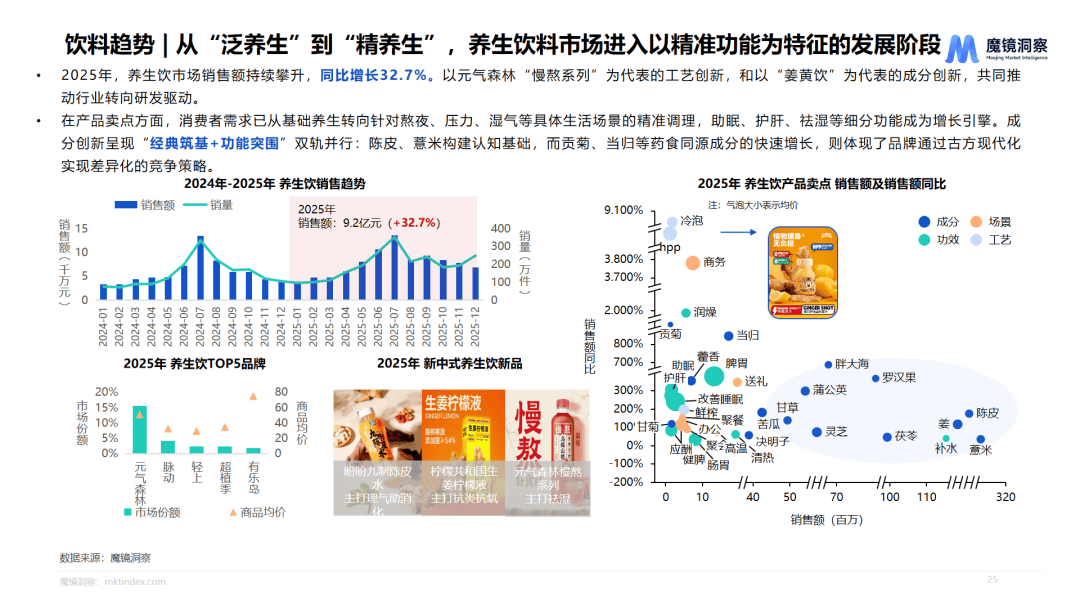
Core Insights - The Chinese consumer market in 2025 is characterized by "structural growth," with a shift from basic needs to precise health demands and personalized expressions [1][2] - Key trends include health, functionality, personalization, and intelligence, with consumers moving from "passive selection" to "active definition" of their needs [1] Group 1: Food and Beverage Sector - The food and beverage industry in China reached a market size of 593.67 billion yuan in 2025, with a sales growth of 7.8% and a volume increase of 6.3% [3] - Health-driven consumption is reshaping the industry, with premium products like fresh cakes and plant-based drinks gaining popularity [3] - The beverage market is transitioning from basic sugar reduction to targeted functionality and natural ingredients [3][6] Group 2: Health Sector - The health market achieved a sales figure of 304.38 billion yuan in 2025, growing by 15.8% year-on-year [10] - The largest segment, health supplements, saw sales of 124.48 billion yuan, with a growth rate of 19.9% [10] - The demand for products enhancing immunity is leading the market, with significant growth in categories addressing anemia and sleep management [10][14][17] Group 3: Home Appliances - The home appliance market reached a sales figure of 766.35 billion yuan in 2025, with an 18.1% year-on-year growth [20] - Major appliances dominate the market, while kitchen and lifestyle appliances show strong growth, with central air conditioning leading at a 52.1% increase [20] - The smart lock market is experiencing rapid growth, driven by consumer demand for safety features [25] Group 4: Beauty and Skincare - The beauty and skincare market reached 454.18 billion yuan in 2025, with a 9.7% increase in sales [29] - Anti-aging products are in high demand, with sales of 129.83 billion yuan, reflecting a growing focus on skincare across all age groups [29] - The beauty market is shifting towards health-oriented and high-quality products, moving away from basic offerings [32] Group 5: 3C Digital Products - The 3C digital market surpassed 1.1 trillion yuan in sales, with an 18.5% increase year-on-year [36] - The mobile power market is rapidly evolving, with certified products seeing explosive growth due to regulatory changes [36] - AI toys are experiencing significant market growth, with sales reaching 740 million yuan, reflecting a shift in consumer preferences [39] Group 6: Maternal and Infant Products - The maternal and infant market grew to 223.78 billion yuan in 2025, with a 12.6% increase [45] - The infant formula market is the largest segment, achieving sales of 50.93 billion yuan, with a growth rate of 18.1% [46] - There is a notable increase in demand for maternal nutrition products, particularly among pregnant women [46][49][52] Conclusion - The growth opportunities in 2025 are clear, focusing on the evolution of traditional demands and the deepening of consumer experiences [53] - Brands must transition from merely providing products to creating meaningful experiences that resonate with consumers' lifestyles [53][56]
2026中国十大消费品行业GEO现状及趋势研究报告2026
亿欧智库· 2026-02-09 06:25
Investment Rating - The report does not explicitly provide an investment rating for the industry. Core Insights - The transition from SEO (Search Engine Optimization) to GEO (Generative Engine Optimization) represents a fundamental shift in digital marketing, driven by generative AI technologies that change how brands interact with consumers [5][12][15]. - The report emphasizes the importance of understanding and mastering GEO logic for brands to capture new growth opportunities in the evolving digital landscape [6][36]. - The industry shows a clear tiered structure in GEO maturity, with significant disparities in development levels across different consumer goods sectors [41][49]. Summary by Sections Chapter 1: Background of the Transition from SEO to GEO - The shift from SEO to GEO is characterized by a change in search paradigms, where users now seek direct answers through natural language queries rather than keyword-based searches [11][15]. - Generative AI is reshaping the logic of brand exposure, requiring brands to adapt their strategies to ensure their products and narratives are accurately understood and recommended by AI [5][6]. Chapter 2: Overview of GEO Status in the Consumer Goods Industry - The report presents a GEO maturity index that categorizes the top ten consumer goods industries into three tiers: high maturity, medium maturity, and low maturity [49][50]. - Key indicators such as visibility, recommendation rate, and content quality are used to assess the performance of brands within these tiers [60][61]. Chapter 3: In-Depth Analysis of Key Consumer Goods Industries - The report highlights the top 50 brands in the consumer goods sector, with a focus on the home appliance, digital 3C, and maternal and infant industries, which are leading in GEO maturity [70][72]. - High maturity industries like home appliances and digital 3C benefit from standardized data and structured content, allowing for precise AI learning and logical reasoning [53][56]. Chapter 4: GEO Brand Rankings - The report provides a ranking of brands based on their GEO index, which is calculated from visibility, recommendation rate, and content quality [72][74]. - Brands such as Apple, Huawei, and Haier lead the rankings, showcasing high visibility and recommendation rates [72]. Chapter 5: Analysis of GEO Content Ecosystem and Implementation Guide - The report outlines the characteristics of effective brand content in the GEO era, emphasizing semantic richness, factual accuracy, and narrative coherence [30][34]. - Brands are encouraged to create content that is not only informative but also structured in a way that is easily understood by AI [34][36]. Chapter 6: Future Trends and Outlook - The report anticipates that brands that quickly adapt to the GEO landscape will secure a competitive advantage, as the digital marketing environment continues to evolve [6][41]. - It highlights the need for brands to build a robust semantic correction mechanism to monitor and correct AI-generated content related to their brand [45].




消费市场步入精算时代,品牌新品如何做到叫好又叫座?
Sou Hu Cai Jing· 2026-02-08 15:53
Group 1 - The consumer industry is entering a rational era by 2025, where consumers become more discerning and focus on product quality rather than brand marketing stories [2] - Successful new products must meet unmet consumer needs with high value, including efficacy and emotional value, while also being perceived as cost-effective [2] - Consumer purchasing behavior is stratified by price segments: low-end consumers prioritize cost-effectiveness, high-end consumers focus on perceived value, and mid-range consumers seek a balance of both [2] Group 2 - The demand for higher-level efficacy in products is becoming a common pursuit among consumers, with a shift from basic needs to more specialized benefits [3] - In oral care, consumers are increasingly looking for products that not only clean but also provide whitening and sensitivity relief, with whitening being the top-selling feature [6] - The pet care market is seeing a trend towards "humanization," where pet owners seek products that offer advanced benefits like digestive health and skin care, reflecting a similar trend in human consumer behavior [8] Group 3 - The market is witnessing a growing preference for complex ingredient combinations in health products, moving from simple supplements to multi-ingredient formulations [10] - Brands can efficiently innovate by cross-applying popular ingredients from other industries, which can lead to immediate market success [12][15] - Data-driven insights are essential for brands to identify and capitalize on emerging trends in efficacy and pricing strategies [19] Group 4 - Consumers are becoming increasingly price-sensitive, focusing on perceived value rather than absolute low prices, leading to a more calculated approach to purchasing [19][20] - Brands must adopt a meticulous pricing strategy to align with consumer expectations and avoid pitfalls associated with price wars [28][30] - The clothing cleaning market is experiencing a shift where premium products are growing faster than budget options, indicating a potential opportunity for brands to target higher price segments [30] Group 5 - Brands need to differentiate their products by offering unique, value-driven innovations that address unmet consumer needs, especially in a market where consumer demands are highly segmented [32] - The report emphasizes the importance of precise data analysis to uncover insights that can challenge existing industry perceptions and guide strategic decisions [32]