
计算机通信电子设备制造

Search documents
监管加码倒逼风控升级!A股董责险渗透率突破32%创历史新高
清华金融评论· 2026-01-07 10:10
Core Viewpoint - The recent release of the "Regulatory Rules for Secretaries of the Board of Directors of Listed Companies (Draft for Comments)" by the China Securities Regulatory Commission signifies a tightening of regulatory constraints on key personnel, leading to an increased demand for directors and officers liability insurance (D&O insurance) among listed companies in the A-share market [2]. Group 1 - The penetration rate of D&O insurance in the A-share market reached a historic high of 32% by 2025, with 643 companies purchasing D&O insurance, marking a 19% increase year-on-year [3][4]. - As of December 2025, a total of 1,753 listed companies had announced their D&O insurance plans, reflecting a 16% increase from the previous year [4]. - The demand for D&O insurance is closely linked to the rising litigation risks faced by directors and senior management, particularly in high-risk industries such as real estate, wholesale, and electricity, where the penetration rate has exceeded 60% [11]. Group 2 - The actual compensation payouts for D&O insurance have significantly increased, with 85 companies facing lawsuits since 2021, indicating a shift from theoretical risk to real financial consequences [7]. - In 2024, there were 26 compensation claims totaling 390 million yuan, while in the first three quarters of 2025, there were 13 claims amounting to 8.947 million yuan, with total disclosed compensation exceeding 850 million yuan from Q1 2022 to Q3 2025 [7]. - The manufacturing sector continues to lead in the number of companies purchasing D&O insurance, particularly in the "Computer, Communication, and Other Electronic Equipment Manufacturing" industry [9]. Group 3 - D&O insurance rates have shown a trend of "rising then falling," currently presenting a rare opportunity for companies to secure lower premiums, with average rates dropping from 0.3% to below 0.05% by Q4 2025 [13]. - The decline in rates is attributed to increased market capacity and irrational competition due to a lack of transparency in claims data, although future rate increases are expected as litigation risks rise and more claims are reported [14]. - Companies are encouraged to take advantage of the current low rate environment to lock in favorable insurance costs before rates increase [14].


感知中国活力·数字看经济
Yang Shi Wang· 2025-12-16 20:29
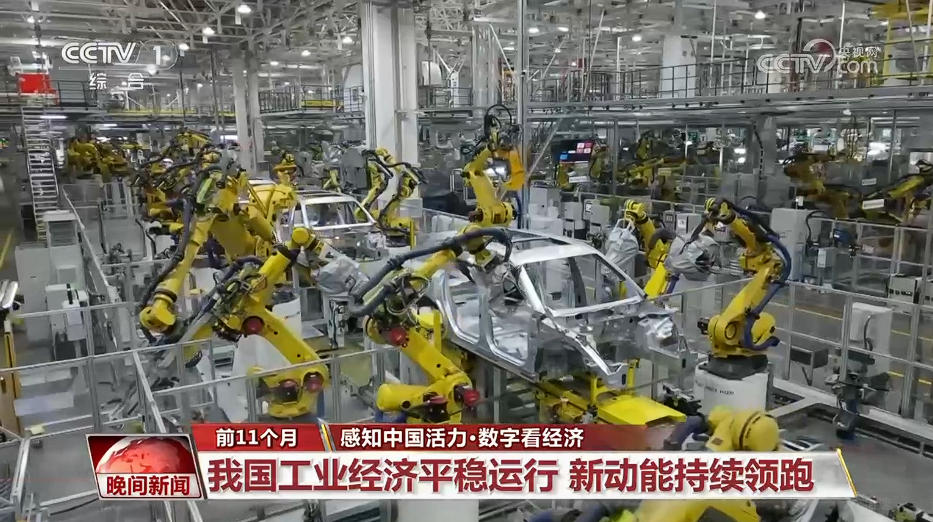
Group 1: Industrial Economy Performance - The industrial economy in China has maintained stable operation and structural optimization, with a year-on-year increase of 6.0% in industrial added value for the first 11 months [4] - In November, 30 out of 41 major industries achieved year-on-year growth, with notable performances in automotive manufacturing, railway, shipbuilding, aerospace, and other transportation equipment manufacturing, all growing by 11.9% [4] - The high-tech manufacturing sector showed strong growth, with an increase of 9.2% in added value year-on-year, and a monthly growth rate of 8.4% in November [3] Group 2: New Energy and Technology - The production of 3D printing equipment surged by 100.5% year-on-year, while industrial robots increased by 20.6%, and the production of new energy vehicles reached 1.841 million units, marking a 17.0% year-on-year growth [3] - The internal driving force for industrial transformation and upgrading is continuously strengthening, supporting the achievement of economic and social expectations for the year [3] Group 3: Railway Passenger Transport - From January to November, the national railway passenger volume reached a record high of 4.28 billion trips, reflecting a year-on-year increase of 6.6% [7] - The average daily operation of passenger trains increased by 7.1% compared to the previous year, with 11,258 trains scheduled daily [7] Group 4: Express Delivery Industry - The express delivery business volume reached 18.074 billion pieces in the first 11 months, showing a year-on-year growth of 14.9% [10] - The demand for express delivery has been significantly boosted by policies promoting the replacement of consumer goods, with large items like home appliances seeing a growth of approximately 30% in delivery volume [10] - The express delivery industry is enhancing its technological innovation capabilities, utilizing robots in smart warehouses and AI recognition systems in sorting centers to improve efficiency [10]
新华指数·博鳌发布|内蒙古生产经营平稳有序 绿色低碳新型电力系统加速构建
Xin Hua Cai Jing· 2025-12-08 09:03
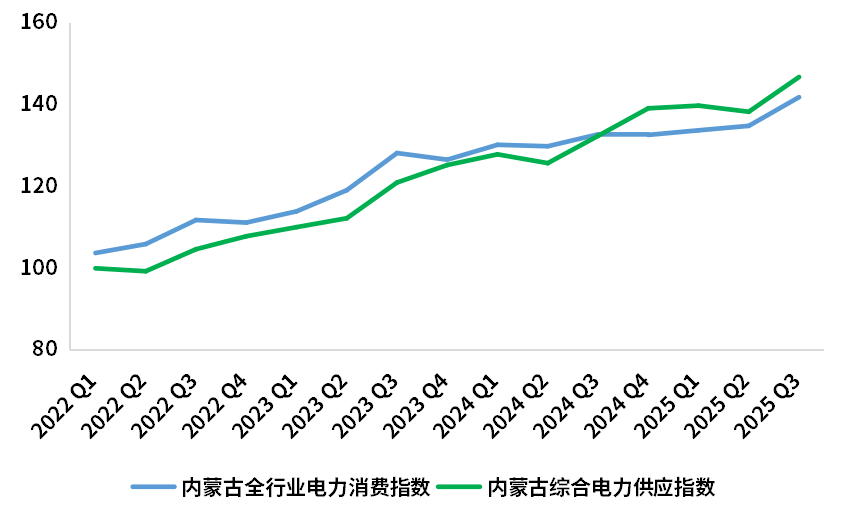
Core Insights - The Inner Mongolia region has made significant progress in developing renewable energy, achieving a historic milestone where installed capacity of new energy surpassed that of thermal power a year ahead of schedule [3] - The overall electricity consumption index and comprehensive electricity supply index in Inner Mongolia have increased by 4.49% and 10.07% year-on-year, respectively, indicating a robust growth in power generation and consumption [1][3] Group 1: Renewable Energy Development - Inner Mongolia's installed capacity of renewable energy exceeded 150 million kilowatts by the end of October 2025, ranking among the top in the country [3] - Wind and solar power account for over 80% of the newly added installed capacity, with wind power supply index and solar power supply index increasing by 24.53% and 61.99% year-on-year, respectively [3] Group 2: Industrial and Economic Impact - The manufacturing sector has played a crucial role in electricity consumption, contributing nearly 60% to the overall growth in electricity demand in the first three quarters of 2025 [4] - The digital economy is thriving, with internet data service electricity consumption increasing by 83.87% year-on-year, driven by the development of green computing hubs in Hohhot and Ulanqab [4] Group 3: Green Energy Utilization - Inner Mongolia is actively promoting the use of green energy in non-electric applications, with one-third of the total electricity consumption being green electricity [4]
深圳前三季度GDP增长5.5%,创新引擎驱动高质量发展
Huan Qiu Wang· 2025-10-31 02:42
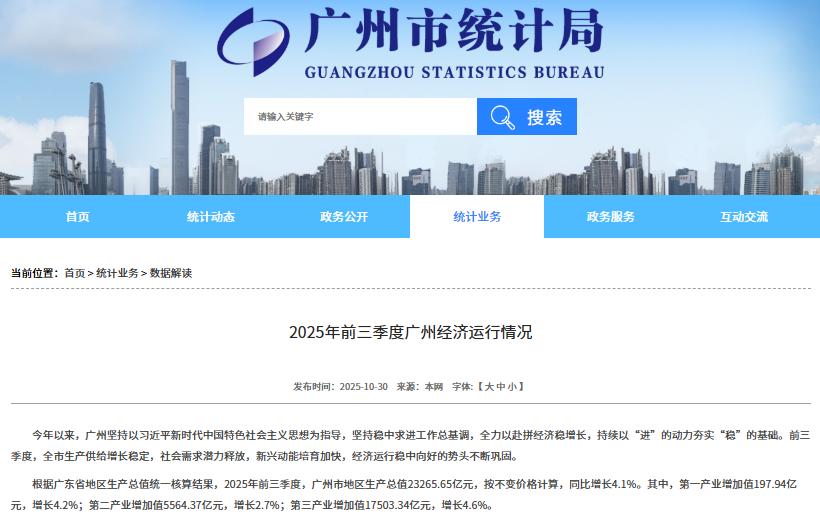
Economic Overview - Shenzhen's GDP for the first three quarters of 2025 reached 27,896.44 billion yuan, reflecting a year-on-year growth of 5.5% at constant prices, indicating strong economic resilience, potential, and vitality in the innovation city [1] Manufacturing Sector - The manufacturing sector continues to be a pillar of growth, with industrial added value above designated size increasing by 5.0% year-on-year, accelerating by 0.7 percentage points compared to the first half of the year [4] - Key industries such as general equipment manufacturing grew by 16.6%, instrument manufacturing by 7.5%, and computer, communication, and other electronic equipment manufacturing by 6.0% [4] - High-tech product output saw significant increases, with civil drones, industrial robots, and 3D printing equipment production rising by 46.9%, 38.2%, and 33.6% respectively, showcasing Shenzhen's strength in high-end manufacturing [4] Service Sector - The service sector showed a robust recovery, with added value reaching 17,932.93 billion yuan, a year-on-year increase of 6.6%, and an acceleration of 0.5 percentage points from the first half of the year [5] - The financial industry performed particularly well, growing by 14.5%, while information transmission, software, and IT services grew by 9.7%, and leasing and business services by 5.6% [5] - The consumer market exhibited a noticeable recovery, with total retail sales of consumer goods amounting to 7,560.81 billion yuan, a year-on-year growth of 3.6% [5] - The "old for new" consumption policy showed effectiveness, with retail sales of home appliances and audio-visual equipment, cultural and office supplies, and communication equipment increasing by 41.5%, 28.2%, and 6.1% respectively [5] - Online retail maintained rapid growth, with retail sales through the internet increasing by 17.8% [5] Foreign Trade and Financial Sector - Shenzhen's foreign trade demonstrated strong resilience, with total import and export volume reaching 33,643.29 billion yuan, a year-on-year increase of 0.1% [6] - Imports amounted to 13,261.25 billion yuan, growing by 8.4%, while high-tech product exports increased by 9.7%, indicating an optimized foreign trade structure [6] - The financial system remained stable, with total deposits in financial institutions reaching 143,649.54 billion yuan, a year-on-year growth of 5.6%, and total loans amounting to 99,404.44 billion yuan, growing by 5.0% [6] - By industry, the primary sector's added value was 17.45 billion yuan, growing by 0.0%; the secondary sector's added value was 9,946.06 billion yuan, growing by 3.5%; and the tertiary sector's added value was 17,932.93 billion yuan, growing by 6.6%, with the service industry being the main driver of economic growth [6]
增长5.5%!深圳,最新公布→
Zheng Quan Shi Bao· 2025-10-30 11:53
Economic Growth - Shenzhen's GDP for the first three quarters of 2025 reached 27,896.44 billion yuan, with a year-on-year growth of 5.5% at constant prices [1] - The primary industry added value was 17.45 billion yuan, showing no growth; the secondary industry increased by 9,946.06 billion yuan, growing by 3.5%; the tertiary industry added 17,932.93 billion yuan, with a growth of 6.6% [1] Industrial Performance - The industrial added value in Shenzhen increased by 5.0% year-on-year, with a growth acceleration of 0.7 percentage points compared to the first half of the year [1] - Key sectors such as general equipment manufacturing grew by 16.6%, instrument manufacturing by 7.5%, and computer, communication, and other electronic equipment manufacturing by 6.0% [1] - High-tech product output saw rapid growth, with civil drones, industrial robots, and 3D printing equipment increasing by 46.9%, 38.2%, and 33.6% respectively [1] Service Sector - The added value of the service industry in Shenzhen was 17,932.93 billion yuan, with a year-on-year growth of 6.6%, accelerating by 0.5 percentage points from the first half of the year [1] - Financial services, information transmission, software and IT services, and leasing and business services grew by 14.5%, 9.7%, and 5.6% respectively [1] Consumer Market - The total retail sales of consumer goods in Shenzhen reached 7,560.81 billion yuan, with a year-on-year growth of 3.6%, slightly up by 0.1 percentage points from the first half of the year [2] - Retail sales of essential goods showed strong growth, with food and daily necessities increasing by 8.4% and 7.5% respectively [2] - The policy for replacing old consumer goods continued to show effects, with retail sales of home appliances and audio-visual equipment increasing by 41.5% [2] Foreign Trade - Shenzhen's total import and export volume for the first three quarters was 33,643.29 billion yuan, with a slight year-on-year increase of 0.1% [2] - Exports amounted to 20,382.04 billion yuan, down by 4.7%, while imports reached 13,261.25 billion yuan, growing by 8.4% [2] - High-tech product exports increased by 9.7% [2] Investment Trends - Fixed asset investment in Shenzhen decreased by 17.4% year-on-year [3] - Real estate development investment fell by 24.8%, while infrastructure investment grew by 6.8% and industrial technological transformation investment surged by 42.7% [3] Financial Sector - As of the end of September, the balance of deposits in Shenzhen's financial institutions (including foreign capital) was 143,649.54 billion yuan, with a year-on-year growth of 5.6% [3] - The balance of loans in financial institutions (including foreign capital) was 99,404.44 billion yuan, growing by 5.0% year-on-year [3]

增长5.5%!深圳,最新公布→
证券时报· 2025-10-30 11:47
Economic Growth - Shenzhen's GDP for the first three quarters of 2025 reached 27,896.44 billion yuan, with a year-on-year growth of 5.5% at constant prices [1] - The primary industry added value was 17.45 billion yuan (0.0% growth), the secondary industry was 9,946.06 billion yuan (3.5% growth), and the tertiary industry was 17,932.93 billion yuan (6.6% growth) [1] Industrial Performance - The industrial added value above designated size in Shenzhen grew by 5.0% year-on-year, accelerating by 0.7 percentage points compared to the first half of the year [1] - Key sectors such as general equipment manufacturing, instrument manufacturing, and computer, communication, and other electronic equipment manufacturing saw growth rates of 16.6%, 7.5%, and 6.0% respectively [1] - High-tech product output continued to grow rapidly, with civil drones, industrial robots, and 3D printing equipment increasing by 46.9%, 38.2%, and 33.6% respectively [1] Service Sector - The added value of the service industry in Shenzhen was 17,932.93 billion yuan, with a year-on-year growth of 6.6%, which is an acceleration of 0.5 percentage points from the first half of the year [2] - Financial services, information transmission, software, and IT services, as well as leasing and business services grew by 14.5%, 9.7%, and 5.6% respectively [2] Consumer Market - The total retail sales of consumer goods in Shenzhen reached 7,560.81 billion yuan, with a year-on-year growth of 3.6%, slightly up by 0.1 percentage points from the first half of the year [2] - Retail sales of essential goods showed strong growth, with food and daily necessities increasing by 8.4% and 7.5% respectively [2] - The policy of replacing old consumer goods continued to show effects, with retail sales of home appliances and audio-visual equipment, cultural and office supplies, and communication equipment increasing by 41.5%, 28.2%, and 6.1% respectively [2] - Online retail sales grew rapidly, with a 17.8% increase in retail sales through the internet [2] Foreign Trade - Shenzhen's total import and export volume reached 33,643.29 billion yuan, with a year-on-year growth of 0.1% [2] - Exports were 20,382.04 billion yuan (down 4.7%), while imports were 13,261.25 billion yuan (up 8.4%) [2] - High-tech product exports increased by 9.7% [2] Investment Trends - Fixed asset investment in Shenzhen decreased by 17.4% year-on-year [3] - Real estate development investment fell by 24.8%, while infrastructure investment grew by 6.8% and industrial technological transformation investment surged by 42.7% [3] Financial Sector - As of the end of September, the balance of deposits in financial institutions (including foreign capital) in Shenzhen was 143,649.54 billion yuan, with a year-on-year growth of 5.6% [3] - The balance of loans in financial institutions (including foreign capital) was 99,404.44 billion yuan, with a year-on-year growth of 5.0% [3]
上海前三季度GDP同比增长5.5%,金融市场活跃财政收支增长
Bei Ke Cai Jing· 2025-10-22 06:02
Economic Overview - Shanghai's GDP for the first three quarters reached 40,721.17 billion yuan, with a year-on-year growth of 5.5% at constant prices [1] - The primary industry added value was 64.26 billion yuan, growing by 0.9%; the secondary industry added value was 8,448.67 billion yuan, growing by 3.9%; and the tertiary industry added value was 32,208.24 billion yuan, growing by 5.9% [1] Industrial Performance - The industrial added value in Shanghai increased by 5.2% year-on-year, with the total output value of industrial enterprises above designated size growing by 5.7% [2] - Key manufacturing sectors showed significant growth: railway, shipbuilding, aerospace, and other transport equipment manufacturing grew by 15.9%; electrical machinery and equipment manufacturing grew by 14.3%; and computer, communication, and other electronic equipment manufacturing grew by 12.1% [2] - The three leading manufacturing industries saw an 8.5% increase in output value, outpacing the overall industrial growth by 2.8 percentage points [2] - Strategic emerging industries in manufacturing grew by 7.3%, with the new energy sector growing by 19.6% and the new generation information technology sector growing by 10.9% [2] Tertiary Sector Growth - The tertiary sector's added value increased by 5.9%, with information transmission, software, and IT services growing by 15.5% [2] - The financial sector's added value was 6,965.27 billion yuan, reflecting a growth of 9.8% [2] - The transportation, warehousing, and postal services sector grew by 5.2%, while leasing and business services grew by 3.2% [2] Investment Trends - Fixed asset investment in Shanghai grew by 6.0%, with industrial investment surging by 20.3% [3] - Urban infrastructure investment increased by 11.7%, while real estate development investment grew by 2.2% [3] Consumer Market - The total retail sales of consumer goods reached 12,302.77 billion yuan, with a year-on-year growth of 4.3% [3] - Categories such as sports and entertainment goods, furniture, and home appliances saw significant retail growth, with increases of 27.7%, 22.1%, and 28.2% respectively [3] Financial Market Activity - Major financial market transaction volumes increased by 12.7%, with the Shanghai Stock Exchange's securities transaction volume growing by 38.4% [3] - By the end of September, the balance of deposits in financial institutions reached 23.84 trillion yuan, growing by 8.4% year-on-year [3] Consumer Prices and Income - The consumer price index (CPI) remained stable year-on-year, with a slight decrease of 0.1% in September [4] - The average disposable income per capita in Shanghai was 69,220 yuan, reflecting a year-on-year growth of 4.3% [5] - The average urban unemployment rate was 4.2% [5]
成都经济运行数据出炉:新能源汽车产量增长326.2%
Zheng Quan Shi Bao Wang· 2025-08-22 02:57
Core Insights - Chengdu's industrial added value for the first seven months of the year increased by 8.0% year-on-year [1] - Fixed asset investment in Chengdu (excluding rural households) grew by 4.5% year-on-year, with private investment rising by 5.6% [1] Industry Performance - Out of 37 major industries, 24 reported an increase in added value [1] - The automotive manufacturing industry saw a significant growth of 22.9% [1] - The computer, communication, and other electronic equipment manufacturing industry experienced a growth of 17.2% [1] Key Product Output - The production of new energy vehicles surged by 326.2% [1] - Smart watch production increased by 135.2% [1] - Lithium-ion battery output grew by 41.4% [1]
主要指标总体平稳 新质生产力稳步发展
Si Chuan Ri Bao· 2025-08-18 22:47
Economic Performance - The industrial added value of large-scale industries in Sichuan increased by 7.2% year-on-year, outpacing the national growth rate by 0.9 percentage points [1] - In July, the industrial added value grew by 7.6% year-on-year, exceeding the national average by 1.9 percentage points [1] - Among 41 major industrial categories, 35 experienced growth, indicating a stable growth rate of over 80% across industries [1] Key Industries - The automotive manufacturing sector saw a significant increase in added value, growing by 19.8% year-on-year [1] - The computer, communication, and other electronic equipment manufacturing industries reported a 15.0% increase in added value [1] - Production of smartwatches and integrated circuits surged by 109.3% and 13.2% respectively [1] - Lithium-ion battery production rose by 50.5% year-on-year [1] Investment Trends - Fixed asset investment (excluding rural households) in Sichuan grew by 2.0% year-on-year, surpassing the national growth rate by 0.4 percentage points [1] - Investment in six key advantageous industries increased by 10.7%, accounting for 32.0% of total investment, which is 2.5 percentage points higher than the previous year [1] - High-tech manufacturing investment rose by 7.8%, outpacing overall manufacturing investment by 1.1 percentage points [1] - Clean energy industry investment saw a substantial increase of 22.3% [1] Consumer Market - The total retail sales of consumer goods in Sichuan reached 16,513.2 billion yuan, marking a year-on-year growth of 5.6%, which is 0.8 percentage points higher than the national average [1] - In July, retail and catering revenues from large enterprises through public networks grew by 34.7% and 29.3% year-on-year respectively [1] - The "old-for-new" policy had a notable impact, with retail sales of communication equipment increasing by 103.0% year-on-year [1]
1-7月北京市规模以上工业增加值同比增长6.1%
Xin Hua Cai Jing· 2025-08-18 05:34
Economic Overview - Beijing's economy showed stable performance in the first seven months of 2025, with industrial production growing rapidly and fixed asset investment expanding [1][2] - The overall economic operation remained stable, supported by continuous policy efforts [1] Industrial Production - The industrial added value in Beijing increased by 6.1% year-on-year, with high-end manufacturing making significant contributions [1] - Key sectors such as computer, communication, and other electronic equipment manufacturing grew by 24.2%, while automotive manufacturing increased by 11.5% [1] - Strategic emerging industries and high-tech manufacturing added value grew by 17.2% and 9.5%, respectively [1] Fixed Asset Investment - Fixed asset investment (excluding rural households) rose by 10.8% year-on-year, with equipment purchase investment surging by 80.3% [2] - Infrastructure investment grew by 4.3%, while real estate development investment declined by 9.9% [2] - High-tech industry investment remained active, increasing by 58.7% [2] Consumer Market - Total market consumption in Beijing increased by 0.7%, driven by service consumption growth of 4.6% [3] - Retail sales of consumer goods totaled 767.43 billion yuan, a decrease of 4.2% [3] - The "trade-in" policy positively impacted sales of home appliances, which grew by 6.9% [3] Price Stability - Consumer prices in Beijing fell by 0.3% year-on-year, with food prices down by 1.8% [4] - Industrial producer prices continued to decline, with a year-on-year decrease of 1.8% [4] - In July, consumer prices decreased by 0.2% year-on-year, while industrial producer prices fell by 1.9% [4]