6G通信

Search documents
未来产业 乘风起势(新时代画卷)
Ren Min Wang· 2026-02-12 22:54
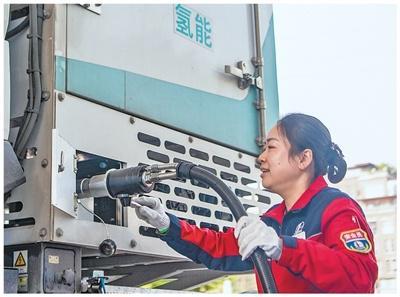
Hydrogen Energy and Nuclear Fusion - The Chongqing Jiulongpo District has staff refueling hydrogen fuel cell vehicles, indicating advancements in hydrogen energy infrastructure [2] - The "China Fusion Engineering Test Reactor" has achieved a breakthrough with a nuclear temperature of 117 million degrees Celsius and an electron temperature of 160 million degrees Celsius, marking a significant milestone in China's fusion research [4] Embodied Intelligence - The Guangdong Embodied Intelligence Robot Innovation Center showcases a pipeline inspection robot, highlighting developments in robotics technology [6] - In Sichuan's Bazhong Tongjiang County, students interact with robotic dogs, demonstrating the integration of robotics in educational settings [8] Biomanufacturing - The Hunan Biomanufacturing Pilot Base features a purification workshop where staff use flat-panel centrifuges for material dehydration, reflecting advancements in biomanufacturing processes [10] Quantum Technology - Researchers are experimenting with the "Zhuangzi 2.0" superconducting chip, discovering controllable patterns in the preheating phase of quantum systems, which is crucial for quantum technology development [12] - The Chinese Academy of Sciences' Quantum Information and Quantum Technology Innovation Research Institute in Hefei is a key player in advancing quantum research [14] Sixth Generation Mobile Communication - The Shanghai 6G Intelligent Communication Valley showcases a company's 6G smart terminal products, indicating progress in next-generation mobile communication technology [16] - In Nanjing, researchers at the Zijinshan Laboratory demonstrate a self-developed Bayesian learning baseband chip, contributing to the development of 6G technology [18] Brain-Computer Interfaces - In Wuhan, researchers utilize mixed reality technology to present the spatial relationship between brain-computer interface devices and rat brain structures, showcasing innovations in neuroscience [20] - At the Beijing Capital International Exhibition Center, visitors experience high-performance brain-computer interface devices, indicating growing interest and advancements in this field [22]

上海松江区有座未来产业园 一栋科创楼串起“6G朋友圈”(在现场)
Ren Min Ri Bao· 2026-02-04 22:05
Core Viewpoint - The establishment of the 6G Innovation Valley in Shanghai aims to develop a comprehensive ecosystem for 6G technology, focusing on immersive communication and the integration of various technologies to enhance future industries [1][4]. Group 1: 6G Technology Development - The 6G Innovation Valley is positioned as a hub for the future industry, with a goal to create China's first commercial 6G deployment city by 2030 [1]. - The functionality of 6G is described as building a "nervous system" for future industries, integrating satellites, ground stations, and terminals into a cohesive network [1][4]. - The 6G ecosystem is being developed with a focus on satellite network control and operation, which is considered a significant challenge in the industry [2]. Group 2: Collaborative Innovations - Companies within the 6G Innovation Valley, such as Guokexinnao and Waterfall AI, are collaborating to develop innovative products like AI glasses that utilize brain-computer interface technology [3]. - The AI glasses aim to detect Alzheimer's disease and will incorporate 6G modules for rapid data transmission to healthcare providers [3]. Group 3: Infrastructure and Testing - The 6G Innovation Valley includes a satellite internet testing and verification platform, facilitating the development and testing of 6G devices [3]. - The workflow involves research and development on lower floors, with testing conducted on the rooftop, ensuring a streamlined process from development to deployment [3]. Group 4: Industry Impact - The ultimate goal of 6G technology is to benefit various industries and improve public welfare, enabling applications such as advanced rescue signals, sensitive autonomous driving, and low-latency remote surgeries [4]. - The 6G Innovation Valley has attracted over 50 related enterprises, creating a network that covers the entire 6G future industry chain [4].
江苏南京:以新质生产力描绘“产业强市”蓝图
Nan Jing Ri Bao· 2026-01-28 13:25
Group 1 - Nanjing has launched the "Several Policies for Accelerating the Cultivation of New Quality Productivity to Promote High-Quality Development (2026 Edition)" to prioritize the "Industry Strong City Strategy" as a key initiative [1] - The policies aim to deepen the "1+4+6" industrial strategy and create a "1026" advanced manufacturing cluster system, introducing a series of breakthrough measures and comprehensive policy support [1] - The focus is on fostering new quality productivity to achieve a path of industrial growth characterized by higher quality and stronger momentum [1] Group 2 - The AI International Community in Nanjing is witnessing the integration of AI technology across various industries, with applications such as AI digital humans and AI-based traditional Chinese medicine diagnostics [3] - The "AI Space: Nanjing Artificial Intelligence International Community Construction Three-Year Action Plan (2026-2028)" aims to cultivate 2-3 landmark AI enterprises, over 10 excellent industry models, and attract more than 1,000 AI companies and teams [5] - Nanjing's AI industry is supported by a strong foundation, with 14 out of the top 20 internet companies in China establishing a presence in the city [5] Group 3 - The policies include the implementation of an "Artificial Intelligence+" action plan, establishing Nanjing as a national pilot zone for AI innovation applications [6] - The city will issue "computing power vouchers" to encourage startups and innovative enterprises to utilize intelligent computing resources [6] - Financial incentives include a one-time reward of 200,000 yuan for AI model developers and project subsidies of up to 200,000 yuan for innovative applications [6] Group 4 - Nanjing is positioned as the only national AI innovation application pilot zone in the province, with a focus on creating a replicable "Nanjing model" for AI industry development [8] - The city aims to optimize the spatial layout of AI, establishing a collaborative development framework with two core areas and several growth poles [8] - Nanjing is set to promote AI applications through regular project roadshows and the replication of successful applications across the city [8] Group 5 - The "Several Policies" emphasize the acceleration of future industry layout, focusing on sectors like 6G, brain-computer interfaces, and advanced semiconductor materials [10] - Nanjing has achieved significant milestones in 6G technology, with over ten world-first achievements and more than 30 innovative results [12] - The city anticipates that its future industries will generate over 300 billion yuan in revenue by 2025, with a strong emphasis on creating international-level pilot zones [12] Group 6 - Nanjing is developing a "scene open city" by promoting the large-scale application of new scenarios across various sectors, including industrial transformation and digital public services [15] - The city plans to release 1,000 application scenarios annually and support the promotion of first-time equipment and software [15] - A three-year action plan will be established to enhance the ecosystem for scenario publication, connection, and implementation [18]

【研报行业】千亿市场+90%国产份额!消费级3D打印产业链进入爆发前夜,这些受益标的值得布局
第一财经· 2026-01-22 12:14
Group 1 - The consumer-grade 3D printing industry is on the verge of explosive growth, with a market size of hundreds of billions and a 90% share of domestic production, indicating potential investment opportunities in related companies [1] - Copper replacement technology is expected to exceed a 40% penetration rate by 2027, with silver paste and copper slurry materials projected to generate a profit margin of 730 million, highlighting investment opportunities in the photovoltaic cost reduction sector [1] - The 6G technology trials have entered the second phase, with a trillion-level commercial market countdown, suggesting significant future investment potential [1] - China's commercial space industry is entering a rapid development phase, with core segments of the industry chain poised to benefit first, indicating a favorable investment landscape [1]

未来产业周报第5期:核聚变技术资本共振,脑机与量子进阶突破,氢能普及提速-20260111
Shenwan Hongyuan Securities· 2026-01-11 14:42
Quantum Technology - The report highlights the clear positioning of the NISQ (Noisy Intermediate-Scale Quantum) era, indicating that current quantum devices are operational but limited in capability, lacking fault tolerance and scalability. Experts estimate that small-scale fault-tolerant quantum computers will take about ten years to develop [8][9] - The collaboration between Argonne National Laboratory and Intel has successfully deployed a 12-qubit silicon-based quantum processor, demonstrating the value of mature silicon technology in scaling quantum computing [10] - D-Wave has showcased a scalable on-chip low-temperature control gate model quantum bit, significantly reducing wiring costs and addressing a major bottleneck in the industry [12][14] Biomanufacturing - Micro Yuan Synthesis has secured nearly 300 million yuan in financing to accelerate the development of methanol biomanufacturing, which addresses the reliance on food-based raw materials in traditional biomanufacturing [15][16] - The first gene-consistent human "lung chip" has been developed, providing a new tool for personalized treatment of respiratory diseases and potentially revolutionizing drug development by reducing reliance on animal models [18] Hydrogen Energy and Nuclear Fusion - Policies in Shanghai and other regions are reducing the operational costs of hydrogen vehicles through subsidies and free highway access, which is expected to significantly boost the adoption of hydrogen fuel cell vehicles [19][20] - The report notes that hydrogen energy is transitioning from being a major electricity consumer to a "regulator" of the grid, enhancing the consumption of renewable energy and long-term storage capabilities [25][28] - The Energy Singularity's "Honghuang 70" nuclear fusion device has achieved a 120-second steady-state operation, marking a significant milestone in commercial nuclear fusion technology [31] - Dongsheng Fusion has completed a multi-hundred million yuan angel round of financing to develop a "deuterium-helium-3" fusion route, which is considered safer and more cost-effective than traditional methods [32][33] Brain-Computer Interface - Strong Brain Technology has raised 2 billion yuan to scale brain-computer interface technology, aiming to help one million disabled individuals regain social functionality within five to ten years [38][39] - Sichuan Province has set maximum prices for brain-computer interface medical services, which will take effect in April 2026, facilitating the clinical application of this technology [40][41] - The first brain-computer interface deep brain stimulator surgery in Southwest China has been successfully performed, providing new treatment options for Parkinson's disease [42][43] Embodied Intelligence - NVIDIA has released several physical AI models and frameworks that support robots in understanding physical laws, enhancing the industrialization of robots across various scenarios [5][13] - Chinese companies represent nearly 25% of robot exhibitors at CES 2026, with humanoid robots making up over 50% of the exhibition area, showcasing the competitive edge of Chinese firms in this sector [5][13] Sixth Generation Mobile Communication (6G) - Nanjing has launched a special plan to build a 6G industrial ecosystem, aiming for full coverage of 6G non-cellular networks by 2027 and the establishment of over 50 vertical industry scenarios [5][14]
新赛道升级 塑造发展新优势
Jing Ji Ri Bao· 2026-01-06 22:35
Core Insights - The "15th Five-Year Plan" emphasizes the cultivation and expansion of emerging and future industries, aiming to create new pillar industries and strategically position future industries for growth [1] Group 1: Emerging Industries - During the "14th Five-Year Plan," China's emerging industries accelerated development, forming significant scale effects with several trillion-yuan market opportunities emerging by 2025 [2] - The commercial aerospace industry is on the verge of explosion, with advancements such as the successful launch of the Zhuque-3 rocket and accelerated deployment of satellite internet constellations [2] - The low-altitude economy is entering a commercial phase, marked by the issuance of operational certificates for manned civil unmanned aerial vehicles and the promotion of typical application scenarios by the Ministry of Transport [2] - New materials are crucial for breakthroughs in aerospace performance, with innovations in high-strength stainless steel and carbon fiber composites being utilized in key projects [2] Group 2: Energy Transition - China's energy transition has accelerated, establishing the world's largest power infrastructure and renewable energy systems, with plans to increase the share of renewable energy significantly by 2026 [3] - The "15th Five-Year Plan" aims to enhance emerging pillar industries, focusing on innovation in sectors like renewable energy, new materials, aerospace, and low-altitude economy [3] Group 3: Future Industries - Rapid advancements in future industries such as artificial intelligence, quantum information, and biomanufacturing have been noted, with significant breakthroughs achieved during the "14th Five-Year Plan" [4] - The development of 6G technology is prioritized, with expectations for commercial applications to begin around 2030, indicating a deep integration with AI [4][5] - Future industries are characterized by their potential to create new demands and economic forms, with quantum technology and nuclear fusion energy expected to play pivotal roles [6] Group 4: Market Opportunities and Challenges - Emerging industries are entering a rapid growth phase, with key scenarios being validated and replicable business models established, while future industries are still in the exploratory phase [7] - The uncertainty in future industries stems from both technological and commercial aspects, requiring significant R&D investment and policy support [8] - The collaboration between emerging and future industries is essential for driving new economic engines, with a focus on innovation and long-term value creation [9]
南京召开新年第一会 打出科技创新“组合拳”
Zheng Quan Shi Bao Wang· 2026-01-05 04:37
Core Insights - Nanjing aims to enhance its industrial technology innovation through a comprehensive plan that integrates government, industry, academia, and finance, focusing on artificial intelligence and its applications Group 1: Development Goals - By 2027, Nanjing plans to achieve the "Ten-Hundred-Thousand" goal, which includes cultivating 10 specialized industrial parks, developing 100 outstanding industry models, launching 1,000 intelligent terminal and intelligent agent products, and enabling 10,000 enterprises to complete their intelligent upgrades [1] - By 2030, the city aims to establish three high grounds: a national innovation source for artificial intelligence, an industrial agglomeration area, and a demonstration area for integrated applications, with the penetration rate of new intelligent terminals and applications exceeding 95% [1] Group 2: Five Major Upgrade Actions - **Technology Product Upgrade**: Establish interdisciplinary and inter-institutional joint laboratories/innovation centers, with over 10 provincial innovation platforms by 2027, and support 30 technology research projects [2] - **Business Entity Upgrade**: Focus on nurturing over 1,000 AI-native enterprises by 2027, with a target of 90% application rate of intelligent tools among key software companies [2] - **Integration Application Upgrade**: Breakthrough in six key areas including technological innovation and urban governance, aiming to cultivate 15 national-level intelligent factories and establish over 5 demonstration sites in various sectors by 2027 [2] - **Industrial Layout Upgrade**: Optimize the spatial layout for "AI+" and create 500 benchmark application scenarios by 2027 [2] - **Supporting Element Upgrade**: Develop a "1+1" intelligent computing cluster and enhance data sharing and open access, while also fostering an open-source ecosystem [3] Group 3: 6G Action Plan - The "6G City" action plan aims to release at least 6 major research achievements in the 6G field by 2027 and create over 50 vertical application scenarios across various industries [3] - The plan also targets the cultivation of at least 200 specialized enterprises in the information and communication sector and the establishment of a 6G industry development demonstration zone [3] Group 4: Key Technological Demands - The conference announced the "Top Ten Technological Achievements of Nanjing" for 2025, focusing on critical technology needs in seven key industrial sectors, including biomedicine and intelligent manufacturing [3]
未来五年,八大领域将站上风口
Guo Ji Jin Rong Bao· 2026-01-04 08:53
Core Themes - The "15th Five-Year Plan" emphasizes the construction of a modern industrial system, promoting technological innovation and self-reliance, and expanding domestic demand, particularly in consumption [1][2]. Commercial Aerospace - The commercial aerospace sector is recognized as a strategic emerging industry cluster in the "15th Five-Year Plan," marking its elevation to a national strategic level [2]. - Key investment areas include the commercial rocket industry chain and satellite manufacturing and application chain, which are expected to benefit from increased launch demand and technological advancements [2][3]. - The commercial aerospace industry is entering a critical phase of scale and commercialization, with over 600 companies projected by 2025 and an expected market size of 2.5 to 2.8 trillion yuan [3]. Low-altitude Economy - The low-altitude economy is defined as activities in the airspace of 1,000 to 3,000 meters, utilizing drones and eVTOLs, with applications in logistics, tourism, and emergency rescue [5]. - The industry is projected to reach a market size of 2 trillion yuan by 2030, with a compound annual growth rate of 34.2% [5]. - As of November 2025, there are over 97,000 companies in the low-altitude economy sector, with significant growth in regions like Guangdong and Shandong [5][6]. Embodied Intelligence - The embodied intelligence sector is experiencing rapid development, with a market size of approximately 5.295 billion yuan in 2025, accounting for 27% of the global market [8]. - The sector is expected to grow to over 1 trillion yuan by 2035, with significant investment activity, including over 500 billion yuan in financing by October 2025 [8][9]. - Companies are advancing towards commercialization, with applications expected to transform household cleaning and other sectors [10]. 6G Technology - The "15th Five-Year Plan" includes a forward-looking layout for 6G technology, which is anticipated to enhance communication, perception, and intelligence integration [10][11]. - The 6G market is projected to reach a scale of 1 trillion yuan by 2035, with significant advancements in technology and standardization expected during the "15th Five-Year Plan" period [12]. Artificial Intelligence - The core AI industry in China is expected to exceed 1 trillion yuan by 2025, with a focus on deep integration with various sectors [14]. - The government aims for AI applications to achieve over 70% penetration in key areas by 2027 and over 90% by 2030 [14][15]. - Infrastructure upgrades and a comprehensive computing network are critical for supporting AI innovation and application [15]. Quantum Technology - Quantum technology is prioritized in the "15th Five-Year Plan," with expectations for significant growth and application across various industries [16][17]. - The global quantum industry is projected to reach approximately 239.1 billion dollars by 2030, with a compound annual growth rate of 65% [16][17]. Cultural and Tourism Industry - The tourism industry is undergoing a quality revolution, with a focus on high-quality tourism products and services as outlined in the "15th Five-Year Plan" [18][19]. - Domestic tourism is recovering, with nearly 50 billion trips recorded in the first three quarters of 2025, reflecting a shift towards deeper consumption and experience upgrades [18]. - The plan emphasizes enhancing inbound tourism services and integrating technology to improve visitor experiences [19]. New Consumption - Consumption is a key driver of economic growth, with retail sales expected to grow from 39.1 trillion yuan in 2020 to 48.3 trillion yuan by 2024 [20][21]. - The government aims to support new consumption models and expand consumer goods supply structures, targeting several trillion-yuan sectors by 2027 [21].
未来产业:如何前瞻布局
Xin Lang Cai Jing· 2025-12-31 21:05
Core Insights - The article discusses the importance of future industries as a core competitive arena for countries to seize technological leadership and cultivate new growth drivers, as outlined in China's 15th Five-Year Plan [10][11][12]. Group 1: Global Competition in Future Industries - Future industries such as quantum technology, bio-manufacturing, and brain-computer interfaces are seen as key areas for countries to gain competitive advantages and enhance national strength [10][11]. - The global R&D expenditure as a percentage of GDP has increased significantly from 2013 to 2022, indicating strong resilience in technology investment despite economic downturns [10]. Group 2: China's Progress in Future Industries - China is transitioning from technology catch-up to proactive layout in future industries, with strengths in quantum communication, 6G, brain-computer interfaces, hydrogen energy, and nuclear fusion [13][14]. - By 2024, China's total R&D investment is expected to exceed 3.6 trillion yuan, a 48% increase from 2020, with R&D intensity reaching 2.69%, surpassing the EU average [14]. Group 3: Funding Support for Future Industries - Future industries require substantial investment and long-term capital support, necessitating a multi-faceted funding structure that includes government, state-owned, and social capital [20][21]. - The establishment of a future industry fund in Shanghai, with a total scale of approximately 15 billion yuan, aims to support the growth of future industries through a structured investment approach [21]. Group 4: Application Scenario Innovation - Application scenarios are crucial for connecting technology with market needs, serving as testing grounds for new technologies and driving industrialization [24][25]. - The Ministry of Industry and Information Technology emphasizes the need for scenario-driven innovation to accelerate the commercialization of future industries [24].
「十五五」时期重点产业前瞻与发展路径研究丨36氪研究院
36氪· 2025-12-31 00:14
Core Insights - The "14th Five-Year Plan" period prioritizes the construction of a modern industrial system, marking a strategic shift from single-point technological breakthroughs to systematic industrial upgrades [6][19]. - The new energy industry is transitioning from a focus on installed capacity to building a "source-grid-load-storage" collaborative system, emphasizing dynamic balance between production and consumption [7]. - The aerospace sector is developing a dual-driven model of national engineering and commercial space, with large aircraft industrialization and commercial space driving the scale and capability of the industry chain [8]. - Future industries such as 6G and quantum technology place China in the global leading tier of R&D, aiming to seize the high ground in technology standards and industrial ecosystems through forward-looking layouts [9]. - The transformation of traditional industries emphasizes not only greening and intelligentization but also explicitly promotes "service-oriented manufacturing," guiding the manufacturing sector to extend services throughout the product lifecycle [10]. Group 1: Modern Industrial System - The construction of a modern industrial system is the primary task of the "14th Five-Year Plan," highlighting its core position as a foundation for new era development [19][20]. - The modern industrial system consists of three parts: upgrading traditional industries, developing emerging pillar industries, and strategically laying out future industries [20]. Group 2: Emerging Pillar Industries - The cultivation of emerging pillar industries is positioned as the strategic core of the modern industrial system, providing a strong new growth engine for high-quality development [23]. - Key emerging pillar industries include new energy, new materials, aerospace, and low-altitude economy, which are expected to drive explosive growth in multiple trillion-level markets [23]. Group 3: New Energy - The new energy sector has evolved into a comprehensive ecosystem encompassing "production, storage, transmission, and application," with a strategic significance in ensuring national energy security and achieving carbon neutrality [24]. - As of the end of 2024, China's cumulative installed capacity of new energy reached 1.41 billion kilowatts, maintaining a global leading position [25]. - The annual new installed capacity during the "14th Five-Year Plan" period is expected to remain around 30 million kilowatts [25]. Group 4: New Materials - The new materials industry in China has rapidly grown, with total output value exceeding 8 trillion yuan in 2024, but still faces structural challenges with about 30% of key high-end materials relying on imports [34]. - Significant breakthroughs are being made in various fields, including third-generation semiconductor materials and high-end alloys for aerospace applications [39]. Group 5: Aerospace - The aerospace sector has formed a dual-driven model of national major projects and commercial markets, with the C919 large aircraft and commercial space rapidly developing [42]. - The market size of China's aerospace manufacturing industry is expected to reach 601.7 billion yuan by 2025, with a compound annual growth rate of approximately 14.05% [42]. Group 6: Low-altitude Economy - The low-altitude economy, driven by various manned and unmanned aerial vehicles, is expected to reach a scale of 505.95 billion yuan in 2023, with a year-on-year growth of 33.8% [50]. - The market is projected to exceed 1 trillion yuan by 2026, with a compound annual growth rate of approximately 29.6% from 2021 to 2026 [50]. Group 7: Future Industries - Future industries represent cutting-edge technological and industrial development directions, including quantum technology, biomanufacturing, hydrogen energy, and brain-computer interfaces [61]. - The quantum technology sector is expected to grow significantly, with the industry scale projected to reach approximately 80 billion USD by 2024 and potentially near 1 trillion USD by 2035 [64].