
消费品行业

Search documents
我国经济总体产出保持稳定
Jing Ji Ri Bao· 2025-11-02 23:20
Group 1 - The manufacturing Purchasing Managers' Index (PMI) for October is 49.0%, a decrease of 0.8 percentage points from the previous month, indicating a slowdown in manufacturing activity [1] - The non-manufacturing business activity index is at 50.1%, an increase of 0.1 percentage points from last month, suggesting stability in the non-manufacturing sector [1] - The comprehensive PMI output index is 50.0%, down 0.6 percentage points from the previous month, reflecting overall economic stability [1] Group 2 - In October, the production index and new orders index for manufacturing are 49.7% and 48.8%, respectively, showing declines of 2.2 and 0.9 percentage points from last month, indicating reduced production and market demand [1] - Factors contributing to the slowdown include international trade uncertainties and seasonal factors related to holidays, which historically lead to a decline in production indices in October [1] - High-tech manufacturing, equipment manufacturing, and consumer goods industries have PMIs of 50.5%, 50.2%, and 50.1%, respectively, all remaining in the expansion zone and significantly above the overall manufacturing level [1] Group 3 - The PMIs for large, medium, and small enterprises are 49.9%, 48.7%, and 47.1%, respectively, with all showing declines from the previous month, indicating varying levels of economic activity [2] - Large enterprises have production and new orders indices of 50.9% and 50.1%, respectively, remaining in the expansion zone for six consecutive months, indicating sustained production and demand [2] - The equipment manufacturing purchase price index and factory price index have risen for three consecutive months, with the factory price index reaching a new high since June 2024 [2] Group 4 - The non-manufacturing business activity index has increased to 50.1%, indicating a stable operating environment, supported by holiday consumption trends [3] - The service sector business activity index is at 50.2%, reflecting a slight recovery in service sector activity [2][3] - Investment and consumption-related activities are showing positive changes, with strong performance in travel, shopping, and entertainment sectors, contributing to overall economic stability [3]
薛鹤翔:“十五五”锚定发展新航向
Sou Hu Cai Jing· 2025-11-02 11:32
Group 1 - Manufacturing PMI fell to 49.0% in October, indicating a contraction due to short-term disturbances from pre-holiday demand release and complex international environment [9][11] - The decline in PMI is not a signal of overall weakness, as large enterprises and advantageous industries continue to show resilience, while small and medium enterprises face pressure [11][12] - High-tech manufacturing, equipment manufacturing, and consumer goods industries maintain expansion in PMI, serving as core support for stabilizing manufacturing [12][31] Group 2 - The non-manufacturing business activity index slightly rose to 50.1%, driven by structural recovery in the service sector, although recovery remains uneven across industries [13][31] - The economic outlook indicates a need for more precise policy alignment with the pain points in specific sectors to support demand recovery [11][12] - The overall economic performance shows signs of stabilization, with a focus on high-quality development and structural optimization [28][31] Group 3 - The U.S. Federal Reserve lowered the benchmark interest rate by 25 basis points to 3.75%-4.00% in October, marking the second consecutive rate cut [22][24] - Despite a cooling of December rate cut expectations, there remains potential for further rate reductions based on economic and inflation conditions [22][25] - The U.S. economy is exhibiting signs of "stagflation," with nominal growth under pressure and rising unemployment, yet the likelihood of significant inflation remains low [23][25]


10月制造业PMI为49.0%经济总体产出保持稳定
Zhong Guo Zheng Quan Bao· 2025-11-01 02:09
Group 1 - The manufacturing Purchasing Managers' Index (PMI) for October is reported at 49.0%, a decrease of 0.8 percentage points from the previous month, indicating a slowdown in manufacturing activity [1] - The non-manufacturing business activity index is at 50.1%, an increase of 0.1 percentage points from last month, suggesting stability in the non-manufacturing sector [1] - The comprehensive PMI output index stands at 50.0%, down 0.6 percentage points from the previous month, reflecting overall economic stability [1] Group 2 - In October, the production index and new orders index for manufacturing are at 49.7% and 48.8%, respectively, showing declines of 2.2 and 0.9 percentage points, indicating reduced production and market demand [1] - Key industries such as food processing, automotive, and aerospace show production and new orders indices above 52.0%, indicating active supply and demand [1] - Large enterprises maintain production and new orders indices above the critical point, with values of 50.9% and 50.1%, respectively, indicating sustained expansion for six consecutive months [1] Group 3 - High-tech manufacturing, equipment manufacturing, and consumer goods industries have PMIs of 50.5%, 50.2%, and 50.1%, respectively, all remaining in the expansion zone and significantly above the overall manufacturing level [2] - The production and business activity expectation index for October is at 52.8%, indicating optimistic market expectations among manufacturing enterprises [2] - The non-manufacturing business activity index reflects a slight increase, with the service sector's index at 50.2%, indicating a recovery in service sector activity [2] Group 4 - The business activity expectation index for the service sector is at 56.1%, indicating strong confidence among service enterprises regarding industry development [2] - Overall, non-manufacturing sectors are stabilizing, with positive changes in investment and consumption-related activities, supported by effective growth policies [2] - The fourth quarter is expected to see strengthened domestic demand, providing solid support for achieving annual economic and social development goals [2]
10月制造业PMI为49.0% 经济总体产出保持稳定
Zhong Guo Zheng Quan Bao· 2025-11-01 00:16
Group 1 - In October, the manufacturing Purchasing Managers' Index (PMI) decreased to 49.0%, down 0.8 percentage points from the previous month, indicating a slowdown in manufacturing activity [1] - The production index and new orders index for manufacturing were 49.7% and 48.8%, respectively, both showing declines of 2.2 and 0.9 percentage points from last month, reflecting weakened production and market demand [1] - Large enterprises maintained production and new orders indices above the critical point, with values of 50.9% and 50.1%, respectively, indicating sustained expansion for six consecutive months [1] Group 2 - Three key sectors, namely high-tech manufacturing, equipment manufacturing, and consumer goods, reported PMIs of 50.5%, 50.2%, and 50.1%, respectively, all remaining in the expansion zone and significantly above the overall manufacturing level [2] - The production and business activity expectation index for October was 52.8%, indicating that most manufacturing companies maintain an optimistic outlook for market development [2] Group 3 - The non-manufacturing business activity index rose to 50.1%, up 0.1 percentage points from the previous month, indicating expansion in the non-manufacturing sector [3] - The service sector's business activity index continued to expand at 50.2%, reflecting a slight recovery in service sector activity levels [3] - The business activity expectation index for the service sector was 56.1%, indicating strong confidence among service enterprises regarding industry development [3]
10月三大重点行业PMI保持扩张 四季度料将发力投资补短板
Zheng Quan Shi Bao· 2025-10-31 18:21
Group 1 - The manufacturing Purchasing Managers' Index (PMI) for October is reported at 49.0%, a decrease of 0.8 percentage points from the previous month, indicating a contraction in the manufacturing sector [1] - The non-manufacturing business activity index stands at 50.1%, reflecting a slight increase of 0.1 percentage points from last month, suggesting stability in the non-manufacturing sector [1] - The comprehensive PMI output index is at 50.0%, down 0.6 percentage points from the previous month, indicating overall economic stability in output [1] Group 2 - Key sectors such as high-tech manufacturing, equipment manufacturing, and consumer goods are showing expansion, which is a positive highlight amidst the overall weak supply and demand in the manufacturing market [1] - There are signs of accelerated activity related to infrastructure investment within the non-manufacturing business activity index, which is noteworthy [1] - The National Development and Reform Commission has allocated 500 billion yuan for local government debt limits to enhance financial capacity and expand effective investment, with an additional 200 billion yuan in special bonds for investment projects [2]
10月份制造业PMI为49% 大型企业产需持续释放
Zheng Quan Ri Bao· 2025-10-31 16:08
Group 1: Manufacturing Sector - In October, the Manufacturing Purchasing Managers' Index (PMI) decreased to 49%, down 0.8 percentage points from September, indicating a slowdown in manufacturing activities [1] - The production index and new orders index for manufacturing were 49.7% and 48.8%, respectively, reflecting declines of 2.2 and 0.9 percentage points from September [1] - PMI for large, medium, and small enterprises were 49.9%, 48.7%, and 47.1%, showing declines of 1.1, 0.1, and 1.1 percentage points respectively [1] Group 2: Key Industries - The PMIs for high-tech manufacturing, equipment manufacturing, and consumer goods sectors were 50.5%, 50.2%, and 50.1%, respectively, all remaining in the expansion zone and significantly above the overall manufacturing level [2] - The high-energy-consuming industries had a PMI of 47.3%, down 0.2 percentage points from September, indicating a decline in economic activity [2] Group 3: Non-Manufacturing Sector - The Non-Manufacturing Business Activity Index rose to 50.1%, up 0.1 percentage points from September, indicating expansion in the non-manufacturing sector [3] - The service sector's business activity index was 50.2%, reflecting a slight increase and improved economic conditions, particularly in transportation, accommodation, and entertainment sectors, which saw indices above 60.0% [3] - The construction sector's business activity index fell to 49.1%, down 0.2 percentage points from September, indicating a slight decline in construction activity [3] Group 4: Economic Outlook - Overall, the non-manufacturing sector continues to stabilize, with positive changes in investment and consumption-related activities [4] - The effectiveness of growth-stabilizing policies is expected to strengthen domestic demand in the fourth quarter, supporting the achievement of annual economic and social development goals [4]
2025年10月PMI数据解读:10月PMI:供需均有所放缓,新动能延续扩张
ZHESHANG SECURITIES· 2025-10-31 10:27
Group 1: PMI Overview - The manufacturing Purchasing Managers' Index (PMI) for October is 49.0%, a decrease of 0.8 percentage points from the previous month, indicating an economic slowdown[1] - The composite PMI output index stands at 50.0%, suggesting overall stability in production and business activities[1] - High-tech manufacturing and equipment manufacturing PMIs are at 50.5% and 50.2%, respectively, indicating continued expansion and support for the manufacturing sector[1] Group 2: Supply and Demand Dynamics - The production index for October is 49.7%, down 2.2 percentage points, reflecting a slowdown in manufacturing production[2] - New orders index recorded at 48.8%, a decline of 0.9 percentage points, indicating reduced demand in the manufacturing sector[3] - New export orders fell to 45.9%, significantly lower than seasonal expectations, influenced by ongoing trade tensions[3] Group 3: Price Index and Economic Resilience - The manufacturing purchase price index is at 52.5%, down 0.7 percentage points, while the factory price index is at 47.5%, also down 0.7 percentage points, indicating a general decline in price levels[7] - Despite the price index decline, new momentum-related industries show positive price trends, with equipment manufacturing prices rising for three consecutive months[7] - The composite PMI output index indicates economic resilience, with a slight decline of 0.6 percentage points, suggesting a convergence towards potential growth[10]
10月份PMI出炉,三大重点行业保持扩张
Xin Hua She· 2025-10-31 09:21
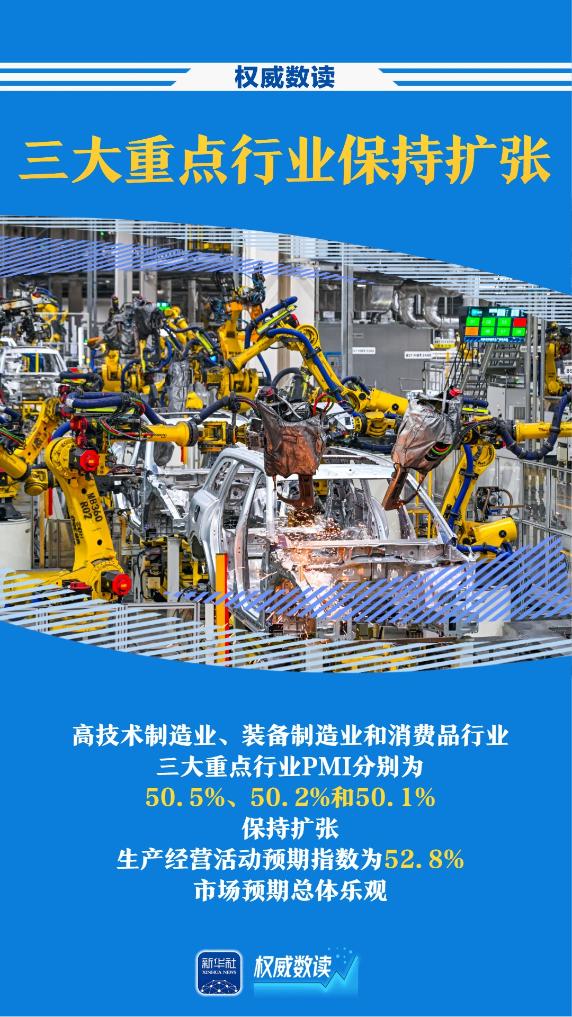
Core Insights - The PMI index for October indicates that high-tech manufacturing, equipment manufacturing, and consumer goods industries continue to expand, significantly above the overall manufacturing level, reflecting sustained industry support and overall optimistic market expectations [1][4]. Group 1: Key Industry Performance - The PMI for high-tech manufacturing, equipment manufacturing, and consumer goods industries are reported at 50.5%, 50.2%, and 50.1% respectively, indicating continued expansion [4]. - The production and business activity expectation index stands at 52.8%, suggesting a positive outlook for market activities [4]. Group 2: Non-Manufacturing Sector - The non-manufacturing business activity index has slightly rebounded to 50.1%, an increase of 0.1 percentage points from the previous month, entering the expansion zone [9]. - The service industry business activity index is reported at 50.2%, also reflecting a 0.1 percentage point increase from last month, continuing its expansion [9].
10月PMI数据点评:“十四五”收官的两个月,关注宏观政策的逆周期调节和跨周期部署
Bank of China Securities· 2025-10-31 09:11
Manufacturing Sector - The October Manufacturing PMI index is at 49.0%, a decrease of 0.8 percentage points from September[2] - The production index for October is 49.7%, down 2.2 percentage points month-on-month[2] - The new orders index stands at 48.8%, reflecting a decline of 0.9 percentage points, with new export orders at 45.9%, down 1.9 percentage points[2] - The raw material inventory index is at 47.3%, a decrease of 1.2 percentage points[2] Non-Manufacturing Sector - The October Non-Manufacturing PMI index is at 50.1%, a slight increase of 0.1 percentage points, remaining above the threshold[10] - The new orders index for non-manufacturing is at 46.0%, unchanged from September, while the new export orders index is at 46.2%, down 3.6 percentage points[10] - The construction sector's PMI index is at 49.1%, a decrease of 0.2 percentage points, indicating continued contraction[13] Economic Outlook - The report emphasizes the importance of macroeconomic policies for counter-cyclical adjustment and cross-cycle deployment as the "14th Five-Year Plan" concludes[1] - A total of 500 billion yuan has been allocated for local government debt to support effective investment, indicating ongoing efforts to stabilize growth[1] - The business activity expectation index for the service sector is at 56.1%, indicating strong confidence among service enterprises[15]
权威数读丨10月份PMI出炉,三大重点行业保持扩张
Xin Hua Wang· 2025-10-31 08:59
Core Viewpoint - The PMI index for October indicates that high-tech manufacturing, equipment manufacturing, and consumer goods industries continue to expand, significantly above the overall manufacturing level, reflecting sustained industry support and overall optimistic market expectations [1][3][5]. Group 1: PMI Data - The PMI for high-tech manufacturing, equipment manufacturing, and consumer goods industries are 50.5%, 50.2%, and 50.1% respectively, indicating continued expansion [5]. - The production and business activity expectation index stands at 52.8%, suggesting a positive outlook for market activities [5]. Group 2: Non-Manufacturing Sector - The non-manufacturing business activity index is at 50.1%, an increase of 0.1 percentage points from the previous month, indicating a return to the expansion zone [10]. - The service industry business activity index is at 50.2%, also up by 0.1 percentage points from last month, continuing its expansion [10].