电子信息

Search documents
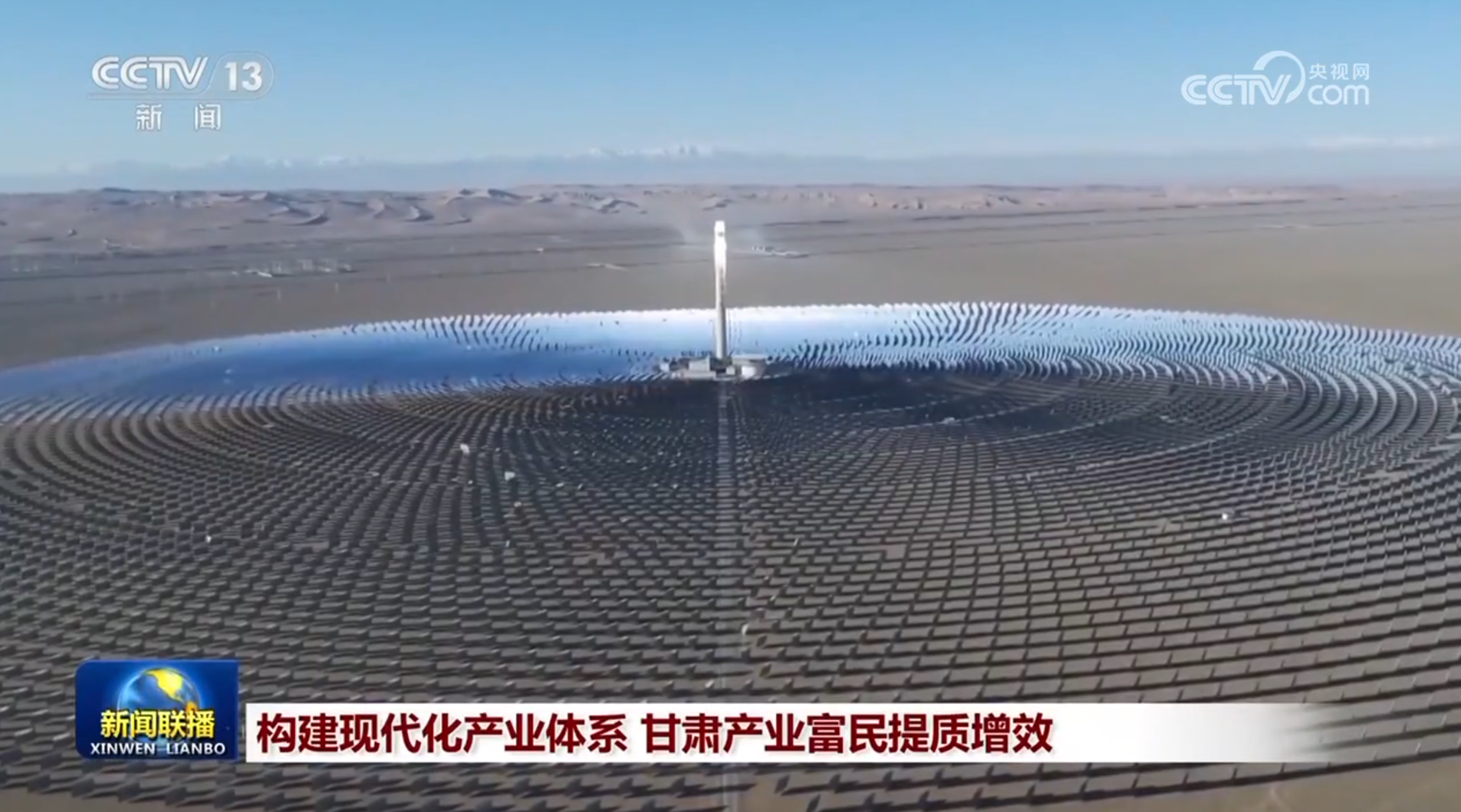
构建现代化产业体系 甘肃产业富民提质增效
Yang Shi Wang· 2025-10-07 12:45
Group 1: Technological and Industrial Development - Gansu has accelerated the integration of technological innovation and industrial innovation since the "14th Five-Year Plan," focusing on developing new productive forces tailored to local conditions [1] - Strategic emerging industries such as new energy, new materials, and electronic information have developed rapidly in Gansu [1] - By the end of August 2025, Gansu is expected to have added nearly 51 million kilowatts of new energy installed capacity, bringing the total to 74.6323 million kilowatts, with new energy accounting for 65.17% of the total installed capacity, ranking among the top in the country [1] - The national integrated computing power network hub node (Gansu·Qingyang) has become the fastest-growing and largest data center cluster in the country [1] Group 2: Agricultural Development and Rural Income - Gansu has further strengthened modern cold and drought-resistant agriculture since the "14th Five-Year Plan," with the total output value of the "cattle, sheep, vegetables, fruits, tubers, and medicinal herbs" industry chain reaching 492.8 billion yuan [3] - The sales revenue of characteristic "Gansu flavor" agricultural product brands has surpassed 30 billion yuan, continuously promoting the quality and efficiency of modern agriculture [3] - In 2024, Gansu achieved a per capita disposable income of rural residents of 14,105 yuan, a year-on-year increase of 7.4%, and a growth of 36.4% compared to 2020 [3]

什么是西部大开发概念,涵盖哪些产业链
Sou Hu Cai Jing· 2025-10-07 01:12
Core Insights - The Western Development Strategy is a long-term policy initiated in 2000 aimed at reducing the development gap between eastern and western regions of China, promoting comprehensive economic and social progress in central and western areas [1][2] - The strategy has attracted significant attention from the capital markets, presenting new development opportunities in the context of the latest round of policy implementation [1] Infrastructure Development - Infrastructure construction is a key focus area, encompassing transportation, energy, water conservancy, and new infrastructure, which drives the growth of related industries such as building materials and engineering machinery [1] - Continuous improvements in highways, railways, and airports are facilitating the development of these sectors [1] Clean Energy and Resource Utilization - The western region is rich in wind and solar resources, making clean energy a priority for development, with significant growth potential in wind power, photovoltaics, and energy storage [1] - Advanced manufacturing and high-tech industries are being actively developed, leveraging resource advantages and policy support [1] Emerging Industries - New industries such as electronic information, new materials, and biomedicine are gradually forming agglomeration effects in the western regions [1] - Modern agriculture is also transforming under policy support, with the extension of specialty agricultural product cultivation and deep processing industry chains contributing to rural revitalization [1] Ecological Protection - Ecological protection is a crucial component of the Western Development Strategy, with ongoing projects in reforestation, soil and water conservation, and desertification control, which in turn foster the growth of the environmental protection industry [1] - The development process is guided by green and low-carbon principles, promoting energy-saving transformations in traditional industries and the establishment of a circular economy [1] Investment Perspective - Understanding the industrial logic behind the Western Development Strategy is essential for investors, as policy dividends often create long-term structural opportunities [2] - Investment should focus on areas with real performance support and sustainable growth, avoiding the temptation of short-term trends [2] - The strategy not only serves as a key measure for regional coordinated development but also provides a diversified investment perspective for the capital market [2]
贵州贸易结构持续优化
Jing Ji Ri Bao· 2025-10-07 00:32
Core Insights - Guizhou Province's foreign trade import and export total increased by 12.8% year-on-year in the first half of this year, ranking among the top in the country [1] - The province's export total reached 26.905 billion yuan, with a year-on-year growth of 14%, contributing 70.41% to the overall foreign trade growth [1] - The export structure is evolving, with a notable reliance on export expansion and optimization of trade structure, highlighting the characteristics of an open inland economy [1] Export Performance - Guizhou exported 3,096 types of products to 209 countries and regions, indicating a significant increase in international influence [1] - Traditional products continue to play a stabilizing role, while high-value products like lithium-ion batteries are emerging as new growth engines, primarily exported to Spain, the UK, India, and Vietnam [1] Market Diversification - Southeast Asia is the largest export market for Guizhou, contributing 30.77% to export growth, followed by South America at 25.20% [2] - Traditional trading partners such as the US, Thailand, and Vietnam maintain their importance, while exports to Africa, Latin America, and Europe are increasing, forming a diversified global trade network [2] Industry Highlights - The food and beverage sector, a key industry in Guizhou, exported to 75 countries and regions, totaling 3.590 billion yuan [2] - Sturgeon and other specialty aquatic products have seen significant export growth, with 2023 export volume ranking first in the country, showcasing Guizhou's ecological resource advantages [2] Future Outlook - Guizhou aims to leverage its industrial advantages in phosphate chemicals, equipment manufacturing, electronic information, and specialty foods to meet diverse market demands [2] - The province plans to utilize policy benefits from the China-ASEAN Free Trade Area, establish overseas warehouses, and develop cross-border e-commerce to reduce logistics costs and enhance market responsiveness [2]
贵州贸易结构持续优化 上半年出口总额同比增长14%
Jing Ji Ri Bao· 2025-10-06 22:03
Core Insights - Guizhou Province's foreign trade import and export total increased by 12.8% year-on-year in the first half of this year, ranking among the top in the country [1] - The province's export performance was particularly strong, with a total export value of 26.905 billion yuan, a year-on-year increase of 14%, contributing 70.41% to the overall foreign trade growth [1] - The export structure is evolving, with a notable reliance on export expansion and continuous optimization of trade structure, highlighting the characteristics of an open inland economy [1] Export Performance - Guizhou exported 3,096 types of products to 209 countries and regions, indicating a significant enhancement in international competitiveness [1] - Traditional advantageous products continue to play a stabilizing role, while high-value-added products like lithium-ion batteries have emerged as new growth engines, primarily exported to Spain, the UK, India, and Vietnam [1] Market Diversification - Southeast Asia is the largest export market for Guizhou, contributing 30.77% to the export growth, followed by South America at 25.20% [2] - Traditional trading partners such as the US, Thailand, and Vietnam maintain their importance, while exports to Africa, Latin America, and Europe are increasing, indicating a diversified global trade network [2] Industry Highlights - The food and beverage sector, a key industry in Guizhou, exported to 75 countries and regions, totaling 3.590 billion yuan [2] - Unique aquatic products, such as sturgeon, have seen significant export growth, positioning Guizhou as a leader in this sector among inland provinces [2] Future Outlook - Guizhou aims to leverage its industrial advantages in phosphate chemicals, equipment manufacturing, electronic information, and specialty foods to meet diverse market demands [2] - Strategies include utilizing the China-ASEAN Free Trade Area policies, establishing overseas warehouses, and engaging in cross-border e-commerce to reduce logistics costs and enhance market responsiveness [2]
河北邢台以链招商力促两大产业聚链成群
Xin Lang Cai Jing· 2025-10-06 03:11
Core Insights - The project in Xingtai Economic Development Zone is the first hydrogen energy industrial park built by China Shipbuilding Group in North China, with a total investment of 6.07 billion yuan, aiming to be fully operational by next year to support green hydrogen applications in the Beijing-Tianjin-Hebei region [1] Investment and Development - A series of new energy equipment and electronic information industry projects are currently under construction in Xingtai, showcasing unprecedented growth momentum [1] - In February, the Taihang Intelligent Computing Center in Xingtai High-tech Zone was launched with a total investment of 5 billion yuan, achieving a computing power of 2000P, which has now reached 4000P [1] - In June, the first phase of the new energy equipment production base project by CRRC Zhuzhou Institute in Xingtai Economic Development Zone began trial production, delivering large wind turbine blades [1] - Since last year, Xingtai has implemented 28 new energy equipment industry projects with a total investment of 69.287 billion yuan [1] - This year, there are 36 electronic information industry projects under construction in Xingtai, each with an investment of over 100 million yuan, totaling 11.38 billion yuan [1]
先进制造业 成都如何从区域中心到全国基地
Si Chuan Ri Bao· 2025-10-05 01:45
Core Insights - The establishment of the first 8.6-generation AMOLED display production line in Chengdu is expected to significantly enhance the city's position as a leading flexible panel production base in China [1] - Chengdu's industrial growth is crucial for its economic development, with a 1% increase in industrial value added potentially driving a 0.5% increase in overall economic growth [1] - The provincial government has issued guidelines to strengthen Chengdu's advanced manufacturing capabilities, emphasizing the need for a modern industrial system [2][3] Industrial Development - Chengdu has a rich industrial history and has developed a robust industrial foundation, including five national advanced manufacturing clusters and two strategic emerging industry clusters [2] - Despite its industrial achievements, Chengdu's industrial proportion has declined from a peak of 25% in 2012 to around 15%, indicating a need for revitalization [2] - The city aims to enhance its industrial base by focusing on manufacturing and industrial growth as a priority [3] Industrial Park Strategy - The transformation of industrial space from scattered to concentrated is a key focus, with industrial parks serving as the main battleground for this change [4] - The city has initiated a significant restructuring of its industrial parks, reducing the number from over 90 to 51, and establishing a new system of "3+22+N" [5] - This restructuring aims to enhance the focus and efficiency of industrial parks, supporting the overall goal of building a national advanced manufacturing base [5][6] Industry Chain Enhancement - Chengdu's development path emphasizes high-quality, high-value-added advanced manufacturing, driven by technological innovation [7] - The city has identified key industry clusters, including electronic information and equipment manufacturing, and aims to elevate the electronic information industry to a world-class level [8] - A modern industrial system is being constructed, focusing on nine major advantageous industry clusters and nine strategic emerging industry clusters [8] Corporate Development - The lack of significant local enterprises in Chengdu poses a challenge for its industrial competitiveness, with only six companies listed in the 2024 China Top 500 Private Enterprises [10] - The government aims to attract major enterprises and enhance the capabilities of local companies through a "big and small" development strategy [10] - Emphasis is placed on promoting high-quality products in key sectors such as flexible displays and industrial drones to drive industrial growth [11]
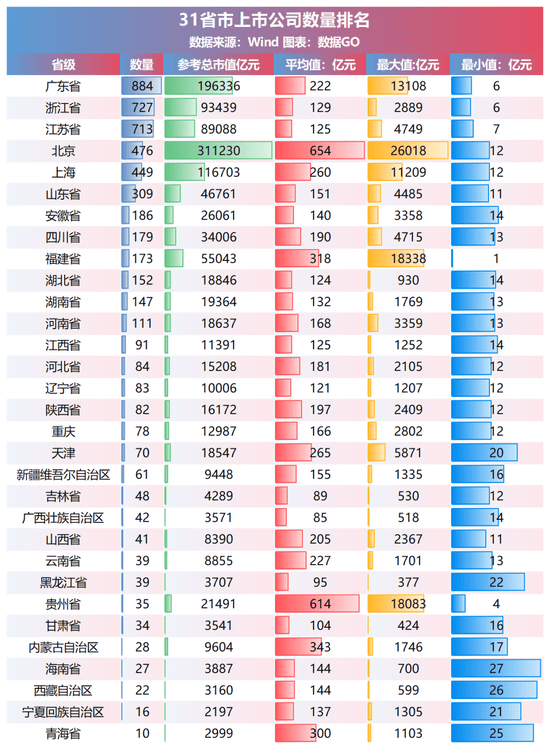
31省市上市公司数量排名:广东884家居首 头部企业带动效应显著
Sou Hu Cai Jing· 2025-10-05 00:15
Core Insights - The article highlights the significant disparities in the development of capital markets and company sizes across different regions in China, with coastal areas leading in the number of listed companies and total market capitalization [1][2][6]. Group 1: Number of Listed Companies - Guangdong (884), Zhejiang (727), and Jiangsu (713) are the top three provinces in terms of the number of listed companies, indicating a high level of economic activity and capital market participation in these eastern coastal regions [1]. - Western regions such as Qinghai (10), Ningxia (16), and Tibet (22) have significantly fewer listed companies, reflecting a gap in economic foundation and capital market engagement [1]. Group 2: Total Market Capitalization - Beijing leads with a total market capitalization of 311,230 billion, supported by numerous state-owned enterprises and leading tech companies, while Guangdong follows with nearly 200,000 billion, benefiting from a large base of companies [2][6]. - The presence of "super-large" listed companies in regions like Beijing (26,018 billion), Fujian (18,338 billion), and Guizhou (18,083 billion) significantly boosts regional total market capitalization [4]. Group 3: Average Market Value - Beijing (654 billion) and Guizhou (614 billion) have the highest average market values, indicating larger overall company sizes, while cities like Jilin (89 billion) and Guangxi (85 billion) show lower averages, suggesting smaller company sizes [3][9]. - The average values in municipalities such as Shanghai (260 billion) and Tianjin (265 billion) also reflect higher overall company quality [3]. Group 4: Extremes in Market Values - The maximum market value in Beijing (26,000 billion) and Shenzhen (13,000 billion) highlights the dominance of leading companies, while the minimum value in Fujian (1 billion) indicates the presence of very small companies [4][9]. - Regions like Hainan (27 billion) and Qinghai (25 billion) have relatively higher minimum values, suggesting a more stable lower limit for listed companies in these areas [4]. Group 5: Regional Disparities and City Effects - Major cities like Beijing, Shanghai, and Shenzhen dominate both the number of listed companies and total market capitalization, showcasing a "siphoning effect" where first-tier cities attract significant capital and industry resources [5][9]. - Emerging cities in the Yangtze River Delta and Pearl River Delta, such as Hangzhou (232) and Suzhou (225), are also performing well, indicating a trend of capital market growth driven by manufacturing and new industries [5][9]. Group 6: District-Level Insights - Core districts like Haidian (167), Pudong (158), and Nanshan (143) show a high concentration of listed companies, driven by technology and financial resources [10][12]. - Districts in the Yangtze River Delta and Pearl River Delta are forming clusters of listed companies due to industrial upgrades, while areas like Beijing's Xicheng and Dongcheng benefit from the presence of state-owned enterprises and financial institutions [12][15].
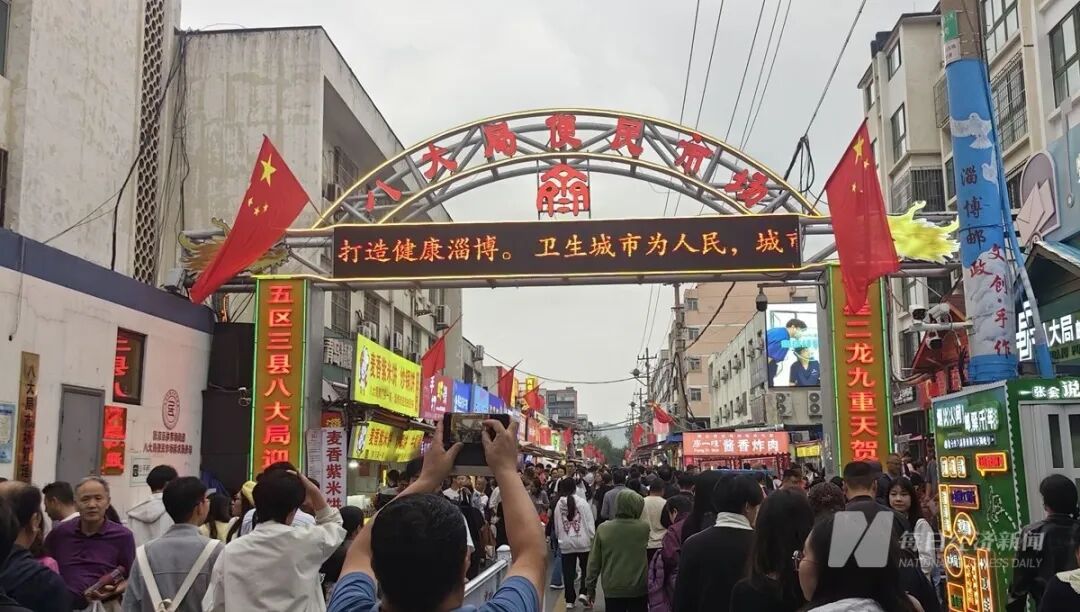
淄博凉了?记者实探:烧烤店“下午5点就排队,凌晨2点才收摊”,博物馆被挤爆!当地:已实现从“网红”到“长红”关键一步
Mei Ri Jing Ji Xin Wen· 2025-10-04 12:53
Core Insights - The article discusses the transformation of the city of Zibo from a "viral city" driven by its barbecue culture to a more sustainable and diversified urban identity, focusing on long-term development strategies rather than short-term trends [2][20]. Group 1: Zibo's Viral Phenomenon - Zibo became a phenomenon in early 2023 due to its barbecue culture, attracting significant attention and visitors [2][5]. - The city has experienced fluctuations in its popularity, with discussions about its status as a "viral city" becoming common [2][6]. - Despite concerns about declining interest, Zibo has maintained a steady flow of visitors during peak seasons, indicating a resilient tourism sector [5][11]. Group 2: Strategic Shift in Development - Zibo's government has shifted its focus from short-term viral trends to long-term industrial and cultural development, emphasizing "new quality productivity" and manufacturing upgrades [2][10]. - The city has established a "high-quality development command" to enhance its cultural and tourism sectors, reflecting a strategic pivot from merely capitalizing on barbecue fame to fostering a broader cultural identity [9][10]. - The local government aims to transform the influx of visitors into sustained interest in the city's diverse offerings, moving beyond the barbecue label [11][12]. Group 3: Economic Impact and Growth - In 2023, Zibo's retail sales of consumer goods increased by 9.6%, with significant growth in the accommodation and catering sectors, indicating a positive economic impact from the viral phenomenon [6][10]. - The city has set ambitious tourism goals, aiming to attract 65 million visitors and achieve over 64 billion yuan in tourism revenue by 2026 [10][18]. - Zibo's industrial transformation is evident, with the contribution of its four key industries rising from 48.9% to 59.8% of the city's industrial output from 2021 to 2024 [17][18]. Group 4: Talent Attraction and Future Prospects - Zibo has implemented policies to attract young talent, successfully bringing in over 40,000 graduates annually, which supports its industrial and economic transformation [18][19]. - The city has established a clear development goal to achieve a GDP of over 700 billion yuan and to join the "trillion GDP club" within the next decade [19][20]. - Zibo's approach to leveraging its viral status as a catalyst for broader economic and cultural development serves as a model for other cities [20][21].
徐州鼓楼AI生态再升级
Xin Hua Ri Bao· 2025-10-03 18:52
Core Insights - The 2025 Xuzhou Ninth Artificial Intelligence Conference was successfully held, focusing on the theme "Intelligence Starts in Gulou + Accelerating the Future," gathering experts and entrepreneurs to explore new paths for technology integration and industry development [1] - Several high-quality projects in cutting-edge fields such as intelligent manufacturing, low-altitude economy, and smart healthcare were signed, injecting new momentum into Xuzhou's AI industry [1] Industry Development - Gulou District has established a clear "dual-driven" path of urban industrial and modern service industries, focusing on three leading industries: semiconductor equipment and advanced packaging, electronic information and digital economy, and smart medical devices [1] - Strategic emerging industries in the district have grown by 49.8% this year, while high-tech industries have increased by 23.7%, accounting for over 50% of the total industrial output value [1] Policy and Support - The local government has implemented a policy system of "rent discounts + financial support + open scenarios" to cultivate provincial-level innovation spaces and incubators, establish industrial investment funds, and create a "precise demand" enterprise service mechanism to optimize the business environment [2] - Major projects, including the AI Intelligent Manufacturing Industrial Base and the Jingye Health Equipment Manufacturing Base, are progressing rapidly, with expectations to attract over 200 upstream and downstream enterprises in intelligent manufacturing and life health sectors [2]
城市24小时 | “工业第一城”,继续“拥抱”传统产业
Mei Ri Jing Ji Xin Wen· 2025-09-30 15:52
Core Insights - Shenzhen aims to leverage its rich innovation resources and diverse industrial categories to upgrade traditional industries, targeting a total scale of over 700 billion yuan in three years [1][2] - The city plans to implement 12 policy measures, including the establishment of various investment funds to support mergers and acquisitions in traditional industries [1][2] - Shenzhen's advanced manufacturing and high-tech manufacturing account for 68.2% and 58.2% of the city's industrial added value, respectively [1] Group 1: Traditional Industry Development - Shenzhen has a strong presence in traditional industries such as high-end women's clothing, jewelry, and eyewear, with the jewelry industry leading the nation in annual industrial output [2] - The city will implement an action plan to integrate artificial intelligence into various traditional sectors, aiming to digitize over 100 traditional enterprises within three years [2][3] - The government encourages the fusion of traditional manufacturing with new technologies and high-performance materials, targeting the creation of over 100 cross-industry fashionable products by 2027 [3] Group 2: Investment and Policy Measures - Shenzhen will utilize strategic emerging industry funds to support state-owned enterprises and traditional industry leaders in establishing acquisition funds [1] - The investment model will combine government guidance, listed company capital, and professional investment institutions to nurture high-potential enterprises [1] - The city has previously recognized the importance of both traditional and emerging industries as components of a modern industrial system, indicating a balanced approach to industrial development [5]