
交通运输

Search documents
大众交通:截至目前公司未涉及充换电业务
Zheng Quan Shi Bao Wang· 2025-10-22 08:02
Core Viewpoint - As of October 22, the company has confirmed that it is not involved in the charging and battery swapping business [1] Group 1 - The company, Dazhong Transportation, stated on its interactive platform that it has not engaged in any charging or battery swapping operations to date [1]

大众交通(600611.SH):未涉及充换电业务
Ge Long Hui· 2025-10-22 07:40
格隆汇10月22日丨大众交通(600611.SH)在互动平台表示,截至目前,我公司未涉及充换电业务。 ...
湖北前三季度GDP增长6% 保持大省领先中部领跑态势
Chang Jiang Ri Bao· 2025-10-22 07:06
Economic Overview - Hubei Province achieved a GDP of 44,875.62 billion yuan in the first three quarters, with a year-on-year growth of 6.0% at constant prices [1] - The GDP growth rate accelerated by 0.2 and 0.3 percentage points compared to the previous year and the same period last year, respectively, and is 0.8 percentage points higher than the national average [1] Industry Performance - The primary industry added value was 3,855.36 billion yuan, growing by 3.2%, while the secondary industry increased by 5.9% to 17,072.96 billion yuan, and the tertiary industry grew by 6.5% to 23,947.30 billion yuan [1] - Industrial output for large-scale enterprises increased by 7.7%, with high-tech manufacturing leading the growth at 13.5%, contributing 26.7% to the overall industrial growth [2] - Key products such as lithium batteries, new energy vehicles, and smartphones saw production increases of 42.8%, 24.0%, and 20.0%, respectively [2] Service Sector - The service sector's added value grew by 6.5%, with significant contributions from transportation, warehousing, and postal services (10.1%), wholesale and retail (5.7%), accommodation and catering (4.1%), and finance (5.1%) [2] Investment and Consumption - Fixed asset investment rose by 6.5%, with manufacturing investment showing a notable increase of 12.5% [2] - The total retail sales of consumer goods reached 19,533.95 billion yuan, growing by 5.2%, with rapid sales growth in home appliances and furniture related to the old-for-new policy [2] - The total import and export volume was 6,176.9 billion yuan, marking a growth of 25.3%, with exports increasing by 30.8% [2] Employment and Income - The employment situation remained stable, with 816,100 new urban jobs created [2] - The per capita disposable income for residents was 28,036 yuan, reflecting a year-on-year growth of 5.3%, while the income gap between urban and rural residents continued to narrow [2] Future Outlook - The overall economic performance in the first three quarters indicates steady progress, with a focus on maintaining stability while pursuing growth [3] - The province aims to continue promoting stable growth, risk prevention, and livelihood protection to achieve sustainable and healthy economic development [3]
前三季度北京地区生产总值同比增5.6%
Zhong Guo Xin Wen Wang· 2025-10-22 06:30
Economic Growth - Beijing's GDP for the first three quarters reached 38,415.9 billion RMB, with a year-on-year growth of 5.6% [1] - The primary industry saw a decrease in value added by 1.1%, while the secondary industry grew by 4.0% to 5,055.9 billion RMB, and the tertiary industry increased by 5.8% to 33,282.0 billion RMB [1] Sector Performance - The information transmission, software, and IT services sector achieved a value added of 9,225.5 billion RMB, growing by 11.2%, contributing significantly to the tertiary industry's growth [1] - The financial sector's value added reached 6,700.0 billion RMB, with a growth rate of 9.0%, together with the information sector, accounting for nearly 80% of the tertiary industry's growth [1] - The rental and business services sector grew by 3.9% to 2,114.8 billion RMB, while transportation, warehousing, and postal services increased by 7.9% to 1,056.0 billion RMB [1] Investment and Consumption - Fixed asset investment in Beijing (excluding rural households) grew by 9.0%, with equipment purchase investment surging by 83.1%, now accounting for 29.3% of total fixed asset investment [2] - Total market consumption in Beijing increased by 0.5%, driven by a 4.8% rise in service consumption, while retail sales of consumer goods totaled 9,803.1 billion RMB, declining by 5.1% [2] - The per capita disposable income of Beijing residents reached 67,206 RMB, marking a growth of 4.5%, with a real growth of 4.9% after adjusting for price factors [2]
GDP同比增长5.5% 上海2025年前三季度经济数据出炉
Zhong Guo Xin Wen Wang· 2025-10-22 03:50
Economic Growth - Shanghai's GDP for the first three quarters of 2025 reached 40,721.17 billion yuan, with a year-on-year growth of 5.5%, surpassing the national average by 0.3 percentage points [1][2] - The primary industry added value was 64.26 billion yuan, growing by 0.9%; the secondary industry added value was 8,448.67 billion yuan, growing by 3.9%; and the tertiary industry added value was 32,208.24 billion yuan, growing by 5.9% [1] Industrial Performance - The industrial added value in Shanghai increased by 5.2% year-on-year, with the total output value of above-scale industries growing by 5.7%, an increase of 0.1 percentage points compared to the first half of the year [1] - The three leading industries in manufacturing saw an output value growth of 8.5%, outpacing the overall growth of above-scale industrial output value by 2.8 percentage points [1] Tertiary Sector Insights - The tertiary sector's added value grew by 5.9% year-on-year, with significant contributions from the information transmission, software, and IT services sector, which saw a 15.5% increase in added value [1] - The financial sector's added value reached 6,965.27 billion yuan, growing by 9.8%, while transportation, storage, and postal services increased by 5.2% [1] Investment and Consumption - Fixed asset investment in Shanghai increased by 6.0% year-on-year, while the total retail sales of social consumer goods reached 12,302.77 billion yuan, growing by 4.3%, with an acceleration of 2.6 percentage points compared to the first half of the year [2] - The average urban survey unemployment rate in Shanghai was 4.2% [2] Financial Market and Budget - The transaction volume in major financial markets in Shanghai grew by 12.7% year-on-year [2] - Local general public budget revenue was 6,555.68 billion yuan, a 1.0% increase, while expenditures rose by 8.0% to 6,876.39 billion yuan [2]
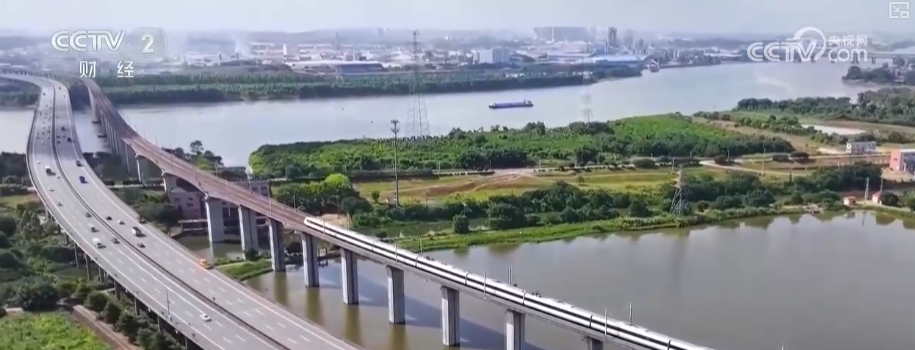
从“线”到“网”跃升!保民生促发展 粤港澳大湾区交通网越织越密
Yang Shi Wang· 2025-10-22 02:18
Core Insights - Infrastructure investment in China is steadily increasing, with a focus on enhancing public welfare and connectivity in the Guangdong-Hong Kong-Macao Greater Bay Area [1] - The opening of five new subway lines in Guangzhou has improved connectivity among six cities, contributing to the development of a "railway network" in the Greater Bay Area [3] - The construction of the Lion Rock Channel, a significant dual-layer highway project, is progressing, with expectations to create multiple world records upon completion [7][8] Infrastructure Investment - In the first three quarters of the year, Guangdong's transportation investment exceeded 130 billion yuan, maintaining a high level of activity [10] - The Lion Rock Channel's main bridge construction has surpassed 30% completion, with significant structural advancements already made [8] Transportation Connectivity - The Greater Bay Area's intercity railway network has evolved from a "line" to a "network," enabling a "one-hour living circle" for residents [5] - Future developments in Guangzhou's subway system will further enhance connectivity within the Greater Bay Area [5] Major Projects - The Lion Rock Channel will be the first dual-layer composite highway in the Pearl River Estuary, featuring a total length of approximately 35 kilometers and designed for 16 lanes [7] - The main span of the Lion Rock Channel will measure 2,180 meters, with a main tower height of 342 meters, setting five world records upon completion [7][8]

江西国资国企高质量发展迈出坚实步伐
Sou Hu Cai Jing· 2025-10-21 23:27
Core Insights - The article highlights the significant progress made by Jiangxi's state-owned enterprises (SOEs) in achieving high-quality development during the "14th Five-Year Plan" period, with total assets exceeding 10 trillion yuan and operating income surpassing 1.4 trillion yuan [1][2] Group 1: Enhancing Core Functions of SOEs - Jiangxi has focused on enhancing the core functions of SOEs by optimizing their layout and structure, resulting in over 97% of provincial SOEs' investments being concentrated in their main business areas [2][3] - The establishment of the Jiangxi Long Travel Group aims to position itself as a leading comprehensive tourism service provider in China, focusing on the entire tourism and health industry chain [2] Group 2: Improving Core Competitiveness - The digital transformation of SOEs has accelerated, with 53 enterprises achieving a digital maturity level of L6 or above, and 29 recognized as digital transformation benchmarks [3][4] - SOEs have actively supported the digital transformation of over 1,100 enterprises in the province, signing nearly 500 digital transformation projects [3] Group 3: Governance and Reform - Jiangxi has advanced its SOE reform actions, establishing a modern enterprise system characterized by improved board governance and enhanced regulatory oversight [6][7] - The province has implemented a "1+3+N" evaluation system for SOE performance, strengthening the governance framework and ensuring effective management [6] Group 4: Technological Innovation - SOEs have been pivotal in driving technological innovation, with significant investments in research and development, resulting in multiple national and provincial awards for technological advancements [5][4] - Jiangxi Copper Group has achieved a historic breakthrough by leading a major national scientific project, reflecting the province's commitment to innovation [5]
陆家嘴财经早餐2025年10月22日星期三
Wind万得· 2025-10-21 22:47
Group 1 - The US President Trump plans to visit China early next year, emphasizing the importance of high-level diplomatic communication in US-China relations [2] - The Chinese Ministry of Commerce held a video conference with EU officials to discuss key trade issues, including export controls and the EU's anti-subsidy measures against Chinese electric vehicles [2] - The Chinese government is enhancing its export control system in response to international obligations, while urging the Netherlands to resolve semiconductor-related issues to maintain global supply chain stability [2] Group 2 - The precious metals market experienced a significant decline, with spot gold dropping as much as 6.3% to approximately $4080 per ounce, marking the largest single-day drop in over 12 years [3] - Spot silver fell by 8.7% to $47.89 per ounce, the worst single-day performance since February 2021, driven by reduced safe-haven demand and a stronger dollar [3] - COMEX gold and silver futures also saw substantial declines, with gold futures down 5.07% to $4138.5 per ounce and silver futures down 6.27% to $48.16 per ounce [3] Group 3 - The Ministry of Commerce held a roundtable meeting with over 170 foreign enterprises, emphasizing China's commitment to maintaining global supply chain stability through responsible export control measures [4] - Domestic tourism in China saw significant growth, with 4.998 billion trips taken in the first three quarters, an increase of 18% year-on-year, and total spending reaching 4.85 trillion yuan, up 11.5% [4] - The People's Bank of China plans to accelerate legislation in key and emerging areas to enhance the financial legal system and support high-quality financial development [4] Group 4 - The A-share market saw a strong upward trend, with the Shanghai Composite Index rising 1.36% to 3916.33 points, driven by interest in technology stocks and consumer themes [5] - The Hong Kong Hang Seng Index closed up 0.65% at 26027.55 points, with significant gains in major financial stocks [5] - A total of 843 A-share companies announced mid-term dividend plans, with a total dividend amount of 662.03 billion yuan, indicating a trend of high amounts and frequency of dividends [6] Group 5 - A report predicts that Wuliangye's third-quarter revenue may decline by 30% year-on-year, with net profit expected to drop by 45% [7] - Changxin Storage, a leading Chinese memory chip manufacturer, plans to launch an IPO on the Shanghai Stock Exchange, targeting a valuation of 300 billion yuan [7] - Pop Mart anticipates a 245%-250% year-on-year increase in overall revenue for the third quarter, with significant growth in both domestic and overseas markets [7] Group 6 - China Telecom reported a third-quarter net profit of 7.756 billion yuan, a year-on-year increase of 3.6% [9] - Wens Foodstuff Group's third-quarter net profit fell by 65.02%, with a proposed dividend of 3 yuan per share [9] - China Giant Glass reported a 54.06% year-on-year increase in net profit for the third quarter [9] Group 7 - The National Medical Products Administration plans to enhance the legal standards for medical devices and accelerate the approval process for innovative products [10] - The total asset management scale of the trust industry in China is expected to reach 32.43 trillion yuan by June 2025, marking a 20.11% year-on-year growth [10] - Guangzhou has announced plans to develop six core future industries, including intelligent systems and quantum technology [10] Group 8 - The US stock market showed mixed results, with the Dow Jones rising 0.47% while the Nasdaq fell 0.16% [17] - Japan's Nikkei 225 index closed above 49000 points for the first time, reflecting investor optimism regarding the new prime minister's fiscal policies [17] - European stock indices experienced slight gains, supported by strong performances in the technology and luxury goods sectors [17]
央企控股上市公司 ESG报告披露率近全覆盖
Zhong Guo Zheng Quan Bao· 2025-10-21 20:29
近日,为促进ESG研究成果进一步落地应用,充分发挥评价体系对央企可持续发展的引导作用,助力央 企实现高质量发展,由国务院国资委研究中心指导、国新证券股份有限公司承办的《央企控股上市公司 ESG评价体系研究》课题发布会在京召开。 课题研究发现,央企控股上市公司在中国资本市场中承担着"压舱石"功能、发挥着"稳定器"作用。截至 2025年7月,379家央企控股上市公司已发布了2024年度ESG相关报告,披露率基本实现全覆盖。2024年 度,央企控股上市公司的ESG相关报告整体披露质量良好,交通运输行业报告披露质量表现突出。 ESG发展迈入黄金期 近年来,央企ESG信息披露政策要求不断完善。2022年,国务院国资委制定印发《提高央企控股上市公 司质量工作方案》提出了中央企业ESG发展的目标和任务;2024年,国务院国资委制定印发《关于新时 代中央企业高标准履行社会责任的指导意见》,明确要求推动控股上市公司围绕ESG议题高标准落实环 境管理要求、积极履行社会责任、健全完善公司治理,加强高水平ESG信息披露,不断提高ESG治理能 力和绩效水平,增强在资本市场的价值认同。 研究中心课题组构建了本土化的ESG评价体系,不仅反 ...
央企控股上市公司ESG报告披露率近全覆盖
Zhong Guo Zheng Quan Bao· 2025-10-21 20:18
Core Insights - The research highlights the importance of ESG (Environmental, Social, and Governance) evaluation systems for state-owned enterprises (SOEs) in China, emphasizing their role in sustainable development and high-quality growth [1][2][3] Group 1: ESG Evaluation and Reporting - By July 2025, 379 SOE-controlled listed companies are expected to release their 2024 ESG reports, achieving nearly full disclosure [1] - The overall quality of ESG reports from SOE-controlled listed companies is deemed good, with the transportation sector showing particularly high quality [1][3] - A localized ESG evaluation system has been developed, with 34.62% of A-share listed companies rated BBB or above, aligning with international standards [2] Group 2: Trends and Improvements - Since 2021, the average ESG rating for SOEs has been on the rise, with over 85% achieving BBB or higher ratings [2] - The transportation industry leads in ESG report quality with an average score of 75, followed by the oil and coal sectors with scores of 73 and 72, respectively [3] Group 3: Challenges and Recommendations - Data governance and strategic planning need enhancement, as some companies lack comprehensive ESG data collection systems, affecting report completeness [4] - Companies are encouraged to adopt suitable ESG standards, create an ESG indicator library, and conduct regular data collection and verification to improve report quality [4][5]