
非银金融

Search documents
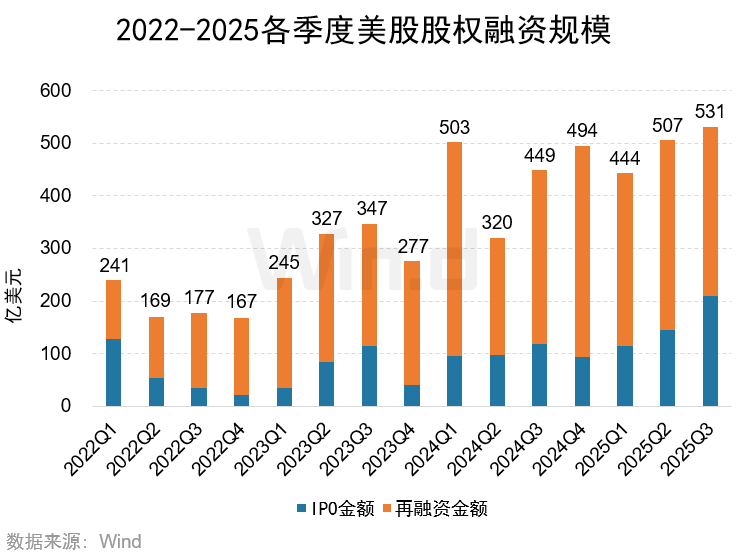
2025年前三季度美股市场股权融资规模总计1481亿美元
Zhi Tong Cai Jing· 2025-10-13 23:32
Core Insights - The U.S. equity underwriting market showed strong performance in the first three quarters of 2025, with total equity financing (including IPOs and refinancing) amounting to $148.1 billion, an increase of $20.9 billion or 16.40% year-over-year [1][3][38]. Equity Financing Overview - Total equity financing in the U.S. for the first three quarters of 2025 reached $148.1 billion, with IPOs contributing $46.9 billion (up 50.07% year-over-year) and refinancing totaling $101.2 billion (up 5.42% year-over-year) [3][7][38]. - The non-bank financial sector led the fundraising with $49.9 billion, followed by software services at $18.4 billion and pharmaceuticals at $13.8 billion [10][45]. IPO Market Analysis - A total of 310 companies went public in the first three quarters of 2025, an increase of 128 companies compared to the previous year [15]. - The Nasdaq remained the leading exchange for IPOs, with 246 companies raising $29.4 billion, accounting for 62.73% of the total IPO market [17]. - The largest IPO was by Venture Global, raising $1.75 billion, followed by CoreWeave at $1.5 billion and SailPoint Parent at $1.38 billion [29]. SPAC and Chinese Companies - There were 85 SPAC IPOs in the first three quarters of 2025, a significant increase of 56 from the previous year, raising $16.2 billion, up 190.93% year-over-year [32]. - 59 Chinese companies went public in the U.S., raising $1 billion, a decrease of 58.35% year-over-year [34]. Refinancing Trends - The refinancing market saw 665 events, a slight increase of 16 from the previous year, with total proceeds of $101.2 billion [2][38]. - The non-bank financial sector led refinancing with $24.2 billion, followed by software services at $12.5 billion and pharmaceuticals at $12.1 billion [45]. Underwriting Rankings - Goldman Sachs topped the IPO underwriting rankings with $4.758 billion from 29 deals, followed closely by Cantor Fitzgerald and JPMorgan [54][56]. - In refinancing, JPMorgan led with $15.458 billion from 58 deals, followed by Goldman Sachs and Morgan Stanley [58][59].

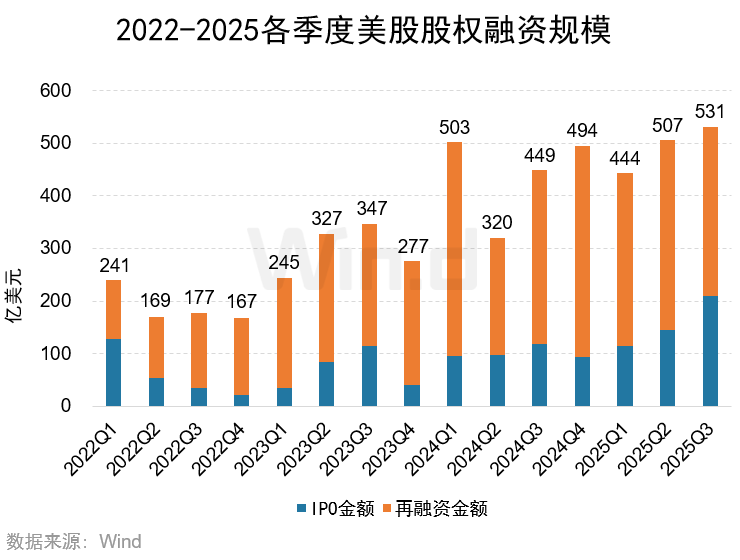
Wind:2025年前三季度美股市场股权融资规模总计1481亿美元
智通财经网· 2025-10-13 23:08
Core Insights - The US equity underwriting market showed strong performance in the first three quarters of 2025, with total equity financing (including IPOs and refinancing) amounting to $148.1 billion, an increase of $20.9 billion or 16.40% year-on-year [1][3][38]. Equity Financing Overview - Total equity financing in the US market reached $148.1 billion, with IPOs contributing $46.9 billion (up 50.07% year-on-year) and refinancing totaling $101.2 billion (up 5.42% year-on-year) [3][6][38]. - Non-bank financial sector led the fundraising with $49.9 billion, accounting for 33.68% of total financing [1][8]. IPO Market - A total of 310 companies went public in the first three quarters, an increase of 128 companies compared to the previous year, raising $46.9 billion [14][15]. - The Nasdaq remained the leading exchange for IPOs, with 246 companies listed, raising $29.4 billion, representing 62.73% of the total IPO market [15][19]. - The largest IPO was by Venture Global, raising $1.75 billion [29]. SPAC and Chinese Companies - SPAC IPOs saw significant growth, with 85 companies going public, raising $16.2 billion, a year-on-year increase of 190.93% [32]. - 59 Chinese companies listed in the US, raising $1 billion, a decrease of 58.35% year-on-year [34]. Refinancing Trends - There were 665 refinancing events, with a total amount of $101.2 billion, reflecting a 5.42% increase year-on-year [2][38]. - The non-bank financial sector led refinancing with $24.2 billion, followed by software services at $12.5 billion [45]. Underwriting Rankings - Goldman Sachs topped the IPO underwriting rankings with $4.758 billion from 29 deals, followed closely by Cantor Fitzgerald and JPMorgan [54][56]. - For refinancing, JPMorgan led with $15.458 billion from 58 deals, followed by Goldman Sachs and Morgan Stanley [58][59].
2025年前三季度美股股权承销排行榜
Wind万得· 2025-10-13 22:38
Market Overview - In the first three quarters of 2025, the US stock market showed strong performance with the Dow Jones Industrial Average rising by 9.06%, the Nasdaq increasing by 17.34%, and the S&P 500 up by 13.72% [2] - The total equity financing in the US stock market reached $148.1 billion, an increase of $20.9 billion or 16.40% compared to the same period last year [2] - The non-bank financial sector raised a total of $49.9 billion, accounting for 33.68% of the total financing [2] IPO Performance - A total of 310 companies successfully went public in the first three quarters of 2025, an increase of 128 companies year-on-year [17] - The total amount raised through IPOs was $46.9 billion, reflecting a year-on-year increase of 50.07% [17] - The largest IPO was by Venture Global, which raised $1.75 billion [31] SPAC and Chinese Companies - There were 85 SPAC IPOs in the first three quarters, a significant increase of 56 companies year-on-year, raising a total of $16.2 billion, up 190.93% [34] - 59 Chinese companies went public in the US, an increase of 20 companies year-on-year, but the total amount raised was only $1 billion, down 58.35% [35] Refinancing Trends - The total number of refinancing events was 665, an increase of 16 events year-on-year, with a total amount raised of $101.2 billion, up 5.42% [3][38] - The non-bank financial sector led refinancing with a total of $24.2 billion raised [43] Industry Distribution - The non-bank financial sector was the top industry for equity financing, raising $49.9 billion, followed by software services at $18.4 billion and pharmaceuticals at $13.8 billion [10] - In terms of the number of financing events, the pharmaceutical sector led with 237 events, followed by non-bank financial with 159 events [14] Underwriting Rankings - Goldman Sachs led the IPO underwriting rankings with $4.758 billion in underwriting amount and 29 deals [51] - For refinancing, JPMorgan topped the rankings with $15.458 billion in underwriting amount and 58 deals [55]
【13日资金路线图】电子板块净流入约159亿元居首 龙虎榜机构抢筹多股
证券时报· 2025-10-13 12:26
Market Overview - The A-share market experienced an overall decline on October 13, with the Shanghai Composite Index closing at 3889.5 points, down 0.19%, the Shenzhen Component Index at 13231.47 points, down 0.93%, and the ChiNext Index at 3078.76 points, down 1.11% [1] - Total trading volume in the A-share market was 23745.34 billion, a decrease of 1599.58 billion compared to the previous trading day [1] Capital Flow - The A-share market saw a net outflow of main funds amounting to 398.64 billion, with an opening net outflow of 240.33 billion and a tail-end net inflow of 40.31 billion [2] - The CSI 300 index recorded a net outflow of 100.45 billion, while the ChiNext and STAR Market saw net outflows of 157.96 billion and 39.57 billion, respectively [4] Sector Performance - Among the 16 sectors, the electronics industry led with a net inflow of 158.99 billion, followed by non-ferrous metals with 125.83 billion [6][7] - The automotive sector experienced the largest net outflow of 72.77 billion, followed by pharmaceuticals with 24.57 billion and food and beverage with 23.07 billion [7] Individual Stock Highlights - Baogang Co. saw the highest net inflow of main funds at 14.37 billion [8] - Institutions showed significant interest in stocks like Canxin Technology, which had a net institutional buy of 203.48 million, and Duofluoride with 176.91 million [10][11] Institutional Focus - Recent institutional ratings highlighted stocks such as Huaguang Co. with a target price of 48.45, indicating a potential upside of 33.69%, and Changshu Automotive with a target price of 26.60, suggesting a 46.23% upside [12]






“黑天鹅”再现,是否还能抄底?
Xin Lang Cai Jing· 2025-10-13 10:42
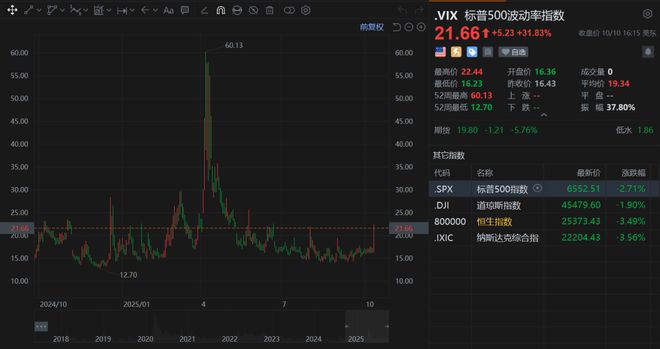
Core Viewpoint - The recent decline in global stock markets, particularly in the U.S., reflects a structural adjustment in investor sentiment towards technology stocks and broader economic concerns, driven by policy changes and trade tensions [2][3][10]. Market Performance - The S&P 500 index fell by 2.71%, marking its largest single-day drop since May, while the Nasdaq index experienced a more significant decline of 3.56%, losing 700 points [1][2]. - The Russell 2000 index, which represents small-cap stocks, dropped by 2.99%, indicating rising concerns about financial stability [2]. Sector Analysis - Major technology companies such as Apple, Tesla, and Nvidia saw declines of 3.45%, over 5.06%, and 4.89% respectively, contributing to the overall market downturn [2]. - The decline in technology stocks has been widespread, affecting the entire industry chain from hardware manufacturing to software services, signaling a general revision of growth expectations in the tech sector [2][3]. Economic Indicators - The U.S. government shutdown has led to over 4000 federal employees being laid off, with a total of 3.4 million employees affected, potentially impacting Q4 GDP growth by 0.3 percentage points [3]. - The unemployment rate in the U.S. rose to 3.8%, highlighting vulnerabilities in the labor market [3]. Trade and Policy Impact - The escalation of trade tensions, particularly the renewed threats of tariffs against China, has increased uncertainty in global supply chains, prompting Goldman Sachs to lower its global economic growth forecast by 0.2 percentage points to 2.4% [3][4]. - The market's response to these developments has been less panicked compared to previous downturns, as indicated by the VIX index, which peaked at 22.6, significantly lower than the 35.2 peak in April [4][8]. Valuation and Market Sentiment - Current valuations are high, with the S&P 500's price-to-earnings ratio at 29.7, up 22.2% from April's low of 24.3 [6]. - The market sentiment has shifted from a focus on external liquidity to an emphasis on internal value, with a need for investors to identify opportunities driven by domestic demand and policy support [10]. Investment Strategy - The focus for investors should shift towards sectors benefiting from domestic consumption and policy support, particularly in consumer and infrastructure sectors, which have shown resilience amid the tech sell-off [3][10]. - Mid-term investment strategies should consider the recovery of global manufacturing and the potential for physical assets to benefit from increased demand [9].
“黑天鹅”再现,是否还能抄底?
格隆汇APP· 2025-10-13 10:27
Core Viewpoint - The recent decline in global risk assets, particularly in the U.S. stock market, reflects a combination of trade tensions, high valuations, and diverging fundamentals, indicating a shift in market dynamics compared to previous downturns [5][23]. Market Performance - The S&P 500 index fell by 2.71%, marking its largest single-day drop since May [2]. - The Nasdaq index experienced a more significant decline of 3.56%, losing 700 points, highlighting a sharp correction in technology stocks [3]. - The ChiNext index in China also dropped by 2%, with tech stocks that previously rose in tandem with U.S. tech shares being heavily sold off [4]. Structural Characteristics of the Decline - The downturn in the U.S. market exhibited structural characteristics, with major tech giants like Apple, Tesla, and Nvidia seeing declines of 3.45%, over 5.06%, and 4.89% respectively, which directly impacted index performance [7]. - The decline spanned the entire tech industry, indicating a broad market correction in growth expectations for the sector [8]. - The Russell 2000 index, which represents small-cap stocks, fell by 2.99%, suggesting rising concerns about financial stability [9]. Economic and Policy Context - The recent asset price fluctuations were triggered by two key policy moves from the Trump administration, including permanent layoffs affecting over 4,000 federal employees and a potential government shutdown impacting GDP growth [10]. - The U.S. economy's vulnerability is highlighted by a rising unemployment rate of 3.8% and a significant drop in non-farm payrolls [10]. - Trade tensions, particularly the renewed threat of tariffs on China, have exacerbated global supply chain uncertainties, leading to a downward revision of global economic growth forecasts by Goldman Sachs [10]. Market Sentiment and Expectations - Unlike the panic seen in April, the current market sentiment is characterized by a lack of extreme fear, as indicated by the VIX index peaking at 22.6 compared to 35.2 in April [11][19]. - Investors have developed a more mature expectation framework regarding trade conflicts, anticipating a cycle of threats, negotiations, and compromises [13]. - The upcoming APEC summit in November is seen as a potential catalyst for renewed U.S.-China trade discussions, providing psychological support to the market [14]. Valuation and Investment Strategy - Current market valuations are high, with the S&P 500's price-to-earnings ratio at 29.7, significantly above the April low of 24.3 [16]. - The absence of extreme panic and new policy stimuli suggests that blindly buying the dip may be risky, as the market is currently experiencing a process of valuation digestion and momentum shifting [19][24]. - Investors are advised to focus on identifying intrinsic value rather than following overseas liquidity trends, with a short-term focus on domestic consumption recovery and policy benefits [25]. Chinese Market Dynamics - The previous reliance of Chinese assets on overseas liquidity and tech stock correlations has revealed vulnerabilities, suggesting a potential for index-level adjustments, albeit manageable [20]. - Domestic policies and signs of recovery in consumer demand are seen as the most certain investment themes, with the "anti-involution" policy extending to high-end manufacturing [20]. - The recovery in social retail sales growth to 4.2% in September indicates a positive trend in domestic demand [20]. Mid-term Investment Focus - The recovery of global manufacturing and rising physical consumption trends are expected to remain central to asset allocation strategies [21]. - Non-bank financial sectors are anticipated to benefit from improving capital returns as manufacturing rebounds, with historical data suggesting significant excess returns following manufacturing PMI recoveries [21]. - Physical assets, particularly in industrial metals and raw materials, are positioned to benefit from demand recovery, with current valuations below historical medians [21].

两市主力资金净流出381.69亿元 电力设备行业净流出居首
Zheng Quan Shi Bao Wang· 2025-10-13 09:31
Market Overview - On October 13, the Shanghai Composite Index fell by 0.19%, the Shenzhen Component Index decreased by 0.93%, and the ChiNext Index dropped by 1.11% [1] - The Shanghai and Shenzhen 300 Index declined by 0.50% [1] - Among the tradable A-shares, 1,684 stocks rose, accounting for 31.05%, while 3,634 stocks fell [1] Capital Flow - The main capital experienced a net outflow of 38.169 billion yuan, marking the fourth consecutive trading day of net outflows [1] - The ChiNext saw a net outflow of 14.297 billion yuan, while the Sci-Tech Innovation Board had a net outflow of 3.681 billion yuan [1] - The Shanghai and Shenzhen 300 constituent stocks faced a net outflow of 10.916 billion yuan [1] Industry Performance - Among the 28 primary industries classified by Shenwan, 6 industries saw gains, with the non-ferrous metals and environmental protection sectors leading with increases of 3.35% and 1.65%, respectively [1] - The automotive and home appliance sectors had the largest declines, with decreases of 2.33% and 1.74% [1] Industry Capital Inflows - Nine industries experienced net inflows, with the steel industry leading at a net inflow of 1.351 billion yuan and a daily increase of 1.49% [3] - The non-ferrous metals sector followed with a net inflow of 1.087 billion yuan and a daily increase of 3.35% [3] Industry Capital Outflows - A total of 22 industries faced net outflows, with the electric equipment sector leading at a net outflow of 7.198 billion yuan and a daily decline of 0.68% [2] - The electronics sector also saw significant outflows, with a net outflow of 7.140 billion yuan and a slight decline of 0.05% [2] Individual Stock Performance - A total of 1,604 stocks experienced net inflows, with 552 stocks having inflows exceeding 10 million yuan [3] - The stock with the highest net inflow was Baogang Co., which rose by 9.84% with a net inflow of 1.860 billion yuan [3] - Conversely, stocks with the largest net outflows included BYD, with a net outflow of 1.508 billion yuan, followed by Sailis and Dongfang Wealth [3]




市场情绪监控周报(20250929-20251010):深度学习因子9月超额3.4%,本周热度变化最大行业为有色金属、非银金融-20251013
Huachuang Securities· 2025-10-13 09:21
Quantitative Models and Construction - **Model Name**: DecompGRU **Model Construction Idea**: The model improves information interaction between time-series and cross-sectional data by introducing two simple de-mean modules on the GRU baseline model[17] **Model Construction Process**: 1. The DecompGRU model is based on the GRU baseline architecture 2. Two de-mean modules are added to enhance the interaction between time-series and cross-sectional data 3. The model is trained using IC and weighted MSE loss functions[17] **Model Evaluation**: The model demonstrates improved performance in capturing trends and cross-sectional interactions[17] Quantitative Models Backtesting Results - **DecompGRU TOP200 Portfolio**: - Cumulative absolute return: 38.64% - Excess return relative to WIND All A equal-weight index: 13.8% - Maximum drawdown: 10.08% - Weekly win rate: 64.29% - Monthly win rate: 100% - September absolute return: 4.19% - September excess return: 3.4%[11] - **ETF Rotation Portfolio**: - Cumulative absolute return: 21.54% - Excess return relative to WIND ETF index: -0.57% - Maximum drawdown: 7.82% - Weekly win rate: 65.52% - Monthly win rate: 66.67% - September absolute return: -1.68% - September excess return: -6.65%[13][14] Quantitative Factors and Construction - **Factor Name**: Sentiment Heat Factor **Factor Construction Idea**: The factor aggregates user behavior data (e.g., browsing, self-selection, and clicks) to measure sentiment heat at the stock, index, industry, and concept levels[18] **Factor Construction Process**: 1. Individual stock heat is calculated as the sum of browsing, self-selection, and click counts 2. Normalize the heat value by dividing it by the total market heat on the same day and multiplying by 10,000 3. Aggregate normalized heat values to broader levels such as indices, industries, and concepts[18] **Factor Evaluation**: The sentiment heat factor serves as a proxy for market sentiment and helps identify mispricing due to attention constraints[18] Quantitative Factors Backtesting Results - **Broad Index Sentiment Heat Rotation Strategy**: - Annualized return since 2017: 8.74% - Maximum drawdown: 23.5% - 2025 portfolio return: 32% - Benchmark broad index equal-weight portfolio return: 30%[27] - **Concept Sentiment Heat TOP/BOTTOM Portfolios**: - BOTTOM portfolio annualized return: 15.71% - Maximum drawdown: 28.89% - 2025 BOTTOM portfolio return: 40%[41][45]
30股特大单净流入资金超2亿元
Zheng Quan Shi Bao Wang· 2025-10-13 09:18
Market Overview - The two markets experienced a net outflow of 17.085 billion yuan, with 30 stocks seeing a net inflow exceeding 200 million yuan, led by Baogang Co. with a net inflow of 2.436 billion yuan [1] - The Shanghai Composite Index closed down by 0.19%, with 1,682 stocks seeing net inflows and 3,060 stocks seeing net outflows [1] Industry Performance - Among the 10 industries with net inflows, the non-ferrous metals sector had the highest net inflow of 2.234 billion yuan, with an index increase of 3.35%. The steel industry followed with a net inflow of 2.090 billion yuan and a 1.49% increase [1] - A total of 21 industries experienced net outflows, with the automotive sector leading with a net outflow of 4.185 billion yuan, followed by the power equipment sector with a net outflow of 3.656 billion yuan [1] Individual Stock Performance - The top 30 stocks with net inflows over 200 million yuan included Baogang Co. (2.436 billion yuan), China Software (1.451 billion yuan), and Northern Rare Earth (869 million yuan) [2] - Stocks with significant net outflows included BYD with a net outflow of 1.176 billion yuan, followed by Sailyis and Dongfang Caifu with outflows of 922 million yuan and 892 million yuan, respectively [2][4] Stock Price Movements - Stocks with net inflows over 200 million yuan saw an average increase of 9.36%, outperforming the Shanghai Composite Index. Notable performers included Galaxy Magnetic Materials and Hongyuan Pharmaceutical, which closed at their daily limit [2] - The top stocks with net inflows and their respective price changes included Baogang Co. (+9.84%), China Software (+10.00%), and Northern Rare Earth (+10.00%) [2] Summary of Net Inflows and Outflows - The ranking of stocks with the highest net inflows included: - Baogang Co. (2.436 billion yuan) - China Software (1.451 billion yuan) - Northern Rare Earth (869 million yuan) [2] - The ranking of stocks with the highest net outflows included: - BYD (-1.176 billion yuan) - Sailyis (-922 million yuan) - Dongfang Caifu (-892 million yuan) [4]
2025年4季度可转债市场展望:风偏或波动,中期看成长
Shenwan Hongyuan Securities· 2025-10-13 09:16
Core Insights - The convertible bond market is expected to experience short-term volatility due to external risks, but medium-term growth is anticipated, particularly in structural opportunities within the market [3][4][19] - The current valuation of convertible bonds is considered reasonable, driven by underlying stocks, with a potential decrease in supply due to an increase in new issuances [3][4][57] - The market is shifting towards a more passive investment approach, with a notable increase in ETF holdings, which may amplify short-term market fluctuations [80][82] Group 1: Market Performance - In September, convertible bonds underperformed compared to underlying stocks, with high-priced and small-cap convertible bonds leading the market [3][6][13] - The technology sector continued to outperform, while bank and non-bank convertible bonds recorded the worst performance of the year [13][19] - The overall market for convertible bonds is characterized by a strong stock nature, with high-priced and small-cap bonds performing better during the recent volatility [14][19] Group 2: Valuation and Supply Dynamics - The current median price of convertible bonds is at a historical high of 132 yuan, with a significant number of high-priced bonds in the market [45][44] - The supply of convertible bonds is expected to increase, with a notable rise in issuance proposals since July, indicating a potential easing of the tight supply situation [60][64] - The market is witnessing a decline in the number of low-priced bonds, with only two bonds priced below their debt floor [45][57] Group 3: Institutional Behavior - In September, insurance institutions and securities asset management firms significantly reduced their holdings in convertible bonds, returning to historical low levels [21][24][70] - Public funds have increased their holdings in convertible bonds, now accounting for approximately 39% of the total market, reflecting a significant rise since the beginning of the year [71][77] - The overall market size of convertible bonds has decreased, but the market value to face value ratio has increased, influenced by concentrated conversions of specific bonds [66][70]