
电力设备

Search documents
鼎信通讯发预亏,预计2025年度归母净亏损5.4亿元至6.4亿元
Zhi Tong Cai Jing· 2026-01-19 12:25
Core Viewpoint - Dingxin Communication (603421.SH) is expected to report a net loss attributable to shareholders of the parent company ranging from 540 million to 640 million yuan for the fiscal year 2025 due to significant impacts from business restrictions and market conditions [1] Group 1: Financial Performance - The company anticipates a net loss of 540 million to 640 million yuan for the fiscal year 2025 [1] - The decline in revenue is primarily attributed to restrictions on bidding qualifications imposed by State Grid Corporation of China, affecting the company's power bidding business [1] Group 2: Business Operations - The company's bidding qualifications with Southern Power Grid Co., Ltd. are expected to be restored only by early November 2025, leading to substantial impacts on annual bidding operations [1] - The company's fire safety business has also experienced a significant revenue decline due to ongoing adjustments in the real estate sector [1] Group 3: Research and Development - Despite the anticipated losses, the company continues to prioritize research and development investments to support future growth [1]

每日看盘|动量资金转向,A股浮现超预期的稳健态势
Sou Hu Cai Jing· 2026-01-19 12:19
Core Viewpoint - The A-share market is experiencing a mixed trend with fluctuations, driven by strong performances in resource stocks and power equipment stocks, while AI hardware leaders face lower-than-expected earnings for Q4 2025 [2][3]. Group 1: Market Dynamics - The recent cooling measures have led to a cautious sentiment among market participants, but new incremental information has shifted attitudes towards seeking investment opportunities [2]. - The re-interpretation of cooling measures aims to stabilize A-share indices and support a slow bull market, reinforcing the confidence of value investors [3]. - Economic data for 2025 indicates robust growth in China's manufacturing sector, providing a strong foundation for A-share companies' earnings growth [3]. Group 2: Sector Performance - The commercial aerospace sector is seeing an increase in IPOs, suggesting continued growth in the industry and potential price stimulation for leading stocks benefiting from this development [3]. - Enhanced investment from the State Grid and urgent needs for overseas grid upgrades have attracted momentum funds to new investment opportunities in the power equipment sector [3]. - On Monday, power equipment stocks surged due to strong order information, significantly boosting market sentiment and alleviating concerns about the impact of cooling measures [3]. Group 3: Investment Strategy - The market is expected to maintain a slow bull trend, with a cautious outlook suggesting narrow fluctuations around current levels, while a more optimistic view anticipates a gradual upward trend [3]. - The focus is shifting from speculative trading to identifying growth leaders with strong earnings capabilities, particularly in the commercial aerospace and resource sectors [4]. - Stocks like Superjet Co. and Aerospace Electronics have shown strong performance, reflecting the market's preference for companies that can deliver on their growth promises [4].


联合动力:发挥规模效应去构建中长期核心竞争力
Zheng Quan Ri Bao Wang· 2026-01-19 12:13
Core Viewpoint - The company aims to enhance cost control through product and technology cost reduction, supply chain and production optimization, business and customer value reconstruction, and service and model innovation [1] Group 1 - The company will focus on product and technology cost reduction as part of its cost control strategy [1] - Supply chain and production optimization will be key areas for the company to improve efficiency [1] - The company plans to reconstruct business and customer value to enhance its market position [1] Group 2 - Continuous technological innovation will be a priority for the company to maintain competitiveness [1] - The company intends to leverage economies of scale to build long-term core competitiveness [1]
浙商证券浙商早知道-20260119
ZHESHANG SECURITIES· 2026-01-19 12:06
Market Overview - On January 19, the Shanghai Composite Index rose by 0.29%, the CSI 300 increased by 0.05%, the STAR Market 50 fell by 0.48%, the CSI 1000 rose by 0.4%, the ChiNext Index decreased by 0.7%, and the Hang Seng Index dropped by 1.05% [3][4] - The best-performing sectors on January 19 were basic chemicals (+2.7%), oil and petrochemicals (+2.08%), electric equipment (+1.84%), automobiles (+1.7%), and social services (+1.63%). The worst-performing sectors were computers (-1.55%), telecommunications (-0.96%), banking (-0.6%), pharmaceuticals and biology (-0.52%), and electronics (-0.49%) [3][4] - The total trading volume for the A-share market on January 19 was 27,322 billion yuan, with a net inflow of 2.292 billion Hong Kong dollars from southbound funds [3][4] Important Insights Macroeconomic Analysis - Latin America is characterized as an export-oriented economy for agricultural and mineral products while importing manufactured goods. The commodity cycle significantly influences total demand through both export and capital expenditure channels [5] - The market anticipates that exports may drive economic growth in 2026 [5] Fixed Income Analysis - The current R007 weighted interest rate is around 1.50%, which reflects both the central bank's preferred pricing (DR007) and liquidity friction between banks and non-banks (the spread between R007 and DR007). It is advised not to hold overly optimistic expectations [7][8] - The market sentiment is relatively optimistic, but there is a cautious stance compared to previous assessments [10]
主力资金丨3股尾盘获资金大幅抢筹
Zheng Quan Shi Bao Wang· 2026-01-19 11:14
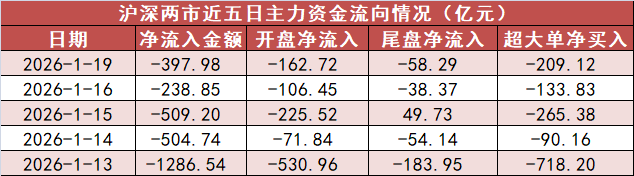
Group 1 - The A-share market showed mixed performance on January 19, with major indices fluctuating and most industry sectors closing higher, particularly in precious metals, electric power equipment, aerospace, and tourism [1] - The net outflow of main funds in the Shanghai and Shenzhen markets reached 39.798 billion yuan, with six industries experiencing net inflows, including electric power equipment, building materials, and banking [1] - The electronic, computer, and communication sectors saw the largest net outflows, with amounts of 9.971 billion yuan, 8.997 billion yuan, and 6.184 billion yuan respectively [1] Group 2 - Seven stocks recorded net inflows exceeding 400 million yuan, with China Western Power leading at 1.076 billion yuan, driven by a government announcement projecting a significant increase in national electricity consumption by 2025 [2] - New Yi Sheng and Goldwind Technology also saw substantial net inflows of 836 million yuan and 738 million yuan respectively, with Goldwind announcing a supply agreement for wind turbines in Vietnam [3] - A total of 74 stocks experienced net outflows exceeding 200 million yuan, with notable outflows from Ningde Times and other tech companies exceeding 1 billion yuan [3] Group 3 - At the end of the trading day, the electric power equipment sector saw a net inflow of over 369 million yuan, while other sectors like retail and non-bank financials also experienced significant inflows [4] - Individual stocks such as TBEA, New Yi Sheng, and Kidswant saw net inflows exceeding 1 billion yuan at the close [5] - Notable net outflows at the end of the day included companies like Rock Mountain Technology and others, with outflows exceeding 200 million yuan [6]




揭秘涨停丨3股封单资金超3亿元
Zheng Quan Shi Bao Wang· 2026-01-19 11:13
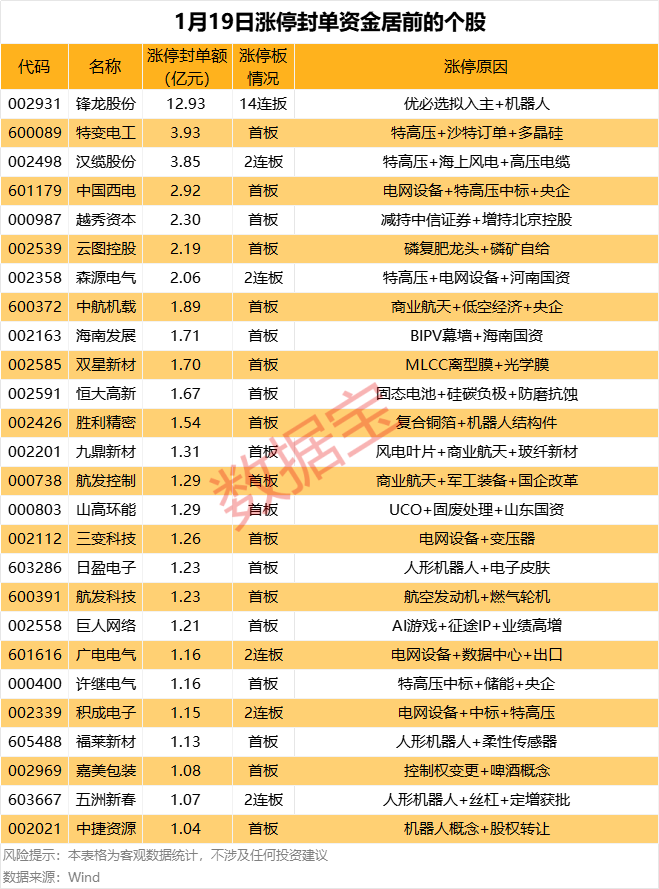
Market Overview - As of January 19, the Shanghai Composite Index closed at 4114 points, up 0.29%, while the Shenzhen Component Index closed at 14294.05 points, up 0.09%. The ChiNext Index fell by 0.70%, and the STAR Market 50 Index decreased by 0.48% [1] - Among the tradable A-shares, 3527 stocks rose, accounting for over 64%, while more than 1800 stocks declined. There were 103 stocks that hit the daily limit up, and 31 stocks hit the limit down. Additionally, 32 stocks failed to hit the limit, resulting in an overall limit-hitting rate of 76.30% [1] Sector Performance - The sectors with the most stocks hitting the daily limit up included power equipment, basic chemicals, and machinery, with 24, 10, and 7 stocks respectively [1] - Among the stocks that hit the daily limit up, 15 were ST stocks, including *ST Bio and *ST Rong Control [1] Notable Stocks - Fenglong Co., Ltd. achieved a remarkable 14 consecutive limit-up days, the highest among all stocks [1] - In terms of limit-up order amounts, Fenglong Co., Ltd., TBEA Co., Ltd., and Hancable Co., Ltd. led with 1.293 billion, 393 million, and 385 million respectively [1][2] - The stocks with significant limit-up order strength (order amount as a percentage of circulating A-shares) included Evergrande High-tech, Fenglong Co., Ltd., and Tiandi Online, with 9.66%, 9.45%, and 4.08% respectively [1]



AI应用,继续调整
中国基金报· 2026-01-19 11:06
Market Overview - The Hong Kong stock market experienced a decline, primarily driven by weak performances in the financial and technology sectors. The Hang Seng Index fell by 1.05% to close at 26,563.90 points, while the Hang Seng Technology Index dropped by 1.24% to 5,749.98 points, and the Hang Seng China Enterprises Index decreased by 0.94% to 9,134.45 points [4][5]. Sector Performance - Major technology stocks showed collective weakness, with Alibaba down by 3.49% and a trading volume of approximately HKD 11.7 billion. Other notable declines included Meituan, JD.com, and Tencent, each falling over 1% [7][8]. - AI application stocks continued their downward trend, with companies like YaoShibang, Ping An Good Doctor, and Alibaba Health experiencing declines of 5.44%, 4.41%, and 3.53% respectively. MINIMAX-WP, Huizhong Technology, and Zhipu saw drops exceeding 10% [10][12]. Biotech Sector - The Hang Seng Biotech Index fell by 3.06%, with key constituents such as Kelun-Biotech, InnoCare Pharma, and BeiGene also closing lower. Despite this, the CRO industry is reportedly improving, with a positive outlook for 2026 due to increased demand for innovative drugs and a recovering financing environment [14][15]. Safe-Haven Assets - The gold sector showed resilience, with international gold prices reaching historical highs, pushing up the prices of Hong Kong-listed gold companies like Datang Gold and Mengjin Garden, which rose by 8.77% and 5.38% respectively [17][18]. Company News - New World Department Store China saw a significant stock price increase of 29.51%, closing at HKD 0.395 per share. This surge followed recent announcements of management changes within the company [20][21].
【19日资金路线图】电力设备板块净流入逾168亿元居首 龙虎榜机构抢筹多股
证券时报· 2026-01-19 10:50
1.A股市场主力资金净流出397.98亿元 今日A股市场主力资金开盘净流出162.72亿元,尾盘净流出58.29亿元,A股市场全天主力资金净流出397.98亿元。 | | | 沪深两市近五日主力资金流向情况(亿元) | | | | --- | --- | --- | --- | --- | | 日期 | | | 净流入金额 开盘净流入 尾盘净流入 超大单净买入 | | | 2026-1-19 | -397.98 | -162.72 | -58. 29 | -209.12 | | 2026-1-16 | -238.85 | -106. 45 | -38. 37 | -133.83 | | 2026-1-15 | -509.20 | -225.52 | 49.73 | -265. 38 | | 2026-1-14 | -504. 74 | -71.84 | -54. 14 | -90. 16 | | 2026-1-13 | -1286. 54 | -530. 96 | -183. 95 | -718. 20 | 盘后数据出炉。 1月19日,A股市场整体涨跌互现。截至收盘,上证指数报4114点,上涨0.29%;深证 ...

【19日资金路线图】电力设备板块净流入逾168亿元居首 龙虎榜机构抢筹多股
Zheng Quan Shi Bao· 2026-01-19 10:50
盘后数据出炉。 1月19日,A股市场整体涨跌互现。截至收盘,上证指数报4114点,上涨0.29%;深证成指报14294.05点,上涨0.09%;创业板指报3337.61点,下跌0.7%; 北证50指数上涨0.02%。 1.A股市场主力资金净流出397.98亿元 今日A股市场主力资金开盘净流出162.72亿元,尾盘净流出58.29亿元,A股市场全天主力资金净流出397.98亿元。 | | | 沪深两市近五日主力资金流向情况(亿元) | | | | --- | --- | --- | --- | --- | | 日期 | | 人民党理市 露金人民地 | | 尾盘净流入 超大单净买入 | | 2026-1-19 | -397.98 | -162.72 | -58. 29 | -209.12 | | 2026-1-16 | -238.85 | -106. 45 | -38. 37 | -133.83 | | 2026-1-15 | -509. 20 | -225.52 | 49.73 | -265. 38 | | 2026-1-14 | -504. 74 | -71. 84 | -54. 14 | -90. 16 | ...

双良节能(600481.SH):中标2.36亿元宁夏电投石嘴山2×660MW超超临界热电项目表凝式自然通风间接空冷系统招标项目
Ge Long Hui A P P· 2026-01-19 10:44
Core Viewpoint - The company, Shuangliang Energy (600481.SH), has recently received a bid notification for a project related to the Ningxia Electric Power Investment Shizuishan 2×660MW ultra-supercritical thermal power project, with an expected bid amount of RMB 236 million, which represents 1.81% of the company's audited revenue for the fiscal year 2024 [1]. Group 1 - The project involves the procurement of a natural ventilation indirect cooling system [1]. - The bid amount of RMB 236 million is significant for the company's financial outlook, contributing to its revenue projections for 2024 [1]. - The project is part of the broader energy sector initiatives aimed at enhancing efficiency and sustainability in power generation [1].
