
装备制造业

Search documents
31省份半年报:粤苏鲁总量领跑,新兴产业成增长“新势力”
2 1 Shi Ji Jing Ji Bao Dao· 2025-08-01 13:16
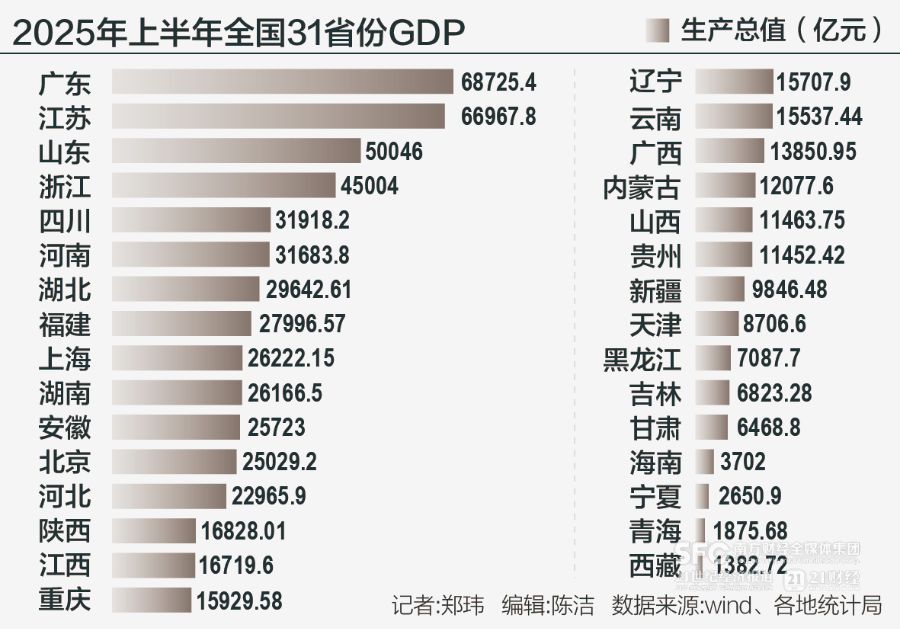
Economic Overview - In the first half of 2025, the GDP of Guangdong, Jiangsu, and Shandong provinces ranked first, second, and third in the country, with values of 68,725.4 billion, 66,967.8 billion, and 50,046 billion respectively [1][3] - The overall economic landscape of the 31 provinces remained consistent with the first quarter, with no changes in the top ten GDP rankings [3] Regional Performance - Eastern provinces maintained a leading economic total, while central provinces showed impressive growth rates, particularly Hubei, which achieved a GDP of 29,642.61 billion, growing by 6.2% [6][3] - Fujian's retail sales reached 12,560.88 billion, with a year-on-year growth of 6.0%, supported by industrial growth of 8.7% [4] Industrial Growth - Industrial growth was a key driver for many provinces, with 27 provinces reporting industrial value-added growth outpacing regional GDP growth [7] - High-tech products such as lithium-ion batteries and industrial robots saw significant growth in Guangdong and Hubei, with production increases exceeding 10% [7][11] Emerging Industries - New industries are becoming significant contributors to economic growth, with a focus on robotics and automation in Guangdong, which is now a major hub for the smart robotics industry [10] - Hubei's high-tech manufacturing sector also reported a 14.4% increase in value-added, contributing 27.5% to overall industrial growth [11] Automotive Sector - The automotive industry showed strong performance, particularly in Henan and Shaanxi, with increases in production values of 24.5% and 27.9% respectively [9] - The growth in new energy vehicle production is driving related industries, indicating a shift towards more sustainable manufacturing practices [9]

7月份制造业PMI回落 经济总体产出保持扩张
Jing Ji Ri Bao· 2025-08-01 07:04
Group 1: Manufacturing Sector - In July, the Manufacturing Purchasing Managers' Index (PMI) dropped to 49.3%, a decrease of 0.4 percentage points from the previous month, indicating a contraction in manufacturing activity [1] - The new orders index for manufacturing was at 49.4%, down 0.8 percentage points from last month, reflecting weakened market demand [1] - Despite the short-term slowdown, the production index remained at 50.5%, indicating expansion for three consecutive months [1] Group 2: Non-Manufacturing Sector - The Non-Manufacturing Business Activity Index was at 50.1%, down 0.4 percentage points from the previous month, but still above the critical point [4] - The construction sector experienced a slowdown, with the business activity index at 50.6%, a decrease of 2.2 percentage points [4] - Service sector activity remained stable, with the business activity index at 50%, a slight decline of 0.1 percentage points [4] Group 3: Price Trends - The main raw materials purchasing price index rose to 51.5%, an increase of 3.1 percentage points, marking the first rise above the critical point since March [2] - The ex-factory price index was at 48.3%, up 2.1 percentage points, indicating an overall improvement in manufacturing market prices [2] Group 4: Business Expectations - Manufacturing enterprises showed optimism for future market conditions, with the production and business activity expectation index at 52.6%, an increase of 0.6 percentage points from last month [3] - Non-manufacturing enterprises maintained a stable optimistic outlook, with the business activity expectation index at 55.8%, up 0.2 percentage points [4]
国家发改委:坚决制止新兴领域盲目跟风、一哄而上、一哄而散
Sou Hu Cai Jing· 2025-08-01 05:47
Group 1: Investment and Economic Measures - The National Development and Reform Commission (NDRC) has fully allocated the 800 billion yuan "two heavy" construction project list, with 735 billion yuan of central budget investment also largely disbursed [1] - A fourth batch of 690 billion yuan for consumer goods replacement will be allocated in October, completing the annual plan of 300 billion yuan [2] - The NDRC aims to enhance domestic demand and support new consumption development while preventing blind following and excessive competition in emerging sectors [3][4] Group 2: Policy Implementation and Economic Monitoring - The NDRC plans to maintain policy continuity and stability while enhancing flexibility and foresight to stabilize the economy and employment [4] - The NDRC will conduct regular economic monitoring and policy research to ensure timely responses to actual needs [4] - The NDRC is focused on optimizing the artificial intelligence ecosystem and promoting its large-scale commercial application [5][6] Group 3: Logistics and Trade - The logistics cost as a percentage of GDP has decreased to 14%, achieving the lowest level since records began, saving over 130 billion yuan in logistics costs [7] - Trade cooperation with Belt and Road Initiative countries has seen a 4.7% increase in imports and exports, totaling 11.29 trillion yuan in the first half of the year [9] Group 4: Infrastructure and Energy - The highest cross-regional electricity transmission reached 148 million kilowatts, marking a new historical high [10] - The NDRC is working on a plan to deepen the construction of a unified national market, with inter-provincial trade sales accounting for 40.4% of total sales revenue [11][12] Group 5: Market Regulation and Competition - The NDRC is committed to regulating disorderly competition among enterprises and will implement measures to clean up market access barriers [13][15] - The NDRC plans to accelerate the implementation of significant reform measures to enhance economic stability and consumer confidence [15] Group 6: Consumer Services and Economic Growth - The NDRC will focus on enhancing consumer capacity and promoting service consumption in areas such as culture, tourism, and healthcare [16] - The NDRC aims to foster a positive cycle of consumption and investment by improving infrastructure and promoting domestic products [16]
在广深科创走廊建产学研联合体
Nan Fang Du Shi Bao· 2025-08-01 02:57
Core Insights - Guangdong's traditional industries are undergoing a significant transformation towards high-end, intelligent, and green integration, with various stakeholders discussing strategies for revitalization [1][2] - The province's manufacturing sector, which accounts for over 70% of its industries, has seen over 4.4 million enterprises implement digital transformation, with a digital management adoption rate of 88.2% [2][3] - Despite positive trends, challenges remain for small and medium-sized enterprises (SMEs), which face barriers to transformation and a lack of skilled talent [4][5] Group 1: Transformation and Achievements - Guangdong's traditional industries have over 160 industrial products leading in national output, supported by the integration of high-end, intelligent, and green practices [2] - The province has established 400 national-level green factories, leading the country in green manufacturing initiatives [3] - Industrial investment in Guangdong is projected to grow by 6.7% in 2024, with significant increases in technological upgrades and equipment renewal investments [3] Group 2: Challenges Faced by SMEs - SMEs are experiencing a "three no" dilemma: reluctance to transform, fear of transformation, and lack of knowledge on how to transform [4] - The lack of technical foundation, talent, experience, and trial-and-error capabilities are significant hurdles for SMEs [4] - The equipment connectivity in the equipment manufacturing sector is only 41%, and the standard adoption rate is 33%, indicating a gap compared to international standards [5] Group 3: Policy and Technical Recommendations - Recommendations include precise policy measures to support SMEs, such as fostering digital transformation service providers and advocating for tax incentives to lower transformation costs [7][8] - Emphasis on collaborative efforts among leading enterprises, research institutions, and service providers to develop tailored digital applications for the manufacturing sector [8] - The establishment of a cross-regional collaboration network to enhance supply chain integration and break down regional barriers is suggested [8]



经济总体产出保持扩张
Jing Ji Ri Bao· 2025-08-01 01:47
Economic Overview - The overall economic output in China continues to expand, despite fluctuations due to extreme weather conditions and a weak demand side [2][4]. Manufacturing Sector - In July, the Manufacturing Purchasing Managers' Index (PMI) dropped to 49.3%, a decrease of 0.4 percentage points from the previous month, indicating a contraction in manufacturing activity [2]. - The new orders index for manufacturing was at 49.4%, down 0.8 percentage points, while the production index remained at 50.5%, indicating continued expansion for three consecutive months [2]. - High-tech manufacturing and equipment manufacturing PMIs were 50.6% and 50.3%, respectively, both above the critical point, showing sustained growth in these sectors [2]. Price Trends - The purchasing price index for major raw materials rose to 51.5%, marking the first increase above the critical point since March, while the factory price index was at 48.3% [3]. - Industries such as petroleum, coal, and black metal processing saw significant improvements in their purchasing and factory price indices [3]. Business Activity in Non-Manufacturing Sector - The non-manufacturing business activity index was at 50.1%, down 0.4 percentage points, but still above the critical point [5]. - The construction sector experienced a slowdown, with its business activity index at 50.6%, a decrease of 2.2 percentage points [5]. - Service sector activity remained stable, with a business activity index of 50%, slightly down by 0.1 percentage points [5]. Future Outlook - Manufacturing enterprises maintain a positive outlook, with the production and business activity expectation index rising to 52.6%, an increase of 0.6 percentage points from the previous month [4]. - Non-manufacturing enterprises also show stable optimism, with a business activity expectation index of 55.8%, up 0.2 percentage points [5].
21专访丨中国机械工业联合会副会长叶定达:调结构优供给 妥善化解重点行业结构性矛盾
2 1 Shi Ji Jing Ji Bao Dao· 2025-08-01 01:46
导读:我国正处在加快转型升级步伐、奋力推进高质量发展的关键阶段,接下来,我国机械工业的重点 改革方向需以培育和发展新质生产力为核心导向。 据新华社报道,中共中央政治局7月30日召开会议,会议指出,要坚定不移深化改革。坚持以科技创新 引领新质生产力发展,加快培育具有国际竞争力的新兴支柱产业,推动科技创新和产业创新深度融合发 展。依法依规治理企业无序竞争。推进重点行业产能治理。 关于会议提到的"推进重点行业产能治理",近期,工业领域对此多有关注,7月28日召开的全国工业和 信息化主管部门负责同志座谈会,提到将巩固新能源汽车行业"内卷式"竞争综合整治成效,加强光伏等 重点行业治理,以标准提升倒逼落后产能退出。相关重点行业面临何种发展上的矛盾?下半年,我国机 械工业发展面临哪些有利条件与挑战?针对工业经济发展的现状、问题与趋势,21世纪经济报道记者专 访了中国机械工业联合会副会长叶定达。 叶定达表示,当前,我国机械工业部分领域仍存在亟待化解的结构性矛盾,与此同时,一些行业的"内 卷式"竞争日益加剧,已严重制约行业整体竞争力的提升和可持续高质量发展,妥善解决这些问题至关 重要。我国正处在加快转型升级步伐、奋力推进高质量 ...
7月份制造业PMI回落,新动能持续增长——经济总体产出保持扩张
Zhong Guo Jing Ji Wang· 2025-08-01 00:53
Economic Overview - In July, the manufacturing Purchasing Managers' Index (PMI) dropped to 49.3%, a decrease of 0.4 percentage points from the previous month, influenced by seasonal production slowdowns and extreme weather conditions [1] - The non-manufacturing business activity index and the comprehensive PMI output index were 50.1% and 50.2%, respectively, both down by 0.4 and 0.5 percentage points, yet remaining above the critical point [1] - Despite short-term fluctuations due to extreme weather, production activities maintained expansion, indicating a solid foundation for economic recovery [3] Manufacturing Sector - The manufacturing new orders index fell to 49.4%, down 0.8 percentage points from last month, while the production index was at 50.5%, still in the expansion zone for three consecutive months [1] - The equipment manufacturing PMI and high-tech manufacturing PMI were 50.3% and 50.6%, respectively, both above the critical point, indicating ongoing expansion in high-end equipment manufacturing [1] - The consumer goods industry PMI was 49.5%, down 0.9 percentage points, while the high-energy-consuming industries PMI improved slightly to 48%, up 0.2 percentage points [1] Price Trends - The main raw materials purchasing price index rose to 51.5%, and the factory price index was at 48.3%, increasing by 3.1 and 2.1 percentage points, respectively, indicating an overall improvement in manufacturing market prices [2] - The purchasing price index for major raw materials in sectors like petroleum and coal processing, as well as black metal smelting, showed significant recovery [2] Business Activity by Company Size - In July, the PMI for large enterprises was 50.3%, down 0.9 percentage points, with production and new orders indices at 52.1% and 50.7%, respectively, indicating sustained good operational conditions [2] - The PMI for medium-sized enterprises increased to 49.5%, up 0.9 percentage points, showing continued improvement in business sentiment [2] - The PMI for small enterprises was 46.4%, down 0.9 percentage points, reflecting weaker business conditions [2] Non-Manufacturing Sector - The non-manufacturing business activity index was 50.1%, down 0.4 percentage points, with construction activity slowing due to adverse weather conditions [4] - The business activity index for the service sector was 50%, slightly down by 0.1 percentage points, while sectors related to travel and consumption showed strong performance with indices above 60% [4] - Non-manufacturing enterprises maintained stable optimism, with a business activity expectation index of 55.8%, up 0.2 percentage points, indicating positive outlooks for the second half of the year [4]
7月份制造业PMI回落、新动能持续增长 经济总体产出保持扩张
Jing Ji Ri Bao· 2025-07-31 23:17
国家统计局服务业调查中心、中国物流与采购联合会发布的数据显示,7月份,受制造业进入传统生产 淡季,部分地区高温、暴雨洪涝灾害等因素影响,制造业采购经理指数(PMI)降至49.3%,比上月下降 0.4个百分点。非制造业商务活动指数和综合PMI产出指数分别为50.1%和50.2%,比上月下降0.4个和0.5 个百分点,均持续高于临界点。国家统计局服务业调查中心高级统计师赵庆河表示,我国经济总体产出 保持扩张。 7月份,我国多地遭遇高温热浪、暴雨洪涝以及干旱等极端天气,给户外施工作业、居民日常生活等带 来阻碍,进而影响到市场需求释放。制造业新订单指数为49.4%,较上月下降0.8个百分点。生产指数为 50.5%,虽较上月下降0.5个百分点,仍连续3个月运行在扩张区间。中国物流信息中心专家文韬认为, 虽然制造业生产活动扩张势头短期有所放缓,但稳中有增态势没有改变。 新动能持续增长。7月份,装备制造业和高技术制造业PMI分别为50.3%和50.6%,均持续高于临界点, 高端装备制造业保持扩张;消费品行业PMI为49.5%,比上月下降0.9个百分点;高耗能行业PMI为 48%,比上月上升0.2个百分点,景气度有所改善。 ...
“十四五”时期,税收改革发展取得积极效果——税费优惠政策为高质量发展注入强劲动力
Zhong Guo Chan Ye Jing Ji Xin Xi Wang· 2025-07-31 23:08
Core Insights - The "14th Five-Year Plan" period in China is characterized by stable economic growth, with tax revenue expected to exceed 155 trillion yuan, accounting for approximately 80% of total fiscal revenue [1] - Cumulative tax reductions and fee cuts are projected to reach 10.5 trillion yuan, significantly supporting economic and social development [2] Tax Policy and Economic Impact - A series of tax and fee reduction policies have been implemented, resulting in a cumulative reduction of 9.9 trillion yuan from 2021 to mid-2023, with an expected total of 10.5 trillion yuan by the end of the year [2] - Tax incentives focused on supporting technological innovation and advanced manufacturing have led to 3.6 trillion yuan in reductions, representing 36.7% of the total [2] - The private economy has benefited significantly, with 7.2 trillion yuan in tax reductions for private enterprises, accounting for 72.9% of the total [2] Manufacturing and Innovation - Manufacturing sector sales revenue has consistently represented about 29% of total enterprise sales from 2021 to 2024, with high-end and high-tech manufacturing showing annual revenue growth of 9.6% and 10.4%, respectively [3] - R&D expense deductions have been optimized, with 3.32 trillion yuan in deductions expected for 2024, marking a 25.5% increase from 2021 [3] Green Taxation - The green tax system has been enhanced, with environmental protection and resource taxes generating 2.5 trillion yuan in revenue from 2021 to mid-2023, alongside 1.5 trillion yuan in tax reductions for green development [4] Personal Income Tax Reforms - The personal income tax system has been improved to promote equitable distribution and enhance compliance, with the top 10% income earners paying about 90% of the total personal income tax [5] - Over 1 billion individuals benefited from special deductions, with a significant portion of the benefits going to the 30-55 age group [6] Smart Taxation Initiatives - The "Smart Taxation" initiative aims to enhance the tax payment experience, reducing the need for physical visits and paperwork, thus improving the overall business environment [7] - By mid-2023, over 61 million taxpayers utilized digital invoices, accounting for over 90% of total invoice amounts, improving efficiency in financial transactions [8]
21评论丨短期扰动不改经济向好趋势
2 1 Shi Ji Jing Ji Bao Dao· 2025-07-31 22:57
Group 1 - The manufacturing PMI in July was 49.3%, a decrease of 0.4 percentage points from the previous month, indicating a return to below the critical point after two months [1] - The non-manufacturing business activity index and comprehensive PMI output index were 50.1% and 50.2% respectively, both remaining in the expansion zone despite a slight decline [1] - The decline in manufacturing PMI is attributed to seasonal factors and extreme weather, with production index at 50.5%, down 0.5 percentage points, indicating weakened production momentum but still in the expansion zone [1][3] Group 2 - The non-manufacturing business activity index remains at 50.1%, supported by stable service sector performance, although the construction industry faced challenges due to extreme weather [2] - The service sector showed structural differentiation, with some areas like transportation and entertainment performing well due to summer consumption, while real estate-related activities remained weak [2] - The service industry business activity expectation index rose to 56.6%, indicating optimistic market expectations overall [2] Group 3 - New growth drivers continue to emerge, with sectors like equipment manufacturing and high-tech manufacturing maintaining good expansion levels, supporting economic structure optimization [3] - Industries such as railway, aerospace, and electronics are showing strong production and new order indices, indicating robust growth momentum [3] - The overall economic operation remains stable, with internal demand recovering and new growth drivers countering downward pressures from old drivers [3] Group 4 - The recent Central Political Bureau meeting highlighted the resilience and vitality of the economy, while acknowledging ongoing risks and challenges [4] - The meeting emphasized the need for macro policies to remain effective and stable, with potential targeted policies to be introduced if significant economic fluctuations occur [4]