
咖啡

Search documents
20家资本竞逐星巴克中国:最新业绩回暖,“择偶”条件大曝光
3 6 Ke· 2025-07-31 08:08
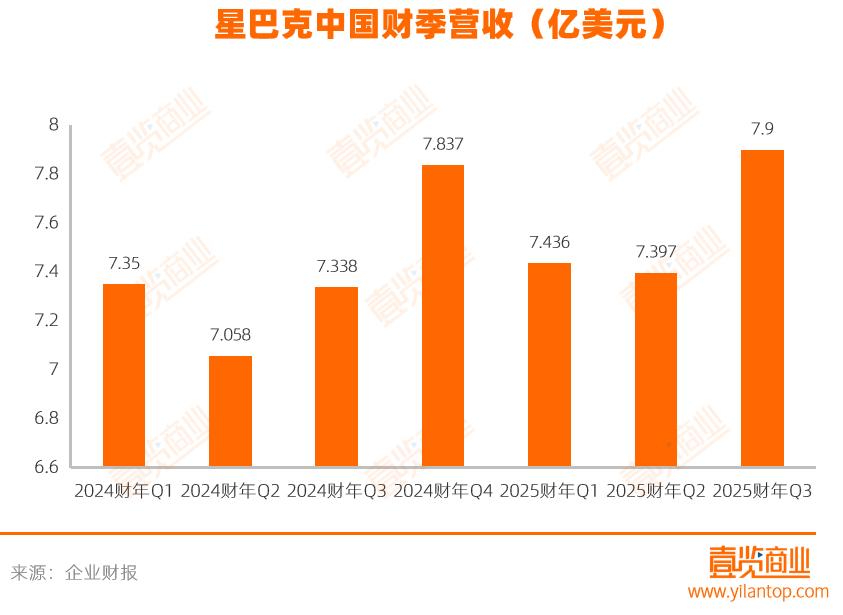
Core Viewpoint - Starbucks China has experienced a performance rebound, with Q3 FY2025 showing an 8% year-on-year revenue growth to $790 million and a 2% increase in same-store sales, marking a significant recovery from a previous 14% decline in Q3 FY2024 [1][4]. Group 1: Same-Store Sales and Revenue Growth - Same-store sales in Starbucks China have returned to growth after four consecutive quarters of decline, with a 2% year-on-year increase in the latest quarter [2][4]. - The growth is attributed to a 6% increase in same-store transaction volume, despite a 4% decline in same-store average ticket price [5][6]. - Product innovation, integrated marketing activities, and the expansion of delivery services have been key drivers of this growth [6][8]. Group 2: Market Expansion and Store Strategy - As of Q3 FY2025, Starbucks China has a total of 7,828 stores, with a net increase of 522 stores year-on-year, including 70 new stores in the latest quarter [9][10]. - The company has focused on expanding into lower-tier cities, with 50% of new stores in FY2024 located in third-tier cities and below [10][11]. - Localized strategies, such as introducing region-specific products and culturally themed store designs, have enhanced customer engagement and sales performance in new markets [11][13]. Group 3: Capital Movements and Partnership Strategy - Starbucks China is actively seeking strategic partners, with over 20 potential partners expressing interest in acquiring a stake in the business [14][15]. - The company aims to retain a significant equity stake, potentially around 30%, while looking for partners that share its mission and can operate efficiently in the local market [14][15]. - Notable potential partners include Hillhouse Capital, KKR, and Meituan, all of which have experience in the food and beverage sector [14][15]. Group 4: Competitive Landscape and Challenges - Despite the positive financial results, Starbucks China faces challenges from a competitive market, with local brands aggressively expanding and driving prices down [17][19]. - Competitors like Luckin Coffee and others are rapidly increasing their store counts, intensifying the competition in both lower-tier and higher-tier markets [18][19]. - The company must navigate these pressures while maintaining its brand positioning and adapting to market pricing dynamics [19].



瑞幸(LKNCY.US)FY25Q2电话会:二季度新增2000多家净门店 对全年业绩谨慎乐观
智通财经网· 2025-07-31 07:33
Core Viewpoint - Luckin Coffee has shown strong growth in store expansion and maintains a cautiously optimistic outlook for its annual performance, leveraging scale effects and operational efficiency to mitigate potential cost impacts from the shift towards delivery services [1][4][5] Store Expansion - In Q2 FY25, Luckin Coffee added over 2,000 net new stores, bringing the total to 26,206 stores by the end of the quarter, exceeding initial plans for the year [1][4] - The company has opened 3,800 net new stores in the first half of the year, indicating a robust expansion strategy [1][4] - The total number of stores in China reached 26,117, with 16,903 self-operated and 9,214 franchised [1] Impact of Delivery Subsidies - The introduction of delivery platform subsidies has significantly increased customer demand for high-quality coffee, putting pressure on supply chain flexibility and service reliability [2][3] - Luckin Coffee's established operational infrastructure has enabled it to effectively respond to the surge in demand, ensuring efficient and consistent beverage preparation [2][3] Market Position and Strategy - The company is positioned as a preferred partner for major food delivery platforms, benefiting from a favorable external environment created by recent subsidy activities [3] - Luckin Coffee aims to maintain a competitive store expansion pace while adapting to market changes, focusing on long-term sustainable growth in the rapidly evolving Chinese coffee market [4][5] - The company emphasizes its commitment to high-quality revenue growth while managing potential cost impacts through scale and operational efficiency [5]
第三届昆明国际咖啡展:全球咖啡文化圈“风味共振”
Zheng Quan Ri Bao· 2025-07-31 06:41
Core Insights - The third Kunming International Coffee Expo was held in Kunming, Yunnan, attracting numerous coffee producers, industry experts, and enthusiasts from around the world, showcasing a "flavor resonance" of diverse coffee cultures [1] - The expo featured over 200 brands and companies, covering the entire coffee industry chain, including raw materials, machines and equipment, packaging, dairy products, technology and services, cultural products, and other related industries [1] - Various high-quality coffee beans from countries such as Vietnam, Thailand, Indonesia, the UK, Kenya, and Rwanda, as well as regions in Yunnan like Baoshan, Pu'er, Nujiang, and Chuxiong, were displayed, emphasizing the industry's refinement and professionalism [1] Product Highlights - Unique coffee products were showcased, such as flower and fruit coffee combining Yunnan's local flavors, and exquisite crafts made from coffee beans and grounds, including lip balms with different coffee aromas [2] - Some coffee companies adopted a "mobile stall" setup for their booths, creating a casual atmosphere for visitors to enjoy coffee while interacting with baristas to learn brewing techniques and cultural stories behind the beverages [2]
凭借规模及供应链等优势 瑞幸咖啡第二季度净利润同比增长44%
Zheng Quan Ri Bao· 2025-07-31 06:39
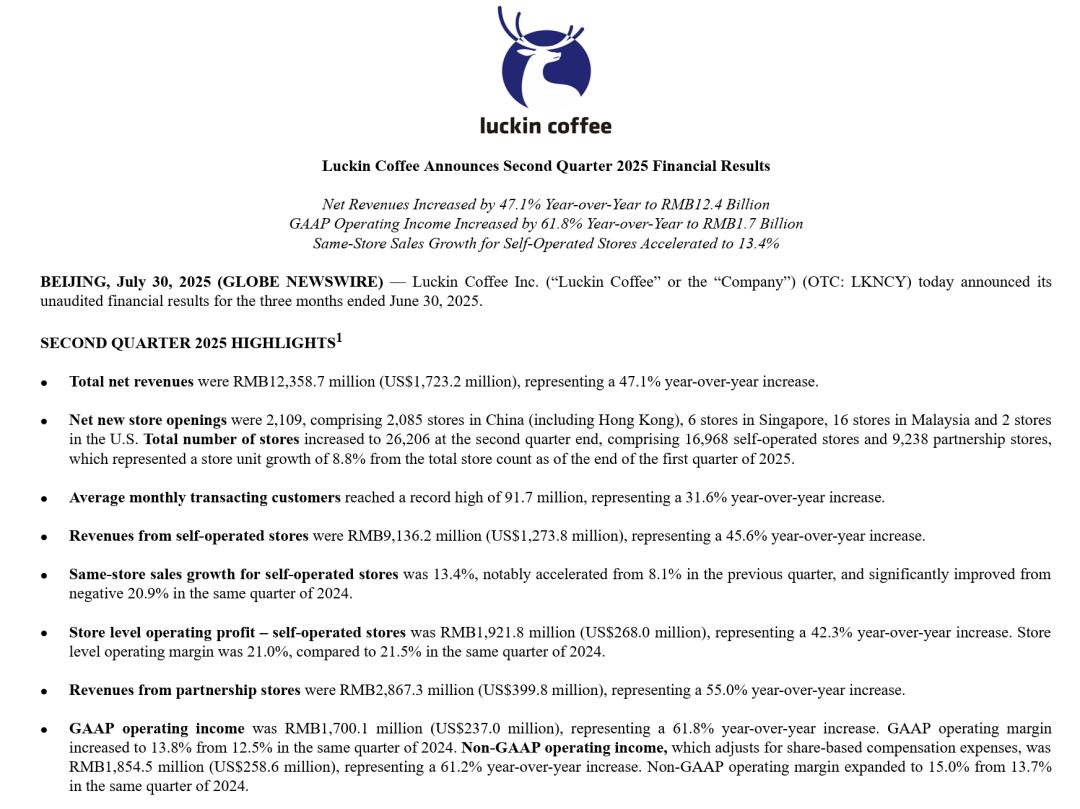
Core Insights - Luckin Coffee reported a total net revenue of 12.359 billion yuan for Q2 2025, representing a year-on-year growth of 47.1% [2] - The net profit attributable to ordinary shareholders was 1.251 billion yuan, an increase of 44% year-on-year [2] - The operating profit margin improved to 13.8%, with a total merchandise transaction volume of 14.179 billion yuan [2] Financial Performance - Self-operated store revenue reached 9.136 billion yuan, up 45.6% year-on-year, with same-store sales increasing by 13.4% [2] - Franchise store revenue was 2.867 billion yuan, showing a growth of 55.0% [2] - The total number of new stores opened in Q2 was 2,109, bringing the global store count to 26,206, with 20,85 new stores in China [2] Customer Metrics - The average monthly transaction customer count reached 91.7 million, a 31.6% increase year-on-year, marking a historical high [2] - Cumulative transaction customer count surpassed 380 million by the end of Q2 [2] Product Innovation - Luckin Coffee launched the "Beverage Card Ice Coffee Season," focusing on low-calorie options, with over 350 million cups sold by the end of Q2 [3] - The new "Light Body Fruit and Vegetable Tea" sold over 11.2 million cups in just two weeks, aligning with consumer preferences for low-calorie, healthy drinks [3] Market Trends - The domestic coffee market is experiencing significant growth, with increasing consumer acceptance and demand, transitioning from a niche to a daily consumption item [4] - Emerging brands are innovating business models and utilizing digital tools to enhance the ordering process, catering to local taste preferences [4] Global Expansion - Luckin Coffee has accelerated its international strategy, officially entering the U.S. market with two self-operated stores, expanding its overseas network to 89 stores [4] - The company is enhancing its supply chain with the construction of a new roasting factory in Xiamen, which will increase annual coffee roasting capacity to 155,000 tons [5] Industry Outlook - The coffee market in China is projected to exceed 1 trillion yuan by 2025, driven by changing public dietary habits and increasing demand [5] - Luckin Coffee's comprehensive growth in scale, profit, store count, and customer reputation reflects the recovery of the coffee industry and its competitive advantages in the supply chain and customer loyalty [5]
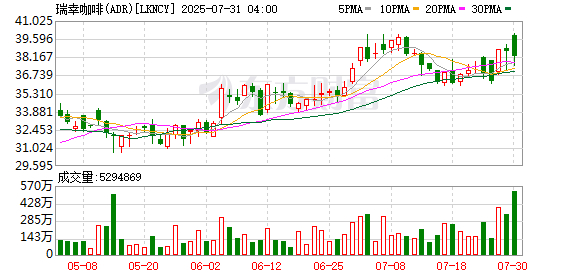
抢钱的咖啡,瑞幸单季度冲至123.6亿营收,CEO豪言:海外照样能卷
3 6 Ke· 2025-07-31 03:47
Group 1: Financial Performance - In Q2 2025, the company achieved total net revenue of 12.359 billion RMB, a year-on-year increase of 47.1%, setting a new quarterly record [1] - Net profit reached 1.25 billion RMB, reflecting a year-on-year growth of 44% [1] - Same-store sales growth for self-operated stores rose to 13.4% due to scale effects [1] Group 2: Store Expansion Strategy - The company continued its aggressive store opening strategy, adding 2,109 new stores in a single quarter, bringing the total to over 26,206 stores [1] - However, this rapid expansion has led to a decline in same-store sales, which fell by 16.7% in 2024, compared to a 21% increase the previous year [4][6] - Management remains optimistic about future growth, emphasizing the importance of scale, efficiency, and supply chain advantages [4][6] Group 3: International Expansion Challenges - The company has faced difficulties in replicating its domestic success in international markets, such as Singapore, where only 51 stores have been opened since April 2023 [7][9] - High operational costs and intense competition in overseas markets have hindered profitability [9][10] - Despite these challenges, the company is expanding into new markets, including Malaysia and the United States, with a total of 89 overseas stores as of mid-2025 [10][12] Group 4: Competitive Landscape - The company has significantly outpaced Starbucks in terms of store count and revenue growth in China, with over 26,117 stores compared to Starbucks' approximately 7,758 [13] - Starbucks has responded to the competitive pressure by adjusting its pricing strategy, indicating the impact of the company's low-price approach [13] - The ongoing competition highlights the need for the company to maintain its growth momentum while addressing potential long-term sustainability issues [13]
小红书从“生活指南”到“兴趣社区”背后,品牌升级的水有多深?
3 6 Ke· 2025-07-31 03:40
Core Viewpoint - Xiaohongshu's rebranding from "Your Life Guide" to "Your Life Interest Community" signifies a strategic shift towards a more community-driven platform, reflecting the evolving needs of users who seek shared interests and emotional resonance rather than just information retrieval [1][2][4] Summary by Sections Brand Strategy Shift - The change in slogan indicates a broader brand strategy upgrade, moving from a utilitarian information platform to a vibrant interest-based social community [1][2] - The term "interest" expands the content categories on the platform, while "community" reflects a shift from one-way information delivery to co-creation [1][2] Content Ecosystem Expansion - Xiaohongshu has actively expanded its content ecosystem, particularly targeting younger audiences with a focus on gaming and anime, resulting in a 168% increase in gaming-related posts and a 175% surge in anime content [2][4] - Collaborations with esports leagues and the hosting of events like "RED LAND" demonstrate Xiaohongshu's commitment to becoming a hub for interest-based social interaction [4] Drivers of Brand Upgrade - The need for brand upgrades is driven by three main engines: the necessity to break through growth ceilings, adapt to changing consumer preferences, and align with strategic transformations [4][5][8] - As markets become saturated, brands must refresh their images to attract new consumer segments, as seen with Xiaohongshu's shift to appeal to Gen Z [8][10] Consumer Engagement - The brand's transformation is also a response to the evolving preferences of younger consumers who prioritize community and shared interests over mere information [8][10] - Successful brand upgrades require deep communication with consumers, ensuring they understand the reasons behind changes and feel involved in the process [15][16] Strategic Alignment - Brand upgrades should be strategically driven rather than superficial, necessitating a coherent strategy that aligns with the brand's new identity [14][15] - Examples like Starbucks and Meta illustrate how strategic shifts necessitate corresponding brand upgrades to support new business directions [10][14] Conclusion - As competition intensifies, brand upgrades are becoming essential for many companies, with those that balance change and continuity, engage authentically with consumers, and follow strategic guidance likely to thrive [16]

年收入近80亿的雀巢咖啡中国,将迎来一位全新“女掌门”
3 6 Ke· 2025-07-31 02:26
Core Insights - Nestlé's coffee business in China, generating nearly 8 billion RMB in annual revenue, is set to have a new leader, Pamela Takai, starting from Q3 [1][12] - The coffee segment is crucial for Nestlé, serving as a strategic vehicle for brand management, product innovation, and consumer loyalty [1][12] Leadership Transition - Pamela Takai, currently leading Nestlé's dairy health and nutrition solutions in the Philippines, will take over the coffee business in China, reporting directly to Kais Marzouki, Chairman and CEO of Nestlé Greater China [1][3] - Takai has over 20 years of experience in fast-moving consumer goods, having previously worked at Unilever and Mondelēz, focusing on brand management and marketing [3][5] - The previous head of the coffee business, Jiang Haiying, is leaving to pursue new opportunities after a year in the role [7][8] Performance and Strategy - Takai is recognized for her strong track record in driving performance growth and business transformation, having successfully revitalized the dairy business in the Philippines [5][10] - Under Jiang's leadership, the coffee business focused on local innovation and product upgrades, launching new ready-to-drink coffee products inspired by local market trends [10][12] - The coffee segment is seen as a fundamental part of Nestlé's business, with a significant contribution to overall revenue, growing at approximately 8% annually over the past three years, generating around 240 billion Swiss Francs (approximately 197.4 billion RMB) [12][13] Market Dynamics - The coffee market is experiencing a shift towards high-end products and diverse consumption scenarios, with younger consumers seeking innovative ways to enjoy coffee at home [16][18] - Nestlé aims to cater to these evolving consumer preferences by developing solutions that allow coffee consumption throughout the day, not just in the morning [16][18] - The competitive landscape in China has intensified, with Nestlé's coffee business revenue showing little change compared to previous years, reflecting challenges in growth [14][16]

特朗普对巴西加征50%关税!但豁免多行业,生效日延后
Jin Shi Shu Ju· 2025-07-31 01:15
Group 1: Tariff Details and Exemptions - The new 50% tariff on most Brazilian goods will take effect on August 6, instead of the initially announced August 1 [2] - The tariff exempts several key Brazilian exports to the U.S., including civilian aircraft, pig iron, precious metals, wood pulp, energy, and fertilizers [2][5] - Approximately 700 products are exempt from the higher tariffs, accounting for 43.4% of Brazil's total exports to the U.S. by value [5] Group 2: Impact on Companies - Embraer, a major Brazilian aerospace company, exports 45% of its commercial aircraft and 70% of its executive jets to the U.S., and its stock rose by 11% following the announcement [6] - Suzano, one of the largest pulp producers globally, also saw its stock increase by over 1% amid concerns about potential impacts from the tariffs [6] - The Brazilian oil lobby group IBP indicated that oil shipments to the U.S. would resume due to the exemption of oil products from the new tariffs [6] Group 3: Industry Concerns - The Brazilian meat processing lobby group Abiec estimated that the new tariffs could lead to a loss of $1 billion in the second half of the year for beef producers, as beef was not exempted [7] - The Brazilian coffee exporters group Cecafe is continuing to push for coffee to be included in the exemption list, highlighting ongoing concerns in the coffee industry [7]
星巴克中国在华业绩回来了
3 6 Ke· 2025-07-31 00:30
Core Insights - Starbucks China has shown a recovery in performance, with Q3 revenue reaching $9.5 billion (approximately RMB 68.2 billion), exceeding market expectations and reflecting a 4% year-on-year growth [1] - The company reported a net profit of $558.3 million, a significant decline of 47.1% year-on-year, while North American same-store sales fell by 2% due to a 4% drop in comparable transaction volume, although average ticket prices increased by 2% [1] - In the Chinese market, Starbucks achieved revenue of $790 million (approximately RMB 5.67 billion), marking an 8% year-on-year increase and continuing three consecutive quarters of growth [1] Revenue and Profitability - The same-store sales metric, a key indicator of store profitability, experienced a crucial turnaround with a 2% growth in the last fiscal quarter, marking the first increase in six quarters [3] - The growth in same-store sales was primarily driven by a significant 6% year-on-year increase in transaction volume, despite a slight 4% decrease in average ticket price [6] Store Expansion and Market Strategy - As of the end of Q3, Starbucks China had a total of 7,828 stores, a net increase of 522 stores (7% year-on-year), moving closer to the goal of operating 9,000 stores by 2025 [6] - The company opened 70 new stores and entered 17 new county-level markets, with new stores contributing above-average same-store sales within two years [6] Factors Driving Improvement - The improvement in performance is attributed to several factors, including a flexible pricing strategy that involved a significant price reduction of over 10% on non-coffee products, effectively broadening the customer base and attracting younger consumers [9] - Product innovation has been tailored to local demands, with 78 new products launched in FY2024, including a coffee bean themed around the Chinese New Year, developed by local baristas [9] - Enhanced marketing strategies, including collaborations with popular brands and celebrities, have driven significant engagement and sales growth [9] Delivery and Competition - The growth in same-store sales is also linked to the booming delivery market, with Starbucks actively participating in promotional activities on platforms like JD.com and Meituan, leading to increased consumer demand [10][12] - Despite the recovery, Starbucks faces intense competition from local brands and is focusing on localizing operations and forming strategic partnerships to strengthen its market position [14] Strategic Partnerships - Starbucks is exploring strategic partnerships to capture future growth opportunities in the Chinese market, with over 20 potential partners being evaluated [15] - The company emphasizes that these partnerships are not primarily for funding but to ensure a stronger brand presence in China, requiring partners to share similar values and possess strong local operational capabilities [15] Conclusion - The recent performance recovery of Starbucks China is a result of multi-faceted strategies involving product, pricing, marketing, delivery, and membership enhancements, reflecting agility in responding to local competition [15] - The pursuit of strategic partnerships may mark a new starting point for Starbucks in the competitive Chinese coffee market [16]
瑞幸咖啡,又爆了!
Zhong Guo Ji Jin Bao· 2025-07-30 15:16
Group 1 - The core viewpoint of the article highlights that Luckin Coffee has achieved record high total net revenue of 12.359 billion yuan in Q2 2025, marking a year-on-year growth of 47.1% [1] - The GAAP operating profit reached 1.7 billion yuan with an operating profit margin of 13.8%, while the net profit attributable to ordinary shareholders was 1.251 billion yuan, reflecting a year-on-year increase of 44% [1] - As of the end of Q2 2025, Luckin Coffee had a total of 26,200 stores, ranking second in the country, just behind Starbucks, with a net increase of 2,109 stores during the reporting period [1][2] Group 2 - Luckin Coffee has been steadily expanding its international presence since launching its globalization strategy in 2024, entering markets such as Singapore, Hong Kong, and Malaysia [2] - The company has opened two PICK UP stores in Manhattan, New York, which signifies its ambition to create a world-class coffee brand and highlights the potential of the U.S. market [2] - Despite overseas stores accounting for less than 0.5% of total stores, the company's low-price strategy (60%-80% of local Starbucks prices) and self-operated model present new revenue growth opportunities [2] Group 3 - According to Deloitte's reports, China's per capita coffee consumption has increased from 9 cups per year in 2021 to approximately 22 cups per year in 2024, indicating significant growth potential compared to the U.S. and other Asian countries [3] - Frost & Sullivan projects that the domestic freshly brewed coffee market will further grow to 331.4 billion yuan by 2027, with a growth rate exceeding 20%, suggesting that the industry is still in a phase of substantial benefits [3]