食品饮料

Search documents
妙可蓝多:赎回3500万元闲置募集资金现金管理产品获收益8.93万元
Xin Lang Cai Jing· 2026-01-28 08:58
Core Viewpoint - The company announced an investment of 35 million yuan in a structured deposit product with Industrial Bank's Shanghai Caohejing branch, with a recent redemption yielding a return of 89,300 yuan and an annualized yield of 1.90% [1] Group 1 - The company signed an agreement on December 9, 2025, to invest 35 million yuan in a structured deposit product [1] - The company redeemed the investment, recovering the principal of 35 million yuan and earning a profit of 89,300 yuan [1] - The annualized yield from the investment was reported at 1.90% [1] Group 2 - As of the announcement date, the company had a cash management balance of 1.38 billion yuan from idle raised funds [1] - The cash management activities are within the authorized limits set by the board of directors [1] - There are no overdue or unrecovered amounts reported [1]

巴菲特这样点评黄金!
Sou Hu Cai Jing· 2026-01-28 08:21
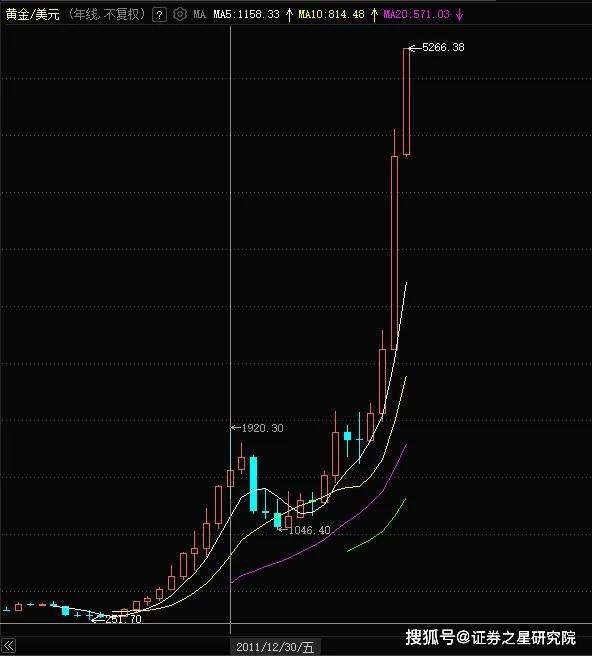
近期,贵金属行情愈演愈烈,黄金、白银价格屡破新高,引来众多投资者瞩目。行情炙手可热之际,讨 论不断刷屏,羡慕与跃跃欲试的情绪也在蔓延。 那么,站在当下展望长期,我们该如何理性看待当下的黄金市场?今天的文章,我们不妨回过头看一看 巴菲特致股东信的历史观点,从价值投资的角度再来审视市场,汲取老巴长期主义的智慧。 注:本文是2011年巴菲特致股东的信的节选,当年黄金价格一度也创下新高,但随后一度暴跌近50%。 如果在彼时最高点买入黄金的投资者,近乎被套9年才回本。 2.也没有生产新价值的能力。 没错,黄金具有某些工业和装饰用途,但是对黄金的这两种需求不仅非常有限而且吸收不了新产品。与 此同时,如果你一直持有一盎司黄金,到最终你也只能拥有这一盎司黄金。 激发大部分炒金客对黄金趋之若鹜的原因是:他们相信人们的恐惧心理会日益膨胀。过去的10年证明了 这一观点的正确性。除此之外,黄金价格持续上扬本身也激发了人们更多的购买热情,将那些把黄金价 格上升看成是验证他们投资理论正确的投资者吸引了过来。 随着"跟风"投资者涌入黄金投资的狂潮,他们创造出他们自己的真理,不过只是在一段时期内。 以下为主要内容: 一、黄金天生具有缺陷 投 ...

老铺子赶上新潮流
Jing Ji Ri Bao· 2026-01-28 08:10
Group 1 - The core idea is that traditional businesses in Qingdao are innovating by integrating modern consumer trends, thereby revitalizing their brand appeal and attracting younger customers [1][2][3] - The T-space Screw Coffee area in a hardware store has successfully attracted a younger demographic, increasing the proportion of young customers from less than 10% to 35% by 2025 [1] - The hardware store's coffee sales have positively impacted its hardware business, with household hardware sales projected to increase by 23% year-on-year in 2025 [1] Group 2 - The historical cultural district of Dabaodao is becoming a hub for traditional brands, with various local old brands establishing a presence and enhancing the area's cultural significance [2][3] - The Gaojia Sugar Ball brand has transformed its traditional sales model by creating an interactive experience center, increasing foot traffic by three times compared to traditional stalls, with over 60% of visitors being under 30 years old [3] - The city government is promoting the revival of old brands as part of a broader urban revitalization plan, aiming to create a cluster of innovative traditional businesses [3]
花旗:欧元走强或为欧洲股市蒙上阴影
Xin Lang Cai Jing· 2026-01-28 07:36
Group 1 - The core viewpoint of the article highlights that the strengthening of the euro against the dollar is becoming a focal point as investors seek to diversify their asset allocation away from the US, which may cast a shadow over European stock markets [1] - Citigroup strategists indicate that the ongoing appreciation of the euro will reinforce a neutral outlook on European equities due to recent transatlantic tensions and tariff uncertainties that have weakened short-term investment prospects [1] - According to Citigroup's estimates, a 10% increase in the euro against the dollar could lead to a reduction of approximately 2% in the earnings per share of European companies [1] Group 2 - The sectors most likely to be impacted by the euro's appreciation include commodities, food and beverage, healthcare, luxury goods, and the automotive industry [1]
消费专题报告:估值低位下的结构演绎,聚焦“红利资产”与“情绪消费”
Huajin Securities· 2026-01-28 06:04
Investment Rating - The report assigns an "Outperform" rating for the consumer services sector, indicating a positive outlook for investment opportunities in this industry [1]. Core Insights - The report emphasizes a dual focus on "service consumption" and "dividend assets" as key investment themes, highlighting the resilience of service consumption compared to goods [4]. - It notes a significant shift in market pricing logic from "total elasticity" to "structural dividends," driven by a clear L-shaped bottoming phase in overall consumption [4]. - The report identifies a "K-shaped differentiation" in the market, with macro-sensitive assets showing strong performance against cyclical sectors like real estate [4]. Summary by Sections Trend Analysis - The report discusses the increasing "K-shaped differentiation" in the market, where service consumption is outperforming goods, with restaurant services growing by 2.2% compared to a mere 0.7% for physical goods [4][14]. - It highlights the impact of the calendar effect on short-term growth rates, particularly due to the timing of the 2026 Spring Festival, which has caused a temporary dip in consumption figures [4][14]. Valuation Analysis - As of January 18, 2026, the core consumer sector's PE-TTM has fallen to historical low levels, with food and beverage sectors at 7.5% and liquor at 4.1%, indicating a significant safety margin and potential for valuation recovery [4][28]. - The report suggests that current valuation levels have adequately priced in macroeconomic disturbances, enhancing the long-term investment appeal of core assets [4][28]. Investment Strategy - The report recommends a "barbell strategy" for investment, balancing defensive positions in essential consumer goods with aggressive positions in sectors benefiting from policy catalysts and improving fundamentals, such as cosmetics and sports [4]. - It emphasizes the importance of focusing on dividend-paying stocks with strong cash flows as a defensive strategy while also targeting high-growth sectors for potential upside [4]. Sector Rotation - The report outlines a sector rotation strategy, advising investments in essential consumption and real estate on the left side, while embracing growth opportunities in overseas markets on the right side [21]. - It notes that the food and beverage sector is poised for growth due to the upcoming Spring Festival, which is expected to catalyze demand [22].
当渠道成为增长瓶颈:食品品牌如何找到“有效对接”?
Sou Hu Cai Jing· 2026-01-28 04:47
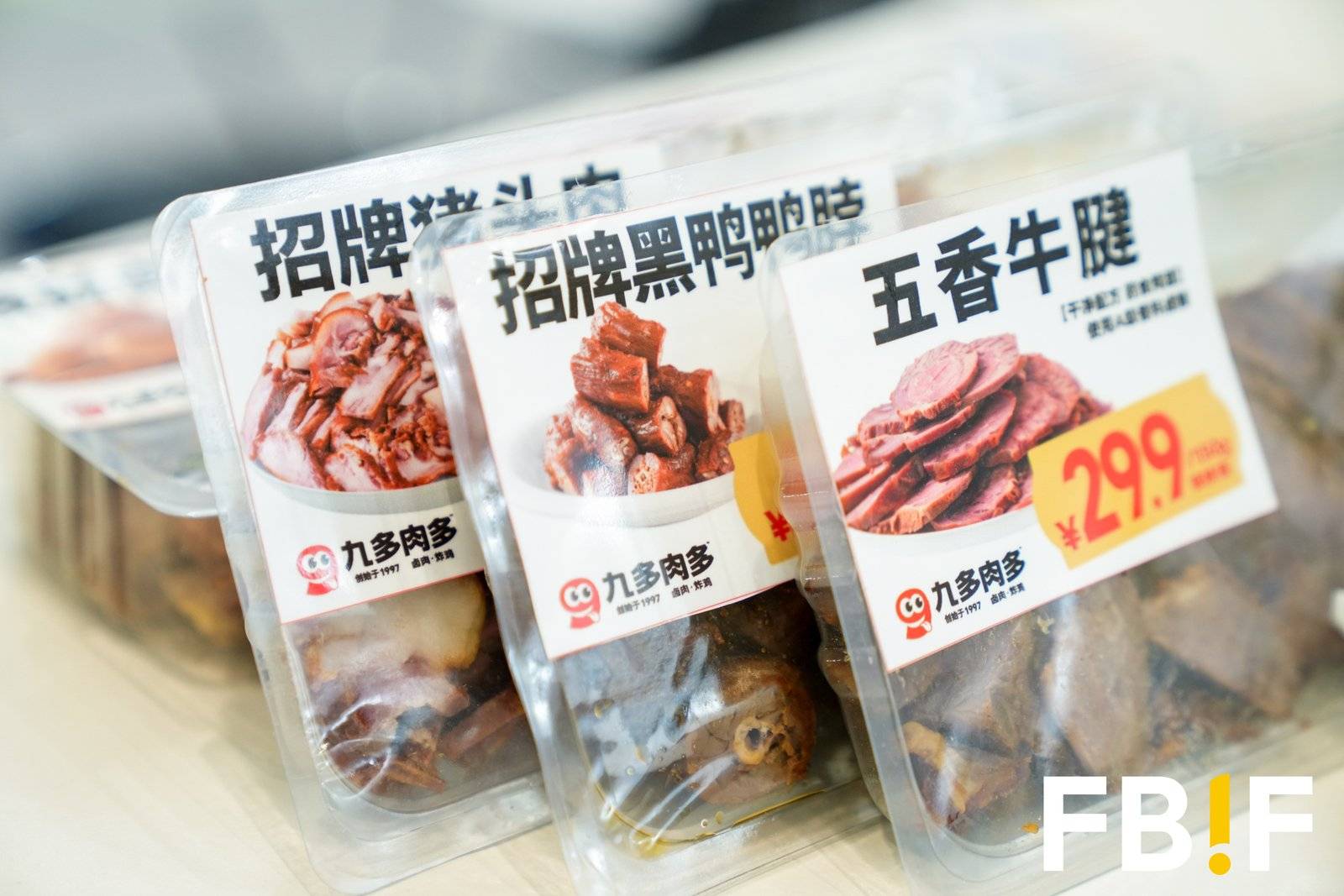
Core Insights - The food and beverage industry is undergoing significant changes in retail channels, focusing on delivering the right products to the right consumers in appropriate consumption scenarios [1][3] - The value of channels has shifted from mere distribution capabilities to facilitating faster validation of brand directions and establishing sustainable partnerships [3] Group 1: Brand and Channel Interaction - Brands are increasingly concerned with efficiently identifying the right consumers, supported by a dense network of channels developed by FBIF, connecting over 2000 food and beverage brands with various retail systems [4] - As channels become consumer-centric, the methods of connecting brands and channels need to evolve, moving from generic interactions to more thematic engagements [6] Group 2: Event Structure and Communication - FBIF has initiated systematic planning of themed offline channel activities to enhance communication between brands and channels, making it more relevant to real work scenarios rather than superficial interactions [6][8] - The WOW FOOD events aim to address common brand pain points by facilitating direct feedback and product suitability assessments through real sales environments [7][9] Group 3: Ongoing Engagement and Evaluation - Beyond large exhibitions, FBIF continues to host monthly channel tasting events focusing on niche categories and trends, providing brands with opportunities for repeated engagement [10][14] - The true value of channel connections lies in their sustainability, emphasizing that collaboration is a process requiring ongoing validation and adjustment [15] Group 4: Understanding and Collaboration - The industry recognizes that the key to successful channel and brand relationships is mutual understanding rather than dominance, with FBIF facilitating a mechanism for brands and channels to meet, experiment, and co-create in a realistic context [16]
佳隆股份:公司持有前海股交投资控股7.64%股权
Zheng Quan Ri Bao Wang· 2026-01-28 03:50
证券日报网讯1月27日,佳隆股份(002495)在互动平台回答投资者提问时表示,公司是前海股交投资 控股(深圳)有限公司的股东,持有其7.64%的股权。前海股交投资控股(深圳)有限公司旗下有前海梧桐等 创投平台。具体情况可参考公司披露的公告。 ...

机构年前正紧急调研哪些股?史上最长春节假期来临,消费热潮受关注
Xin Lang Cai Jing· 2026-01-28 03:20
Group 1 - The public fund industry is maintaining a high-intensity research pace ahead of the Spring Festival, focusing on key sectors such as commercial aerospace and consumer goods [1][2] - Commercial aerospace remains a significant area of interest, with companies like Xingchen Technology, Taili Technology, and Chaojie Co. receiving intensive research from multiple public funds [2][3] - Xingchen Technology has been a focal point, with 23 fund companies conducting research in the past week, emphasizing its servo technology and future applications in motion control [2][3] Group 2 - Taili Technology is also under scrutiny, with several fund companies exploring its development strategies in the aerospace sector, particularly its core material technology [3] - Chaojie Co. has been engaged by various fund companies, focusing on its manufacturing of commercial rocket structures and its completed production line for 2024 [3] - Additionally, Dajin Heavy Industry, a supplier of offshore wind power equipment, has attracted attention from 47 fund companies due to its expanding overseas business, particularly in Europe and emerging markets like Japan and South Korea [4][5] Group 3 - The longest Spring Festival holiday is increasing interest in the consumer sector, with companies in food and beverage, as well as tourism and entertainment, receiving attention from multiple public funds [5] - The consumer sector is expected to present structural investment opportunities, especially as macro policies aimed at expanding domestic demand continue to take effect [5]

广货出圈正当时!新春前后江门将打造超50场重点促消费活动
Nan Fang Du Shi Bao· 2026-01-28 03:02
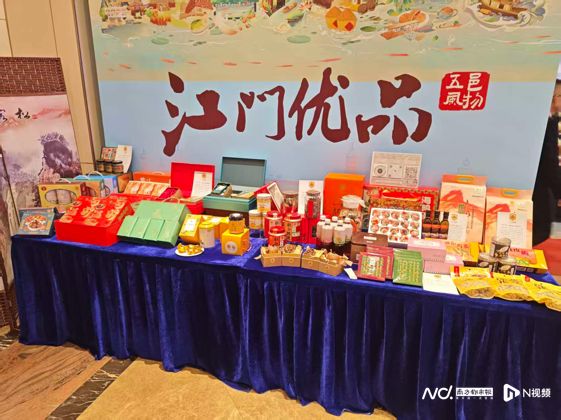
Group 1 - Jiangmen is organizing over 50 key promotional consumption activities to boost local products and enhance consumer engagement during the Spring Festival [1] - The "Guanghuo Goes Global" theme aims to promote Jiangmen's unique products, including coffee and local specialties, through various platforms [1] - The overseas Chinese community is actively participating in these events, showcasing Jiangmen's products to over 300 representatives from different countries [1] Group 2 - The Jianghai Quality Products New Year Festival introduces an innovative "time-slot" shopping model, bringing convenience to local consumers and promoting local brands [3] - This initiative aims to meet the New Year shopping needs of the public while expanding the distribution channels for Jianghai quality products [3] Group 3 - The Kaiping Gourmet Culture Week will feature over 120 national brands, creating a unique culinary experience that highlights local flavors [5] - This event is designed to attract food enthusiasts and promote Jiangmen's culinary offerings as a significant part of Guangdong's food landscape [5] Group 4 - The Taishan New Spring Festival will take place from February 9 to 18, focusing on a one-stop shopping experience that combines cultural elements and recreational activities [7] - The event will feature various stalls showcasing local products and daily performances, enhancing consumer engagement and promoting Taishan's unique offerings [7] Group 5 - The Fourth China Qiaodu (Jiangmen) Coffee Festival will occur from March 5 to 8, featuring over 200 coffee brands and aiming to elevate the event's brand influence [9] - Jiangmen is positioned as a national coffee roasting export base and a global coffee equipment production hub, using the festival to showcase its coffee products [9] Group 6 - Jiangmen is leveraging diverse promotional activities to enrich consumer experiences and enhance the visibility of quality local products [11] - The focus is on creating varied consumption scenarios and improving the overall quality of consumer experiences [11]
因负债被公司提出仲裁申请,她被免职
Yang Zi Wan Bao Wang· 2026-01-28 02:42
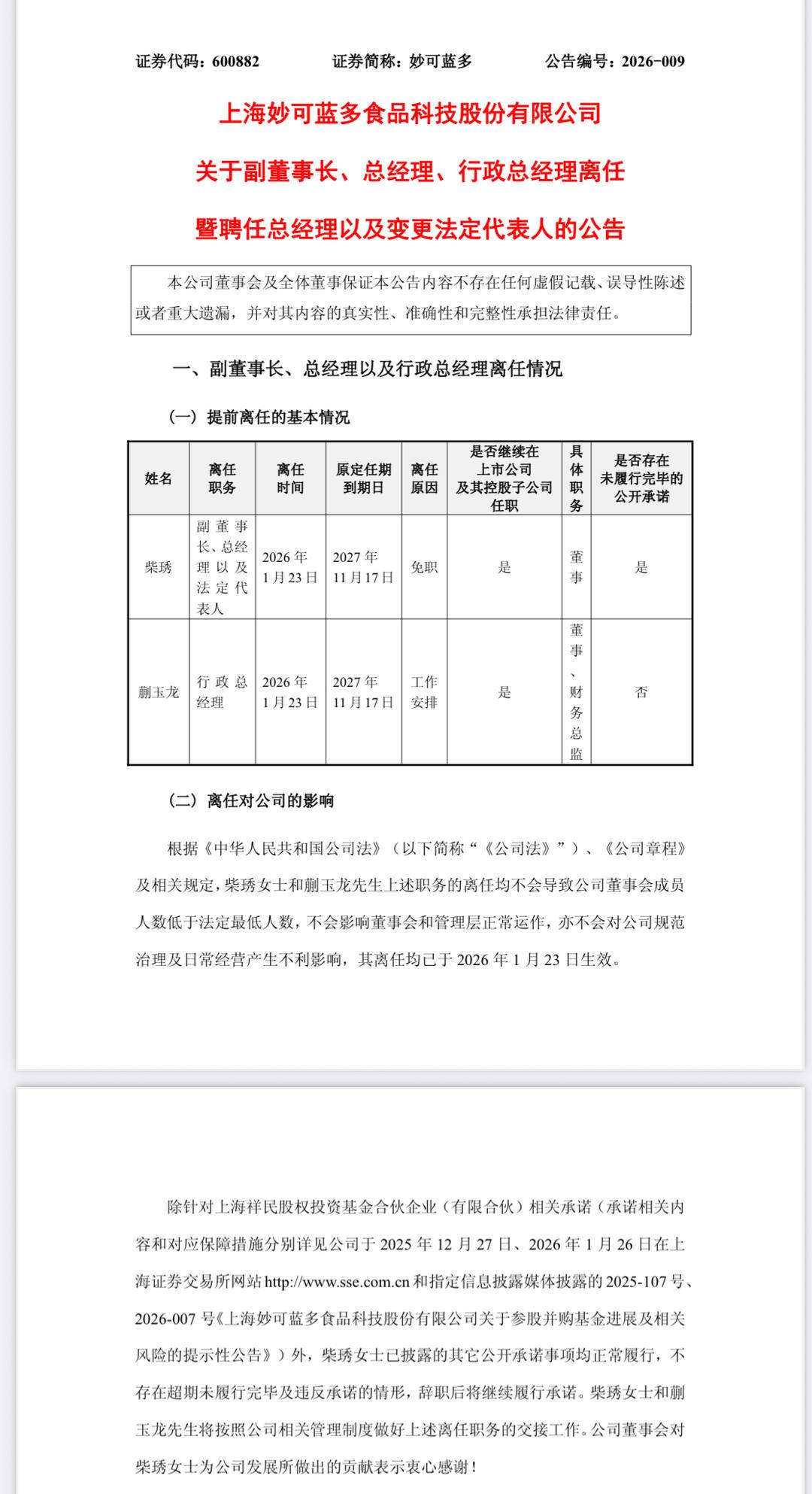
扬子晚报网1月28日讯(记者范晓林薄云峰)1月25日,妙可蓝多(600882)连发数条公告,宣布其创始人柴琇被"免职",自1月23日起不再担任公司副董事 长、总经理、法定代表人,但柴琇会继续担任上市公司董事职务。同时公告称,柴琇存在未履行完毕的公开承诺。 | 姓名 | 离任 | 离任 | 原定任期 | 离任 | 是否继续在 上市公司 | 賞 体 | 是否存在 未履行完毕的 | | --- | --- | --- | --- | --- | --- | --- | --- | | | 职务 | 时间 | 到期日 | 原因 | 及其控股子公司 | 职 | 公开承诺 | | | | | | | 任职 | 务 | | | 柴秀 | 副董事 长、总经 理以及 法定代 | 2026 年 1月23日 | 2027 年 11月17日 | 免职 | 是 | 章 事 | 是 | | | 表人 | | | | | | | | 蒯玉龙 | 行政总 经理 | 2026年 1月23日 | 2027 年 11月17日 | 工作 安排 | 是 | 直 事 1 财 | 否 | | | | | | | | 务 | | | | | | | | | ...