
饮料

Search documents
新纪录!5300亿元,中国首富,是他
Zhong Guo Ji Jin Bao· 2025-10-28 07:29
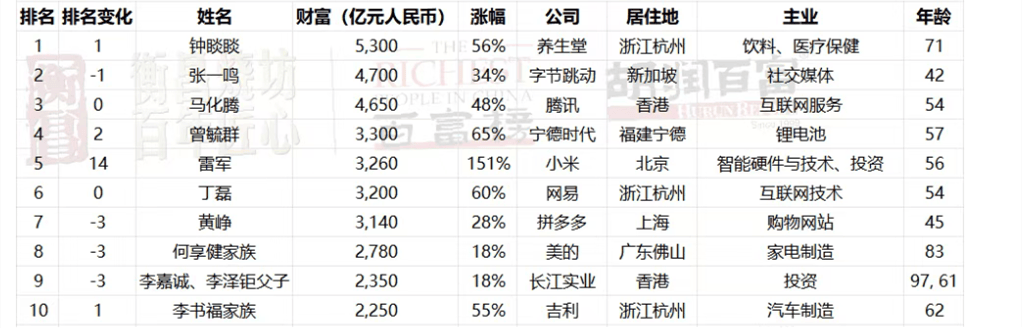
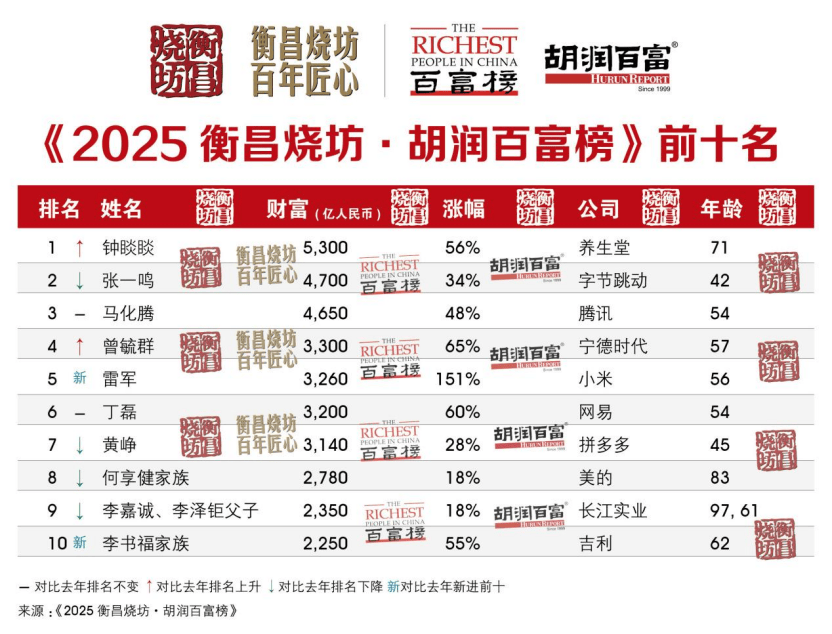
Core Insights - The Hu Run Research Institute's "2025 Hu Run Rich List" reveals that Zhong Shanshan of Nongfu Spring has become China's richest person for the fourth time, with a wealth of 530 billion RMB, setting a new record for the wealthiest individual in China [1][3] - Lei Jun of Xiaomi Group saw a wealth increase of 196 billion RMB, ranking fifth on the list, primarily benefiting from the growth of Xiaomi's automotive sector and the high-end breakthrough in mobile phones [1][6] Wealth Distribution - The total wealth of listed entrepreneurs approaches 30 trillion RMB, with 1,434 individuals having wealth exceeding 5 billion RMB, marking a year-on-year growth of 31% [3] - The top five wealthiest individuals are: 1. Zhong Shanshan - 530 billion RMB (56% increase) 2. Zhang Yiming - 470 billion RMB (34% increase) 3. Ma Huateng - 465 billion RMB (48% increase) 4. Zeng Yuqun - 330 billion RMB (65% increase) 5. Lei Jun - 326 billion RMB (151% increase) [2] Industry Performance - Six industries showed significant wealth growth among entrepreneurs: new energy vehicles, consumer electronics, new consumption, computing power, biomedicine, and securities services [5][6] - In the new energy vehicle and battery sector, Lei Jun's wealth increased by 196 billion RMB, while Zeng Yuqun of CATL entered the top five with 330 billion RMB [6] - In the consumer electronics sector, the demand for smart hardware and the popularity of short videos contributed to wealth increases for several entrepreneurs, including Liu Jingkang and Pan Yao, who debuted on the list with 38.5 billion RMB [6] Regional Insights - The Yangtze River Delta region has 483 entrepreneurs on the list, accounting for 34%, while the Guangdong-Hong Kong-Macau Greater Bay Area has 363, making up 25% [8] - The top three cities with the highest number of listed entrepreneurs are Shanghai, Shenzhen, and Beijing, with 152, 147, and 146 individuals respectively [9][10][11] - The increase in the number of entrepreneurs in Shanghai and Shenzhen is attributed to the recovery of the A-share market and the concentration of industries such as semiconductors, biomedicine, and AI in these cities [13]

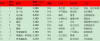
2025胡润百富榜:钟睒睒财富5300亿比去年增长1900亿,第四次成为中国首富!80%财富来源于农夫山泉,一年分红70亿
Sou Hu Cai Jing· 2025-10-28 07:10
Core Insights - The 2025 Hurun Rich List reveals that Zhong Shanshan's wealth has increased by 190 billion RMB, reaching 530 billion RMB, making him the richest person in China for the fourth time and setting a new record for wealth among Chinese billionaires [1] - Zhong Shanshan's wealth grew by 56% compared to the previous year, and he is a representative of China's vast domestic market with a population of 1.4 billion [1] Company Performance - Nongfu Spring, led by Zhong Shanshan, maintains the top market share in China's packaged drinking water, with sales exceeding 25 billion RMB in the first half of the year, reflecting a year-on-year growth of over 15% [1] - The company has made significant progress in the tea beverage sector, with new brands like Dongfang Shuye contributing to overall performance growth [1] - The market capitalization of Nongfu Spring has reached a record high of 520 billion RMB, driven by overall market recovery and rapid performance growth [1] Wealth Distribution - Approximately 80% of Zhong Shanshan's wealth is derived from Nongfu Spring, highlighting the company's pivotal role in his financial success [1] - In the past year, Zhong Shanshan distributed over 7 billion RMB in dividends, indicating strong cash flow and profitability within the company [1]

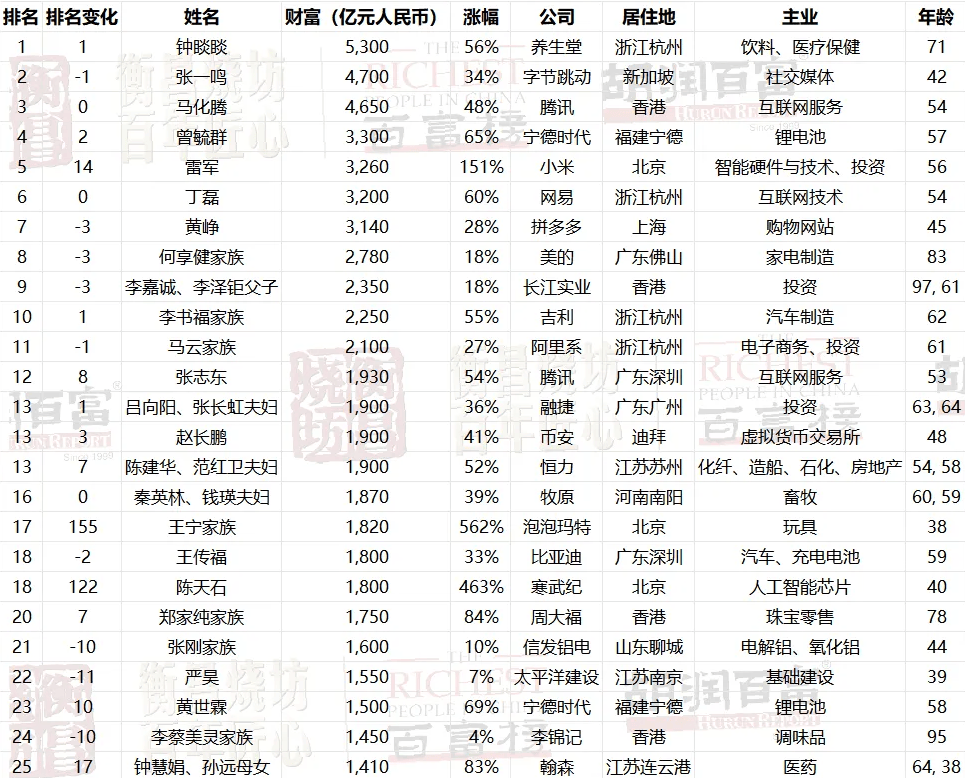
钟睒睒财富5300亿元比去年增长1900亿元,排名提升1位
Xin Lang Zheng Quan· 2025-10-28 06:57
Core Insights - Zhong Shanshan's wealth increased by 190 billion RMB, reaching 530 billion RMB, making him the richest person in China for the fourth time and setting a new record for wealth in the country [1][2] - His company, Nongfu Spring, maintains the largest market share in China's packaged drinking water, with sales exceeding 25 billion RMB in the first half of the year, reflecting a year-on-year growth of over 15% [1] - The company has made significant progress in the tea beverage sector, with new brands like Dongfang Shuye contributing to overall performance growth [1] Company Performance - Nongfu Spring's market capitalization has reached 520 billion RMB, driven by a recovery in the Hong Kong stock market and rapid growth in performance [1] - Zhong Shanshan's wealth is primarily derived from Nongfu Spring, accounting for 80% of his total wealth [1] - The company has been focusing on product premiumization and brand upgrading, representing a model for high-quality development among Chinese enterprises [1] Wealth Rankings - The 2025 Hurun Rich List shows Zhong Shanshan at the top, followed by Zhang Yiming with 470 billion RMB and Ma Huateng with 465 billion RMB [2] - The list highlights significant wealth increases among various entrepreneurs, with notable growth percentages, such as 151% for the Xiaomi founder [2]
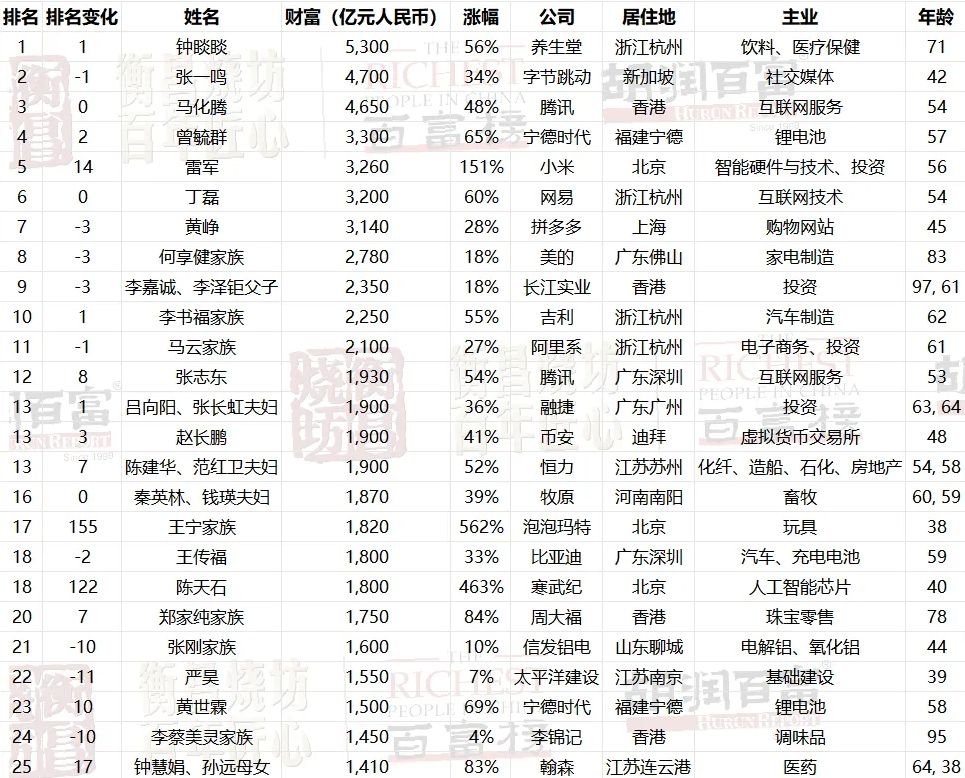
2025胡润百富榜发布:钟睒睒以5300亿元身价第四次成为中国首富!张一鸣、马化腾分列第二、第三名
Sou Hu Cai Jing· 2025-10-28 06:42
Core Insights - The 2025 Hurun Rich List reveals a significant increase in the number of billionaires and total wealth in China, with 1,434 individuals having wealth exceeding 5 billion RMB, marking a 31% increase from last year. Total wealth approaches 30 trillion RMB, up 42% from the previous year [1] Group 1: Wealth Growth and Rankings - Zhong Shanshan, founder of Nongfu Spring, saw his wealth increase by 190 billion RMB, reaching 530 billion RMB, making him the richest person in China for the fourth time and setting a new record for wealth [1] - Zhang Yiming, founder of ByteDance, experienced a wealth increase of 120 billion RMB, driven by advancements in AI, but fell to second place with 470 billion RMB [1] - Ma Huateng, founder of Tencent, gained 150 billion RMB, maintaining third place with a wealth of 465 billion RMB, supported by growth in gaming, advertising, and fintech [1] Group 2: New Entrants and Notable Growth - The list features 376 new faces, a sevenfold increase from last year, with notable newcomers including Xu Gaoming and Xu Dongbo from Laopu Gold, who entered the top 100 with 69.5 billion RMB [2] - Lei Jun from Xiaomi was named the "Growth King," with a wealth increase of 196 billion RMB, attributed to explosive growth in Xiaomi's automotive business and high-end smartphone sales [2] - Other rapidly growing entrepreneurs include Wang Ning from Pop Mart, with a wealth increase of 154.5 billion RMB, and Chen Tianshi from Cambrian, who saw a wealth increase of 148 billion RMB due to AI chip advancements [2]


5300亿元身价!中国首富是他→
Sou Hu Cai Jing· 2025-10-28 06:42
Group 1 - The 2025 Hurun Rich List features 1,434 entrepreneurs with wealth exceeding 5 billion RMB, a 31% increase from last year, totaling nearly 30 trillion RMB, which is a 42% growth [1] - Zhong Shanshan, founder of Nongfu Spring, saw his wealth increase by 190 billion RMB, reaching 530 billion RMB, making him the richest person in China for the fourth time [1] - Zhang Yiming, founder of ByteDance, experienced a wealth increase of 120 billion RMB, driven by advancements in AI, placing him second with 470 billion RMB [1] Group 2 - The list includes 376 new faces, seven times more than last year, with notable newcomers like Xu Gaoming and Xu Dongbo from Laopu Gold, who entered the top 100 with 69.5 billion RMB [2] - Lei Jun from Xiaomi was named the "growth king," with a wealth increase of 196 billion RMB, attributed to explosive growth in Xiaomi's automotive business and high-end smartphone sales [2] - Other rapidly growing entrepreneurs include Wang Ning from Pop Mart, whose wealth increased by 154.5 billion RMB, and Chen Tianshi from Cambrian, with a wealth increase of 148 billion RMB due to AI chip advancements [2]

东鹏饮料的“资本迷局”:一边分掉54亿利润,一边携百亿现金赴港募资 | IPO观察
Tai Mei Ti A P P· 2025-10-28 06:26
Core Viewpoint - Dongpeng Beverage's revenue is heavily reliant on energy drinks, accounting for at least 70% of its income, which raises concerns about its product diversification despite strong financial performance [2][3][5]. Financial Performance - Dongpeng Beverage's revenue and profit have shown an upward trend during the reporting period, with revenues of 85 billion RMB, 112.57 billion RMB, 158.3 billion RMB, and 107.32 billion RMB, and profits of 14.41 billion RMB, 20.4 billion RMB, 33.26 billion RMB, and 23.75 billion RMB respectively [4][11]. - The compound annual growth rates for revenue and profit from 2022 to 2024 are 36.47% and 51.92% respectively [4]. Dividend Policy - The company has distributed a total of 54 billion RMB in dividends during the reporting period, which represents 58.81% of its total profit of 91.82 billion RMB [5][7]. - The dividend amounts for the years were 8 billion RMB, 10 billion RMB, 23 billion RMB, and 13 billion RMB [5]. IPO and Fundraising - Dongpeng Beverage is pursuing an IPO in Hong Kong to raise funds for capacity expansion, supply chain upgrades, brand building, and market expansion, despite having substantial cash reserves [7][8]. - As of the end of 2023, the company had over 60 billion RMB in cash and cash equivalents, and projected to exceed 100 billion RMB in cash-like assets by 2024 and the first half of 2025 [8][10]. Market Position - According to Frost & Sullivan, Dongpeng Beverage has maintained its position as the leading functional beverage brand in China by sales volume for four consecutive years, with a market share of 26.3% in 2024 [5].


《2025胡润百富榜》出炉:深圳富豪数反超北京
2 1 Shi Ji Jing Ji Bao Dao· 2025-10-28 06:09
Group 1 - The 2025 Hurun Rich List features 1,434 entrepreneurs with wealth exceeding 5 billion RMB, a 31% increase from last year, with total wealth nearing 30 trillion RMB, up 42% [1][6] - The top three wealthiest entrepreneurs are Zhong Shanshan (5,300 billion RMB), Zhang Yiming (4,700 billion RMB), and Ma Huateng (4,650 billion RMB) [3][5] - There are 376 new faces on the list, a sevenfold increase from last year, with the top newcomers being Xu Gaoming and Xu Dongbo from Laopu Gold, with a wealth of 695 billion RMB [1][3] Group 2 - The distribution of entrepreneurs' residences shows a "3+2+3" pattern, with Shanghai, Shenzhen, and Beijing leading in density, and for the first time, Beijing is surpassed by Shanghai and Shenzhen [2] - Shanghai has 152 listed entrepreneurs, an increase of 40 from last year, while Shenzhen has 147, up 39, and Beijing has 146, up 31 [2] - The A-share market recovery has significantly contributed to the wealth increase of entrepreneurs in Shanghai and Shenzhen, which are hubs for industries like semiconductors, biomedicine, gaming, and AI [2][6] Group 3 - The wealthiest entrepreneurs in Shenzhen include Zhang Zhihong, Wang Chuanfu, and Wang Tao, with a combined wealth of 29,030 billion RMB [14] - Among the 147 Shenzhen entrepreneurs, 81 experienced wealth growth, with notable increases from DJI's Wang Tao and others, while only 8 saw declines [14] - The new entrants from Shenzhen include 40 individuals, with Liu Jingkang and Pan Yao leading at 385 billion RMB [14]

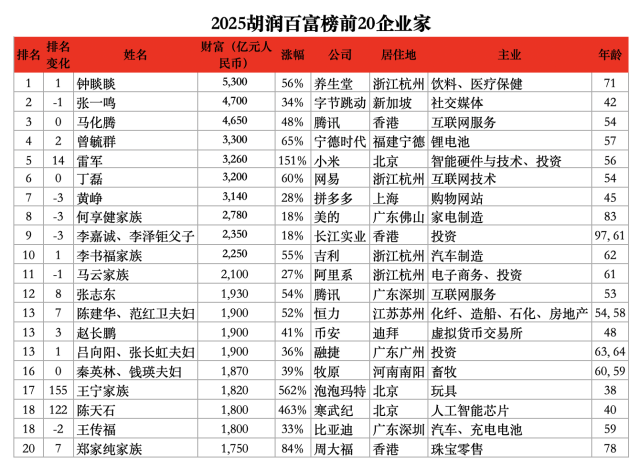
2025胡润百富榜发布!71岁钟睒睒反超张一鸣,以5300亿元第四次登顶
Sou Hu Cai Jing· 2025-10-28 05:40
Core Insights - The 2025 Hurun Rich List was released by Hurun Research Institute, marking the 27th consecutive year since its inception in 1999, with the wealth calculation deadline set for September 1, 2025 [1] - The list shows that Zhong Shanshan of Nongfu Spring, Zhang Yiming of ByteDance, and Ma Huateng of Tencent occupy the top three positions [1] Group 1: Wealth Rankings - Zhong Shanshan ranks first with a wealth of 530 billion RMB, marking a 56% increase [2] - Zhang Yiming is second with 470 billion RMB, experiencing a 34% increase [2] - Ma Huateng holds the third position with 465 billion RMB, reflecting a 48% increase [2] - The threshold for the top ten increased by 60 billion RMB to 225 billion RMB [3] Group 2: Wealth Growth - Zhong Shanshan's wealth increased by 190 billion RMB, setting a new record for the wealth of a Chinese billionaire [3] - Zhang Yiming's wealth grew by 120 billion RMB, driven by advancements in AI business [6] - Ma Huateng's wealth rose by 150 billion RMB, supported by growth in gaming, advertising, and fintech sectors [10] - Lei Jun of Xiaomi saw the largest increase in wealth, up by 196 billion RMB, attributed to the explosive growth of Xiaomi's automotive business [12][14] Group 3: New Entrants and Trends - The list features 1,434 individuals with wealth exceeding 5 billion RMB, a 31% increase from the previous year [3] - There are 41 billionaires with wealth exceeding 100 billion RMB, an increase of 15 individuals [3] - The average age of the top ten billionaires is 62, which is three years younger than last year [3] - The number of new entrants to the list reached 376, seven times higher than the previous year [14]
钟睒睒,再次登顶!雷军,时隔十年闯进前五!2025胡润百富榜揭晓→
Sou Hu Cai Jing· 2025-10-28 05:25
Core Insights - The 2025 Hurun Rich List reveals a significant increase in the number of billionaires in China, with 1,434 individuals having a wealth of over 5 billion RMB, an increase of 340 from last year, and total wealth approaching 30 trillion RMB, up 42% from the previous year [1][3]. Group 1: Wealth Rankings - Zhong Shanshan, founder of Nongfu Spring, tops the list with a wealth of 530 billion RMB, marking his fourth consecutive year as China's richest person and setting a new record for wealth [1][4]. - Zhang Yiming, founder of ByteDance, ranks second with 470 billion RMB, having seen a wealth increase of 1.2 billion RMB, or 34% [5][6]. - Lei Jun, founder of Xiaomi, ranks fifth with 326 billion RMB, experiencing the highest percentage increase in wealth at 151% [6][10]. Group 2: Geographic Distribution - The top three cities with the most billionaires are Beijing, Shanghai, and Shenzhen, with Shenzhen housing 147 billionaires whose total wealth amounts to 2.9 trillion RMB, accounting for 9.6% of the total [1][13]. - The Yangtze River Delta region has 483 billionaires, making up 34% of the total, while the Guangdong-Hong Kong-Macau Greater Bay Area has 363, accounting for 25% [14]. Group 3: Newcomers and Growth Sectors - A total of 376 newcomers made the list this year, a sevenfold increase from last year, with the top newcomer being Xu Gaoming from Laopu Gold, with a wealth of 69.5 billion RMB [8][9]. - Sectors showing strong performance include new energy vehicles, consumer electronics, and AI, with significant contributions from companies like Xiaomi and CATL [10][11].
东鹏饮料(605499):电解质饮料高速增长,Q3盈利强劲
CSC SECURITIES (HK) LTD· 2025-10-28 05:10
Investment Rating - The report assigns a "Buy" rating for the company, indicating a potential upside of 15% to less than 35% [3][8]. Core Insights - The company has shown strong revenue growth, with a 34.1% year-on-year increase in revenue for the first three quarters of 2025, reaching RMB 16.84 billion, and a net profit increase of 39% to RMB 3.76 billion [8]. - The energy drink segment is a significant contributor, accounting for 79.63% of the product mix, with notable growth in electrolyte drinks, which saw a 134.8% increase in revenue [12]. - The company maintains a robust gross margin of 45.17%, benefiting from lower raw material costs, although Q3 saw a slight decline in gross margin due to the introduction of new products [12]. Summary by Sections Company Overview - The company operates in the food and beverage industry, with a current A-share price of RMB 287.01 and a market capitalization of RMB 149.25 billion [2]. Financial Performance - For Q3 2025, the company reported revenue of RMB 6.1 billion, a 30.4% increase year-on-year, and a net profit of RMB 1.39 billion, up 42% [8]. - The company’s revenue from distributors reached RMB 14.5 billion, a 32.8% increase, while online sales grew by 48.9% [12]. Future Projections - The company is expected to achieve net profits of RMB 4.45 billion, RMB 5.6 billion, and RMB 6.8 billion for the years 2025, 2026, and 2027, respectively, with year-on-year growth rates of 33.8%, 25.8%, and 21.5% [12].