黄金投资

Search documents
买时金包铜,卖时八两秤,提纯折旧费“打骨折”,实物黄金“三大套路”存风险
Sou Hu Cai Jing· 2025-11-13 13:17
Core Insights - Since 2025, international gold prices have surged over 60%, reaching a peak of $4,300 per ounce in late October, leading to high investment enthusiasm and demand for physical gold [1] - However, as gold's popularity rises, various deceptive practices have emerged, causing significant losses for ordinary investors [1][4] Group 1: Deceptive Practices in Gold Investment - Investors in Shenzhen and Nanjing reported encountering three main scams: "gold wrapped in copper" when buying, "ghost scales" when selling, and "purification depreciation fees" that significantly reduce returns [1][4] - A case study highlighted an investor who purchased a gold bracelet labeled as 999 pure gold, only to discover it was primarily copper upon attempting to sell it, resulting in substantial financial loss and a complicated legal battle [4][5] - Another investor experienced a significant weight loss in gold during the selling process, attributed to the use of manipulated scales by the buyer, leading to a loss of nearly $8,000 [5][7] Group 2: Impact of New Tax Policies - On November 1, the Ministry of Finance and the State Taxation Administration announced new tax policies that increased the procurement costs of physical gold bars and jewelry due to a disruption in the VAT deduction chain [3] - As a result, jewelry prices increased by 60-70 yuan per gram on the same day, prompting many investors to shift towards online gold investment options that retain VAT tax benefits [3] Group 3: Shift to Online Gold Investment - In response to the challenges faced in physical gold investment, many ordinary investors are turning to online platforms for gold accumulation and ETFs, which offer lower costs and fewer hidden fees [11][12] - Young investors prefer digital investment methods, such as bank apps and platforms like Alipay, to avoid the high premiums and difficulties associated with physical gold [11][12] - The volatility of the gold market, with prices fluctuating significantly, has led to a more cautious approach among investors, emphasizing the importance of a diversified investment strategy [14][16]


炒黄金一站式解决资产配置焦虑,领峰环球4步教你黄金投资
Sou Hu Cai Jing· 2025-11-13 07:55
Core Insights - The article emphasizes the growing appeal of gold investment as a low-cost, low-barrier entry point for new investors, particularly in the context of economic uncertainty and inflation [1][2][4]. Investment Appeal of Gold - Gold is presented as a reliable hedge against economic volatility and a safeguard for wealth during turbulent times, contrasting with the potential declines in stocks and funds [1][2]. - It is characterized as an effective counter to inflation, maintaining its value as currency purchasing power diminishes due to central bank policies [1][2]. Flexibility and Accessibility of Trading - The article highlights the flexibility of trading gold on platforms like LPM Global, which allows for 24-hour trading and T+0 transactions, enabling investors to capitalize on daily market movements [2][4]. - Unlike traditional investments such as real estate or stocks, gold trading requires minimal capital, making it accessible for younger investors [2][4]. Support for New Investors - LPM Global offers various resources to assist new investors, including live analysis from experienced analysts, educational content, and a user-friendly trading app [4][5]. - The platform provides a simulated trading environment with virtual funds, allowing users to practice without financial risk [8]. Steps to Start Investing - The article outlines a four-step process for new investors to begin trading gold, including quick account setup, risk-free practice, low initial investment, and the potential for daily earnings [7][9][10].

等你来投!《清华金融评论》12月刊 “ 黄金投资逻辑:历史周期与趋势演变 ” 征稿启事
清华金融评论· 2025-11-10 10:06
Core Viewpoint - The article emphasizes the increasing importance of gold as a safe-haven asset due to geopolitical tensions, declining dollar credibility, and central banks' increasing gold reserves, alongside a steady rise in industrial demand for gold driven by the rapid development of electronic and renewable energy industries [4][5]. Group 1: Current Market Dynamics - Geopolitical conflicts and the decline in dollar credibility have enhanced gold's role as a hedge against risk [4][5]. - Central banks globally have significantly increased their gold purchases, with a net total of 634 tons in the first three quarters of 2023, surpassing pre-2022 averages [4]. - As of the end of October, China's gold reserves reached 74.09 million ounces (approximately 2,304.457 tons), marking a continuous increase for 12 months [4]. Group 2: Investment Trends and Regulatory Changes - The domestic gold ETF holdings increased by 79.015 tons in the first three quarters of 2023, reaching a total of 193.749 tons by the end of September [5]. - A new tax policy announced by the Ministry of Finance and the State Taxation Administration categorizes gold transactions into "investment" and "non-investment" types, providing clearer guidelines for future trading [5]. Group 3: Research and Analysis Focus - The article outlines a call for papers on the investment logic of gold, focusing on historical cycles and trend evolution, with specific topics including the cyclical characteristics of gold prices, the impact of inflation and interest rates, and the comparison between gold and digital currencies [6]. - The submission deadline for the papers is set for November 18, 2025, with a word count recommendation of 4,000 to 6,000 words [10].
前三季度黄金ETF增仓79吨 周大福、周大生收缩关店
2 1 Shi Ji Jing Ji Bao Dao· 2025-11-10 06:36
Group 1: Gold Investment Trends - Domestic gold ETF holdings increased significantly, with a net increase of 79.015 tons in the first three quarters of 2025, a 164.03% year-on-year growth compared to 2024 [1] - The total gold consumption in China decreased by 7.95% year-on-year to 682.730 tons in the first three quarters of 2025, with gold jewelry consumption dropping by 32.50% [2] - The demand for gold bars and coins increased by 24.55%, indicating a strong investment interest amid rising gold prices [2] Group 2: Retail Sector Challenges - Chow Tai Fook closed 905 stores in 2025, averaging 2.5 closures per day, marking a significant reduction from previous years of expansion [3] - Chow Sang Sang reported a net decrease of 560 stores, primarily in franchise locations, reflecting a challenging retail environment due to high gold prices [3] - The retail sector is experiencing a dichotomy, with strong demand for high-value jewelry products but overall retail consumption being suppressed by high gold prices [3][4] Group 3: Central Bank Gold Reserves - As of October 2025, global central banks increased their gold reserves, with gold's share in reserves rising from 24% to 30% since June 2025 [6] - The World Gold Council reported a record high global gold demand of 1313 tons in Q3 2025, driven by strong investment demand and central bank purchases [6] - 95% of surveyed central banks expect to continue increasing their gold holdings in the next 12 months, indicating a structural shift towards gold accumulation [7] Group 4: Future Price Predictions - Predictions for gold prices by the end of 2025 range from $4200 to $4600 per ounce, with significant variations in forecasts for 2026 [7] - Despite short-term volatility, gold is expected to maintain its status as a safe-haven asset and a means of value preservation in the medium to long term [7]


金荣中国:现货黄金守住隔夜回吐,目前暂交投于3990美元附近
Sou Hu Cai Jing· 2025-11-07 03:33
基本面: 周五(11月7日)亚盘时段,现货黄金守住隔夜回吐并仍维持近期区间内收敛,目前暂交投于3990美元附近。周四金价上演了一出"冲高回落"的惊险大戏, 早盘一度强势拉升近1%,直逼4020美元/盎司关口,最高触及4019.44美元/盎司的亮眼高点,却在纽约时段戛然而止,全线回吐涨幅,最终收于3976.85美元/ 盎司,几乎与前一交易日持平。这波震荡行情是美国政府史上最长停摆、特朗普关税政策合法性疑云笼罩,以及疲软劳动力市场数据等多重不确定性交织而 成的结果。 尽管避险需求一度主导,但纽约时段的金价回落,却暴露了美股大跌的"连坐效应"。道琼斯工业指数下跌0.84%至46913.65点,标普500指数下滑1.12%至 6,720.38点,纳斯达克指数更重挫1.90%至23,053.99点,尤其是人工智能相关股票的集体跳水,让费城半导体指数暴跌2.4%。美股的全面回调,导致投资者 持币观望需求激增,黄金虽有避险光环,却难独善其身,最终在尾盘时段被迫"陪绑"。 仍以3925--4025区间操作为主,止损10美元,目标30--50美元 激进3980附近多单尝试,止损3974,目标4005/4025附近 内容仅为个人 ...

果然财评|税收新政后,普通人应该怎样买黄金?越调整越要买?
Sou Hu Cai Jing· 2025-11-05 10:12
Core Viewpoint - The new gold tax policy, effective from November 1, 2025, aims to regulate the gold market by categorizing gold transactions into "investment" and "non-investment" types, potentially leading to an increase in retail prices of investment gold bars and widening the buy-sell price gap [2] Group 1: Tax Policy Implications - The new tax policy will exempt value-added tax (VAT) on standard gold traded on exchanges, while non-exchange transactions will incur VAT, promoting a more regulated and transparent market [2] - For ordinary consumers, tax costs are a significant factor in choosing investment channels, with lower costs available through exchange member units compared to non-exchange channels [2] Group 2: Investment Options and Strategies - Physical gold is a direct investment method, but gold jewelry is not suitable for pure investment due to high premiums and potential depreciation [3] - Gold ETFs offer liquidity, low transaction costs, and no storage costs, making them accessible for ordinary investors [3] - Gold dollar-cost averaging is recommended to mitigate risks associated with price volatility, allowing investors to smooth costs over time [3] Group 3: Market Trends and Recommendations - Experts suggest that the proportion of gold assets in total household assets should be controlled, with conservative investors keeping it under 5% and aggressive investors under 10% [4] - Gold serves as a hedge against inflation and credit currency risks, typically moving inversely to stock markets, thus providing risk diversification [4] - Central banks globally are increasing their gold reserves, with a reported net purchase of 634 tons in the first three quarters of 2025, indicating a trend towards asset diversification and geopolitical risk management [4] Group 4: Market Risks and Investor Behavior - Ordinary investors should be cautious of short-term market volatility, as current gold prices are at historical highs, with signs of market overbuying [5] - The tax adjustment is seen as a means to standardize transactions rather than alter value, with historical data indicating that gold prices will ultimately align with core economic factors [5] - Investors are advised to consider their risk tolerance and investment horizon when selecting gold products and channels, ensuring that gold serves as a stabilizing asset in their portfolio [5]

黄金税收新政利好场内投资,关注黄金ETF(159934)配置价值
Sou Hu Cai Jing· 2025-11-05 06:24
Core Viewpoint - The recent tax policy change in the gold market is expected to benefit gold ETFs, with the exemption of value-added tax (VAT) on on-site transactions at the Shanghai Gold Exchange and a 6% input tax deduction for jewelry and industrial gold usage, effective until the end of 2027 [1] Group 1: Tax Policy Impact - The new tax policy exempts VAT on on-site transactions at the Shanghai Gold Exchange, which aligns with the operational model of gold ETFs, providing a stable cost advantage [1] - The policy specifies that investment gold bars cannot provide VAT invoices for input tax deductions upon secondary sales, potentially increasing hidden costs for physical investments and driving funds towards lower-cost channels, enhancing the attractiveness of gold ETFs [1] Group 2: Market Dynamics - Gold is not viewed as a short-term profit asset; price fluctuations due to policy changes and geopolitical factors are normal, and corrections may offer reasonable entry points for long-term investments [1] - Gold continues to serve as a hedge against credit currency risks, supported by ongoing purchases from global central banks, maintaining its role as a "risk buffer" in diversified asset portfolios [1] Group 3: Gold ETF Performance - The gold ETF (159934) has seen over 4 billion yuan in net inflows in the past month, reaching a total scale of 31.6 billion yuan, indicating strong liquidity [1] - This ETF invests in Au99.99 spot contracts on the Shanghai Gold Exchange, tracking domestic gold price performance and providing investors with a convenient, low-cost asset allocation tool [1]
为什么金价跌了,你买黄金还是亏钱?业内人士绝不会说的秘密
Sou Hu Cai Jing· 2025-11-05 01:15
Core Viewpoint - The article highlights the hidden traps in gold investment that can lead to significant losses, especially during price declines, emphasizing the importance of understanding costs, timing, and liquidation channels [1][10]. Cost Structure - Many retail investors overlook the "cost premium" associated with gold purchases, which includes craftsmanship and channel markups, leading to a situation where gold prices must rise significantly just to break even [3][4]. - For example, a gold bracelet priced at 1150 CNY per gram has a markup of over 25% compared to the raw material price of 917.8 CNY per gram, meaning a 10% drop in gold price requires a 25% increase to cover costs [3]. Timing and Market Signals - Investors often mistakenly believe that a price drop indicates a buying opportunity, but the true bottom is determined by macroeconomic signals rather than just price declines [6]. - The correlation between the 10-year TIPS yield and gold prices is strong, with a coefficient of -0.82, indicating that rising yields can pressure gold prices [6]. Liquidation Challenges - The process of selling gold can also lead to losses due to various hidden fees and practices, such as "color compression" and additional charges that can reduce the amount received significantly [8]. - For instance, a seller may receive 30 CNY less per gram if the gold is measured at a lower purity than purchased, leading to substantial losses upon liquidation [8]. Investment Strategy Recommendations - Investors are advised to choose low-cost gold products, such as bank investment gold bars with a premium of only 2%-3% or commission-free gold ETFs, to minimize costs [9]. - Timing for entry into the gold market should be based on specific signals, such as a decline in the 10-year TIPS yield or stabilization of gold prices above key support levels [9]. Conclusion - Understanding the hidden traps in gold investment is crucial for mitigating risks and avoiding significant losses, as gold should be viewed as a long-term asset rather than a speculative short-term investment [10].

黄金税改的影响与启示|迎接黄金ETF的“黄金时代”
Sou Hu Cai Jing· 2025-11-04 11:03
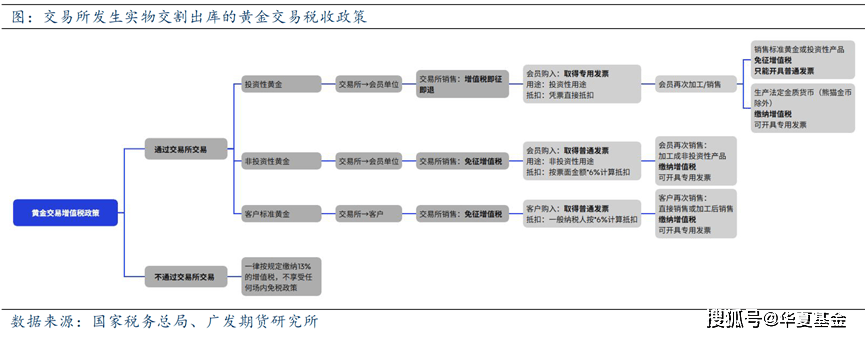
Core Viewpoint - The new tax regulations on gold in China are reshaping the investment logic in the gold market, particularly affecting the trading of physical gold and promoting alternatives like gold ETFs [1][3]. Policy Changes - The new tax policy, effective from November 1, 2025, introduces a dual classification management system for gold transactions, categorizing them into on-market and off-market, both subject to a 13% value-added tax (VAT) [4][6]. - The policy distinguishes between investment gold (e.g., gold bars with purity over 99.95%) and non-investment gold (e.g., jewelry and industrial gold) [6][7]. - The new regulations impose stricter VAT collection on physical gold, reducing the tax credits available to businesses, which may lead to increased costs passed on to consumers [7][8]. Market Impact - For investment gold, institutions can still obtain tax-deductible invoices when purchasing from gold exchanges, but the sales to downstream dealers will only allow for regular invoices, reducing their tax deduction capabilities [8][11]. - For jewelry purchases, the input tax deduction drops from 13% to 6%, potentially increasing costs by 60-70 yuan per gram of gold, which could lead to higher retail prices [12][13]. - The new tax structure aims to curb speculative behaviors in the gold market and promote orderly trading practices [16][17]. Investment Strategy - The long-awaited tax reform signals a shift in asset allocation strategies, encouraging investors to consider gold ETFs and futures instead of physical gold, which may become less attractive due to rising costs [15][17]. - The long-term value of gold as a hedge against macroeconomic uncertainties remains intact, with gold ETFs providing a more accessible and cost-effective investment vehicle [24][28]. Gold ETF Advantages - Gold ETFs allow investors to trade gold like stocks, with lower entry costs and no stamp duty, making them a favorable option in the current tax environment [30][31]. - The structure of gold ETFs addresses common pain points for retail investors, such as high storage costs and complex purchasing processes associated with physical gold [31][32]. - The shift towards gold ETFs reflects a broader understanding of gold's role in asset allocation, moving away from the notion that physical gold is the only form of investment [33][34].
金价持续下行,现在想买黄金?先搞懂这5个问题再出手
Sou Hu Cai Jing· 2025-11-04 01:15
Core Viewpoint - The recent decline in gold prices is attributed to a combination of short-term factors, but long-term support remains intact, indicating a healthy correction within a bull market rather than the onset of a bear market [3][4]. Market Analysis - Gold prices have dropped from a peak of 4381 USD/oz to 4025.34 USD/oz, a decline of over 8% [1]. - The recent downturn is driven by three short-term factors: excessive prior gains, easing geopolitical risks, and a temporary rebound in the US dollar [3]. - Despite the short-term pressures, long-term support remains strong due to continued interest rate cuts by the Federal Reserve and significant gold purchases by global central banks [3][4]. Investment Strategies - Investors are advised to look for stability signals, such as gold prices maintaining above 4025 USD for three consecutive days and a downward trend in 10-year US Treasury yields [4]. - Two recommended investment methods include dollar-cost averaging and phased buying to mitigate risks associated with price volatility [6][7]. Product Selection - Preferred investment options include low-premium, easily liquidated products, while high-premium and pseudo-investment products should be avoided [6][8]. - Specific investment vehicles such as gold ETFs and bank gold bars are highlighted for their lower premiums and ease of transaction [8]. Risk Management - It is crucial to limit gold holdings to 5-10% of total assets to avoid liquidity issues and missed opportunities [10]. - Investors should adopt a strategy of taking profits when gold prices rise significantly while maintaining a long-term holding approach during short-term declines [10][11].