能源

Search documents
能源化工期权策略早报:能源化工期权-20251111
Wu Kuang Qi Huo· 2025-11-11 02:03
1. Report Industry Investment Rating - No information provided in the content 2. Core Viewpoints of the Report - The energy - chemical sector is divided into energy, alcohols, polyolefins, rubber, polyesters, alkalis, and others. Strategies are recommended for selected options in each sector [8]. - A seller - based options portfolio strategy and spot hedging or covered strategies are constructed to enhance returns [2]. 3. Summary by Relevant Catalogs 3.1 Market Overview of Underlying Futures - Information on the latest price, price change, percentage change, trading volume, volume change, open interest, and open interest change of various energy - chemical option underlying futures is presented, including crude oil, LPG, methanol, etc [3]. 3.2 Option Factors - Volume and Open Interest PCR - The volume PCR and open interest PCR of various energy - chemical options are provided, which can be used to analyze the strength of the underlying option market and the turning point of the market [4]. 3.3 Option Factors - Pressure and Support Levels - The pressure points, pressure point offsets, support points, support point offsets, maximum call option open interest, and maximum put option open interest of various energy - chemical options are given, which can help analyze the pressure and support levels of the underlying options [5]. 3.4 Option Factors - Implied Volatility - The at - the - money implied volatility, weighted implied volatility, change in weighted implied volatility, annual average implied volatility, call option implied volatility, put option implied volatility, 20 - day historical volatility, and difference between implied and historical volatility of various energy - chemical options are presented [6]. 3.5 Option Strategies and Recommendations 3.5.1 Crude Oil Options - Fundamental analysis shows that US refinery demand has stabilized and recovered, shale oil production has slightly increased, OPEC exports have increased, and European refinery demand is about to enter the peak season [7]. - The option implied volatility has decreased to near the average, the open interest PCR is below 0.80, indicating a weak market. The pressure level is 500 and the support level is 450 [7]. - Directional strategy: None. Volatility strategy: Construct a short - biased call + put option combination strategy. Spot long - hedging strategy: Construct a long collar strategy [7]. 3.5.2 LPG Options - The cost - end crude oil is under pressure from oversupply and geopolitical issues. LPG has shown a market trend of over - sold rebound and slight consolidation [9]. - The option implied volatility has dropped significantly to below the average, the open interest PCR is around 0.80, indicating a weak market. The pressure level is 4550 and the support level is 4200 [9]. - Directional strategy: None. Volatility strategy: Construct a neutral - biased call + put option combination strategy. Spot long - hedging strategy: Construct a long collar strategy [9]. 3.5.3 Methanol Options - Port and enterprise inventories are high and difficult to deplete significantly in the short term. Methanol has shown a weak downward trend [9]. - The option implied volatility fluctuates around the historical average, the open interest PCR is below 0.80, indicating a weak and volatile market. The pressure level is 2200 and the support level is 2050 [9]. - Directional strategy: Construct a bearish spread combination strategy of put options. Volatility strategy: Construct a short - biased call + put option combination strategy. Spot long - hedging strategy: Construct a long collar strategy [9]. 3.5.4 Ethylene Glycol Options - Port and downstream factory inventories are high, and the port inventory is expected to continue the accumulation cycle. Ethylene glycol has shown a weak market trend [10]. - The option implied volatility fluctuates below the average, the open interest PCR is around 0.70, indicating strong short - selling power. The pressure level is 4500 and the support level is 4050 [10]. - Directional strategy: Construct a bearish spread combination strategy of put options. Volatility strategy: Construct a short - volatility strategy. Spot long - hedging strategy: Hold a spot long position + buy a put option + sell an out - of - the - money call option [10]. 3.5.5 Polypropylene Options - PE and PP inventories have different trends. Polypropylene has shown a weak downward trend [10]. - The option implied volatility has decreased to near the average, the open interest PCR is around 0.70, indicating a weak market. The pressure level is 7000 and the support level is 6300 [10]. - Directional strategy: Construct a bearish spread combination strategy of put options. Volatility strategy: None. Spot long - hedging strategy: Hold a spot long position + buy an at - the - money put option + sell an out - of - the - money call option [10]. 3.5.6 Rubber Options - Exchange rubber warehouse receipts are at a ten - year low, and there is an expectation of inventory accumulation. Rubber has shown a weak consolidation trend [11]. - The option implied volatility has decreased to below the average after a sharp rise, the open interest PCR is below 0.60. The pressure level has dropped significantly to 16000 and the support level is 14500 [11]. - Directional strategy: None. Volatility strategy: Construct a short - biased call + put option combination strategy. Spot hedging strategy: None [11]. 3.5.7 PTA Options - PTA social inventory is accumulating, and although the polyester start - up will remain high, inventory accumulation is expected to continue. PTA has shown a rebound trend with pressure [11]. - The option implied volatility fluctuates at a relatively high level, the open interest PCR is around 0.70, indicating a volatile market. The pressure level is 4700 and the support level is 4300 [11]. - Directional strategy: None. Volatility strategy: Construct a neutral - biased call + put option combination strategy. Spot hedging strategy: None [11]. 3.5.8 Caustic Soda Options - The average utilization rate of caustic soda production capacity has increased. Caustic soda has shown a weak short - selling trend [12]. - The option implied volatility fluctuates at a relatively high level, the open interest PCR is below 0.80, indicating a weak and volatile market. The pressure level is 2600 and the support level is 2240 [12]. - Directional strategy: Construct a bearish spread combination strategy. Volatility strategy: None. Spot collar hedging strategy: Hold a spot long position + buy a put option + sell an out - of - the - money call option [12]. 3.5.9 Soda Ash Options - Soda ash factory inventory has increased. Soda ash has shown a low - level weak consolidation trend [1]. - The option implied volatility fluctuates at a relatively high historical level, the open interest PCR is below 0.60, indicating strong short - selling pressure. The pressure level is 1300 and the support level is 1100 [12]. - Directional strategy: Construct a bearish spread combination strategy. Volatility strategy: Construct a short - volatility combination strategy. Spot long - hedging strategy: Construct a long collar strategy [12]. 3.5.10 Urea Options - Enterprise inventory is at a high level, and port inventory has decreased. Urea has shown a low - level shock and rebound trend [13]. - The option implied volatility fluctuates around the historical average, the open interest PCR is below 0.60, indicating strong short - selling pressure. The pressure level is 1800 and the support level is 1600 [13]. - Directional strategy: None. Volatility strategy: Construct a neutral - biased call + put option combination strategy. Spot hedging strategy: Hold a spot long position + buy an at - the - money put option + sell an out - of - the - money call option [13].
昨夜,芯片股大涨!
Zheng Quan Shi Bao· 2025-11-10 23:55
Market Overview - On November 10, US stock indices collectively rose, with the Dow Jones up 0.81%, S&P 500 up 1.54%, and Nasdaq up 2.27% [1][2] - The S&P 500 saw eight sectors rise and three decline, with the technology and communication services sectors leading the gains at 2.68% and 2.53% respectively [2] Semiconductor Sector - The Philadelphia Semiconductor Index increased by 3.02%, with notable gains in Micron Technology (over 6%), Nvidia (over 5%), and AMD (over 4%) [2] - Industry reports indicate a global AI wave is driving demand, leading to a shortage of storage chips and prompting a production expansion [2] - Major companies like Samsung, SK Hynix, and Micron are shifting capital expenditures towards high-bandwidth memory (HBM) products, suggesting a supply-demand gap in traditional storage will persist at least until next year [2] Notable Stocks - SanDisk shares rose by 11.89%, reaching a historical high, with a year-to-date increase of over 400% [2] - SanDisk has reportedly raised contract prices for its November NAND flash memory chips by 50%, driven by AI-related demand growth [2] Banking Sector - Bank stocks saw a general increase, with Morgan Stanley, Goldman Sachs, and US Bancorp rising over 1% [3] Energy Sector - Energy stocks also experienced gains, with US energy up nearly 2% and companies like ConocoPhillips and BP rising over 1% [3] Chinese Stocks - The Nasdaq Golden Dragon China Index rose by 2.25%, with significant increases in stocks like XPeng (over 16%) and Canadian Solar (nearly 14%) [3]
德龙汇能:关于控股股东股份解除质押的公告
Zheng Quan Ri Bao Zhi Sheng· 2025-11-10 14:17
Core Points - Delong Energy announced the release of stock pledges by its controlling shareholder, Beijing Dingxin Ruitong Technology Development Co., Ltd. [1] - The number of shares released from pledge amounts to 86,000,000 shares, which represents 74.94% of the shares held by the controlling shareholder and 23.98% of the total share capital of the company [1]

城记 | 进博会上看静安:不只做采购冠军,更做全球投资的“战略合伙人”
Xin Hua Cai Jing· 2025-11-10 13:44
Core Insights - Shanghai Jing'an District continues to lead in procurement orders at the China International Import Expo (CIIE), showcasing its role as an international hub for innovation and business services [1][12] - Major multinational companies like L'Oréal are not only participating in the CIIE but are also establishing local partnerships to enhance innovation and market presence in China [2][4] - Jing'an has transformed from a traditional trade zone to a global city core, focusing on high-end services, technological consumption, and cultural appeal [12][13] Group 1: Investment and Business Development - Jing'an District has attracted 142 multinational company headquarters and over 6,100 foreign enterprises, maintaining the highest density of headquarters economy and global brand concentration in Shanghai [4] - The district's strategy includes building collaborative platforms to address core challenges from R&D to commercialization, enhancing the competitive edge of local enterprises [4][8] - During the CIIE, 14 companies from various sectors signed investment agreements, indicating a shift towards long-term partnerships and shared risks [4][8] Group 2: International Collaboration and Market Entry - Companies like Grin and CAPOLAVORO have successfully navigated the Chinese market with the support of Jing'an's incubation services, demonstrating the district's role in facilitating foreign brands' entry [5][8] - Jing'an's global service provider plan aims to connect domestic companies with international markets, offering a comprehensive infrastructure for cross-border operations [8][12] - The district's unique exhibition areas at the CIIE highlight its commitment to showcasing regional industrial competitiveness and cultural charm [9][12] Group 3: Future Development and Strategic Goals - Jing'an aims to enhance its internationalization, focusing on high-end elements and service-driven economic growth, while promoting innovation in fashion consumption and technology [12][13] - The district plans to optimize its business environment and improve service mechanisms to support enterprise development [12][13] - Jing'an positions itself as a strategic partner for global innovators and investors, emphasizing its collaborative ecosystem for shared growth [13]


美元流动性有所缓解,商品短期或震荡运行
Guo Tou Qi Huo· 2025-11-10 12:18
Group 1: Report Industry Investment Rating - No relevant information provided Group 2: Core Viewpoints of the Report - The commodity market declined last week and then rebounded, with an overall decline of 0.47%. The black sector led the decline, while precious metals and agricultural products rose. The market is expected to fluctuate in the short - term due to factors such as the possible end of the US government shutdown and mixed macro - economic indicators [1]. - Different commodity sectors, including precious metals, non - ferrous metals, black metals, energy, chemicals, and agricultural products, are expected to have short - term fluctuations based on their respective fundamentals and macro - economic factors [1][2][3]. Group 3: Summary by Related Catalogs 1. Market Review - The commodity market fell 0.47% last week. The black sector dropped 2.62%, energy and chemicals fell 0.41% and 0.06% respectively, while precious metals and agricultural products rose 0.11% and 0.57% [1]. - Among specific varieties, rapeseed meal, pulp, and eggs had the highest increases of 6.32%, 3.49%, and 2.32% respectively, while asphalt, iron ore, and methanol had the largest declines of 6.04%, 4.94%, and 3.12% [1]. - The 20 - day average volatility of the commodity market decreased, and the market scale increased by nearly 10 billion, with only the precious metals sector showing net capital outflows [1]. 2. Outlook for Different Sectors - **Precious Metals**: Officials' hawkish remarks and the uncertainty of the US government shutdown situation may keep the sector in high - level fluctuations in the short - term [1]. - **Non - ferrous Metals**: With a neutral macro - environment and mixed fundamentals, the sector is expected to fluctuate in the short - term [2]. - **Black Metals**: With weakening demand, falling production, and increasing raw material pressure, the sector may continue to be supported by costs and fluctuate [2]. - **Energy**: The oversupply of crude oil and the impact of the US government shutdown on demand may lead to short - term oil price fluctuations [2]. - **Chemicals**: Cost support from coal and mixed demand expectations may result in short - term fluctuations and mid - term anti - arbitrage opportunities [3]. - **Agricultural Products**: The reduction of US soybean tariffs and the weak rebound of palm oil may lead to different trends in different agricultural products, with some under pressure [3]. 3. Commodity Fund Overview - Gold ETFs generally had negative weekly returns, with a total scale increase of 0.81%. Energy - chemical, soybean meal, non - ferrous metal, and silver ETFs also had different return and scale changes [35].
宁泉资产减持新天绿色能源(00956)60.1万股 每股作价4.63港元
智通财经网· 2025-11-10 11:17
Group 1 - Shanghai Ningquan Asset Management Co., Ltd. reduced its holdings in Xintian Green Energy (00956) by 601,000 shares at a price of HKD 4.63 per share, totaling approximately HKD 2.7826 million [1] - After the reduction, the latest number of shares held by Shanghai Ningquan is approximately 183 million shares, representing a holding percentage of 9.98% [1]
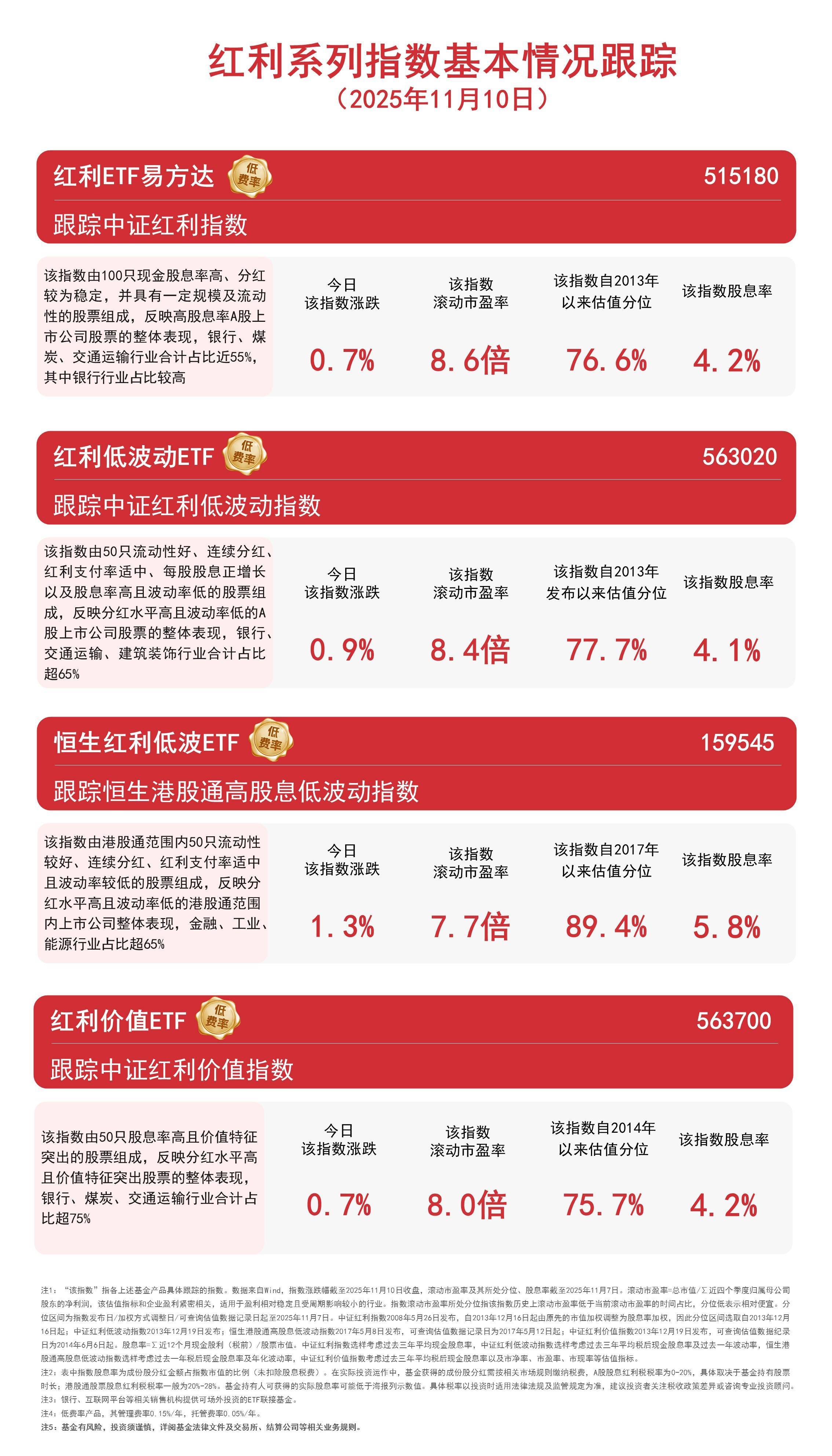
红利板块集体走强,恒生红利低波ETF(159545)全天净申购超1.6亿份
Sou Hu Cai Jing· 2025-11-10 10:54
Group 1 - The dividend sector showed strong performance today, with the Hang Seng High Dividend Low Volatility Index rising by 1.3% and the CSI Dividend Low Volatility Index increasing by 0.9% [1][6] - All four indices, including the CSI Dividend Index and CSI Dividend Value Index, achieved a six-day consecutive increase, indicating strong investor interest in related products [1][4] - The Hang Seng Dividend Low Volatility ETF (159545) saw a net subscription of over 160 million units today, reflecting significant capital inflow [1][4] Group 2 - The composition of the dividend-paying stocks includes those with moderate payout ratios, positive growth in dividends per share, high dividend yields, and low volatility, indicating a strong overall performance of A-share listed companies [4] - The banking, transportation, and construction industries collectively account for over 65% of this dividend-paying stock group [4] - The Hang Seng Dividend Low Volatility ETF tracks 50 liquid stocks within the Hong Kong Stock Connect that have a history of continuous dividends, moderate payout ratios, and low volatility, with financial, industrial, and energy sectors making up over 65% of the index [8]
高频数据跟踪:供地迎季节性高峰,物价整体下行
China Post Securities· 2025-11-10 09:21
Report Information - Report Type: Fixed Income Report - Release Date: November 10, 2025 - Analysts: Liang Weichao (SAC Registration No.: S1340523070001), Cui Chao (SAC Registration No.: S1340523120001) [2] Core Views - High-frequency economic data focuses: Production end overall declined with decreased coke oven, asphalt, and PTA operating rates and reduced rebar output; blast furnace and PX operating rates increased, and automobile tire operating rates remained relatively stable. Second, commercial housing transactions increased slightly, and the land supply area in 100 large and medium-sized cities increased seasonally, with a peak expected at the end of the month. Third, overall prices declined, with oil, coking coal, copper, aluminum, and rebar prices all dropping; agricultural product prices continued to rise but at a slower rate, with vegetable prices rising continuously and pork prices stabilizing and rebounding. Fourth, in terms of shipping prices, the SCFI index rose and then fell, while the BDI rebounded significantly. Short-term focus is on the implementation of incremental policies on the consumption and investment ends and the recovery of the real estate market [2][35] Production - Steel: Coke oven capacity utilization decreased by 0.90 pct, blast furnace operating rate increased by 1.38 pct, and rebar output decreased by 4.05 tons. On the week of November 7, the coke oven capacity utilization of domestic independent coking plants (230 samples) was 71.84%, a 0.9 pct decrease from the previous week; the blast furnace operating rate of steel mills (247 samples) was 83.13%, a 1.38 pct increase from the previous week; the national building materials steel mill rebar output was 208.54 tons, a 4.05 tons decrease from the previous week; inventory was 166.84 tons, a 4.87 tons decrease from the previous week [3][10] - Petroleum Asphalt: Operating rate decreased by 1.8 pct. On the week of November 5, the operating rate of domestic petroleum asphalt plants was 29.7%, a 1.8 pct decrease from the previous week [3][10] - Chemicals: PX operating rate increased by 2.56 pct, and PTA operating rate decreased by 1.19 pct. On November 6, the domestic chemical PX operating rate was 90.49%, a 2.56 pct increase from the previous week; the PTA operating rate was 77.19%, a 1.19 pct decrease from the previous week [3][10] - Automobile Tires: All-steel tire operating rate increased by 0.12 pct, and semi-steel tire operating rate increased by 0.26 pct. On the week of November 6, the all-steel tire operating rate was 65.46%, a 0.12 pct increase from the previous week; the semi-steel tire operating rate was 73.67%, a 0.26 pct increase from the previous week [3][11] Demand - Real Estate: Commercial housing transaction area increased slightly, and the inventory-to-sales ratio decreased; land supply area increased seasonally and significantly, and the residential land transaction premium rate decreased slightly. On the week of November 2, the commercial housing transaction area in 30 large and medium-sized cities was 201.93 million square meters, a 2.01 million square meters increase from the previous week; the inventory-to-sales ratio (area) of commercial housing in 10 large cities was 82.59, an 18.6 decrease from the previous week; the land supply area in 100 large and medium-sized cities was 3749.75 million square meters, a 1761.59 million square meters increase from the previous week; the residential land transaction premium rate in 100 large and medium-sized cities was 4.17%, a 0.04 pct decrease from the previous week [3][15] - Movie Box Office: Increased by 6 million yuan compared to the previous week. On the week of November 2, the total national movie box office revenue was 215 million yuan, a 6 million yuan increase from the previous week [3][15] - Automobiles: On the week of October 31, the daily average retail sales of manufacturers increased by 86,000 vehicles, and the daily average wholesale sales increased by 107,800 vehicles. On the week of October 31, the daily average retail sales volume of national passenger vehicle manufacturers was 154,796 vehicles, an 85,525 vehicles increase from the previous week; the daily average wholesale sales volume was 210,099 vehicles, a 107,782 vehicles increase from the previous week [3][21] - Shipping Index: SCFI decreased by 3.59%, CCFI increased by 3.60%, and BDI rebounded significantly by 7.02%. On the week of November 7, the Shanghai Containerized Freight Index (SCFI) was 1495.1 points, a 55.6 points decrease from the previous week; the China Containerized Freight Index (CCFI) was 1058.17 points, a 36.78 points increase from the previous week. On November 7, the Baltic Dry Index (BDI) was 2104 points, a 138 points increase from the previous week, with a weekly increase of 7.02% [3][23] Prices - Energy: Brent crude oil price decreased by 2.21% to $63.63 per barrel. On November 7, the settlement price of Brent crude oil futures (continuous contract) was $63.63 per barrel, a $1.44 per barrel decrease from the previous week, with a weekly change of -2.21%. Coking coal futures price decreased by 1.31% to 1278.5 yuan per ton. On November 7, the settlement price of coking coal futures (active contract) was 1278.5 yuan per ton, a 17 yuan per ton decrease from the previous week, with a weekly change of -1.31% [4][25] - Metals: LME copper, aluminum, and zinc futures prices changed by -1.80%, -0.90%, and +0.54% respectively, and the domestic rebar futures price decreased by 2.35%. On November 7, the closing price of LME copper futures (active contract) was $10,695 per ton, a $196.5 per ton decrease from the previous week, with a weekly change of -1.8%; the closing price of LME aluminum futures (active contract) was $2862 per ton, a $26 per ton decrease from the previous week, with a weekly change of -0.9%; the closing price of LME zinc futures (active contract) was $3066.5 per ton, a $16.5 per ton increase from the previous week, with a weekly change of 0.54%; the settlement price of domestic rebar futures (active contract) was 3036 yuan per ton, a 73 yuan per ton decrease from the previous week, with a weekly change of -2.35% [4][26] - Agricultural Products: Overall prices continued to rise but at a slower rate. The agricultural product wholesale price 200 index rose by 0.18%. The prices of pork, eggs, vegetables, and fruits changed by +2.42%, -0.14%, +1.58%, and 0 respectively compared to the previous week. On November 7, the agricultural product wholesale price 200 index released by the Ministry of Agriculture and Rural Affairs was 125.24, a 0.22 increase from a week ago, with a weekly change of 0.18%. Among the main agricultural products, the average wholesale price of pork was 18.23 yuan per kilogram, a 0.43 yuan per kilogram increase from a week ago, with a weekly change of 2.42%; the average wholesale price of eggs was 7.35 yuan per kilogram, a 0.01 yuan per kilogram decrease from a week ago, with a weekly change of -0.14%; the average wholesale price of 28 key monitored vegetables was 5.78 yuan per kilogram, a 0.09 yuan per kilogram increase from a week ago, with a weekly change of 1.58%; the average wholesale price of 7 key monitored fruits was 7.04 yuan per kilogram, unchanged from a week ago [4][28] Logistics - Subway Passenger Volume: Beijing slightly increased, and Shanghai slightly decreased. On November 7, the seven-day moving average of Beijing subway passenger volume was 10.4051 million person-times, a 14,900 person-times increase from the previous week, with a weekly change of 0.14%; the seven-day moving average of Shanghai subway passenger volume was 10.6257 million person-times, a 92,900 person-times decrease from the previous week, with a weekly change of -0.87% [4][30] - Flight Operations: Both domestic and international flight operations continued to decrease. On November 8, the seven-day moving average of domestic (excluding Hong Kong, Macao, and Taiwan) flight operations was 12,270.57 flights, a 108.71 flights decrease from the previous week, with a weekly change of -0.88%; the seven-day moving average of domestic (Hong Kong, Macao, and Taiwan) flight operations was 359.86 flights, a 6.43 flights decrease from the previous week, with a weekly change of -1.76%; the seven-day moving average of international flight operations was 1817.43 flights, a 2.57 flights decrease from the previous week, with a weekly change of -0.14% [4][33] - Urban Traffic: The peak congestion index in first-tier cities continued to decline. On November 8, the seven-day moving average of the peak congestion index in first-tier cities was 1.76, a 0.05 decrease from the previous week, with a weekly change of -2.97% [4][33]
国家发展改革委等部门:推动物流数据与产业数据等多源数据融合应用 促进产业结构和空间布局优化
Mei Ri Jing Ji Xin Wen· 2025-11-10 09:03
Core Viewpoint - The implementation plan aims to promote the integration of logistics data with multi-source data to effectively reduce logistics costs across society [1] Group 1: Logistics Data Integration - The plan encourages the integration of logistics data with industrial data to optimize industrial structure and spatial layout [1] - It provides reference for the planning and construction of related infrastructure in energy, transportation, and logistics [1] Group 2: Industry Adaptation - Logistics companies are encouraged to adapt to the needs of modern industrial systems, focusing on sectors like smart manufacturing, modern agriculture, and commercial circulation [1] - The plan emphasizes the deepening of cross-industry data integration to enhance digital supply chain service capabilities [1] Group 3: Financial Sector Application - The plan aims to deepen the application of logistics data in the financial sector to optimize financing and insurance products [1] - It addresses the challenges faced by enterprises, particularly small and medium-sized enterprises, in accessing affordable financing [1] - The initiative seeks to reduce operational risks for businesses [1]
美国泰国对等贸易框架协议公布:泰国取消99%商品的关税壁垒
Ge Long Hui· 2025-11-10 06:40
Core Points - The U.S. and Thailand have reached a joint statement regarding a framework for a bilateral trade agreement, focusing on tariff reductions and non-tariff barriers [1] Tariff Summary - Thailand will eliminate tariffs on 99% of goods, covering all U.S. industrial products, food, and agricultural products [3] - The U.S. will maintain a 19% reciprocal tariff on Thai goods, but certain items listed in the September 5 Executive Order will have zero tariffs [3] Non-Tariff Barriers Summary - Thailand will address non-tariff barriers for U.S. industrial products by accepting U.S. standards for vehicles and FDA-approved pharmaceuticals, issuing import licenses for U.S. ethanol, and removing customs incentives related to penalty targets [3] - For U.S. food and agricultural products, Thailand will expedite the entry of certified meat, poultry, and horticultural products, and accept U.S. certification [3] Service Trade and Investment Summary - Thailand commits to not imposing a digital services tax, ensuring free data transmission, supporting the WTO's suspension of electronic transmission tariffs, and removing film screening quotas [3] - The country will relax foreign ownership limits in the telecommunications sector and eliminate regulations requiring domestic processing of transactions for Thai-issued debit cards [3] Purchase Commitments Summary - Thailand plans to purchase approximately $2.6 billion worth of U.S. agricultural products annually, including feed corn and soybean meal [4] - The country will buy around $5.4 billion in U.S. energy products, including LNG, crude oil, and ethane [4] - Thailand will acquire 80 U.S. aircraft totaling $18.8 billion [4] Future Negotiations Summary - Future negotiations on the bilateral trade agreement will take place in the coming weeks, with preparations for signing and domestic procedures to make the agreement effective [4]