商用车

Search documents
【环球财经】日野汽车和三菱扶桑确定业务合并
Xin Hua Cai Jing· 2025-06-10 13:45
Group 1 - Toyota's Hino Motors and Daimler's Mitsubishi Fuso Truck and Bus Corporation announced a business merger to enhance competitiveness in the commercial vehicle sector [1][2] - The merger will create a new joint venture company, with Hino and Mitsubishi Fuso becoming wholly-owned subsidiaries, aiming to start operations by April 2026 [1][2] - The new holding company will be based in Tokyo, with Daimler and Toyota each holding 25% of the shares, and the CEO will be Karl Deppen from Mitsubishi Fuso [1][2] Group 2 - The automotive industry is undergoing a transformation with electric and autonomous driving technologies, and Japanese commercial vehicle manufacturers are lagging in next-generation technology development [2] - The merger aims to improve efficiency in R&D, procurement, and production, strengthening the Japanese and Asian automotive industry's foundation [2] - The merger creates two major camps in the Japanese commercial vehicle market: one formed by Mitsubishi Fuso and Hino, and the other by Isuzu and its UD Trucks [2]
重磅!这一商用车氢动力系统工厂投产
第一商用车网· 2025-06-10 06:24
Core Viewpoint - Foton Motor's hydrogen power system factory marks a significant step in the company's comprehensive strategy for new energy, internationalization, and intelligent manufacturing, positioning itself as a leader in the hydrogen fuel cell commercial vehicle sector [1][2][5]. Group 1: Factory Overview - The Foton Kavin hydrogen power system factory integrates hydrogen fuel engine, electric drive bridge, and hydrogen storage system production, showcasing full autonomous and process manufacturing capabilities [1]. - The factory features three specialized production lines: hydrogen fuel cell engine production, heavy-duty electric drive bridge assembly, and vehicle-mounted hydrogen storage systems, utilizing advanced assembly and testing technologies [2][4]. Group 2: Technological Integration - The factory employs advanced manufacturing processes and integrates digital technologies such as the Internet, big data, and artificial intelligence to create a highly digitalized and intelligent production system [4]. - Smart logistics solutions are implemented, including automated material handling and storage, enhancing the efficiency of production material flow [4]. Group 3: Industry Leadership and Achievements - Foton Motor has promoted over 3,200 hydrogen fuel commercial vehicles, accumulating over 120 million kilometers in operational mileage, demonstrating its commitment to the hydrogen fuel vehicle market [5][6]. - The company has achieved breakthroughs in key technologies related to low-energy liquid hydrogen production, storage, and refueling, continuously enhancing the hydrogen industry chain [6][8]. Group 4: Future Outlook - The hydrogen power system factory aims to produce 5,000 units annually across various power segments, supporting the transition to a zero-carbon economy and enhancing the reliability of fuel cell systems [8]. - Foton Motor's investment in hydrogen technology is seen as a pivotal move towards leading the commercial vehicle industry into a new era of hydrogen energy [8].



解放狂签大单 福田/东风等属地化布局 上半年卡车出口有多活跃?| 头条
第一商用车网· 2025-06-10 06:24
Core Viewpoint - The domestic commercial vehicle market in China has entered a stage of stock competition, prompting companies to focus on overseas markets for growth opportunities. Major truck manufacturers are accelerating their international strategies, particularly with significant developments expected by 2025 [1][2]. Group 1: Company Strategies and Achievements - FAW Jiefang aims to achieve global sales of over 500,000 units by 2030, with 180,000 units from overseas markets, representing over one-third of total sales [2][4]. - In 2025, FAW Jiefang has made significant progress in overseas markets, including signing contracts for 500 units in Vietnam and 10,000 units in the Philippines [4][6]. - China National Heavy Duty Truck Group (CNHTC) has maintained its position as the top exporter of heavy trucks in China for 20 consecutive years, with a record export of 135,000 heavy trucks in 2024 [7][9]. - Foton Motor has launched a localized manufacturing project in Brazil, with an annual production capacity of 5,000 units, and reported a 180% year-on-year increase in sales in Brazil in Q1 2025 [12][13]. - Dongfeng Group plans to establish a company in Indonesia and aims to export 40,000 commercial vehicles by 2025, focusing on localized operations and market penetration [18][19]. Group 2: New Entrants and Market Expansion - New entrants like DeepWay, SuBao, Proton, and WeiDu are also prioritizing overseas market expansion, with significant investments and partnerships established in various regions [25][26]. - SuBao is investing 350 million yuan in an overseas manufacturing base, expected to be operational by the end of 2025, to provide localized solutions for Europe and the Middle East [26]. - WeiDu Technology secured a 36 million CAD order for long-range electric heavy trucks in Canada, marking its entry into a new international market [28]. - Proton Automotive has initiated its first exports of hydrogen fuel heavy trucks to Australia, expanding its footprint in the renewable energy vehicle sector [30]. - DeepWay has made strides in Southeast Asia, signing multiple dealer agreements and securing orders in Singapore, Thailand, and Malaysia [32][34]. Group 3: Market Trends and Future Outlook - The ongoing globalization trend presents both opportunities and challenges for Chinese truck manufacturers, emphasizing the importance of overseas market strategies for future growth [26][35]. - The competitive landscape is expected to evolve, with Chinese companies likely to feature prominently in the global truck manufacturing sector by 2030 [36].




交车50辆并签约100辆!谁家新能源重卡斩大单?
第一商用车网· 2025-06-09 07:06
Core Viewpoint - The article highlights the successful delivery of 50 JH6 new energy vehicles by FAW Jiefang to Guangxi Panchi Supply Chain Co., showcasing the company's commitment to the new energy vehicle market and its strategic alignment with national goals [2][14]. Group 1: Market Performance - FAW Jiefang achieved a market share of 15.8% in the new energy tractor market from January to May 2025, leading the industry and reflecting strong market recognition of its technological capabilities [2]. - The event in Nanning marked a significant milestone in the green logistics ecosystem, emphasizing the importance of collaboration with local users to create a sustainable future [14]. Group 2: Product and Service Innovation - FAW Jiefang has developed a comprehensive ecosystem covering research and development, infrastructure, and services, offering customized new energy vehicles that meet diverse market demands [5]. - The company has introduced flexible solutions such as battery leasing and vehicle leasing, along with 24/7 safety management services, to address customer pain points related to vehicle purchase and operation [5]. Group 3: Commitment to Quality and Customer Focus - FAW Jiefang emphasizes a customer-centric approach, providing high-quality products and services to support users in their business endeavors [8][14]. - The signing of new contracts during the event demonstrated customers' strong confidence in FAW Jiefang's new energy products, reinforcing the company's commitment to innovation and service excellence [10][14].

重汽济南卡车股份总经理换人!谁升职?| 头条
第一商用车网· 2025-06-07 07:41
张欣女士熟悉董事会秘书履职相关法律法规、具备与岗位要求相适应的职业操守,具备相应的 专业胜任能力与从业经验。其本人已取得深圳证券交易所颁发的董事会秘书资格证书,任职资 格符合《深圳证券交易所股票上市规则》《深圳证券交易所上市公司自律监管指引第 1 号— 主板上市公司规范运作》等有关规定。其联系方式如下: 办公电话:0531-58067586 传真号码:0531-58067003 6月7日,中国重汽集团济南卡车股份有限公司发布关于聘任任公司高级管理人员及变更董事 会秘书的公告。公告显示,中国重汽集团济南卡车股份有限公司董事会于近日收到赵尔相、毕 研勋的书面辞职报告。因工作变动,赵尔相申请辞去公司首席执行官(CEO、总经理),毕研 勋申请辞去公司董事会秘书职务。上述人员均未持有公司股份,其本人的辞职报告自送达董事 会之日起生效。赵尔相辞去上述职务后,将继续担任公司董事;毕研勋辞去该职务后,将继续 担任公司董事、财务总监。 公司董事会对赵尔相、毕研勋任职期间勤勉尽责以及为提升公司规范运作水平和健康发展等方 面所做出的贡献表示衷心的感谢! 公司于2025年6月6日召开第九届董事会2025年第三次临时会议,同意聘任赵海 ...

每周股票复盘:中集车辆(301039)每10股派发现金红利2.8元
Sou Hu Cai Jing· 2025-06-07 02:30
公司公告汇总:中集车辆每10股派发现金红利人民币2.8元(含税),A股股权登记日为2025年6月 10日 公司公告汇总 中集车辆(集团)股份有限公司发布2024年度A股权益分派实施公告。公司每10股派发现金红利人民币 2.8元(含税),A股股权登记日为2025年6月10日,除权除息日为2025年6月11日。2025年第一次临时股 东会审议通过2024年度利润分配预案,以2024年12月31日总股本1,874,124,420股为基数,向全体股东每 10股分派现金股利人民币2.8元(含税),合计派发现金红利人民币524,754,837.60元(含税),不送红 股,不以公积金转增股本。A股股本为1,453,680,000股,向A股股东派发的现金红利总额为人民币 407,030,400.00元(含税)。非上市外资股股本为420,444,420股,向非上市外资股股东派发的现金红利 总额为人民币117,724,437.60元(含税)。本次权益分派对象为截止2025年6月10日下午深圳证券交易所 收市后,在中国结算深圳分公司登记在册的本公司全体A股股东。公司委托中国结算深圳分公司代派A 股股东现金红利,部分股东现金红利由公 ...
每周股票复盘:东风股份(600006)间接控股股东暂不涉及重组,政府补助1000万
Sou Hu Cai Jing· 2025-06-06 18:35
Core Viewpoint - Dongfeng Motor Corporation's stock has experienced a decline of 10.76% this week, closing at 7.3 yuan, with a total market capitalization of 14.6 billion yuan as of June 6, 2025 [1] Company Announcements - On June 4, 2025, Dongfeng Motor Corporation announced that its indirect controlling shareholder, Dongfeng Motor Group Co., Ltd., will not be involved in any asset or business restructuring, and the company's normal production and operations will not be affected [1] - The company received a government subsidy of 10 million yuan on June 4, 2025, which accounts for 34.29% of the audited net profit attributable to shareholders for the fiscal year 2024, positively impacting the company's profits for 2025 [1] - On June 5, 2025, the company held its second extraordinary general meeting of shareholders for 2025, where a resolution to replace some directors was passed with 99.38% approval [1] Production and Sales Data - In May 2025, Dongfeng Motor Corporation produced 11,724 commercial vehicles, a year-on-year decrease of 1.27%, with a cumulative production of 56,454 vehicles, down 18.48% year-on-year [2] - The company sold 10,073 vehicles in May 2025, a year-on-year decline of 13.27%, with cumulative sales of 59,859 vehicles, down 14.45% year-on-year [2] - Light truck production was 11,225 units in May, up 8.09% year-on-year, but cumulative production for the year was down 16.34% [2] - Bus production fell significantly, with a May output of 267 units, down 78.83% year-on-year, and cumulative production down 52.46% [2] - New energy vehicle production increased by 109.82% year-on-year in May, totaling 3,621 units, but cumulative production for the year was down 36.56% [2] - Dongfeng Cummins engine production reached 18,168 units in May, up 20.16% year-on-year, with cumulative production up 5.24% [2]

财报横评 | 起底7家商用车企一季报:潍柴动力利润增速跑赢收入增速,客车企业净利大涨
Mei Ri Jing Ji Xin Wen· 2025-06-06 15:28
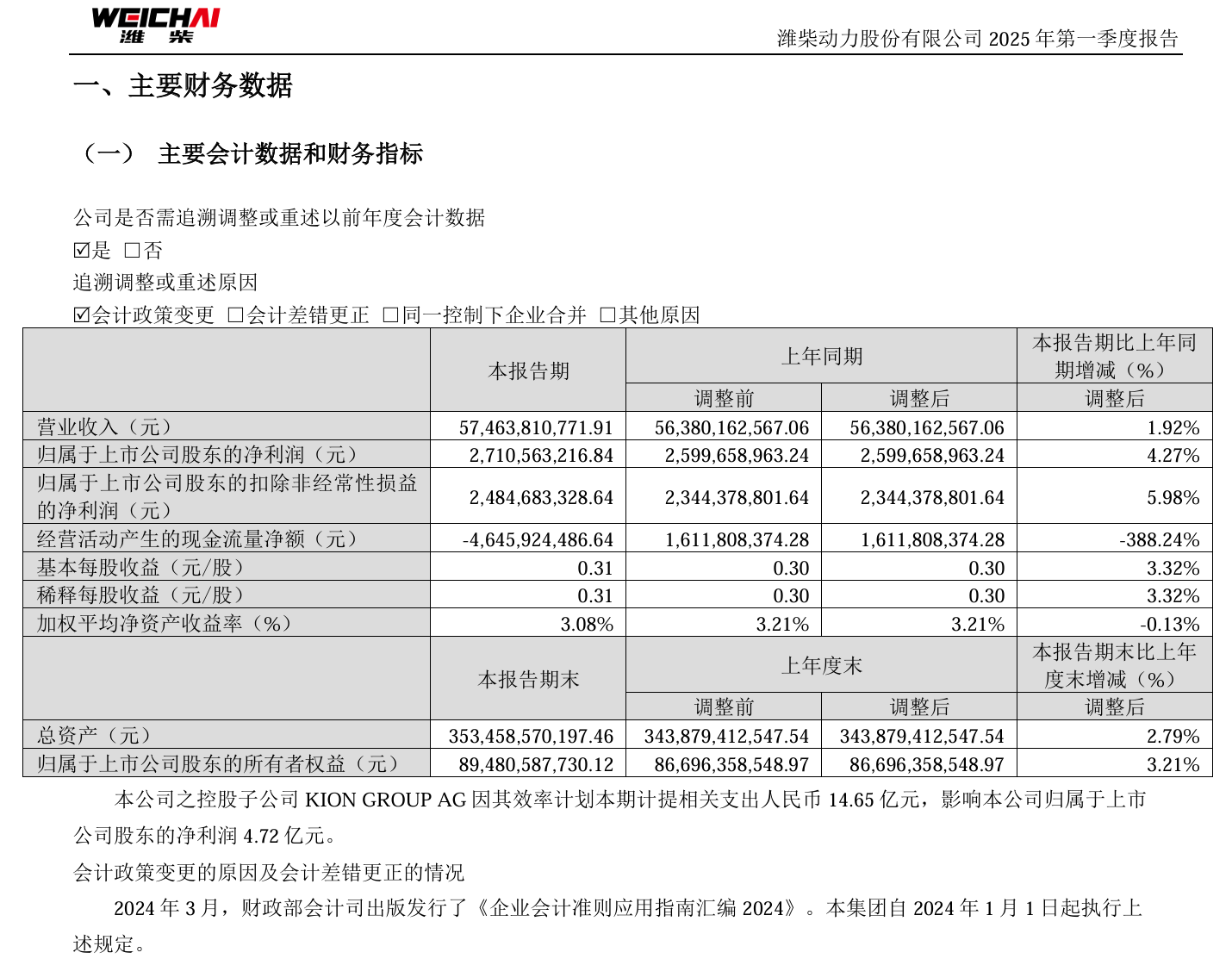
Core Viewpoint - The commercial vehicle industry in China is experiencing a mixed performance in Q1 2025, with significant disparities in profitability among listed companies, reflecting varying business structures and responses to market changes [1][2]. Group 1: Heavy Truck Market Performance - The heavy truck market is showing signs of recovery, with a total commercial vehicle sales of 1.051 million units in Q1 2025, a year-on-year increase of 1.8%. Heavy truck sales reached 111,500 units, a quarter-on-quarter growth of 37.02% [3][8]. - Leading companies like Weichai Power reported a revenue of 57.464 billion yuan, a year-on-year increase of 1.92%, and a net profit of 2.711 billion yuan, up 4.27% year-on-year. Excluding certain expenses, the net profit growth rate was 22.42%, returning to levels seen in 2018 [3][4][6]. - China National Heavy Duty Truck achieved a revenue of 12.91 billion yuan, a 13% increase, and a net profit of 310 million yuan, up 13.3% [7]. Group 2: Commercial Vehicle Industry Overview - The total revenue of seven listed commercial vehicle companies exceeded 113 billion yuan, with a total net profit of nearly 4.4 billion yuan in Q1 2025 [2]. - Foton Motor reported a revenue of 14.8 billion yuan, a 15% increase, and a net profit of 436 million yuan, a significant rise of 70.1%. The company saw a total sales volume of over 170,000 units, a 9.8% increase, driven by strong growth in new energy vehicle sales [7]. - In contrast, FAW Jiefang faced challenges with a revenue of 14.34 billion yuan but a net profit of only 29.05 million yuan, down 83.42% year-on-year, indicating internal adjustment pressures [7]. Group 3: Bus Market Performance - The bus market is experiencing a positive trend, with all reported bus companies showing significant profit increases. Yutong Bus reported a revenue of 6.418 billion yuan and a net profit of 755 million yuan, a year-on-year increase of 14.91% [9]. - Zhongtong Bus achieved a revenue of 1.693 billion yuan, a 32.1% increase, and a net profit of 76.51 million yuan, up 80.52% year-on-year. The sales volume reached 2,766 units, a 10.02% increase [11]. - King Long Motor reported a revenue of 4.922 billion yuan, a 23.69% increase, and a net profit of 46.76 million yuan, up 164.79% year-on-year, benefiting from the transition to new energy and overseas market expansion [11].
【会讯】2025年6月乘用车市场分析发布会会议通知
乘联分会· 2025-06-06 08:55
Core Viewpoint - The article discusses the upcoming "2025 June Passenger Car Market Analysis Release Conference" organized by the China Automobile Circulation Association, focusing on the dynamics of the national passenger car market, industry policies, pricing, used cars, new energy vehicles, commercial vehicles, and the Shanghai automotive market [2][3]. Group 1: Conference Details - The conference will be held online and aims to provide timely insights into the passenger car market [2]. - The report will be published on June 9, 2025, at 16:00, through the WeChat subscription account (cpca2024) and the official website (www.cpcaauto.com) [3][4]. Group 2: Report Content - The report will include various analyses, such as: 1) May 2025 Shanghai automobile market registration data [4]. 2) April 2025 price index report [4]. 3) Analysis of national policies encouraging the construction of new energy vehicle charging and swapping infrastructure [4]. 4) Insights on CATL's battery swapping 2.0 [4]. 5) April 2025 new energy vehicle industry monthly report [4]. 6) May 2025 light commercial vehicle market forecast [4]. 7) April 2025 national used car market in-depth analysis [4]. 8) April 2025 Beijing automobile market analysis [4]. 9) May 2025 national passenger car market analysis [4].

重卡市场爆发在即!27省市区出台2025报废更新补贴细则! | 头条
第一商用车网· 2025-06-06 06:51
Core Viewpoint - The heavy-duty truck market is expected to experience a new surge in demand in the second half of 2025 due to government policies promoting the scrapping and updating of old trucks, particularly those meeting National III and IV emission standards [1][3][46]. Policy Overview - The Chinese government has significantly increased efforts to eliminate old operational trucks, expanding the scrapping policy to include National IV standards and providing differentiated subsidies for scrapping and purchasing new vehicles [3][4]. - As of now, 27 out of 32 provinces and municipalities have issued specific guidelines for the 2025 truck scrapping and updating subsidies, covering nearly 85% of the country [1][15]. Subsidy Details - The subsidy for scrapping old trucks can reach up to 45,000 yuan for the scrapped vehicle and up to 95,000 yuan for the new purchase, totaling a maximum of 140,000 yuan per vehicle [4][34]. - The subsidy structure varies by vehicle type and the duration of early scrapping, with specific amounts allocated for different categories of trucks [6][9][28]. Market Impact - In May 2025, the heavy-duty truck market saw sales of approximately 85,000 units, a year-on-year increase of about 9%, indicating a recovery in the market driven by the scrapping policies [11]. - The policies are expected to stimulate both terminal and wholesale sales, addressing the current challenges in the freight market, such as oversupply and low freight rates [11][46]. Regional Implementation - Regions like Shanghai and Beijing have implemented aggressive policies, with Shanghai aiming to eliminate National IV diesel trucks by 2027 and offering substantial subsidies for both scrapping and purchasing new vehicles [18][24]. - Other provinces have set specific targets for the number of trucks to be scrapped and updated, with Shanghai targeting 50,000 trucks and Zhejiang aiming for 40,000 [38][39]. Conclusion - The truck scrapping and updating policies are designed to lower the cost of purchasing new vehicles through financial subsidies, thereby invigorating the market and promoting the transition to greener logistics, aligning with national carbon reduction goals [46].