
服务业

Search documents
海外避险情绪升温,国内弱复苏延续
Tong Guan Jin Yuan Qi Huo· 2025-06-03 12:12
Report Title - Macro Weekly Report: Overseas Risk-Aversion Sentiment Intensifies, Domestic Weak Recovery Continues [1] Core Views - Overseas, there are signs of partial recovery in the US "soft data", with the Michigan Consumer Sentiment Index rising in May and inflation expectations falling from their highs. However, the manufacturing sector remains sluggish due to tariff disruptions, with the May ISM Manufacturing PMI contracting for three consecutive months, weaker than expected, and the import sub-index hitting a 16-year low, while the price sub-index remains high. Overall, the US economic fundamentals remain resilient, and the GDPNow model has revised up its Q2 economic growth forecast to 4.6%. This week, attention is focused on the May non-farm payroll report and the services PMI. Last week, the US dollar index maintained a weak oscillation, and the gold price returned to a high level, reflecting three risks: internal conflicts in the US weakening its sovereign credit, setbacks in the US tariff negotiations with other countries, and renewed conflicts in war-torn countries. In June, attention is on the progress of Trump's tax cut bill in the Senate and the trade court's ruling on tariffs [2]. - Domestically, the manufacturing sector's sentiment improved slightly in May, with both supply and demand improving. The reduction in Sino-US tariffs has led to a marginal recovery in production driven by pre-export activities, and new orders have significantly improved due to external demand. However, price pressures remain, and the signs of companies "trading price for volume" and actively reducing inventory continue. In addition, the sentiment in the service and construction sectors remains lower than in previous years, indicating that domestic demand is still the main drag in the second quarter, and more policy support is urgently needed in the context of weak inflation. In June, attention is on the possibility of a meeting between the Chinese and US presidents [3] Section Summaries Overseas Macro - US May Manufacturing PMI Weakens: The May ISM Manufacturing PMI was weak, indicating that the "rush to import" may have ended. The May ISM Manufacturing PMI was 48.5, lower than the expected 49.5 and the previous value of 48.7, remaining in the contraction range for three consecutive months. New orders continued to shrink, external demand was under pressure, costs were high, and employment was weak. The import sub-index hit a 16-year low, suggesting that the peak of "rush to import" may have passed under tariff disruptions. The trade surplus has led the GDPNow to revise up the Q2 economic growth rate to 4.6%. Meanwhile, the final value of the US May Markit Manufacturing PMI was 52.0, slightly lower than the expected 52.3 and the initial value of 52.3, still in the expansion range. The difference between the two may be due to the ISM PMI's high dependence on external demand, supply chains, and large manufacturers, making it more sensitive to policy shocks and external uncertainties [5]. - Consumer Confidence Recovers, Inflation Expectations Fall from Highs: After the easing of tariff negotiations, the US "soft data" has improved. The final value of the US May Michigan Consumer Sentiment Index was 52.2, higher than the expected 51.0 and the initial value of 50.8. With the significant reduction in Sino-US tariffs, consumer confidence has recovered, but the absolute level remains at a historical low, indicating that consumers are still highly concerned about the future economy. The final value of the one-year inflation expectation in May was 6.6%, lower than the expected 7.1% and the initial value of 7.3%; the final value of the 5 - 10-year inflation expectation was 4.2%, lower than the expected 4.5% and the initial value of 4.6%, ending four months of sharp increases [7]. Domestic Macro - China's May Manufacturing Sentiment Improves as Expected: The May Manufacturing PMI rose slightly to 49.5, in line with expectations and up from the previous value of 49.0. There were differences among enterprises of different sizes, with large enterprises rising 1.5 to 50.7, entering the expansion range, while medium and small enterprises remained in the contraction range. Both supply and demand improved, with external demand making a prominent contribution. Production rose 0.9 to 50.7, returning to the expansion range; new orders rose 0.6 to 49.8, approaching the boom-bust line; new export orders rose significantly by 2.8 to 47.5, showing obvious marginal improvement. Overall, with the phased easing of Sino-US tariff frictions, enterprises have seized the window period to accelerate production, and the release of export orders has driven the recovery of the production side. Prices were weak, and enterprises actively reduced inventory. The raw material inventory rose to 47.4, and the finished product inventory fell 0.8 to 46.5. In terms of prices, the purchase price of raw materials in April fell 0.1 to 46.9, and the ex-factory price fell 0.1 to 44.7, indicating that the signs of companies "trading price for volume" and actively reducing inventory continue [10]. - Construction and Service Sectors Remain Sluggish, Domestic Demand Recovery is Weak: In the non-manufacturing sector, the May Service PMI was 50.2, slightly higher than the previous value of 50.1 but lower than the level of previous years. Driven by the May Day holiday, tourism, travel, and catering consumption were active, and the sentiment in the transportation and accommodation industries rose to the expansion range; high - growth industries such as postal, communication, and the Internet continued to grow steadily. The Construction PMI was 51.0, lower than the previous value of 51.9 and at the lowest level in the same period over the years, with real estate construction remaining sluggish [11]. Performance of Major Asset Classes - Equity: The performance of equity markets varied. In the A-share market, the Wind All - A Index was at 5074.29, with a weekly decline of -0.02%, a monthly increase of 2.39%, and a year - to - date increase of 1.04%. The Shanghai Composite Index was at 3347.49, with a weekly decline of -0.03%, a monthly increase of 2.09%, and a year - to - date decline of -0.13%. In the Hong Kong stock market, the Hang Seng Index was at 23289.77, with a weekly decline of -1.32%, a monthly increase of 5.29%, and a year - to - date increase of 15.44%. Overseas, the Dow Jones Industrial Average was at 42270.07, with a weekly increase of 1.60%, a monthly increase of 3.94%, and a year - to - date decline of -0.64% [19]. - Bonds: In the domestic bond market, the 1 - year Treasury yield was 1.46%, with a weekly increase of 1.51 basis points, a monthly increase of 0.08 basis points, and a year - to - date increase of 35.30 basis points. In the overseas bond market, the 2 - year US Treasury yield was 3.89%, with a weekly decline of 11.00 basis points, a monthly increase of 29.00 basis points, and a year - to - date decline of 36.00 basis points [22]. - Commodities: The Nanhua Commodity Index was at 2349.69, with a weekly decline of -1.62%, a monthly decline of -2.40%, and a year - to - date decline of -5.88%. The CRB Commodity Index was at 290.43, with a weekly decline of -2.10%, a monthly increase of 0.57%, and a year - to - date decline of -2.12%. COMEX Gold was at 3313.10, with a weekly decline of -1.57%, a monthly decline of -0.18%, and a year - to - date increase of 25.45% [23]. - Foreign Exchange: The US dollar to RMB exchange rate was 7.1953, with a weekly increase of 0.08%, a monthly decline of -0.93%, and a year - to - date decline of -1.42%. The US dollar index was at 99.4393, with a weekly increase of 0.32%, a monthly decline of -0.20%, and a year - to - date decline of -8.34% [26]. High - Frequency Data Tracking - Domestic: The report includes data on the congestion index of 100 cities, the subway passenger volume of 23 cities, the commercial housing transaction area of 30 cities, the second - hand housing transaction area of 12 cities, passenger car sales, and the apparent consumption of rebar [28]. - Overseas: The report includes data on the Redbook commercial retail sales and the number of unemployment benefit claims in the US [32]. This Week's Important Economic Data and Events - The report lists important economic data and events for this week, including China's May Caixin Manufacturing PMI, the eurozone's May CPI annual and monthly rates, the US's May ADP employment data, and the US's May ISM Non - Manufacturing PMI [39].
5月PMI数据点评:制造业PMI边际改善,但仍偏弱
LIANCHU SECURITIES· 2025-06-03 11:31
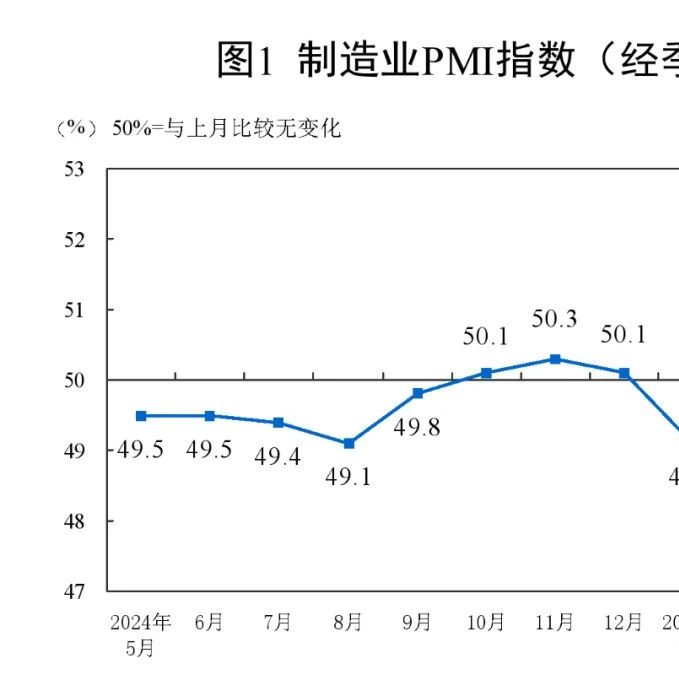
Group 1: Manufacturing Sector - The manufacturing PMI for May is 49.5%, an increase of 0.5 percentage points from the previous month, but still below the critical line, indicating weak manufacturing sentiment[7] - The new orders index for manufacturing is at 49.8%, up 0.6 percentage points, but remains below the critical line, suggesting insufficient demand[11] - The inventory indices for raw materials and finished products are both below the critical point, indicating inadequate replenishment sentiment in manufacturing[16] Group 2: Service Sector - The service sector PMI increased to 50.2%, a rise of 0.1 percentage points, indicating continued expansion in business activities[21] - The new orders index for services is at 46.6%, below the critical line, pointing to weak demand conditions[21] - The business activity expectations index is at 56.5%, indicating a positive outlook for future service sector activities[21] Group 3: Construction Sector - The construction PMI is recorded at 51%, a decrease of 0.9 percentage points, but still above the critical line, indicating ongoing expansion albeit at a slower pace[27] - The new orders index for construction is at 43.3%, suggesting pressure on demand[27] - The employment index in construction is at 39.5%, indicating insufficient hiring sentiment in the sector[27] Group 4: Economic Outlook - The overall economic sentiment is supported by recent monetary policy measures, including interest rate cuts and structural adjustments aimed at economic recovery[30] - Risks include deviations from expected fundamental recovery, unexpected macroeconomic policies, and geopolitical uncertainties[31]
5月PMI与4月工业企业绩效分析:6月18日是重要观察点
Yong Xing Zheng Quan· 2025-06-03 09:14
Industrial Performance - In the first four months, industrial enterprises' cumulative revenue increased by 3.2% year-on-year, down from 3.4% in the previous period[2] - Cumulative profit for industrial enterprises rose by 1.4% year-on-year, up from 0.8% previously, with April's profit showing a 3.0% increase year-on-year[2] - Private industrial enterprises achieved a cumulative profit growth of 4.3%, recovering from a decline of 0.3% in the previous period[2] Price and Inventory Trends - The Producer Price Index (PPI) for April showed a year-on-year decline of 2.7%, continuing a downward trend for two consecutive months[3] - Cumulative inventory of finished products in industrial enterprises increased by 3.9% year-on-year, down from 4.2% previously, marking the first decline since November 2024[3] PMI Insights - The manufacturing PMI for May was reported at 49.5%, slightly up from 49.0% in April, with the production index exceeding the critical threshold[3] - The new orders index for manufacturing PMI in May was 49.8%, an increase from 49.2% in April, while the export orders index rose to 47.5% from 44.7%[3] Employment and Sector Performance - The employment index for manufacturing in May was 48.1%, up from 47.9% in April, indicating a slight improvement in employment conditions[4] - The construction PMI for May was 51.0%, down from 51.9% in April, while the services PMI remained stable at 50.2%[4] Economic Outlook - June 18 is identified as a critical observation point for economic and policy developments, following the release of key economic data and the Federal Reserve's meeting[5] - The report highlights risks including external uncertainties and potential delays in counter-cyclical policies[6]
2025年5月PMI数据点评:PMI环比回升,生产回到扩张区间
Tebon Securities· 2025-06-03 07:35
Group 1: PMI Overview - The manufacturing PMI for May is at 49.5%, a month-on-month increase of 0.5 percentage points, still in the contraction zone[4] - The production index rose to 50.7%, up 0.9 percentage points, indicating a return to the expansion zone[4] - The new orders index increased to 49.8%, up 0.6 percentage points, reflecting improved demand[4] Group 2: Sector Performance - The new export orders index rose to 47.5%, up 2.8 percentage points, but remains below the levels seen in March (49.0%) and April[4] - High-tech manufacturing PMI decreased by 0.6 percentage points to 50.9%, remaining in the expansion zone for four consecutive months[4] - Large enterprises' PMI increased to 50.7%, up 1.5 percentage points, while medium enterprises' PMI fell to 47.5%, down 1.3 percentage points[5] Group 3: Price and Inventory Trends - The raw materials price index is at 46.9%, down 0.1 percentage points, indicating ongoing price pressure[4] - The finished goods price index is at 44.7%, also down 0.1 percentage points, suggesting weak downstream demand[4] - The raw materials inventory index is at 47.4%, up 0.4 percentage points, while the finished goods inventory index is at 46.5%, down 0.8 percentage points[5] Group 4: Economic Outlook - The production activity expectation index for manufacturing is at 52.5%, up 0.4 percentage points, indicating improved business sentiment[6] - The overall economic environment shows a structural characteristic where supply exceeds demand, necessitating policy support to alleviate price pressures[4]
【数据发布】2025年5月中国采购经理指数运行情况
中汽协会数据· 2025-06-03 07:04
Group 1: Manufacturing PMI Overview - In May, the Manufacturing Purchasing Managers' Index (PMI) was 49.5%, an increase of 0.5 percentage points from the previous month, indicating an improvement in manufacturing activity [1] - Large enterprises had a PMI of 50.7%, up 1.5 percentage points, while medium-sized enterprises saw a PMI of 47.5%, down 1.3 percentage points, and small enterprises had a PMI of 49.3%, up 0.6 percentage points [1] - The production index was at 50.7%, rising 0.9 percentage points, indicating an acceleration in production activities [1] Group 2: Manufacturing Sub-Indices - The new orders index was 49.8%, up 0.6 percentage points, suggesting a recovery in market demand [2] - The raw materials inventory index was 47.4%, up 0.4 percentage points, indicating a narrowing decline in inventory levels [2] - The employment index was 48.1%, up 0.2 percentage points, reflecting an improvement in employment conditions within the manufacturing sector [2] - The supplier delivery time index was at 50.0%, down 0.2 percentage points, indicating stable delivery times compared to the previous month [2] Group 3: Non-Manufacturing PMI Overview - In May, the Non-Manufacturing Business Activity Index was 50.3%, a decrease of 0.1 percentage points, but still above the critical point, indicating continued expansion in the non-manufacturing sector [5] - The construction industry business activity index was 51.0%, down 0.9 percentage points, while the service industry index was 50.2%, up 0.1 percentage points [8] Group 4: Non-Manufacturing Sub-Indices - The new orders index for non-manufacturing was 46.1%, up 1.2 percentage points, indicating a rebound in market demand [10] - The input prices index was 48.2%, up 0.4 percentage points, suggesting that input prices remained below the previous month's level [10] - The sales prices index was 47.3%, up 0.7 percentage points, indicating a narrowing decline in sales prices [10] - The employment index for non-manufacturing was 45.5%, stable compared to the previous month, indicating stable employment conditions [10] Group 5: Composite PMI Overview - The Composite PMI Output Index was 50.4% in May, an increase of 0.2 percentage points, indicating that production and business activities continued to expand overall [15]

5月PMI:内外分化加深——中采PMI点评(25.05)(申万宏观·赵伟团队)
赵伟宏观探索· 2025-06-03 01:06
Core Viewpoints - The manufacturing PMI for May increased marginally to 49.5%, up 0.5 percentage points from the previous month, indicating a slight recovery in manufacturing activity [2][10][52] - The new export index remains low, while domestic demand, particularly in consumer goods and equipment manufacturing, shows significant improvement [2][21] Manufacturing Sector - The manufacturing PMI shows overall improvement, with production and new order indices rising by 0.9 and 0.6 percentage points to 50.7% and 49.8%, respectively [2][52] - The production index has recovered above the expansion threshold, while the new order index remains in contraction territory, indicating faster production but weaker demand [2][10] - Industries with high domestic demand, such as equipment manufacturing and consumer goods, have seen PMIs rise by 1.6 and 0.8 percentage points to 51.2% and 50.2% [2][21] - Conversely, export-dependent sectors like textiles and chemicals have underperformed, with production and new order indices below the critical point [2][21] Non-Manufacturing Sector - The non-manufacturing PMI decreased slightly to 50.3%, with the construction sector experiencing a notable decline due to weak real estate performance [2][67] - The construction PMI fell by 0.9 percentage points to 51%, while civil engineering activities are accelerating, as indicated by a PMI of 62.3% [29][67] - Service sector PMI saw a marginal increase to 50.2%, driven by improved activity in tourism and dining during the holiday period [40][67] Future Outlook - Uncertainties surrounding U.S. tariff policies remain significant, necessitating close monitoring of fiscal policies' impact on domestic demand [45] - The recent court ruling against Trump's tariffs has created a temporary freeze on tariff enforcement, adding to the external uncertainties [45] - Service consumption and infrastructure investment are expected to be key areas for fiscal support, potentially enhancing domestic demand [45]
5月份PMI指数环比回升 宏观政策综合成效渐显
Zheng Quan Ri Bao· 2025-06-02 16:10
Core Insights - The Purchasing Managers' Index (PMI) for May indicates a slight recovery in China's manufacturing sector, with the manufacturing PMI at 49.5%, up 0.5 percentage points month-on-month, while the non-manufacturing business activity index is at 50.3%, down 0.1 percentage points [1][2] - The overall economic output remains in an expansion phase, with the composite PMI output index at 50.4%, reflecting a 0.2 percentage point increase [1] Manufacturing Sector - The production index rose to 50.7%, indicating a recovery in manufacturing activities, while the new orders index increased to 49.8% [2] - The high-tech manufacturing PMI stands at 50.9%, maintaining expansion for four consecutive months, while equipment manufacturing and consumer goods PMIs are at 51.2% and 50.2%, respectively [3] - Large enterprises show a PMI of 50.7%, returning to expansion, while medium-sized enterprises have a PMI of 47.5%, and small enterprises at 49.3% [3] Trade and Export - New export orders index and import index improved to 47.5% and 47.1%, respectively, with increases of 2.8 and 3.7 percentage points month-on-month [2] - The recent China-US Geneva trade talks have positively impacted manufacturing exports, leading to a slowdown in the decline of new export orders [2] Non-Manufacturing Sector - The non-manufacturing business activity index remains above the critical point at 50.3%, indicating continued expansion, although it decreased by 0.1 percentage points [5] - The construction industry index is at 51%, while the service industry index is at 50.2%, showing mixed performance [5][6] - The information service sector continues to thrive, with business activity indices in various service sectors remaining above 55.0%, indicating strong growth [6][7] Economic Outlook - Analysts suggest that the government should enhance economic stabilization policies and promote domestic demand while maintaining high-level openness to external markets [4] - The business activity expectation index for the construction sector is at 52.4%, reflecting optimism among construction enterprises [6]
5月PMI:内外分化加深——中采PMI点评(25.05)(申万宏观·赵伟团队)
申万宏源宏观· 2025-06-02 05:10
Core Viewpoints - The manufacturing PMI for May increased marginally to 49.5%, indicating a slight recovery in manufacturing activity, although it remains below the expansion threshold of 50 [2][10] - The new export index is low, but domestic demand, particularly in consumer goods and equipment manufacturing, shows significant improvement [2][21] - The service sector PMI also saw a slight increase, driven by improvements in life services, particularly during the "May Day" holiday [40][67] Manufacturing Sector - The manufacturing PMI rose by 0.5 percentage points to 49.5%, with production and new orders indices increasing by 0.9 and 0.6 percentage points to 50.7% and 49.8%, respectively [2][52] - The production index has recovered above the expansion line, while the new orders index remains in contraction territory, indicating a disparity between production acceleration and weak demand [2][10] - Industries with strong domestic demand, such as equipment manufacturing and consumer goods, showed better performance, with PMIs rising by 1.6 and 0.8 percentage points to 51.2% and 50.2% [21][24] New Orders and Exports - The internal demand orders index rose above the expansion line to 50.1%, while the new export orders index increased by 2.8 percentage points to 47.5%, indicating a divergence in recovery between domestic and export orders [3][24] - The average value of new export orders over April and May remains lower than in March, suggesting ongoing pressure on exports [3][24] Non-Manufacturing Sector - The non-manufacturing PMI decreased slightly to 50.3%, primarily due to a decline in the construction sector, which fell by 0.9 percentage points to 51% [67][29] - Despite the decline in construction, civil engineering activities are accelerating, with the civil engineering PMI rising to 62.3% [29][84] - The service sector PMI increased by 0.1 percentage points to 50.2%, supported by active consumer spending during the holiday period [40][67] Future Outlook - Uncertainties surrounding U.S. tariff policies remain significant, with ongoing monitoring of fiscal policies' support for domestic demand [45][45] - The focus will be on the potential for fiscal measures to bolster service consumption and infrastructure investment, which are expected to enhance domestic demand support [45][45]
价格回落势头渐止——5月PMI数据解读
CAITONG SECURITIES· 2025-06-01 02:15
宏观月报 / 2025.05.31 ——5 月 PMI 数据解读 证券研究报告 分析师 陈兴 SAC 证书编号:S0160523030002 chenxing@ctsec.com 分析师 马骏 SAC 证书编号:S0160523080004 majun@ctsec.com 相关报告 1. 《PMI 节前还比较弱——1 月 PMI 数 据解读》 2024-01-31 2. 《PMI 节后表现如何?——2 月 PMI 数据解读》 2024-03-01 3. 《出口带动需求回暖——3 月 PMI 数 据解读》 2024-03-31 4. 《生产高位扩张,价格持续上行—— 4 月 PMI 数据解读》 2024-04-31 5. 《成本压力上升——5 月 PMI 数据解 读》 2024-05-31 6. 《PMI 还是弱了些——6 月 PMI 数据 解读》 2024-06-30 7. 《出口订单创同期新高——7 月 PMI 数据解读》 2024-07-31 8. 《外需仍有回升——8 月 PMI 数据解 读》 2024-08-31 9. 《PMI 再现背离,经济景气如何?— —9 月 PMI 数据解读》 2024-09 ...
5月份制造业PMI环比上升0.5个百分点—— 我国经济总体产出保持扩张
Jing Ji Ri Bao· 2025-05-31 22:01
Group 1: Manufacturing Sector - In May, the manufacturing Purchasing Managers' Index (PMI) rose to 49.5%, an increase of 0.5 percentage points from the previous month, indicating an improvement in manufacturing sentiment [1] - The production index for manufacturing activities returned to the expansion zone at 50.7%, up 0.9 percentage points from last month, reflecting a recovery in production activities [1] - New orders index increased to 49.8%, up 0.6 percentage points, while the business activity expectation index rose to 52.5%, indicating stable confidence among manufacturers regarding market development [1] Group 2: High-Tech and Equipment Manufacturing - The high-tech manufacturing PMI stood at 50.9%, maintaining expansion for four consecutive months, while the equipment manufacturing and consumer goods PMIs were 51.2% and 50.2%, respectively, both showing month-on-month increases [2] - New orders indices for both high-tech and equipment manufacturing remained above 52%, indicating strong market demand [2] Group 3: Non-Manufacturing Sector - The non-manufacturing business activity index was 50.3%, slightly down 0.1 percentage points but still above the critical point, indicating stable growth in the service sector [3] - The service sector business activity index rose to 50.2%, driven by increased consumer activity during the "May Day" holiday, with a business activity expectation index of 56.5%, reflecting optimism among service providers [3] - The construction industry continued to expand, with the civil engineering business activity index at 62.3%, up 1.4 percentage points, indicating accelerated project construction [3] Group 4: Economic Outlook and Policy Implications - The rise in manufacturing PMI in May suggests that proactive macroeconomic policies are beginning to show results, although the price index remains slightly down, indicating an oversupply situation [4] - Experts emphasize the need for continued government investment in public goods to support production and employment recovery, while also advocating for measures to boost domestic demand and enhance external trade [4] - The manufacturing sector's recovery is still under observation due to external uncertainties and the fact that many sub-indices remain below 50%, indicating potential risks [4]