稀土

Search documents
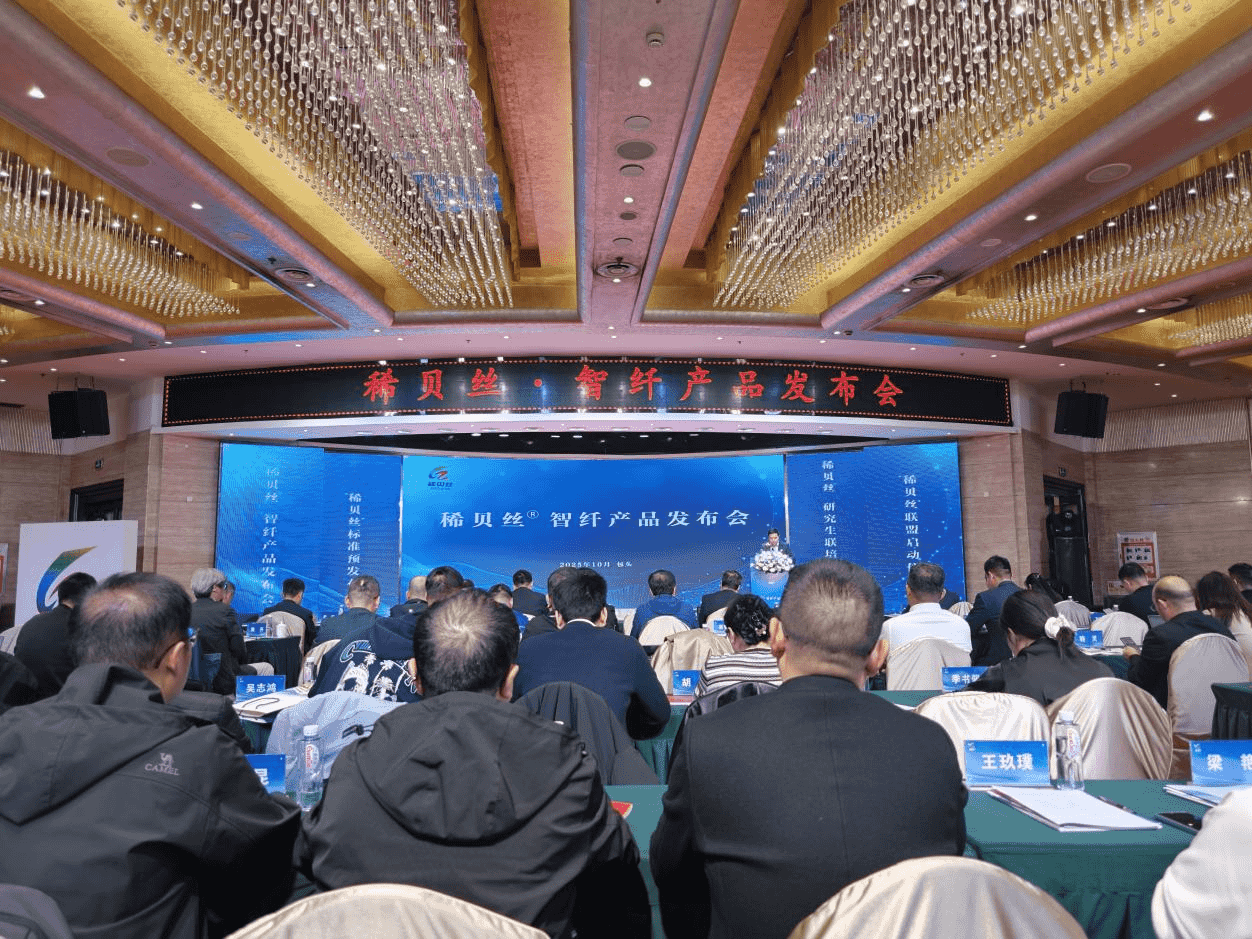
智慧赋能 破茧成“纤” 包钢集团稀贝丝智纤产品隆重发布
Zhong Guo Jin Rong Xin Xi Wang· 2025-11-03 08:12
Core Viewpoint - The launch of the "Rarebeisi® Smart Fiber" marks a significant breakthrough in the rare earth functional fiber sector, showcasing advanced technology and broad application prospects, attracting high industry attention [1][3]. Group 1: Product Features - Rarebeisi® Smart Fiber integrates rare earth element modification technology with fiber manufacturing processes, resulting in a comprehensive enhancement of fiber performance [3]. - The product features three core functionalities: - Extreme cold protection, improving warmth retention by 30% in -40°C conditions compared to traditional materials, providing new solutions for cold region operations and outdoor protective gear [3]. - High ultraviolet (UV) blocking capability, with a UV blocking rate exceeding 99%, effectively protecting users from UV harm, suitable for military, police, and outdoor sports scenarios [3]. - Intelligent response functionality, incorporating temperature and humidity sensing technology for "human-clothing-environment" interaction, promoting the smart and functional development of textiles [3]. Group 2: Industry Collaboration - The "Rarebeisi Alliance" was officially launched, gathering resources from the entire industry chain, including rare earth raw materials, fiber research and development, textile manufacturing, and end brands, aimed at creating an open and collaborative platform for efficient technology transfer and industrial application [4]. - The alliance's establishment is expected to facilitate collaboration among industry partners to explore innovation directions, development paths, and industrialization processes for rare earth functional fibers [4]. - A pre-release standard for "Quantitative Analysis of Rare Earth Elements in Textiles" was announced, and a joint graduate training cooperation agreement was signed between Tianjin Baogang Rare Earth Research Institute and Donghua University, indicating a commitment to standardized industry development [4].


贝森特警告中国“犯下真正错误”,并预测美国12-24个月内实现供应链独立!
Sou Hu Cai Jing· 2025-11-03 04:14
Core Viewpoint - The article highlights concerns regarding China's control over critical mineral supplies and the implications for global supply chains, particularly in the context of the U.S. aiming for supply chain independence within 12 to 24 months [1][3]. Group 1: China's Mineral Control - China controls over 60% of global rare earth mining and more than 85% of processing, with a 70% share in battery metals such as lithium, cobalt, and nickel, leading to vulnerabilities in Western supply chains [3]. - A suspension of certain rare earth exports by China in April 2025 caused significant disruptions in the global automotive and semiconductor industries for several weeks, prompting the G7 to label it as "non-market behavior" [3]. Group 2: G7 Response and Initiatives - In June 2025, the G7 launched the "Critical Minerals Action Plan" during a summit in Canada, focusing on diversifying supply sources, establishing price floors, and creating long-term procurement agreements [3]. - The "Critical Minerals Production Alliance" was officially introduced at a meeting in Toronto on October 31, 2025, outlining 26 initiatives involving nine countries (G7 plus allies like Australia and South Korea) aimed at building a transparent and sustainable supply chain from "mine to magnet" to reduce reliance on China [3]. Group 3: Expert Insights - In an interview with the Financial Times on October 31, 2025, Bessent criticized China's recent export controls on rare earths as a "real mistake," suggesting it has alerted the world to Beijing's coercive capabilities [3]. - Bessent predicts that the U.S. will establish reliable alternatives within "12 to 24 months" through investments from the Department of Defense in companies like MP Materials, alongside price floors and "forward purchasing" strategies [3].

全球稀土三十年争霸战:中国如何从47%份额到绝对主导
Sou Hu Cai Jing· 2025-11-02 22:23
Core Insights - The global rare earth industry has undergone significant changes over the past thirty years, with China increasing its market share from 47% to 70% and controlling 90% of the refining capacity, establishing itself as the dominant player in this resource competition [1][5][19] Production and Market Share - In 1994, China's rare earth oxide (REO) production was approximately 31,000 tons, accounting for about 47% of global output, while the Mountain Pass mine in the U.S. was the largest producer [3][19] - By 2024, China's REO production has reached 270,000 tons, representing nearly 70% of global production, with a year-on-year increase of 12.5% [5][19] - The U.S. rare earth production is projected to be around 46,000 tons in 2024, which, despite recovery, remains significantly lower than China's output [3][5] Technological Advancements - China has made significant technological breakthroughs, such as improving the recovery rate of rare earths to 78% through intelligent sorting technology, a 15 percentage point increase since 2020 [5] - Innovations in biometallurgy have reduced mining costs by 30%, and advancements in neodymium-iron-boron magnetic material technology have enhanced product performance by 20% [7] Export and Import Dynamics - In the first nine months of 2025, China's rare earth permanent magnet material exports increased by 27%, with international prices rising by 18% since the beginning of the year [8] - In September 2025, China's rare earth exports reached 4,000.3 tons, with total exports for the first nine months amounting to 48,355.7 tons, while imports for the same month were 6,864.7 tons [8] Resource Distribution and Competitiveness - China holds the largest rare earth reserves globally, with 44 million tons, while Brazil, India, and Russia follow with significantly lower reserves [10] - The competition in the rare earth industry extends beyond resource availability to include deep processing technology, with China holding 41% of global PCT international patents in rare earth permanent magnets and catalytic materials [12] Strategic Responses from Other Countries - In response to China's dominance, the U.S. and EU are actively seeking to diversify their supply sources, collaborating with countries like Australia, Canada, and Japan to ensure resource security [14][15] - The U.S. has invested $120 million to restart domestic rare earth production, aiming for a capacity of 2,000 tons by 2025, which is minimal compared to China's annual production of 390,000 tons [15][20] Future Outlook - The next decade will see continued focus on technological innovation and supply chain security in the rare earth industry, driven by growing demand in sectors like renewable energy and aerospace [20]
欲替代中国稀土?澳洲稀土巨头喊话全球,美方不愿看到的局面出现了
Sou Hu Cai Jing· 2025-11-02 19:11
Core Viewpoint - The CEO of Lynas Rare Earths Ltd. is creating anxiety in the market by suggesting that global buyers must accept premium prices for rare earths from non-Chinese sources following China's new export controls [1][3][4]. Group 1: Market Dynamics - Lynas claims that after China's export restrictions, buyers should no longer expect cheap rare earths from China, implying that they will need to pay more for alternative supplies [3][4]. - The company is attempting to position itself as a key alternative to Chinese rare earths, despite its limited production capacity and reliance on Chinese technology and equipment [4][6]. - Lynas's new heavy rare earth plant in Malaysia is not expected to be operational until 2026, with a production capacity of only 5,000 tons, which is significantly lower than China's output [6][11]. Group 2: Strategic Positioning - The timing of Lynas's statements coincides with geopolitical maneuvers, including recent agreements between the U.S. and Japan to strengthen supply chains, suggesting that Lynas is part of a broader strategy involving the U.S. and its allies [6][8]. - Lynas's CEO emphasizes prioritizing supply for defense and high-tech sectors, indicating a shift in how rare earths are perceived, transforming them from commodities to strategic resources [6][10]. Group 3: Financial Performance - Lynas is facing significant financial challenges, with a reported 90% drop in net profit, leading to a cash reserve decline from 523 million AUD to 166 million AUD [13][14]. - The company is resorting to issuing new shares at discounted prices to raise funds, indicating a desperate need for capital [14][15]. Group 4: Industry Challenges - The overall reliance of Western countries on Chinese rare earths remains high, with 80% of the refined minerals still needing to be processed in China, highlighting the difficulties in establishing a self-sufficient supply chain [16][18]. - The cost of production for Lynas's Texas plant is projected to be 40% higher than that of Chinese facilities, further complicating its competitive position [11][16]. Group 5: Geopolitical Implications - Lynas's rhetoric reflects a broader Western strategy that politicizes economic issues, treating market competition as a zero-sum game, which may lead to inefficient use of taxpayer money to support less competitive industries [18][19].


中上协发布上市公司三季报经营业绩报告 整体业绩持续改善 含“科”量进一步提高
Zheng Quan Shi Bao· 2025-11-02 18:07
Core Insights - The overall performance of listed companies in China has shown continuous improvement, with significant contributions from the technology sector, indicating a shift towards high-quality development [1][2][3] Group 1: Financial Performance - In the first three quarters, listed companies achieved a total revenue of 53.46 trillion yuan and a net profit of 4.7 trillion yuan, representing year-on-year growth of 1.36% and 5.50% respectively [1] - In Q3 alone, revenue and net profit grew by 3.82% and 11.45% year-on-year, with quarter-on-quarter growth of 2.40% and 14.12%, indicating a solid upward trend [1] Group 2: Sector Performance - The technology sector, particularly the ChiNext, STAR Market, and Beijing Stock Exchange, showed remarkable growth, with revenues of 32,486.28 billion yuan, 10,142.07 billion yuan, and 1,450.68 billion yuan respectively, and net profits of 2,446.61 billion yuan, 441.25 billion yuan, and 92.03 billion yuan [2] - Advanced manufacturing and new energy sectors are emerging as significant growth drivers, with storage chip companies reporting revenue growth of 16.08% and net profit growth of 26.44% [3] Group 3: Consumer Trends - Consumer sectors are experiencing a boost, with the total box office surpassing 40 billion yuan and gaming industry revenues increasing by 24.40% [4] - The precious metals sector saw revenue growth of 22.36% and net profit growth of 55.96%, driven by rising gold prices [4] Group 4: Innovation and R&D - Listed companies invested a total of 1.16 trillion yuan in R&D, marking a year-on-year increase of 3.88%, with a total R&D intensity of 2.16% across the market [4] - Strategic emerging industries have a higher R&D intensity of 5.21%, indicating a strong focus on innovation [4] Group 5: Shareholder Returns - A total of 1,033 companies announced cash dividend plans, with a total cash dividend amounting to 734.9 billion yuan, reflecting an increase in shareholder returns [5] - The number of share buyback plans reached 1,525, with a total buyback amount of 92.3 billion yuan, indicating a commitment to returning value to shareholders [5] Group 6: Market Reforms - The capital market reforms are progressing, with initiatives aimed at attracting long-term investments and enhancing market adaptability and inclusiveness [6]
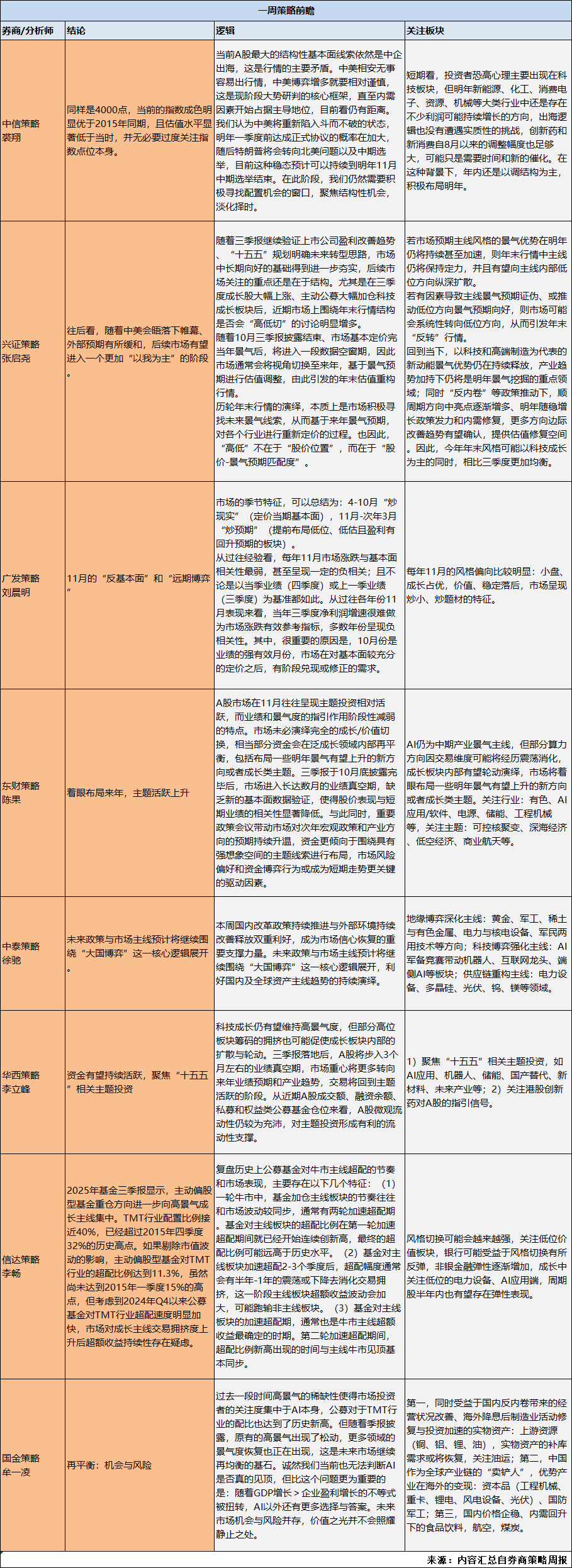
A股分析师前瞻:历史上的11月风格更偏向炒小、炒题材?
Xuan Gu Bao· 2025-11-02 13:55
Group 1 - The core viewpoint of the articles discusses the historical market trends in November and year-end, highlighting a shift from "pricing current fundamentals" from April to October to "pricing expectations" from November to March of the following year [1][5] - Historical data indicates that the correlation between market performance in November and fundamentals is weak, often showing a negative correlation, as October is a strong earnings month leading to a need for market correction [1][5] - The market style in November tends to favor small-cap and growth stocks while value and stability lag behind, reflecting a trend of speculative investments in smaller themes [1][5] Group 2 - The year-end market performance is characterized by a search for future economic clues, leading to a revaluation of various industries based on next year's economic expectations [2][3] - The technology and high-end manufacturing sectors are expected to continue their growth momentum, becoming key areas for economic exploration in the coming year [2][3] - The "anti-involution" policies are expected to enhance cyclical sectors, with more areas showing marginal improvement trends, providing room for valuation recovery [2][3] Group 3 - The market is anticipated to enter a more balanced phase with a focus on technology growth, compared to the previous quarter [3] - The scarcity of high-growth sectors has led to increased investor focus on AI, with public funds heavily weighted towards the TMT sector, reaching historical highs [3][6] - As earnings reports conclude, the market is expected to shift focus towards next year's performance expectations and industry trends, leading to a more active thematic investment phase [5][6]
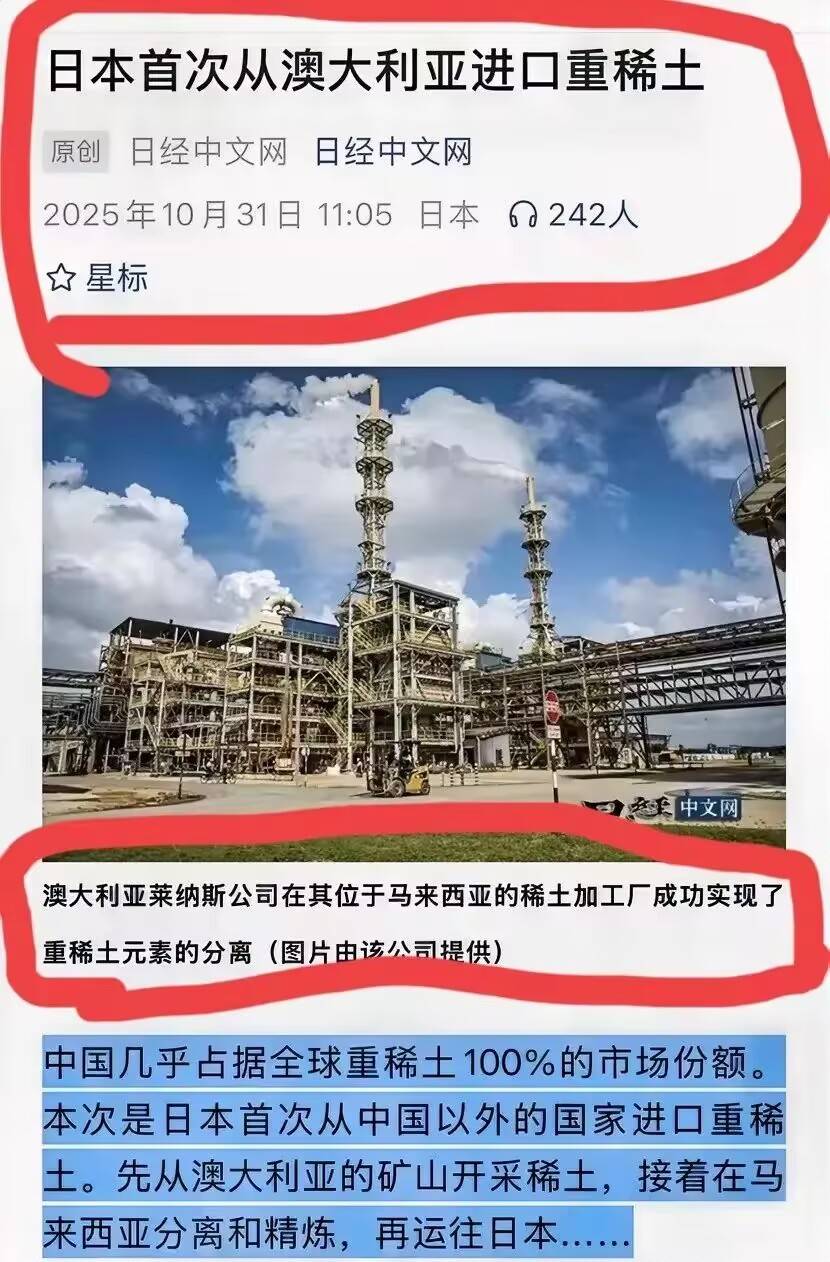
稀土人才被挖,澳大利亚宣布首次实现重稀土产量达到可出口级别!
Sou Hu Cai Jing· 2025-11-02 10:44
Core Viewpoint - Japan has become the first country to purchase heavy rare earths from Australia, marking a significant shift in the global rare earth supply chain, previously dominated by China [1][3]. Group 1: Supply Chain Developments - China previously controlled 100% of the global heavy rare earth supply, but Australia’s Lynas has successfully exported heavy rare earths to Japan, showcasing rapid progress in diversifying supply sources [3]. - The heavy rare earths were mined from Mount Weld in Australia, processed in Malaysia, and then shipped to Japan, indicating a well-coordinated supply chain operation [3]. Group 2: Strategic Importance for Japan - Japan places high importance on this batch of rare earths as it provides a potential breakthrough against China's dominance in the sector, with plans to utilize these materials in electric vehicles, wind turbines, and motors [5]. - The production process heavily relies on technical personnel who were previously employed in China, suggesting that the loss of talent may have contributed to this technological advancement [5]. Group 3: Talent Acquisition and Competition - There has been a significant increase in overseas recruitment efforts targeting technical personnel, with reports indicating a tenfold rise in headhunter contacts since the beginning of the year, and some offers exceeding an annual salary of 5 million [5]. - Western countries are employing aggressive tactics to attract talent, including offering salaries 4-5 times higher than domestic rates and providing green card incentives [5]. Group 4: Recommendations for China - In response to the talent drain, it is suggested that China should implement strict management of technical personnel's exit from the country, requiring special approval for key technical staff traveling to the US, Germany, Japan, etc., with passports managed by their employers [5].
7349亿元!A股公司今年以来大手笔分红
Zhong Guo Zheng Quan Bao· 2025-11-02 09:11
Core Insights - The overall performance of listed companies in China has shown continuous improvement, with a notable contribution from technology-driven enterprises, indicating a shift towards high-quality development [1][2] Group 1: Economic Performance - China's GDP grew by 5.2% year-on-year in the first three quarters of 2025, reflecting a stable economic development [1] - Total revenue for listed companies reached 53.46 trillion yuan, with a net profit of 4.70 trillion yuan, marking year-on-year growth of 1.36% and 5.50% respectively [2] - In the third quarter alone, revenue and net profit increased by 3.82% and 11.45% year-on-year, with quarter-on-quarter growth of 2.40% and 14.12% [2] Group 2: Sector Performance - Among 19 industry categories, 17 reported profits, with 9 experiencing revenue growth and 10 showing net profit growth [3] - The semiconductor industry saw a revenue increase of 16.08% and a net profit increase of 26.44% due to rising demand for AI data storage [3] - The new energy vehicle sector also reported significant growth, with revenue and net profit growth rates exceeding 10% and 20% respectively [3] Group 3: Innovation and R&D - Listed companies invested a total of 1.16 trillion yuan in R&D, marking a year-on-year increase of 3.88% [4] - The overall R&D intensity across the market was 2.16%, with the ChiNext, Sci-Tech Innovation Board, and Beijing Stock Exchange showing higher intensities of 4.54%, 11.22%, and 4.42% respectively [4] Group 4: Shareholder Returns - A total of 1,033 listed companies announced cash dividend plans, with a total cash dividend amounting to 734.9 billion yuan [5] - The number of companies engaging in share buybacks reached 1,195, with a total buyback amount of 92.3 billion yuan [6]
帮主郑重:前三季度存储芯片产业上市公司净利猛增26.44%,AI需求引爆新周期
Sou Hu Cai Jing· 2025-11-02 08:44
Group 1: Storage Chip Industry - The storage chip industry has shown impressive growth with a revenue increase of 16% and a net profit surge of 26%, indicating strong demand driven by AI advancements [1] - The demand for storage chips is primarily fueled by the rapid evolution of AI models, which require vast amounts of data storage, likening the need for storage chips to a "super warehouse" for AI [3] - The current demand for storage chips is expected to rise as various industries undergo digital transformation, making storage chips essential for data management in sectors like smart vehicles and industrial internet [3] Group 2: Solid-State Battery Technology - Breakthroughs in solid-state battery technology are set to enhance the range of electric vehicles, indicating ongoing innovation in the new energy sector despite previous concerns about stagnation [4] - The transition from lithium batteries to solid-state batteries represents a new wave of opportunities within the industry, similar to past technological shifts [4] Group 3: Resource Materials Sector - The resource materials sector, particularly superhard materials and rare earth elements, has seen a revenue growth of 10%, highlighting their strategic importance in high-end manufacturing [5] - These materials are essential for the industrial 4.0 era, akin to how salt is indispensable in cooking, emphasizing their foundational role in advanced manufacturing processes [5] Group 4: Traditional Industries Transformation - Traditional industries such as solar energy and cement are undergoing transformation by focusing on quality over quantity, with companies successfully reducing losses [6] - This shift indicates a maturation in these industries, moving from aggressive expansion to sustainable practices [6] Group 5: Investment Focus Areas - For the storage chip sector, short-term growth is driven by AI demand, while long-term prospects depend on technological advancements, suggesting a focus on companies with core technology capabilities and those that can keep pace with global innovation [7] - In the solid-state battery space, attention should be given to companies with significant R&D investments and early patent acquisitions to avoid being misled by speculative trends [8] - The resource materials sector requires a geopolitical perspective to identify opportunities in critical supply chain segments, akin to strategic chess moves [9] - Identifying companies in traditional industries with strong management and stable cash flows could yield significant returns as the sector undergoes consolidation [10]

【转|太平洋有色新材料-北方稀土深度】资源与技术优势,卡位高质量发展
远峰电子· 2025-11-02 08:07
Core Viewpoint - The article emphasizes the growth potential of the rare earth industry, particularly focusing on the company's strategic positioning and product development in response to increasing demand across various sectors, including electronics, robotics, and renewable energy [2][4][19]. Company Overview and Financial Data - The company, China Northern Rare Earth Group, has a rich history dating back to 1927, evolving through four strategic phases: foundational research, industrial expansion, full industry chain integration, and high-quality development [4]. - As of 2024, the company has 28 first-level subsidiaries and 17 second-level subsidiaries, covering all aspects of rare earth mining, separation, processing, and material manufacturing [8]. - The company achieved a total rare earth mining quota of 188,700 tons in 2024, maintaining a 69.9% share of the national quota [13]. Product and Revenue Structure - The company produces over 100 types of rare earth products, categorized into raw materials, functional materials, and end-use products [10]. - In 2024, the company reported a revenue of 32.97 billion yuan, a slight decrease of 1.58% year-on-year, with a net profit of 1.004 billion yuan, down 57.64% due to fluctuating prices of key products [15][19]. - The revenue structure shows a clear focus on rare earth products, which accounted for 72.25% of total revenue in 2024, while environmental services grew significantly [19]. Market Demand and Applications - The demand for rare earth materials is driven by their applications in consumer electronics, electric vehicles, and renewable energy technologies, with significant growth expected in the automotive sector [52][55]. - The company is positioned to benefit from the increasing demand for rare earth permanent magnets, particularly in electric vehicles and energy-efficient appliances [55][62]. Price Trends and Cost Structure - Rare earth prices have shown volatility, with significant price increases for key products like praseodymium and neodymium oxides in 2024, which positively impacted the company's profitability [28][15]. - The cost structure indicates that raw material costs account for approximately 70% of total costs, with ongoing efforts to optimize production costs [25]. Global Industry Context - China remains the largest supplier of rare earths globally, with a significant share of the world's reserves and production capacity [33][36]. - The article highlights the increasing competition from international players, particularly in the U.S. and Australia, as they ramp up their rare earth production capabilities [39][43]. Future Outlook - The company is optimistic about the future of the rare earth industry, projecting continued growth in net profits from 2025 to 2027, driven by rising demand and improved operational efficiencies [2][19]. - The strategic focus on high-quality development and technological innovation positions the company favorably within the global rare earth supply chain [4][19].