
农产品加工

Search documents
创新推广“两国双园”模式 开创深化友谊共赢发展新局面
Zheng Zhou Ri Bao· 2025-11-04 00:37
Core Points - The meeting between Zhengzhou officials and Nicaraguan representatives highlights the strengthening bilateral relations and cooperation between China and Nicaragua, particularly in the context of economic development and trade opportunities [1][2] - Zhengzhou aims to expand its international cooperation, especially with Latin American countries, focusing on industries such as agricultural processing, equipment manufacturing, and new energy vehicles [1] - Nicaragua expresses a strong interest in establishing a long-term and stable partnership with China, emphasizing the importance of collaboration for mutual prosperity [2] Summary by Sections Bilateral Relations - The meeting signifies the rapid development of relations between China and Nicaragua under the leadership of President Xi Jinping and President Ortega [1] - Both parties are committed to deepening cooperation and enhancing bilateral exchanges [1][2] Economic Cooperation - Zhengzhou is actively promoting its advantageous industries to international markets, particularly in Latin America [1] - The city is working to create a mutually beneficial framework for cooperation, referred to as the "Two Countries, Double Parks" model [1] Future Prospects - There is a mutual desire to expand cooperation in various fields, aiming for a win-win development scenario [1] - Nicaragua is keen to welcome more investments from Zhengzhou, promising to create favorable conditions for Chinese enterprises [2]
【咸阳】在天津推介“咸农优品”
Shan Xi Ri Bao· 2025-11-03 22:49
Core Viewpoint - The event "Xian Agricultural Quality Products" promotion in the Beijing-Tianjin-Hebei region resulted in significant investment and sales contracts, highlighting the growth potential of Xianyang's agricultural sector [1] Investment and Contracts - 12 investment projects were signed with a total amount of 39.6 billion yuan, focusing on areas such as deep processing of agricultural products, facility agriculture, and integration of agriculture with culture and tourism [1] - 12 purchase and sales contracts were signed, totaling 9.7 billion yuan, covering various agricultural products including apples, pears, kiwis, grapes, pomegranates, goat milk powder, and miscellaneous grains [1] Agricultural Development Strategy - Xianyang is prioritizing key rural specialty industries like apples, aiming to enhance brand promotion and market expansion, particularly for the "Xianyang Malan Red" apple brand [1] - The city is recognized as Shaanxi's largest pollution-free fine vegetable production base and an important processing supply base for livestock products [1] Government Support and Future Plans - The local government is committed to improving the business environment, promoting technology, and nurturing industries to attract investment and support entrepreneurship in Xianyang [1]
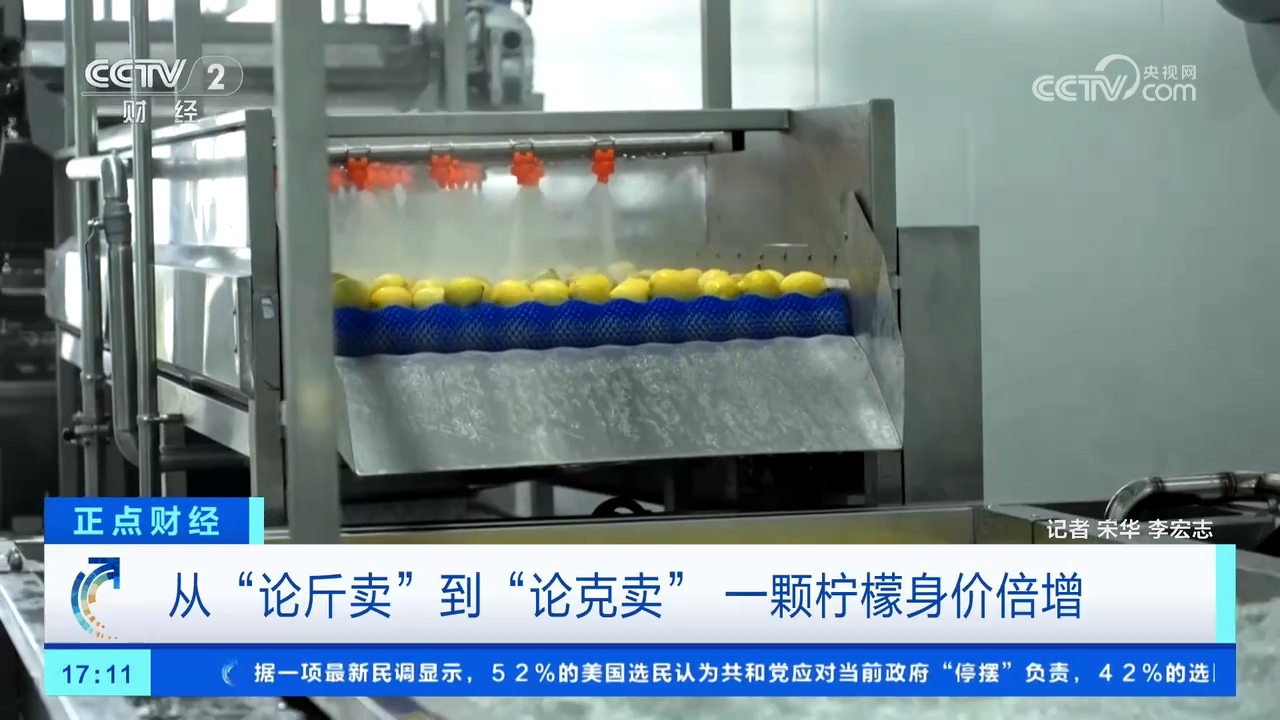
从“论斤卖”到“论克卖” 一颗柠檬身价倍增!
Yang Shi Wang· 2025-11-03 16:33
Core Insights - The price of lemons in China has significantly increased, with the average wholesale price reaching 14.87 yuan per kilogram in September 2025, nearly double the price of 7.84 yuan per kilogram from the previous year [1] - Sichuan Anyue County, a major lemon production and export base, is experiencing a surge in lemon prices and exports due to the entry of high-value deep processing enterprises [1][9] - The deep processing of lemons is transforming the local industry, allowing previously lower-grade fruits to be utilized effectively and providing stability for local farmers [1][7] Industry Developments - A new lemon deep processing facility in Sichuan Anyue has commenced operations, with a processing capacity exceeding 10,000 tons of fresh lemons annually [3] - The facility has developed over 30 types of lemon beverages based on seasonal aroma and acidity characteristics, indicating innovation in product offerings [5] - Freeze-dried lemon slices are emerging as a new growth point for companies, with the value of processed products significantly higher than fresh lemons, showcasing a growth rate of over 20% annually [5] Value Addition - The deep processing of lemons allows for comprehensive utilization, including juice extraction, seed research, fiber food production from pulp, and dried peel applications [7] - The transition from selling fresh lemons by weight to selling processed products by weight reflects a significant shift in the market strategy of Anyue lemons [7] - The number of deep processing enterprises in Anyue has increased to 33, with an additional processing capacity of over 50,000 tons [9]

农产品增值税进项税额核定扣除
蓝色柳林财税室· 2025-11-03 15:17
Core Viewpoint - The article discusses the implementation of tax incentives for agricultural production, specifically focusing on the value-added tax (VAT) input tax deduction for agricultural products, aimed at promoting the development of rural specialty industries [2][3]. Summary by Relevant Sections Tax Incentives for Agricultural Production - Since July 1, 2012, general VAT taxpayers engaged in the production and sale of liquid milk, dairy products, alcoholic beverages, and vegetable oils can deduct VAT input tax on purchased agricultural products, regardless of whether these products are used in production [2]. - From September 1, 2013, local tax authorities can collaborate with financial departments to select specific industries for the VAT input tax deduction pilot program based on regional characteristics [2]. - Taxpayers can calculate VAT input tax using methods such as input-output method, cost method, or reference method [2]. Eligibility Criteria - Agricultural products must be listed in the "Scope of Agricultural Products Subject to Tax" as per the relevant notification [3]. - Taxpayers producing goods from agricultural products must apply for deduction standards to the tax authority by January 15 of the current year or within 30 days of production commencement [4]. - The deduction for VAT input tax on purchased agricultural products for direct sales or production must be recorded with the tax authority during tax declaration [4]. Policy Basis - The article references several official notifications and regulations that provide the legal framework for the VAT input tax deduction for agricultural products [10].

玉米淀粉日报-20251103
Yin He Qi Huo· 2025-11-03 10:50
Report Summary 1. Report Industry Investment Rating No relevant content provided. 2. Core Views - The U.S. corn market is in a narrow - range oscillation. The import profit of foreign corn has declined, and the domestic corn spot has different trends in different regions. The short - term corn spot still has room to fall. The 01 corn futures have limited rebound space [4][6][8]. - The corn starch inventory has decreased this week. The starch price depends on corn price and downstream stocking. The enterprise profit is good due to the large decline in corn price. The 01 starch futures are expected to oscillate at the bottom in the short term [7]. 3. Summary by Directory Part 1: Data - **Futures Market**: For corn futures, C2601 closed at 2141 with a 0.51% increase, C2605 at 2244 with a 0.76% increase, and C2509 at 2263 with a 0.44% increase. For corn starch futures, CS2601 closed at 2453 with a 0.53% increase, CS2605 at 2558 with a 0.39% increase, and CS2509 at 2601 with a 0.46% increase [2]. - **Spot and Basis**: Corn spot prices in different regions had different changes, with prices in Qinggang falling by 5, and in Zhucheng Xingmao rising by 52. Starch spot prices in most regions remained stable, except for Yufeng which decreased by 30. The basis of corn and starch also varied in different regions [2]. - **Spread**: The spreads of corn and corn starch futures contracts and cross - variety spreads had different changes. For example, C01 - C05 was - 103 with a - 6 change, and CS01 - CS05 was - 105 with a 3 change [2]. Part 2: Market Judgment - **Corn**: The U.S. corn market is affected by the high - yield situation and the easing of Sino - U.S. relations. The import profit of foreign corn has declined. The domestic corn market has different trends in different regions. The short - term corn spot still has room to fall, and the market is concerned about the selling pressure of Jilin corn at the end of October [4][6]. - **Starch**: The number of vehicles arriving at Shandong deep - processing plants has decreased, and the corn starch inventory has declined. The starch price is mainly affected by corn price and downstream stocking. The enterprise profit is good, but the corn starch spot may fall later [7]. - **Trading Strategy**: The U.S. corn is expected to oscillate narrowly. The 05 and 01 corn long positions should be closed and wait and see. The spread between 01 corn and starch can be tried to shrink when it is high [8][9]. Part 3: Corn Options - The option strategy is a short - term cumulative put and call strategy with rolling operations [11]. Part 4: Related Attachments - There are six figures, including the spot price of corn in different regions, the basis of corn 01 contract, the spreads of corn 1 - 5 and corn starch 1 - 5, the basis of corn starch 01 contract, and the spread of corn starch 01 contract [13][15][20].
《农产品》日报-20251103
Guang Fa Qi Huo· 2025-11-03 09:34
1. Overall Investment Ratings - No industry investment ratings are provided in the reports. 2. Core Views 2.1 Oils and Fats - Palm oil: Malaysian BMD crude palm oil futures are under pressure and may fall further, with potential support at 4000 - 4100 ringgit. Dalian palm oil futures are also under pressure, expected to test 8500 - 8600 yuan for support. Overall, a view of near - term weakness and long - term strength is maintained [1]. - Soybean oil: There are both bullish and bearish factors. The overall supply - demand pattern is oversupplied, but due to factors such as high Brazilian soybean prices and potential factory shutdowns, the spot basis quote has limited short - term fluctuation space [1]. 2.2 Corn and Corn Starch - Corn: Currently, the supply is abundant, and the price is in a downward channel. The demand is mainly for rigid needs, and the futures market is expected to fluctuate weakly and approach the new - season cost price of 2050 yuan. In the long - term, it will be in a tight - balance pattern with policy support [2]. - Corn starch: The price of corn starch 2601 has increased slightly, and the market situation is affected by the corn market [2]. 2.3 Meal Products - Meal products: The expectation of China purchasing US soybeans has increased, and the domestic cost support remains. With high domestic soybean and soybean meal inventories and poor crushing margins, the domestic soybean meal trend is expected to be strong [5]. 2.4 Live Pigs - Live pigs: The market supply is relatively loose, and the pig price has weakened. There may be short - term support from secondary fattening, but there will be increased supply pressure in November and December, and the futures market is following the spot market down [7]. 2.5 Sugar - Sugar: The expected increase in supply surplus and weak energy prices have led to a weakening of raw sugar prices. Domestic sugar prices are also under pressure but have cost support at around 5400 yuan, and the market is expected to maintain a low - level oscillation [10]. 2.6 Cotton - Cotton: The new cotton cost provides support, but there is also hedging pressure. The downstream demand is weak, and the cotton price is expected to oscillate within a range in the short term [12]. 2.7 Eggs - Eggs: The short - term supply - demand imbalance persists, and the price is expected to be in a state of being difficult to rise or fall. With the slow recovery of demand, the price may gradually rise, with a reference range of 2900 - 3300 [14]. 3. Summary by Related Catalogs 3.1 Oils and Fats - **Soybean oil**: On October 31, the spot price in Jiangsu was 8400 yuan, unchanged from the previous day; the futures price of Y2601 was 8128 yuan, down 40 yuan (- 0.49%); the basis was 272 yuan, up 40 yuan (17.24%) [1]. - **Palm oil**: On October 31, the spot price in Guangdong was 8700 yuan, down 50 yuan (- 0.57%); the futures price of P2601 was 8764 yuan, down 64 yuan (- 0.72%); the basis was - 64 yuan, up 14 yuan (17.95%) [1]. - **Rapeseed oil**: On October 31, the spot price in Jiangsu was 9750 yuan, down 50 yuan (- 0.51%); the futures price of O1601 was 9422 yuan, down 107 yuan (- 1.12%); the basis was 328 yuan, up 57 yuan (21.03%) [1]. 3.2 Corn and Corn Starch - **Corn**: On November 3, the flat - hatch price of corn 2601 in Jinzhou Port was 2130 yuan, up 19 yuan (0.90%); the basis was 0 yuan, down 9 yuan (- 100.00%); the 1 - 5 spread was - 97 yuan, up 5 yuan (4.90%) [2]. - **Corn starch**: On November 3, the price of corn starch 2601 was 2440 yuan, up 21 yuan (0.87%); the basis was 70 yuan, down 21 yuan (- 23.08%); the 1 - 5 spread was - 108 yuan, up 3 yuan (2.70%) [2]. 3.3 Meal Products - **Soybean meal**: On November 3, the spot price in Jiangsu was 3020 yuan, up 50 yuan (1.68%); the futures price of M2601 was 3021 yuan, up 27 yuan (0.90%); the basis was - 1 yuan, up 23 yuan (95.83%) [5]. - **Rapeseed meal**: On November 3, the spot price in Jiangsu was 2470 yuan, down 10 yuan (- 0.40%); the futures price of RM2601 was 2388 yuan, down 13 yuan (- 0.54%); the basis was 82 yuan, up 3 yuan (3.80%) [5]. 3.4 Live Pigs - **Futures**: On November 3, the price of live pigs 2605 was 11895 yuan, down 5 yuan (- 0.04%); the price of live pigs 2601 was 11815 yuan, down 65 yuan (- 0.55%); the 1 - 5 spread was - 80 yuan, down 60 yuan (- 300.00%) [7]. - **Spot**: The spot prices in different regions showed slight fluctuations, with the price in Henan at 12500 yuan, up 50 yuan; the price in Shandong at 12550 yuan, unchanged; etc [7]. 3.5 Sugar - **Futures**: On November 3, the price of sugar 2601 was 5483 yuan, up 11 yuan (0.20%); the price of sugar 2605 was 5413 yuan, up 6 yuan (0.11%); the 1 - 5 spread was 70 yuan, up 5 yuan (7.69%) [10]. - **Spot**: The spot price in Nanning was 5750 yuan, unchanged; the spot price in Kunming was 5710 yuan, down 10 yuan (- 0.17%); the Nanning basis was 337 yuan, down 6 yuan (- 1.75%); the Kunming basis was 297 yuan, down 16 yuan (- 5.11%) [10]. 3.6 Cotton - **Futures**: On November 3, the price of cotton 2605 was 13605 yuan, down 2 yuan (- 0.04%); the price of cotton 2601 was 13595 yuan, down 5 yuan (- 0.04%); the 5 - 1 spread was 10 yuan, unchanged [12]. - **Spot**: The Xinjiang arrival price of 3128B was 14674 yuan, up 16 yuan (0.11%); the CC Index of 3128B was 14860 yuan, up 17 yuan (0.11%); the 3128B - 01 contract spread was 1069 yuan, up 21 yuan (2.00%) [12]. 3.7 Eggs - **Futures**: On November 3, the price of the egg 12 - contract was 3146 yuan, down 11 yuan (- 0.35%); the price of the egg 01 - contract was 3318 yuan, down 35 yuan (- 1.04%); the basis was - 203 yuan, up 21 yuan (9.39%); the 12 - 01 spread was - 172 yuan, up 24 yuan (12.24%) [14]. - **Related indicators**: The egg - laying hen chick price was 2.80 yuan, up 0.15 yuan (5.66%); the culled hen price was 4.11 yuan, down 0.18 yuan (- 4.20%); the egg - feed ratio was 2.35, up 0.04 (1.73%); the breeding profit was - 26.10 yuan, up 2.61 yuan (9.09%) [14].
农产品加工板块11月3日涨0.87%,华资实业领涨,主力资金净流入6082.48万元
Zheng Xing Xing Ye Ri Bao· 2025-11-03 08:40
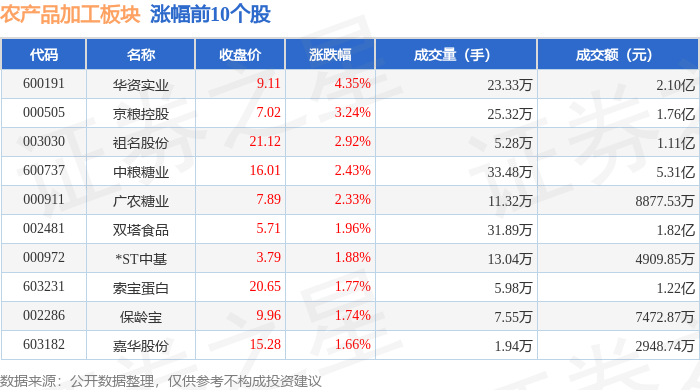
Core Insights - The agricultural processing sector experienced a rise of 0.87% on November 3, with Huazi Industrial leading the gains [1] - The Shanghai Composite Index closed at 3976.52, up 0.55%, while the Shenzhen Component Index closed at 13404.06, up 0.19% [1] Agricultural Processing Sector Performance - Huazi Industrial (600191) closed at 9.11, up 4.35% with a trading volume of 233,300 shares and a turnover of 210 million yuan [1] - Jingliang Holdings (000505) closed at 7.02, up 3.24% with a trading volume of 253,200 shares and a turnover of 176 million yuan [1] - Zuneng Co., Ltd. (003030) closed at 21.12, up 2.92% with a trading volume of 52,800 shares and a turnover of 111 million yuan [1] - Other notable performers include COFCO Sugar (600737) at 16.01, up 2.43%, and Guangnong Sugar (000911) at 7.89, up 2.33% [1] Capital Flow Analysis - The agricultural processing sector saw a net inflow of 60.82 million yuan from institutional investors, while retail investors experienced a net outflow of 14.89 million yuan [2] - Major stocks like COFCO Sugar had a net inflow of 10.3 million yuan from institutional investors but faced significant outflows from retail investors [3] - Double Tower Food (002481) recorded a net inflow of 25.30 million yuan from institutional investors, indicating strong institutional interest [3]





行业库存再度去化 玉米淀粉随玉米市场同步震荡
Jin Tou Wang· 2025-11-03 08:04
Market Overview - As of October 31, the Dalian Commodity Exchange reported 12,504 corn starch futures warehouse receipts, unchanged from the previous trading day [1] - National corn processing volume for the week of October 23-29 was 597,300 tons, an increase of 23,300 tons from the previous week [1] - Weekly corn starch production reached 304,500 tons, up 16,800 tons from the prior week, with an operating rate of 58.86%, reflecting a 3.25% increase [1] - The top 20 futures companies held a total of 157,000 long positions and 215,800 short positions in corn starch, resulting in a long-to-short ratio of 0.73 and a net position decrease of 2,454 contracts [1] Industry Insights - According to Guangzhou Futures, the recent fluctuation in the starch-corn price spread is attributed to two main factors: the reduction of industry inventory and improved corn quality concerns in North China following rainfall, suggesting that the deep processing corn purchase prices may gradually align with feed corn prices [2] - As new season corn supply increases, the pressure on raw corn supply is rising, leading to a decline in corn starch cost support. Additionally, the competitive advantage of cassava starch continues to squeeze the demand for corn starch [3] - Despite the ongoing low operating rates compared to previous years, recent good sales performance has led to a slight decrease in corporate inventory. As of October 29, total corn starch inventory across enterprises was 1,128,000 tons, down 12,000 tons week-on-week, with a weekly decline of 1.05% and a monthly decline of 0.97%, but a year-on-year increase of 36.89% [3] - The market for starch is expected to fluctuate in tandem with the corn market, with a short-term outlook of cautious observation [3]
“电引擎”串起农业产业链 激活乡村振兴“一池春水”
Xin Hua Cai Jing· 2025-11-03 07:05
Group 1: Agricultural Development and Innovation - The integration of electricity into rural development is significantly enhancing agricultural productivity and creating new business models in the sector [1][2] - In Guangxi, a company has implemented an intelligent production line that processes 330 tons of rice daily, which is ten times more than traditional methods [1] - In Henan, a stone mill has adopted automated packaging and online sales, achieving a daily production capacity of 2000 jin [1] Group 2: Power Supply Enhancements - Power supply companies are customizing solutions to meet the high-quality electricity needs of agricultural enterprises, ensuring continuous production [1][2] - In Hebei, new transformers and power lines have been installed to support the local chili pepper industry, enhancing operational efficiency [2] - In Shandong, the establishment of new cold storage facilities and the addition of transformers are ensuring the stability of the cold chain for agricultural products [3] Group 3: Renewable Energy Initiatives - A corn processing company in Shandong is converting agricultural waste into clean energy through a new biomass power generation project, which will reduce energy costs [3] - The project includes a 12 MW biomass generator and a 1 MWh energy storage facility, contributing to sustainable energy practices in agriculture [3] Group 4: Rural Tourism and Infrastructure Development - The development of rural tourism in Shanghai is being supported by improved electrical infrastructure, enhancing the appeal of local attractions [4] - The underground power network installation on Feiyun Island has increased the average household capacity from 3 kW to 32 kW, promoting safety and convenience [4]
豆粕周报:中美贸易谈判初步协议,豆粕震荡回升-20251103
Da Yue Qi Huo· 2025-11-03 06:05
1. Report Industry Investment Rating The document does not mention the industry investment rating. 2. Core Viewpoints of the Report - **Soybean**: In the short - term, US soybeans are in a moderately strong oscillation, waiting for further guidance on the follow - up of China - US trade negotiations and the harvest weather in US soybean - producing areas. Domestic soybeans are in a narrow - range oscillation, affected by the US soybean trend, the cost of imported soybeans, and the expected increase in domestic soybean production. They are expected to maintain an oscillatory pattern, influenced by factors such as the implementation of the China - US trade agreement and the arrival of imported soybeans [11]. - **Soybean Meal**: Domestic soybean meal is oscillating and rising, driven by the US soybean trend. However, the short - term demand slump and the spot price discount limit the upward space of the futures price. It is expected to maintain an oscillatory pattern in the short term, affected by factors such as the follow - up of China - US trade negotiations, the harvest weather in the US, and the arrival of imported soybeans [10]. 3. Summary according to the Directory 3.1 Weekly Tips The document does not mention specific weekly tips. 3.2 Recent News - The preliminary agreement of China - US trade negotiations is short - term positive for US soybeans. The US soybean market is oscillating strongly above the 1000 - point mark in the short term, and the domestic soybean meal market is oscillating moderately strongly in the short term and will return to the range - bound pattern in the medium term [13]. - The arrival of imported soybeans in China will decrease in November, and the soybean meal inventory of oil mills will remain high. The demand for soybean meal in November is weak, but the cost of imported soybeans will rise at the end of the year [13]. 3.3 Long and Short Concerns 3.3.1 Soybean Meal - **Positive Factors**: The preliminary agreement of China - US trade negotiations is short - term positive for US soybeans; the soybean meal inventory of domestic oil mills is not under pressure; there are still uncertainties in the weather of US and South American soybean - producing areas [14]. - **Negative Factors**: The total arrival of imported soybeans in China remains high in November; South American soybeans are expected to have a bumper harvest under normal weather conditions [15]. 3.3.2 Soybean - **Positive Factors**: The increase in the cost of imported soybeans supports the domestic soybean market; the expected recovery of domestic soybean demand supports the domestic soybean price [16]. - **Negative Factors**: After the preliminary agreement of China - US trade negotiations, China starts to purchase US soybeans; the expected increase in domestic soybean production suppresses the soybean price [16]. 3.4 Fundamental Data 3.4.1 Global Soybean Supply - Demand Balance Sheet The report provides the global soybean supply - demand balance sheet from 2015 to 2024, including data on harvested area, beginning inventory, production, total supply, total consumption, ending inventory, and inventory - to - consumption ratio [21]. 3.4.2 USDA's Monthly Supply - Demand Report in the Past Six Months It shows the planting area, yield per unit, production, ending inventory, new - bean exports, crushing volume, and the production of Brazilian and Argentine soybeans in the USDA's monthly supply - demand reports from March to September 2025 [22]. 3.4.3 US Soybean Planting and Growth Progress in 2024 The report details the sowing, emergence, flowering, pod - setting, leaf - falling, and harvesting progress of US soybeans in 2024, as well as the comparison with the same period last year and the five - year average [23][24][25]. 3.4.4 Brazilian and Argentine Soybean Planting and Harvesting Progress It includes the planting and harvesting progress of Brazilian soybeans in the 2024/25 and 2025/26 seasons, and the planting progress of Argentine soybeans in the 2024/25 season [26][27][28][30]. 3.5 Position Data The document does not mention position data. 3.6 Soybean and Soybean Meal Fundamentals (Supply - Demand and Inventory Structure) 3.6.1 US Soybean Market Analysis US soybeans are oscillating and rising due to the preliminary agreement of China - US trade negotiations, but the bumper harvest of US soybeans limits the upward space. The short - and medium - term trends are mainly affected by the weather in South American soybean - producing areas and the implementation of the China - US trade agreement [34]. 3.6.2 Domestic Soybean Meal Industry Chain - **Arrival of Imported Soybeans**: The arrival of imported soybeans in November is decreasing from a high level, and the year - on - year overall shows an increase [37]. - **Oil Mill Pressing and Inventory**: The soybean inventory of oil mills remains high, the soybean meal inventory has a slight increase, the soybean crushing volume remains high, and the soybean meal production in September increases year - on - year [38][40]. - **Soybean Meal Transaction**: The downstream procurement has a slight decrease, and the pick - up volume is decreasing from a high level [45]. - **Pig Farming Inventory**: The pig inventory is on the rise, the sow inventory is flat year - on - year and slightly decreasing month - on - month. The pig price has stopped falling and started to rise recently, and the profit of pig farming has improved [47][49][53]. 3.7 Market Structure of Meal Products - **Soybean Meal and Rapeseed Meal Basis Analysis**: The soybean meal futures are oscillating and rising, the spot price is relatively stable, and the spot discount has a slight increase [58]. - **Soybean Meal and Rapeseed Meal Price Difference**: The spot price difference between soybean meal and rapeseed meal fluctuates slightly, and the price difference of the 2601 contract has rebounded from a low level [60]. 3.8 Technical Analysis 3.8.1 Soybean Technical Analysis The soybean futures are in a narrow - range oscillation. Technical indicators such as KDJ and MACD are in an oscillatory state, and the soybean futures are expected to maintain an oscillatory pattern, waiting for new market guidance [65]. 3.8.2 Soybean Meal Technical Analysis The soybean meal futures are oscillating and rising. Technical indicators such as KDJ and MACD show that the soybean meal futures are in an oscillatory and rebound stage, and the upward space is limited. They are expected to maintain an oscillatory pattern, waiting for new guidance from the US and domestic markets [68]. 3.9 Next Week's Concerns - **Most Important**: The harvest weather in US soybean - producing areas, the implementation of the China - US trade agreement, and the arrival and operation of imported soybeans in China [71][72]. - **Second - Most Important**: The domestic demand for soybean meal, the inventory of domestic oil mills, and downstream procurement [73]. - **Less Important**: Macroeconomic factors, the situation of the Russia - Ukraine conflict, and the Israel - Palestine conflict [73].