
外卖

Search documents
热身赛已吞百亿利润,美团这次真“狼来了”?
Hu Xiu· 2025-08-27 13:56
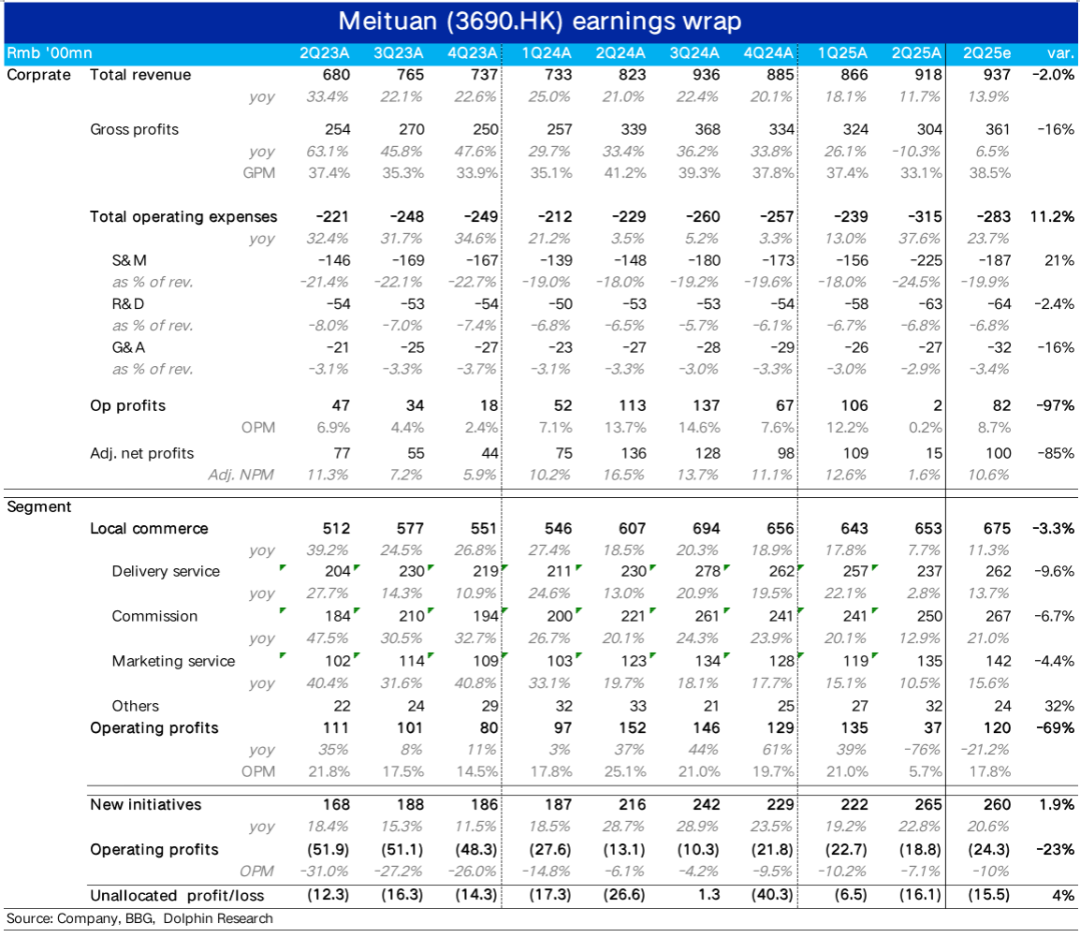
Core Viewpoint - Meituan's Q2 earnings report reveals a significant decline in profitability, with operating profit dropping to only 2 million RMB, far below market expectations, primarily due to the intense competition in the food delivery sector [1][17][21]. Group 1: Impact of Subsidies and Revenue Decline - Delivery revenue growth plummeted to just 2.8% year-on-year, significantly lower than expected, primarily due to increased subsidies affecting delivery income [2][44]. - The average net delivery income per order is estimated to have decreased by over 1 RMB compared to the previous quarter [3][45]. - The surge in subsidies has led to a substantial increase in rider delivery costs, contributing to a notable decline in gross margin [4][64]. Group 2: Local Commerce and In-store Business Performance - Local commerce commission and advertising revenue growth slowed significantly, with increases of only 13% and 10.5% respectively, both below market expectations [5][48]. - The interdependence between delivery and in-store consumption has resulted in negative impacts on both core business areas due to the ongoing "delivery war" [6][51]. - Total revenue for core local commerce reached approximately 653 billion RMB, a year-on-year increase of 7.7%, but fell short of Bloomberg's consensus forecast by about 2.2 billion RMB [53]. Group 3: Profitability and Cost Structure - The core local commerce segment's operating profit was only 3.7 billion RMB, indicating a significant loss in the delivery and flash purchase segments, estimated at over 1 billion RMB [8][61]. - The overall gross margin for the quarter was just 33.1%, down 8 percentage points year-on-year, leading to a gross profit of 304 billion RMB, which is a decrease of 35 billion RMB compared to the previous year [13][64]. - Marketing expenses surged to 22.5 billion RMB, an increase of 7.7 billion RMB year-on-year, driven by intense competition and increased user subsidies [15][67]. Group 4: New Initiatives and Future Outlook - Revenue from innovative businesses reached 26.5 billion RMB, with a year-on-year growth rate of 23%, primarily driven by the overseas Keeta business and adjustments in the Meituan Preferred model [10][54]. - Despite the revenue growth in new initiatives, losses have unexpectedly decreased, indicating a strategic shift to focus resources on core business areas amid fierce competition [12][60]. - The outlook for Q3 suggests that losses may escalate further as competition intensifies with the entry of Taobao Flash Purchase into the market [22][28].


美团CEO王兴:巴西市场竞争格局复杂,不会仓促行动,Keeta目标“10年内实现1000亿美元GMV”
Mei Ri Jing Ji Xin Wen· 2025-08-27 13:48
Core Insights - Meituan's CEO expressed optimism about the potential of the Brazilian market, highlighting its position as one of the top five global markets in terms of gross merchandise volume (GMV) for food delivery [1] - The company is conducting preliminary research in Brazil and has established a small local team to prepare for market entry, emphasizing a cautious approach due to the complex competitive landscape [1] - Meituan has set an ambitious long-term goal for its subsidiary Keeta, aiming to achieve a GMV of $100 billion within ten years, starting from May 2023 [1]
将全面取消!美团宣布→
Sou Hu Cai Jing· 2025-08-27 13:40
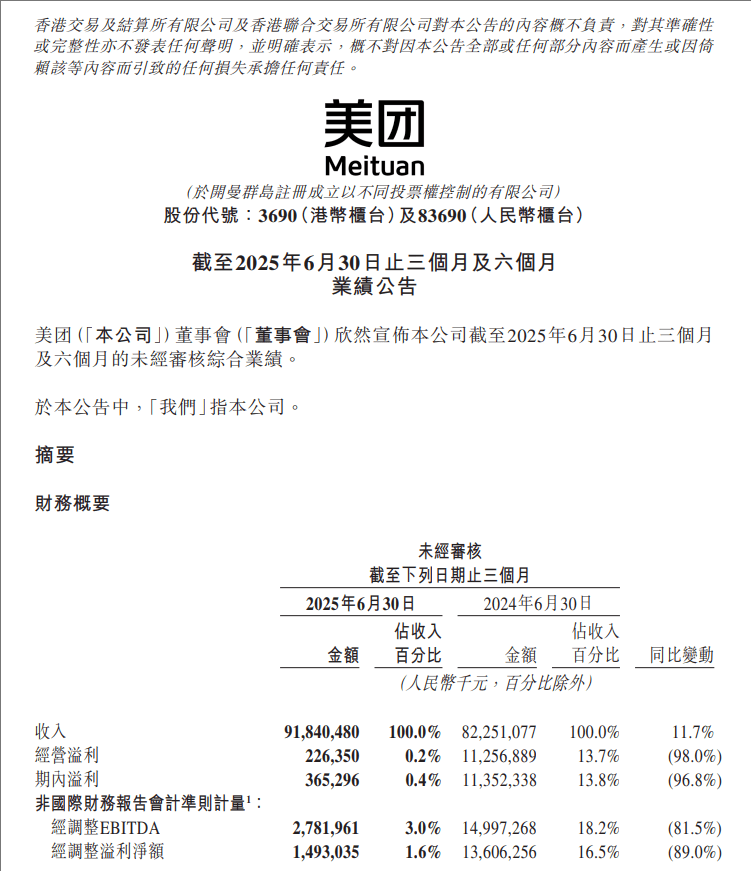
Group 1 - The core point of the news is that Meituan plans to eliminate "overdue penalties" for delivery riders by the end of 2025, which has sparked significant discussion among netizens [1] - Meituan has implemented the "Rider-Friendly Community" initiative to address the issue of riders facing difficulties entering residential areas, with over 24,700 communities in 150 cities modified to facilitate quick access for riders [1] - As of July 1, Meituan has fully paid for "work injury insurance" for all riders in 17 provinces and cities, and plans to extend pension insurance subsidies to riders nationwide by the end of this year, benefiting over one million riders [1] Group 2 - In the second quarter of 2025, Meituan reported revenue of 91.84 billion RMB, a year-on-year increase of 11.7% from 82.25 billion RMB in the same period of 2024 [3] - The operating profit for the core local commerce segment significantly declined to 3.7 billion RMB due to intense competition in the food delivery industry [3] - The adjusted EBITDA and adjusted net profit for the second quarter of 2025 decreased to 2.8 billion RMB and 1.5 billion RMB, respectively, reflecting a decline of 81.5% and 89.0% year-on-year [3]
美团CEO王兴电话会谈外卖竞争:一切花里胡哨后会回归本质
Di Yi Cai Jing· 2025-08-27 13:33
Group 1 - The core viewpoint of the article emphasizes that true incremental demand relies not only on subsidies but also on supply-side optimization and the cultivation of consumer mindset and habits [1][3] - In Q2, Meituan reported revenue of 91.84 billion yuan, a year-on-year increase of 11.7%, while adjusted net profit fell by 89% to 1.49 billion yuan [1] - CEO Wang Xing stated that Meituan opposes internal competition but acknowledges the ongoing fierce competition in the takeaway market, asserting that the company will continue to defend its market position [1][3] Group 2 - Meituan has seen significant growth in the lower-tier markets for instant retail, with a year-on-year increase of 50%, and plans to enhance differentiated supply and expand categories [3] - The company prioritizes growth over profitability to maintain its leading position, although subsidies are expected to decrease over time [3] - Meituan's international expansion has made notable progress, with strong growth in order volume and GTV for its Keeta platform, and the company is optimistic about entering the Brazilian market [4][5]

外卖大战烧钱超预期? 美团经调整净利润下滑89%
2 1 Shi Ji Jing Ji Bao Dao· 2025-08-27 12:53
Core Insights - Meituan reported a revenue of 91.8 billion RMB for Q2 2025, representing a year-on-year growth of 11.7%, but adjusted net profit fell by 89% to 1.49 billion RMB due to "irrational competition" starting in the quarter [1] - The core local commerce segment saw a significant decline, with operating profit dropping from 15.2 billion RMB in Q2 2024 to 3.7 billion RMB in Q2 2025, a decrease of 75.6%, and operating profit margin falling from 25.1% to 5.7% [1] - The increase in sales and marketing expenses, which rose by 51.5% year-on-year to an additional 7.7 billion RMB, reflects the intense competition in the food delivery and instant retail sectors [1] Industry Context - The competitive landscape in the food delivery market has intensified, leading to significant profit declines across major players, with JD's net profit halving and Meituan's net profit dropping by 89% [2] - Market attention is focused on Alibaba's upcoming Q2 financial results, as the industry anticipates how it will respond to the ongoing competitive pressures [2]
美团官宣,将全面取消
Xin Lang Cai Jing· 2025-08-27 12:33
Group 1 - Meituan announced the complete cancellation of the "overtime penalty" for delivery riders by the end of 2025, addressing a major concern among the crowd-sourced riders [1] - The company has implemented a new system called "Anzhun Card" to replace the previous penalty system, which has been piloted in 22 cities and received positive feedback from riders and the public [1][2] - Meituan is shifting its management approach from punitive measures to positive incentives, focusing on training and learning instead of solely penalizing riders [1] Group 2 - The company has introduced fatigue prevention measures, including pop-up reminders after 8 hours of work and mandatory offline after 12 hours, with 18% of riders triggering the 8-hour reminder [2] - Meituan has launched a "safety score" system in over 100 cities to improve traffic safety among riders, resulting in a 26% reduction in traffic violations [2] - The company plans to enhance the reporting and appeal processes for riders using AI to improve efficiency and quality in problem resolution [2] Group 3 - In Q2, Meituan reported revenue of approximately 91.84 billion yuan, an increase of 11.7% year-on-year, while adjusted net profit decreased by 89% to approximately 1.493 billion yuan [3] - The core local commerce segment saw a revenue increase of 7.7% to 65.3 billion yuan, but operating profit dropped by 75.6% to 3.7 billion yuan due to irrational competition [3] - New business revenue grew by 22.8% to 26.5 billion yuan, with operating losses expanding by 43.1% to 1.9 billion yuan, although the operating loss rate improved by 3.1 percentage points [3]
王兴电话会谈外卖竞争:坚决反对内卷,坚持做正确的事
Xin Lang Ke Ji· 2025-08-27 12:26
Core Viewpoint - Meituan's CEO Wang Xing emphasized the company's commitment to maintaining its market position amidst increasing competition in the food delivery sector, stating that the company firmly opposes "involution" and will continue to focus on providing quality supply, stable fulfillment, and reasonable pricing to enhance user experience [1] Group 1: Company Strategy - Meituan has grown and solidified its leading position through intense competition over the years, focusing on doing the right things regardless of market changes [1] - The company prioritizes essential operations, ensuring fast and reliable fulfillment while maintaining affordable prices for consumers [1] - Meituan aims to build a long-term ecosystem that benefits consumers, merchants, and delivery riders [1]
美团这下脑袋瓜子嗡嗡的吧
Sou Hu Cai Jing· 2025-08-27 12:06
Core Viewpoint - Meituan's recent Q2 financial report indicates a significant decline in net profit, highlighting the intense competition in the food delivery market, particularly from JD and Alibaba, which has led to a drastic reduction in profitability despite a modest revenue growth [1][4][8]. Financial Performance - In Q2, Meituan reported revenue of 91.84 billion RMB, a year-on-year increase of 11.7% [1][3]. - Adjusted net profit fell to 1.49 billion RMB, a staggering 89% decrease compared to the previous year, which was 13.6 billion RMB [1][3]. - The operating profit for the core local business dropped from 152 billion RMB in the previous year to 37 billion RMB, with the operating profit margin plummeting from 25.1% to 5.7% [12]. Market Competition - The competition from JD and Alibaba has intensified, leading to what Meituan describes as "irrational competition," which has severely impacted its growth trajectory [8][12]. - Meituan's market share in the food delivery sector has decreased from over 70% to approximately 44%, while Ele.me (Taobao Flash Sale) has gained ground, reaching a market share of 44.5% [13][14]. Strategic Response - In response to the competitive pressure, Meituan has initiated aggressive subsidy campaigns to retain market share, resulting in a significant increase in order volume, with a record of 1.5 billion orders in a single day [12]. - The company is expected to incur even higher costs in Q3 as it continues to engage in this competitive battle, indicating a challenging outlook ahead [12].
美团电话会:预计短期内激烈竞争仍将持续
Hua Er Jie Jian Wen· 2025-08-27 11:53
Core Insights - Meituan's profitability has been significantly impacted amid fierce competition in the food delivery market, with adjusted net profit in Q2 dropping nearly 90% year-on-year, falling far below market expectations [1] Group 1: Financial Performance - The adjusted net profit for Meituan in Q2 experienced a substantial decline of nearly 90% compared to the same period last year [1] - The financial results were significantly lower than what the market had anticipated [1] Group 2: Market Competition - Management has warned during the earnings call that intense competition in the food delivery sector is expected to persist in the short term [1]
美团发布Q2财报:营收增长,盈利承压
Guan Cha Zhe Wang· 2025-08-27 11:45
Core Viewpoint - Meituan reported a steady revenue growth in Q2 2025, but faced significant declines in operating and net profits due to intense market competition [1][2] Group 1: Financial Performance - In Q2 2025, Meituan's revenue increased by 11.7% year-on-year to 91.8 billion yuan [1] - Operating profit fell to 226 million yuan, a 98% decline year-on-year [1] - Adjusted net profit decreased by 89% year-on-year to 1.493 billion yuan [1] - Sales costs rose by 27.0% year-on-year to 61.4 billion yuan, accounting for 66.9% of revenue, up from 58.8% [1] - Sales and marketing expenses surged by 51.8% year-on-year to 22.5 billion yuan, representing 24.5% of revenue, up from 18.0% [1] Group 2: Business Operations - Core local commerce revenue reached 65.3 billion yuan, growing by 7.7% year-on-year [1] - Monthly active users of Meituan's app exceeded 500 million, with annual transaction frequency hitting a historical high [1] - During the "618" shopping festival, Meituan supported nearly one million physical stores, serving over 100 million users [2] - High-ticket item sales on the platform doubled, and daily order volume for instant retail peaked at over 150 million in July [2] - The dine-in business saw order volume grow by over 40% year-on-year, with active merchant numbers reaching a new high [2] Group 3: International Expansion and Future Outlook - Meituan's international operations saw growth, with Keeta's order volume and GTV continuing to rise [2] - Keeta solidified its leading position in Hong Kong and expanded to 20 cities in Saudi Arabia, with services recently launched in Qatar [2] - CEO Wang Xing emphasized the importance of balancing market share and profitability amid increasing competition, while focusing on technological innovation and ecosystem development [2]
