
贵金属

Search documents
4天连破6道整百关口,现货黄金涨破5500美元,金饰克价首次站上1700元
Feng Huang Wang· 2026-01-29 04:07
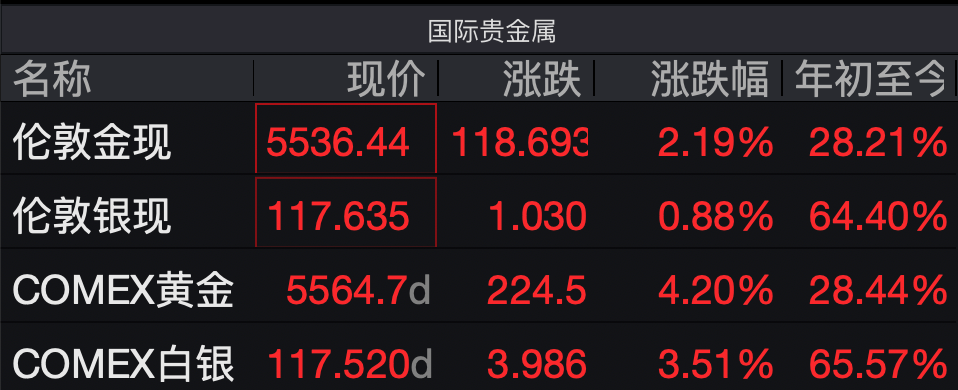
1月的最后一个交易周,金价加速狂飙,在短短4个交易日内,连破6道整百关口! 1月29日早间,国际黄金市场再度迎来历史性突破。其中现货黄金(伦敦金现)逼近5600美元/盎司,最高上探至5598.75美元/盎司,日内 涨逾3%,年初至今已涨超28%,涨逾1200美元。 截至发稿,报5536.44美元/盎司,涨2.19%。 值得注意的是,现货黄金价格在1月26日至1月29日的4个交易日中,已连破5000、5100、5200、5300、5400、5500这6道整百关口。 COMEX黄金则在1月29日盘中已率先突破5600美元,达5626.8美元/盎司。 | 国际贵金属 | | --- | | 名称 现价 涨跌 涨跌幅 年初至今 | | 伦敦金现 5536.44 118.693 2.19% 28.21% | | 伦敦银现 | | COMEX黄金 5564.7d 224.5 4.20% 28.44% | | COMEX白银 117.520d 3.986 3.51% 65.57% | 国内品牌金饰价格也进一步攀升至历史新高,站上1700元/克。老凤祥黄金足金饰品报价1713元/克,单日上涨93元/克;周生生金饰价格 为17 ...

A股午评:科创50指数跌超1% AI应用端、资源股持续活跃
2 1 Shi Ji Jing Ji Bao Dao· 2026-01-29 04:04
南方财经1月29日电,三大指数盘中集体翻绿,沪指窄幅震荡,创业板指冲高回落,科创50指数跌超 1%。截至收盘,沪指跌0.1%,深成指涨0.01%,创业板指跌0.05%。沪深两市半日成交额2.02万亿,较 上个交易日放量1039亿。盘面上热点快速轮动,全市场超2800只个股下跌。从板块来看,贵金属概念反 复活跃,西部黄金7天4板,中国黄金5连板,湖南黄金4连板。油气股延续强势,通源石油涨超10%。AI 应用概念表现活跃,浙文互联8天4板,因赛集团、粤传媒涨停。银行板块持续走高,青岛银行涨停。房 地产板块震荡反弹,大悦城、三湘印象、我爱我家涨停。下跌方面,半导体产业链走势较弱,北京君 正、神工股份跌超6%。 相关快讯 A股午评:科创50指数跌超1% AI应用端、资源股持续活跃 21世纪经济报道 21快讯 2026-01-29 11:33 南方财经1月29日电,三大指数盘中集体翻绿,沪指窄幅震荡,创业板指冲高回落,科创50指数跌超 1%。截至收盘,沪指跌0.1%,深成指涨0.01%,创业板指跌0.05%。沪深两市半日成交额2.02万亿,较 上个交易日放量1039亿。盘面上热点快速轮动,全市场超2800只个股下跌。从 ...
泰国“锁死”国内黄金交易沪金飙涨
Jin Tou Wang· 2026-01-29 04:02
Group 1 - The Bank of Thailand has tightened regulations on gold trading, reducing the daily limit for online transactions to 50 million THB and banning short selling to address the appreciation pressure on the Thai Baht [2] - The Thai Baht has reached its highest level since March 2021, appreciating 9% cumulatively in 2025 and an additional 1% in 2026, which negatively impacts export competitiveness and increases costs for tourists [2] - Thailand is the seventh-largest gold trading market globally and the largest in ASEAN, with daily trading exceeding 50 billion THB, where 65% of transactions are conducted online in THB, making it crucial for exchange rate management [2] Group 2 - The new regulations aim to stabilize the exchange rate and protect exports while also preventing risks associated with speculative trading on online platforms, which could lead to price volatility and cross-border capital risks [3] - Experts predict that some short-term funds from Southeast Asia may shift to New York and London gold markets, potentially increasing volatility in the international precious metals market [3] Group 3 - The Shanghai gold futures market has shown strong performance, with the main contract AU2606 breaking through 1240 CNY per gram, closing at 1196.80 CNY per gram, marking a daily increase of over 3% and reaching a historical high [4] - The price has consistently remained above the 5-day and 20-day moving averages, with significant volume increases, indicating sustained bullish momentum [4] - The technical analysis suggests a continuation of the upward trend, with key resistance at 1250 CNY per gram and support at 1180 CNY per gram [4]
午间涨跌停股分析:49只涨停股、14只跌停股,贵金属板块活跃,白银有色8连板
Xin Lang Cai Jing· 2026-01-29 03:53
Group 1 - A-shares saw 49 stocks hitting the daily limit up and 14 stocks hitting the daily limit down during the first half of the trading day on January 29 [1] - The precious metals sector was active, with silver-related stocks achieving an 8-day consecutive limit up, and Western Gold reaching 4 limit ups in 7 days [1] - The short drama concept gained strength, with Tian Di Online achieving 5 limit ups in 9 days, and Hengdian Film and Television, Guangdong Media also hitting the limit up [1] Group 2 - Among the consecutive limit up stocks, China Gold achieved 5 consecutive limit ups, Zhejiang Wenhu Interconnection reached 4 limit ups in 8 days, and Jinchen Co. had 3 limit ups in 5 days [1] - Several stocks faced consecutive limit downs, including *ST Aowei with 15 consecutive limit downs, *ST Wanfang with 13 consecutive limit downs, and *ST Yanshi with 4 consecutive limit downs [1] - Other stocks like *ST Dongjing and ST Yingfeitop experienced 3 consecutive limit downs, while *ST Sailong and others faced 2 consecutive limit downs [1]


午评:沪指半日跌0.1% 贵金属板块走强
Zhong Guo Jing Ji Wang· 2026-01-29 03:46
Core Viewpoint - The A-share market showed mixed performance in early trading, with the Shanghai Composite Index slightly declining while the Shenzhen Component Index experienced a marginal increase [1]. Market Performance - As of the midday close, the Shanghai Composite Index was at 4147.15 points, down by 0.10% - The Shenzhen Component Index stood at 14344.96 points, up by 0.01% - The ChiNext Index reported a decline of 0.05%, closing at 3322.00 points [1]. Sector Performance Top Performing Sectors - Precious Metals: Increased by 7.28%, with a total trading volume of 1454.32 million hands and a net inflow of 542.70 million yuan - Cultural Media: Rose by 4.54%, with a trading volume of 5188.46 million hands and a net inflow of 819.58 million yuan - Oil and Gas Extraction and Services: Gained 3.13%, with a trading volume of 2916.06 million hands and a net inflow of 223.11 million yuan [2]. Underperforming Sectors - Electronic Chemicals: Decreased by 1.81%, with a trading volume of 514.94 million hands and a net outflow of 11.54 million yuan - Components: Fell by 1.52%, with a trading volume of 733.32 million hands and a net outflow of 29.22 million yuan - Non-metallic Materials: Declined by 1.26%, with a trading volume of 90.45 million hands and a net outflow of 1.70 million yuan [2].
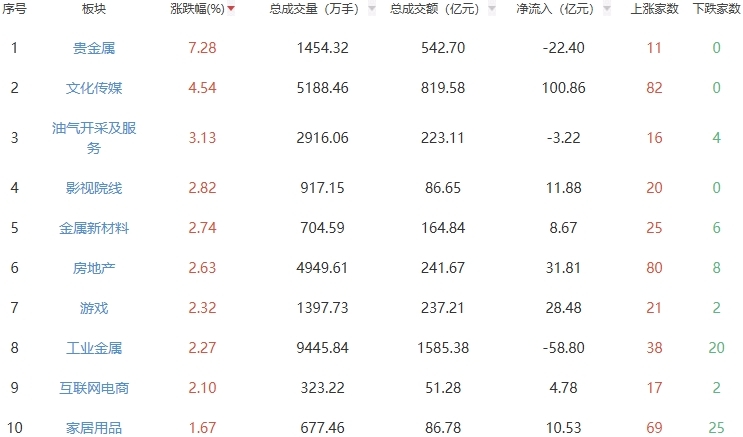
1月29日沪指半日跌0.1%,创业板指跌0.05%,贵金属涨幅居前
Sou Hu Cai Jing· 2026-01-29 03:44
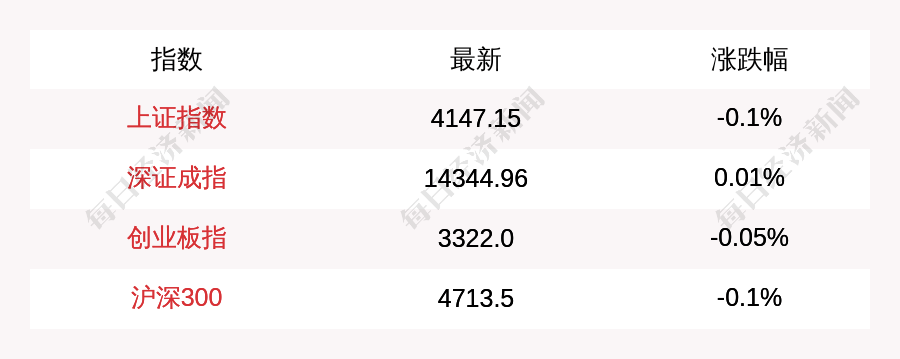
Market Overview - The Shanghai Composite Index decreased by 4.09 points, a decline of 0.1%, closing at 4147.15 points with a trading volume of 904.204 billion [1] - The Shenzhen Component Index increased by 2.07 points, a rise of 0.01%, closing at 14344.96 points with a trading volume of 1112.338 billion [1] - The ChiNext Index fell by 1.56 points, a decrease of 0.05%, closing at 3322.0 points with a trading volume of 512.53 billion [1] - The CSI 300 Index dropped by 4.49 points, a decline of 0.1%, closing at 4713.5 points with a trading volume of 531.63 billion [1] Industry Performance - The top five performing industries were: - Precious Metals with a rise of 7.29% - Cultural Media with an increase of 4.19% - Mining Industry up by 3.23% - Real Estate Services up by 2.92% - Real Estate Development up by 2.15% [1] - The industries with the largest declines included: - Electronic Chemicals down by 1.69% - Power Equipment down by 1.28% - Grid Equipment down by 1.19% - Wind Power Equipment down by 1.14% [1]

午评:科创50指数半日跌超1%,AI应用端、资源股持续活跃
Feng Huang Wang· 2026-01-29 03:43
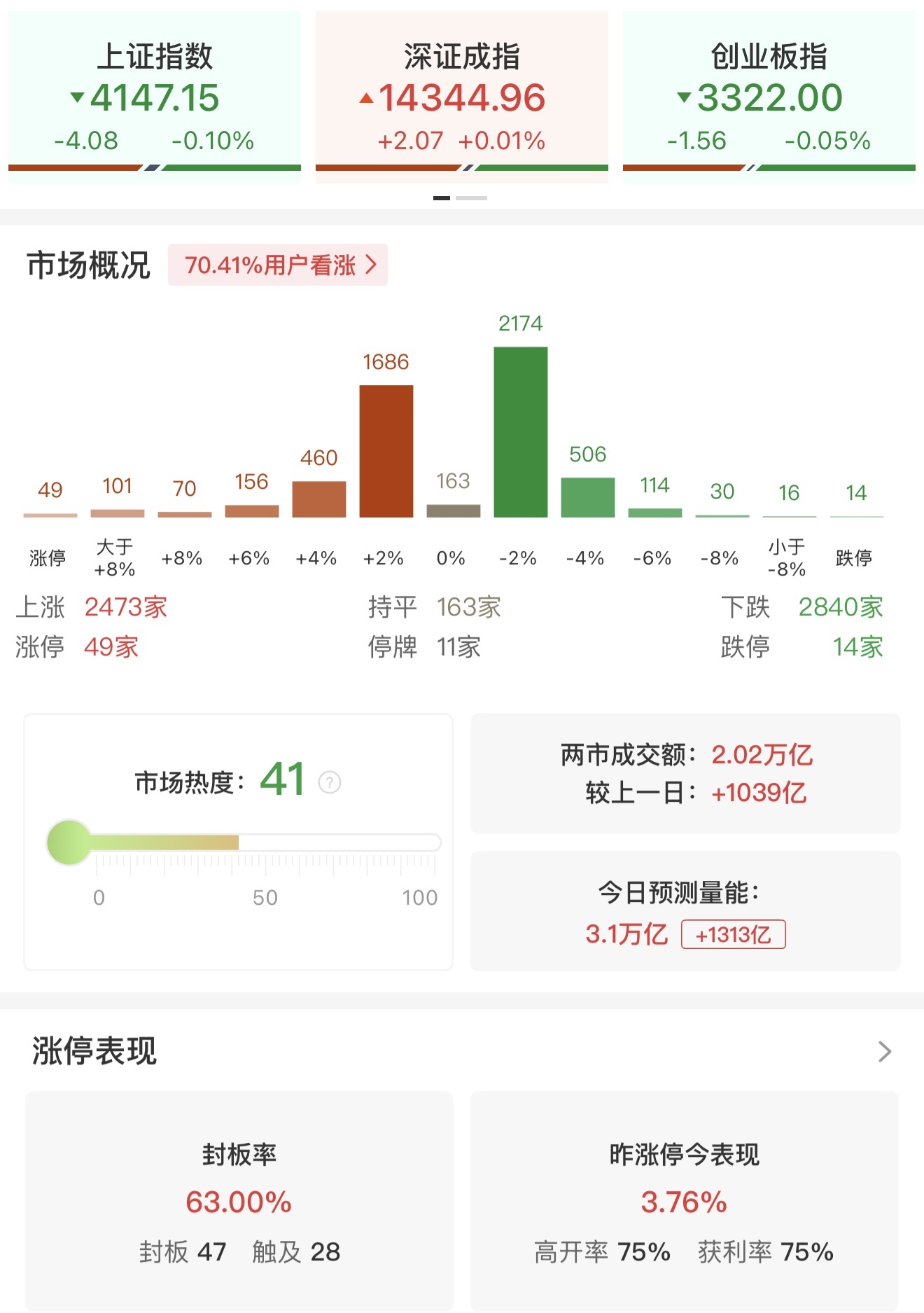
Market Overview - The three major indices turned negative during the session, with the Shanghai Composite Index experiencing narrow fluctuations, the ChiNext Index rising and then falling, and the Sci-Tech 50 Index dropping over 1% [1] - The total trading volume in the Shanghai and Shenzhen markets reached 2.02 trillion yuan, an increase of 103.9 billion yuan compared to the previous trading day [1] - Over 2,800 stocks in the market declined, indicating a broad market downturn [1] Sector Performance - Precious metals sector showed repeated activity, with Western Gold achieving four consecutive daily limits, China Gold with five consecutive limits, and Hunan Gold with four consecutive limits [1] - Oil and gas stocks continued to perform strongly, with Tongyuan Petroleum rising over 10% [1] - AI application concepts were active, with Zhejiang Wenlian achieving four limits in eight days, and companies like Yinsai Group and Yue Media hitting the daily limit [1] - The banking sector saw sustained growth, with Qingdao Bank hitting the daily limit [1] - The real estate sector experienced a rebound, with stocks like Dayue City, Sanxiang Impression, and I Love My Home hitting the daily limit [1] - The semiconductor industry chain showed weak performance, with Beijing Junzheng and Shenkong shares dropping over 6% [1] Trading Metrics - The limit-up performance rate was 63.00%, with 47 stocks hitting the limit and 28 stocks touching the limit [4] - The limit-up performance from the previous day was 3.76%, with a high opening rate of 75% [4]
沪指半日跌0.1% AI应用端持续活跃
Sou Hu Cai Jing· 2026-01-29 03:41
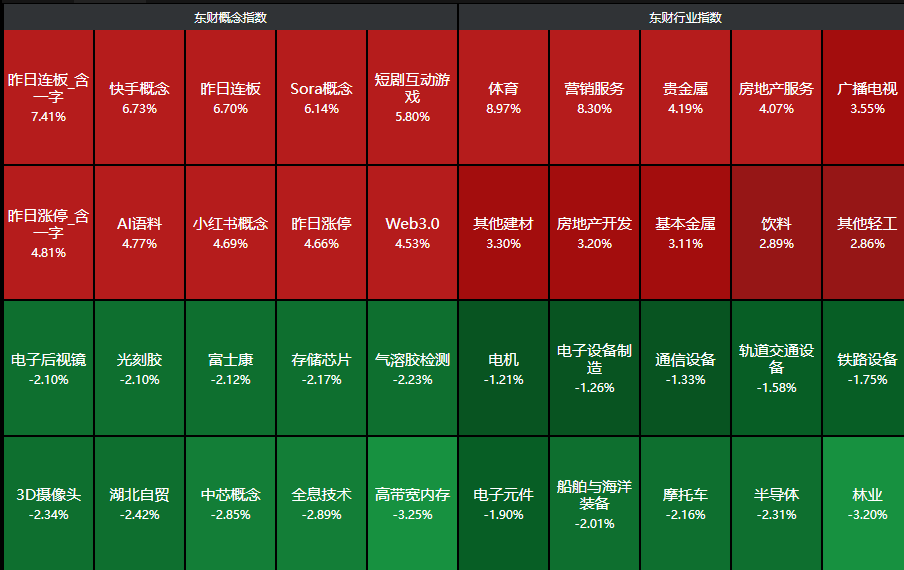
Market Overview - The Shanghai Composite Index experienced a slight decline of 0.1% while the Shenzhen Component Index increased by 0.01% and the ChiNext Index fell by 0.05% during the morning session on January 29 [1] - The AI application sector remained active, with companies like Sai Group and Zhejiang Wenlian hitting the daily limit up [1] - The precious metals sector showed strength, with China Gold achieving five consecutive limit ups and Hunan Gold four consecutive limit ups [1] - The basic metals sector saw fluctuations, with Silver Nonferrous achieving eight consecutive limit ups and companies like Yiqiu Resources also hitting the daily limit up [1] - The real estate sector experienced a rally, with companies like Shen Shen Fang A reaching the daily limit up [1] - Sectors that faced declines included forestry and semiconductors, which had the largest drops [1] Sector Performance - The East Finance Concept Index showed significant gains in various sectors, with the marketing services sector leading at 8.97% [2] - Other notable sectors included the short drama interactive gaming sector at 6.14% and the real estate service sector at 4.19% [2] - Conversely, the electronics sector, including components like electronic rearview mirrors and storage chips, faced declines ranging from -2.10% to -3.25% [2]
黄金白银的“沸腾”行情分析师都看不懂:贵金属市场逻辑已“崩坏”?
Xin Lang Cai Jing· 2026-01-29 03:35
Core Viewpoint - The price of gold has surged past $5,500 per ounce, reaching a historical high, while silver has also seen significant gains, indicating a broader rally in precious metals driven by geopolitical tensions, rising government debt, and uncertainty in interest rates and currencies [3][9]. Group 1: Gold and Silver Price Movements - Gold has continued its upward trend, breaking the $5,500 mark, with silver also experiencing a notable increase, surpassing $117 per ounce, reflecting a year-to-date rise of nearly 65% [3][9]. - Analysts attribute the demand for these metals to investors seeking refuge from geopolitical risks and economic uncertainties, with central bank purchases providing additional support for gold prices [3][9]. Group 2: Market Dynamics and Influences - The recent price increases in precious metals are seen as being less influenced by physical supply and demand, and more by unstable liquidity flows, leading to extreme price volatility [4][10]. - The dollar index has decreased by nearly 11% over the past 12 months, contributing to the rise in gold prices as it is perceived as a currency [11]. Group 3: Speculative Capital and Market Behavior - The influx of speculative capital into the precious metals market has distorted price behavior, with relatively small inflows causing significant price increases, detaching prices from traditional supply-demand dynamics [13]. - Analysts warn that the current price levels may not be sustainable, as the physical supply of metals cannot quickly adjust to meet the surging demand, potentially leading to a sharp reversal if liquidity dries up [13].

资讯早班车-2026-01-29-20260129
Bao Cheng Qi Huo· 2026-01-29 02:27
1. Report Industry Investment Rating No relevant content provided. 2. Core Viewpoints of the Report - The Fed maintained the benchmark interest rate at 3.50%-3.75%, pausing after three consecutive 25-basis-point rate cuts, in line with market expectations. The unemployment rate has shown initial signs of stabilizing, inflation remains relatively high, and economic prospects are still highly uncertain [4][13]. - The prices of precious metals and non-ferrous metals have continued to surge, with gold and silver hitting new highs. The gold recycling business has boomed, and the scale of gold-themed funds has grown significantly [5][6]. - The A-share market has seen resource stocks rally, while the photovoltaic industry chain has adjusted. The Hong Kong stock market has also risen, with the Hang Seng Index hitting a new high since August 2021 [31]. 3. Summary by Directory 3.1 Macro Data Overview - GDP growth in Q4 2025 was 4.5% year-on-year, down from 4.8% in the previous quarter and 5.4% in the same period last year [1]. - The manufacturing PMI in December 2025 was 50.1%, up from 49.8% in the previous month and the same as the same period last year [1]. - The non-manufacturing PMI in December 2025 was 50.2%, up from 50.0% in the previous month but down from 52.2% in the same period last year [1]. - Social financing in December 2025 was 2.2075 trillion yuan, down from 3.5299 trillion yuan in the previous month and 2.8537 trillion yuan in the same period last year [1]. - The year-on-year growth rates of M0, M1, and M2 in December 2025 were 10.2%, 3.8%, and 8.5% respectively [1]. - New RMB loans in December 2025 were 910 billion yuan, down from 1.29 trillion yuan in the previous month and 990 billion yuan in the same period last year [1]. - The CPI in December 2025 increased by 0.8% year-on-year, up from -0.3% in the previous month and 0.1% in the same period last year [1]. - The PPI in December 2025 decreased by 1.9% year-on-year, narrowing from -2.3% in the previous month and the same period last year [1]. - Fixed asset investment in 2025 decreased by 3.8% year-on-year, down from -0.5% in the previous period and 3.2% in the same period last year [1]. - Retail sales of consumer goods in 2025 increased by 3.7% year-on-year, down from 4.5% in the previous period but up from 3.5% in the same period last year [1]. - Exports in December 2025 increased by 6.6% year-on-year, down from 8.2% in the previous month and 10.67% in the same period last year [1]. - Imports in December 2025 increased by 5.7% year-on-year, down from 7.4% in the previous month but up from 0.84% in the same period last year [1]. 3.2 Commodity Investment Reference 3.2.1 Comprehensive - Futures exchanges have tightened risk control. The Shanghai Gold Exchange will adjust the margin level of the Ag(T+D) contract to 20% and the daily limit to 19% from the close of trading on January 30 [2]. - The Shanghai Futures Exchange will adjust the daily limit and margin ratio of nickel and other futures contracts from the close of trading on January 30 [2]. - The Chicago Mercantile Exchange has raised the margin requirements for silver, platinum, and palladium [2]. - On January 28, 32 domestic commodity varieties had positive basis, and 36 had negative basis. The basis of Shanghai nickel, live pigs, and eggs was the largest, while that of Shanghai tin, butadiene rubber, and international copper was the smallest [3]. - The Guotou Silver LOF will be suspended from trading from 9:30 to 10:30 on January 29, 2026. If the premium rate of its secondary market trading price does not effectively decline, the fund has the right to take measures such as applying for intraday suspension or extending the suspension time to alert the market to risks [3]. 3.2.2 Metals - On January 29, spot silver and New York silver futures exceeded $119 per ounce, hitting new highs. Spot gold fell below $5,500, dropping more than $100 in the short term. Palladium futures exceeded $2,100 per ounce, rising 11.67% intraday [5]. - On January 28, most London base metals rose. The Fed's decision to keep interest rates unchanged has affected global liquidity expectations, and the long-term demand logic of base metals is being re-evaluated [5]. - The prices of precious metals and non-ferrous metals have continued to surge. On January 28, the gold futures price on the New York Mercantile Exchange exceeded $5,400 per ounce, and the domestic gold futures price approached 1,200 yuan per gram. The precious metals and non-ferrous metals sectors in the A-share market have seen a wave of limit-up stocks [5]. - The gold recycling business has boomed. The scale of gold-themed funds has grown significantly, with the total scale of 53 gold-themed funds approaching 380 billion yuan as of January 28, an increase of nearly 100 billion yuan from the end of last year, a rise of 35.7% [6]. - Russia's Norilsk Nickel expects its nickel production in 2026 to be between 19,300 and 20,300 tons and its palladium production to be between 2.415 and 2.465 million ounces [7]. - As of January 27, lead inventory decreased by 2,000 tons to 209,175 tons; copper inventory increased by 1,575 tons to 173,925 tons, hitting a new high in more than eight months; aluminum inventory decreased by 2,275 tons to 499,975 tons; tin inventory decreased by 25 tons to 7,060 tons; nickel inventory increased by 612 tons to 286,338 tons, hitting a new high in more than seven years and seven months; zinc inventory decreased by 175 tons to 110,375 tons; aluminum alloy inventory remained stable at 1,500 tons, the lowest level in more than four years and ten months; and cobalt inventory remained stable at 121 tons, the lowest level in more than one year and three months [7]. 3.2.3 Coal, Coke, Steel, and Minerals - The EU and Vietnam are expected to deepen cooperation on critical minerals and semiconductors [8]. 3.2.4 Energy and Chemicals - The main contract of U.S. crude oil closed higher. Trump warned Iran to reach an agreement as soon as possible, and U.S. crude oil inventories decreased by 2.295 million barrels last week, more than expected, supporting oil prices [9]. - U.S. Treasury Secretary Bezant said that an increase in Venezuelan crude oil supply means a decrease in natural gas prices [10]. 3.2.5 Agricultural Products - The Ministry of Agriculture and Rural Affairs has deployed work to stabilize beef cattle production and accelerate the relief of the dairy industry. It emphasizes the need to implement relief support policies, stabilize basic production capacity, and promote the high-quality development of the industry [11]. 3.3 Financial News Compilation 3.3.1 Open Market - On January 28, the central bank conducted 377.5 billion yuan of 7-day reverse repurchase operations at a fixed interest rate of 1.40%, with a net investment of 1.4 billion yuan [12]. - On January 28, the Ministry of Finance and the central bank conducted a tender for the first-phase central treasury cash management commercial bank time deposit in 2026, with a winning amount of 150 billion yuan and a winning interest rate of 1.73% [12]. 3.3.2 Important News - The Fed maintained the benchmark interest rate at 3.50%-3.75%, pausing after three consecutive 25-basis-point rate cuts, in line with market expectations. The unemployment rate has shown initial signs of stabilizing, inflation remains relatively high, and economic prospects are still highly uncertain [4][13]. - The "report card" of central state-owned enterprises in 2025 was released. By the end of 2025, the total assets of central state-owned enterprises exceeded 95 trillion yuan, and the total profit in 2025 was 2.5 trillion yuan. The State-owned Assets Supervision and Administration Commission of the State Council will promote the establishment of new central state-owned enterprises and strategic reorganizations and is drafting a document on promoting the cultivation of emerging pillar industries by central state-owned enterprises [13]. - The National Tax Work Conference emphasized the need to strengthen the standardization of tax incentives. During the 14th Five-Year Plan period, the tax department collected more than 156 trillion yuan in taxes and fees, accounting for about 80% of the full-caliber fiscal revenue, and provided more than 10 trillion yuan in tax cuts, fee reductions, and tax refunds [14][15]. - China will host the first senior officials' meeting and related meetings of APEC in Guangzhou from February 1 to 10, 2026 [15]. - The 2026 National Population and Family Development Work Conference emphasized the need to optimize fertility support policies and incentives, promote a positive marriage and childbearing concept, and develop inclusive childcare services [15]. - The "report cards" of China's economic provinces in 2025 were released. Guangdong and Jiangsu both exceeded 14 trillion yuan in GDP, and Shandong became the third province with a GDP exceeding 10 trillion yuan [15]. - Nearly 60% of surveyed U.S. companies plan to increase their investment in China, more than half of the surveyed companies expect to make a profit or a significant profit in 2025, and more than 70% of the companies have not considered moving their production or procurement links outside China [15]. - Many real estate companies have confirmed that they are no longer required by regulatory authorities to report the "three red lines" indicators monthly. However, some troubled real estate companies are still required to report financial indicators such as asset - liability ratios to the special team in their headquarters cities regularly [16]. - In 2025, a total of 27,100 urban old communities and 4.99 million households were renovated, with a total investment of 133.2 billion yuan [16]. - With the decline in deposit interest rates and the maturity of a large number of high - interest fixed deposits, residents' deposits are flowing into the market. There is a trend of seeking "deposit alternatives" [16]. - As of the end of December 2025, the total scale of China's public funds reached 37.7 trillion yuan, a record high. The scale of bond funds increased by more than 410 billion yuan, and the scale of stock funds increased by more than 250 billion yuan [16][17]. - Qinghai Province plans to actively resolve local debt risks and exit the list of key provinces for local debt [17]. - The Hong Kong branch of the China Development Bank successfully issued 5.5 billion yuan of RMB public bonds in the Macao Special Administrative Region, including 3.5 billion yuan of 3 - year special bonds with an issue interest rate of 1.75% and 2 billion yuan of 5 - year special bonds with an issue interest rate of 1.85% [17]. - The Ministry of Finance announced the ranking of spot trading volumes of book - entry treasury bonds in 2025. Ping An Bank, Citic Securities, and Orient Securities ranked among the top three [18]. - Tianjin's bond market has achieved good development, with the issuance of Tianjin's science and technology innovation bonds reaching 12.811 billion yuan, a year - on - year increase of 27.7%, and the issuance of green bonds reaching 18.027 billion yuan, a year - on - year increase of 58.9% [18]. - The bid - to - cover ratio of Japan's 40 - year treasury bond auction reached 2.76, the highest level since March 2025, temporarily alleviating the tension in the bond market [18]. - The minutes of the Bank of Japan's meeting showed that if the outlook is in line with expectations, it is advisable to continue raising interest rates [19]. - There were a series of bond - related events, including equity transfers, bond redemptions, and credit rating changes [20]. 3.3.3 Bond Market Summary - The Chinese bond market warmed up in the afternoon, with the yields of interest - rate bonds generally declining. The 10 - year treasury bond yield reached 1.81%. Bond futures rose across the board, and the money market was stable with little price change. The bond market is expected to remain volatile in the short term [21]. - In the exchange bond market, Vanke's bonds performed strongly, while some other bonds declined. The CSI Convertible Bond Index rose 0.85%, and the money market interest rates mostly declined [22][23]. - The winning yields of Agricultural Development Bank's 1.0356 - year, 3 - year, and 10 - year financial bonds were 1.4720%, 1.6074%, and 1.9650% respectively. The winning yields of Export - Import Bank of China's 2 - year and 3 - year financial bonds were 1.5501% and 1.6044% respectively [24]. - The yields of European government bonds mostly declined, while the yields of U.S. Treasury bonds were mixed [24]. 3.3.4 Foreign Exchange Market - The on - shore RMB closed at 6.9453 against the U.S. dollar, up 123 basis points from the previous trading day. The central parity rate of the RMB against the U.S. dollar was 6.9755, up 103 basis points from the previous trading day [25]. - The U.S. dollar index rose 0.63% to 96.35 in New York trading. Non - U.S. currencies showed mixed performance [26]. 3.3.5 Research Report Highlights - CITIC Construction Investment's research shows that the pricing power of long - duration interest - rate bonds is concentrated in funds, while rural commercial banks are "passive" allocation players. Insurance companies have a small amount of pricing power in ultra - long - term treasury bonds, and large banks have more pricing power in short - duration treasury bonds. The change speed of bond fund duration is a better indicator for short - term timing [27]. - Guosheng Fixed Income believes that there is no need to be overly worried about the current deposit transfer. The transfer of corporate deposits has been occurring since April 2024, and the transfer of residents' deposits is not a major concern for now [27]. - CITIC Securities states that the U.S. private banking industry has a mature system, and the asset allocation of Chinese private banking is shifting from deposits and real estate to functional products and service - based architectures [28]. 3.4 Stock Market News - The A - share market fluctuated, with resource stocks surging and the photovoltaic industry chain adjusting. The Shanghai Composite Index rose 0.27%, the Shenzhen Component Index rose 0.09%, the ChiNext Index fell 0.57%, the North Star 50 Index fell 0.16%, and the Wind All - A Index rose 0.11%. The market turnover reached 2.99 trillion yuan [31]. - The Hang Seng Index rose 2.58% to 27,826.91, hitting a new high since August 2021. The Hang Seng Technology Index rose 2.53%, and the Hang Seng China Enterprises Index rose 2.89%. The precious metals, non - ferrous metals, and petroleum sectors led the gains. Mingming很忙, the "first stock in the bulk snack industry," rose 69% on its first day of listing. Southbound funds sold more than HK$3.4 billion, with net sales for four consecutive trading days [31].