通用设备

Search documents
川润股份:截至7月31日股东户数为80024户
Zheng Quan Ri Bao Wang· 2025-08-04 09:11
证券日报网讯川润股份(002272)8月4日在互动平台回答投资者提问时表示,截至2025年7月31日公司 股东户数为80024户。 ...

多领域上半年“成绩单”出炉 利好积聚经济“跃动”内生动力强劲
Yang Shi Wang· 2025-08-04 08:55
记者8月4日从中国机械工业联合会获悉,2025年上半年,我国机械工业经济运行稳中向好,产品产销平 稳增长,对外贸易展现韧性,创新活力加快释放,新质生产力积极发展,产业升级和高质量发展成效显 著。 2025年上半年,机械工业产业支柱地位稳固提升。截至6月末,机械工业规模以上企业数量达13.6万 家,较上年同期增加0.6万家,占全国工业的26.2%。 此外,上半年,机械工业规模以上企业增加值同比增长9.0%,增速高于全国工业和制造业2.6和2个百分 点,为稳定经济大盘、提振工业经济发挥积极作用。 不仅如此,机械工业主要涉及的5个国民经济行业大类增加值均实现同比增长。其中,汽车和电气机械 行业实现两位数增长,增速分别为11.3%和12.2%。通用设备、专用设备和仪器仪表行业增速分别为 8.3%、3.8%和7.6%。 罗俊杰表示,近期,工业和信息化部即将印发机械、汽车、电力装备等行业稳增长工作方案。着力提升 优质供给能力,优化行业发展环境,推动行业实现质的有效提升和量的合理增长。综合判断,预计下半 年,机械工业经济运行将延续稳中向好的总体态势,全年主要经济指标增速在5.5%左右,对外贸易保 持基本稳定。 国家税务总局 ...
通用设备板块8月4日涨2.99%,思林杰领涨,主力资金净流入21.76亿元
Zheng Xing Xing Ye Ri Bao· 2025-08-04 08:35
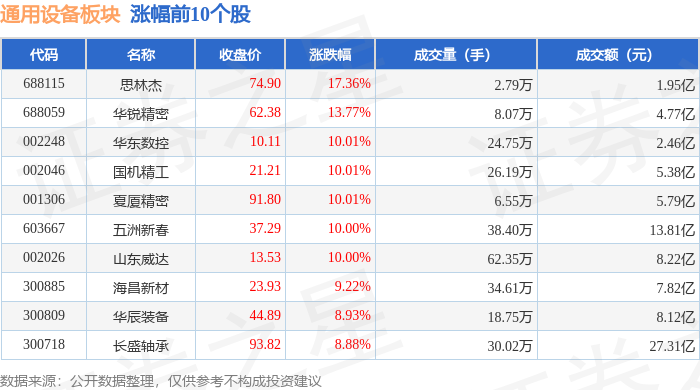
Market Performance - The general equipment sector increased by 2.99% on August 4, with Slinjet leading the gains [1] - The Shanghai Composite Index closed at 3583.31, up 0.66%, while the Shenzhen Component Index closed at 11041.56, up 0.46% [1] Top Gainers - Slinjet (688115) closed at 74.90, up 17.36% with a trading volume of 27,900 lots and a transaction value of 195 million [1] - Huarui Precision (688059) closed at 62.38, up 13.77% with a trading volume of 80,700 lots and a transaction value of 477 million [1] - Huadong CNC (002248) closed at 10.11, up 10.01% with a trading volume of 247,500 lots and a transaction value of 246 million [1] Top Losers - Jikang Technology (830879) closed at 30.23, down 4.85% with a trading volume of 102,800 lots and a transaction value of 325 million [2] - Xun'an Technology (834950) closed at 25.27, down 3.77% with a trading volume of 42,500 lots and a transaction value of 106 million [2] - Jingjiang Technology (688627) closed at 92.44, down 1.70% with a trading volume of 25,400 lots and a transaction value of 235 million [2] Capital Flow - The general equipment sector saw a net inflow of 2.176 billion in main funds, while retail funds experienced a net outflow of 1.138 billion [2][3] - The top stocks by main fund inflow included Changsheng Bearing (300718) with a net inflow of 368 million, and Wuzhou Xinchun (603667) with a net inflow of 343 million [3] Individual Stock Analysis - Changsheng Bearing (300718) had a main fund net inflow of 368 million, representing 13.46% of its total trading volume, while retail funds saw a net outflow of 348 million [3] - Wuzhou Xinchun (603667) had a main fund net inflow of 343 million, accounting for 24.82% of its trading volume, with retail funds experiencing a net outflow of 164 million [3]


今年上半年机械工业增加值同比增长9% 产业支柱地位稳固提升
news flash· 2025-08-04 08:11
Core Viewpoint - The mechanical industry in China has shown stable growth in the first half of the year, with significant contributions to economic stability and industrial development [1] Group 1: Economic Performance - The number of large-scale enterprises in the mechanical industry reached 136,000 by the end of June, an increase of 6,000 compared to the same period last year, accounting for 26.2% of the national industrial total [1] - The added value of large-scale mechanical enterprises grew by 9.0% year-on-year, surpassing the national industrial and manufacturing growth rates by 2.6 and 2 percentage points respectively [1] Group 2: Sector Growth - All five major categories of the national economy related to the mechanical industry achieved year-on-year growth in added value [1] - The automotive and electrical machinery sectors experienced double-digit growth rates of 11.3% and 12.2% respectively, while general equipment, specialized equipment, and instruments and meters grew by 8.3%, 3.8%, and 7.6% respectively [1] Group 3: Market Demand - The domestic market demand improved due to the combined effects of existing policies and the new round of "two new" policies, leading to better overall production and sales conditions in the mechanical industry compared to the previous year [1] - Among the 122 key monitored products, 84 products saw year-on-year production growth, representing 68.9% of the total, an increase of 7.4 percentage points from the previous year [1]
8月4日上证指数收盘上涨0.66%,创业板指上涨0.5%,航天航空与贵金属板块大涨
Sou Hu Cai Jing· 2025-08-04 07:17
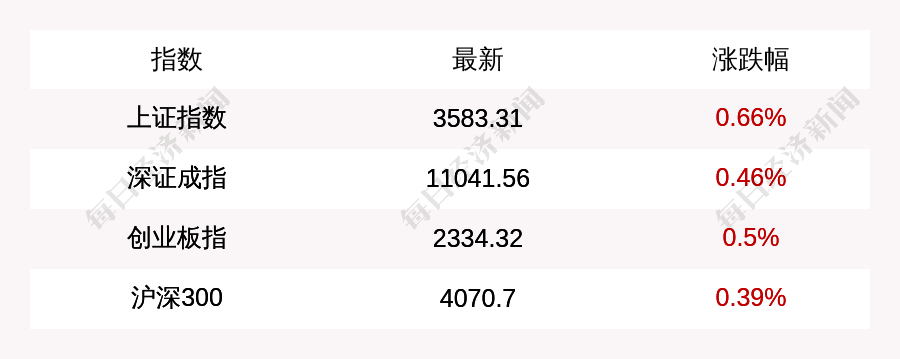
每经AI快讯:北京时间8月4日15:00,上证指数收盘上涨23.36点,涨幅为0.66%,报收3583.31点,成交额6397.76亿元;深证成指 收盘上涨50.24点,涨幅为0.46%,报收11041.56点,成交额8587.75亿元;创业板指收盘上涨11.69点,涨幅为0.5%,报收2334.32 点,成交额4377.0亿元;沪深300收盘上涨15.77点,涨幅为0.39%,报收4070.7点,成交额2959.77亿元。 涨幅前五的行业分别是航天航空4.56%、贵金属3.98%、电机2.58%、仪器仪表2.55%、通用设备2.52%。 (记者 谭玉涵) 免责声明:本文内容与数据仅供参考,不构成投资建议,使用前请核实。据此操作,风险自担。 每日经济新闻 跌幅前五的行业分别是商业百货-0.66%、保险-0.61%、光伏设备-0.41%、水泥建材-0.39%、教育-0.36%。 | 指数 | 最新 | 涨跌幅 | | --- | --- | --- | | 上证指数 | 3583.31 | 0.66% | | 深证成指 | 11041.56 | 0.46% | | 创业板指 | 2334.32 | 0.5% | ...

机械工业上半年利润增长9.4%,战新产业带动作用增强
Di Yi Cai Jing Zi Xun· 2025-08-04 03:13
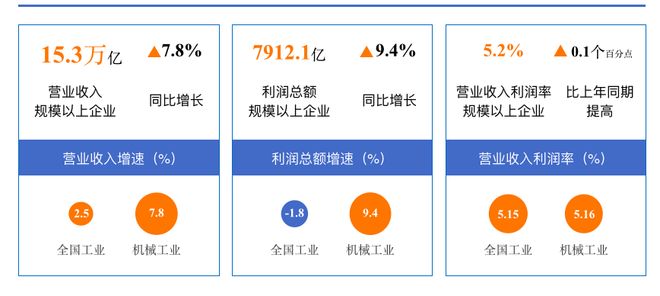
Core Viewpoint - The mechanical industry in China showed stable growth in the first half of the year, with key economic indicators such as value-added output, revenue, and profit all experiencing positive year-on-year growth, despite facing challenges like insufficient effective demand and external trade pressures [1][2][6]. Economic Performance - In the first half of the year, the value-added output of large-scale mechanical enterprises grew by 9.0% year-on-year, with total revenue reaching 15.3 trillion yuan, a 7.8% increase [1][2]. - Total profit amounted to 791.21 billion yuan, reflecting a 9.4% year-on-year growth, which is 11.2 percentage points higher than the national industrial average [1][2]. - The operating profit margin was 5.2%, slightly above the national industrial average [2]. Sector Growth - The automotive and electrical machinery sectors led the growth with increases of 11.3% and 12.2%, respectively, while general equipment, specialized equipment, and instruments also saw growth rates of 8.3%, 3.8%, and 7.6% [2]. - Among 122 monitored products, 84 saw year-on-year production increases, representing 68.9% of the total, which is an improvement of 7.4 percentage points from the previous year [2]. Strategic Emerging Industries - Strategic emerging industries continue to drive growth in the mechanical sector, with revenue and profit growth rates for these industries exceeding the overall mechanical industry by 1.3 and 5.4 percentage points, respectively [3]. Challenges and Risks - Over 60% of enterprises reported insufficient orders, with challenges including market fluctuations, insufficient effective demand, and pressure from external trade [5][6]. - The impact of U.S. tariff policies has led to increased caution among foreign buyers, resulting in a slowdown in order growth, particularly in sectors like petrochemical machinery and agricultural machinery [6]. - The price index for mechanical products has been declining, with a consistent drop of around 2% year-on-year for 29 consecutive months, further compressing profit margins [6]. Future Outlook - The mechanical industry is expected to maintain a stable growth trajectory in the second half of the year, with a projected annual growth rate of around 5.5% for major economic indicators [1][7]. - Continued emphasis on technological innovation, industrial upgrading, and the cultivation of new productive forces is anticipated to enhance the resilience and safety of the supply chain [7].

A股2025年8月观点及配置建议:先抑后扬,蓄力新高-20250803
CMS· 2025-08-03 10:52
Market Outlook - The market is expected to experience a volatile pattern in early August, followed by a return to an upward trend in late August, potentially reaching new highs[2] - Concerns regarding the US-China tariff conflict may persist until around August 12, after which risk appetite is likely to recover[3] - The overall free cash flow of listed companies is anticipated to improve, reinforcing the logic for re-evaluating A-shares[3] Economic Indicators - The GDP growth rate for the first half of the year is reported at 5.3%, indicating a stable economic environment[17] - The second quarter earnings growth for listed companies is expected to remain between 0% and 5%[16] - The market has successfully surpassed key resistance levels, with the Shanghai Composite Index above 3450 and the WIND All A Index above 5400 points[18] Investment Strategy - A "barbell" investment strategy is recommended, focusing on high ROE and free cash flow companies on one side, and sectors like AI and defense on the other[19] - Key sectors to watch include non-bank financials, pharmaceuticals, electric power equipment, and machinery[21] Fund Flows - Incremental capital is expected to continue flowing into the market, driven by financing, private equity, and industry ETFs[7] - The net inflow of funds is likely to persist, supported by the positive feedback loop from the market's performance[25] Industry Focus - Attention should be given to sectors with high earnings growth or marginal improvement, particularly in TMT, manufacturing, and essential consumer goods[8] - The focus on "de-involution" competition is expected to drive capacity clearing in various industries, enhancing profitability[21]
每周股票复盘:大西洋(600558)每股派发现金红利0.10元人民币
Sou Hu Cai Jing· 2025-08-02 20:26
Summary of Key Points Core Viewpoint - The company Atlantic (600558) has experienced a decline in stock price, closing at 5.43 yuan as of August 1, 2025, down 2.86% from the previous week [1] Company Performance - The highest intraday price for Atlantic on July 28 was 5.59 yuan, while the lowest intraday price on August 1 was 5.39 yuan [1] - The current total market capitalization of Atlantic is 4.874 billion yuan, ranking 106th out of 216 in the general equipment sector and 3223rd out of 5149 in the A-share market [1] Dividend Announcement - Atlantic announced a cash dividend of 0.10 yuan per share for the 2024 annual profit distribution, with the record date set for August 7, 2025, and the payment date on August 8, 2025 [1] - The total cash dividend to be distributed amounts to 89.760483 million yuan, based on the total share count of 897,604,831 shares [1] - For individual shareholders and securities investment funds, no personal income tax will be withheld; however, QFII shareholders and investors from the Hong Kong Stock Exchange will have a 10% withholding tax applied, resulting in a net dividend of 0.09 yuan per share [1]

每周股票复盘:兰剑智能(688557)首次回购股份并持续推进回购计划
Sou Hu Cai Jing· 2025-08-02 19:22
Core Viewpoint - Lanjian Intelligent (688557) has seen a stock price increase of 3.7% this week, closing at 34.19 yuan, with a market capitalization of 3.494 billion yuan as of August 1, 2025 [1][2] Company Announcements - The company conducted its first share buyback on July 28, 2025, repurchasing 64,366 shares at a total cost of 2.1336 million yuan, representing 0.0630% of the total share capital [2] - As of July 31, 2025, the cumulative number of shares repurchased reached 151,890, accounting for 0.15% of the total share capital, with a total expenditure of 4.9992 million yuan [2] - The share buyback plan was initially disclosed on June 6, 2025, with a proposed budget of 10 million to 20 million yuan, aimed at employee stock ownership plans or equity incentives [2]

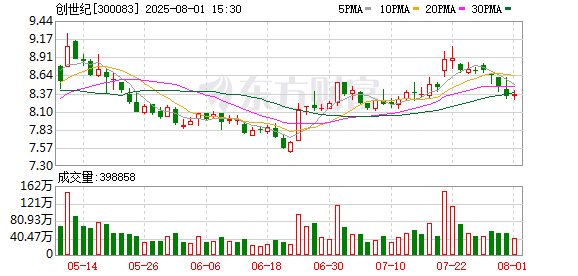
创世纪:累计回购公司股份16795000股
Zheng Quan Ri Bao· 2025-08-01 14:09
Group 1 - The company announced that as of July 31, 2025, it has repurchased a total of 16,795,000 shares through a dedicated repurchase account via centralized bidding transactions, which represents 1.01% of the company's total share capital [2]