电子

Search documents
智能汽车ETF(159889)涨超0.5%,市场关注产业升级机遇
Mei Ri Jing Ji Xin Wen· 2026-01-16 06:49
Core Viewpoint - The automotive industry is expected to undergo significant upgrades driven by the current wave of technology represented by AI, with opportunities for investment emerging in various segments of the industry by 2026 [1] Group 1: Automotive Sector Insights - The complete vehicle segment is anticipated to see accelerated advancements in high-level assisted driving and robotics, potentially leading to a new valuation anchor and a valuation reconstruction [1] - The robotics sector is moving towards large-scale production, with investment opportunities in the industry shifting from a dispersed to a concentrated approach [1] - The components sector is accelerating its global capacity layout and expanding its second growth curve [1] - The two-wheeler segment continues to trend towards international markets, with significant growth potential overseas [1] Group 2: Policy and Market Dynamics - Nine departments have issued a notice to promote green consumption, which includes supporting consumers in purchasing new energy vehicles and strengthening the automotive supply chain, while exploring the potential of the "aftermarket" such as used cars and car rentals [1] - GAC Group has signed a comprehensive cooperation framework agreement with Huawei, aiming to deepen collaboration on HarmonyOS cockpit and other projects [1] Group 3: Investment Products - The Smart Car ETF (159889) tracks the CS Smart Car Index (930721), which selects listed companies in the smart automotive sector from the Shanghai and Shenzhen markets, reflecting the overall performance of these companies [1] - The index includes companies from various industries such as electronics, computers, and automotive, with a focus on information technology and discretionary consumer sectors, showcasing the comprehensive characteristics of the smart automotive supply chain [1]
【盘中播报】沪指跌0.25% 传媒行业跌幅最大
Zheng Quan Shi Bao Wang· 2026-01-16 06:34
| 煤炭 | | | | 大有能源 | | | --- | --- | --- | --- | --- | --- | | 综合 | -1.71 | 40.62 | -10.25 | 东阳光 | -3.11 | | 石油石化 | -2.08 | 149.05 | -4.01 | 通源石油 | -11.54 | | 传媒 | -4.36 | 917.61 | -28.39 | 流金科技 | -11.65 | (文章来源:证券时报网) 证券时报·数据宝统计,截至下午13:57,今日沪指跌0.25%,A股成交量1377.73亿股,成交金额25125.16 亿元,比上一个交易日增加7.95%。个股方面,2508只个股上涨,其中涨停63只,2835只个股下跌,其 中跌停51只。从申万行业来看,电子、汽车、机械设备等涨幅最大,涨幅分别为2.60%、1.50%、 1.34%;传媒、石油石化、综合等跌幅最大,跌幅分别为4.36%、2.08%、1.71%。(数据宝) 今日各行业表现(截至下午13:57) | 申万行业 | 行业涨跌(%) | 成交额(亿元) | 比上日(%) | 领涨(跌)股 | 涨跌幅(%) | | --- ...
今日沪指跌0.22% 传媒行业跌幅最大
Zheng Quan Shi Bao Wang· 2026-01-16 05:18
Market Overview - The Shanghai Composite Index fell by 0.22% today, with a trading volume of 1,120.06 million shares and a total transaction value of 20,102.58 billion yuan, an increase of 6.96% compared to the previous trading day [1]. Industry Performance - The electronics sector showed the highest increase, rising by 1.83% with a transaction value of 3,777.97 billion yuan, up by 52.15% from the previous day, led by Tianyue Advanced, which surged by 20% [1]. - The automotive industry increased by 1.48%, with a transaction value of 890.59 billion yuan, up by 13.32%, driven by N Kema, which skyrocketed by 473.58% [1]. - The machinery equipment sector rose by 1.29%, with a transaction value of 1,392.70 billion yuan, up by 20.21%, with Jintaiyang leading at 20% [1]. Declining Sectors - The media sector experienced the largest decline, falling by 4.60% with a transaction value of 804.18 billion yuan, down by 25.79%, led by Liujin Technology, which dropped by 11.74% [2]. - The computer industry decreased by 1.89%, with a transaction value of 1,825.95 billion yuan, down by 15.82%, with *ST Cube falling by 15.66% [2]. - The social services sector declined by 1.62%, with a transaction value of 183.86 billion yuan, down by 5.83%, led by Waiservice Holdings, which fell by 10.03% [2].
研究所日报-20260116
Yintai Securities· 2026-01-16 05:17
Report Summary 1. Industry Investment Rating - Not provided in the given content. 2. Core Views - The central bank has rolled out a "combination punch" to support high - quality economic development, focusing on private SMEs and technological innovation. There is still room for reserve requirement ratio cuts and interest rate cuts, with favorable conditions for further loosening of monetary policy [2][3]. 3. Key Points by Category Central Bank Policies - The central bank has lowered the rediscount and relending rates by 0.25 percentage points. It has increased the relending quota for agriculture and small businesses by 500 billion yuan, set up a 1 - trillion - yuan relending quota for private enterprises, and increased the quota for technological innovation and transformation relending by 400 billion yuan. It has also expanded the scope of the carbon emission reduction support tool and reduced the minimum down - payment ratio for commercial housing loans to 30% [2]. - Central bank deputy governor Zou Lan stated that there is still room for reserve requirement ratio cuts and interest rate cuts. Conditions for further loosening monetary policy are relatively sufficient, and loose monetary policy is needed to support positive fiscal policies, consumption boost, and investment stabilization [3]. Stock Market Performance On January 15, 2026 - A - share indices showed mixed performance. The Shanghai Composite Index fell 0.33%, the Shenzhen Component Index rose 0.41%, and the total trading volume of the two markets was 2,905.496 billion yuan, a decrease of 1,035.893 billion yuan from the previous trading day. The ChiNext Index rose 0.56%, and the STAR 50 Index fell 0.46% [4]. - Internationally, South Korean, Dutch, and US stocks led the gains, while the Hang Seng Tech Index, Saudi All - Share Index, and Nikkei 225 led the losses. European major stock indices also showed mixed performance [4]. - The 10 - year China Treasury bond yield was 1.8483%, with a change of - 0.14BP. The average daily prices of inter - bank R001 and R007 were 1.4154% and 1.5497% respectively [4]. - In terms of sectors, electronics, basic chemicals, and non - ferrous metals led the gains, while the comprehensive, national defense and military industry, and media sectors led the losses [4]. On January 8, 2026 - The Shanghai Composite Index fell slightly by 0.07%, and the Shenzhen Component Index fell 0.51%. The total trading volume of the two markets was 2,800.265 billion yuan, a decrease of 538.76 billion yuan from the previous trading day. The ChiNext Index fell 0.82%, and the STAR 50 Index rose 0.82% [7]. - US stocks showed mixed performance, and European stocks also had mixed results. The Nikkei 225, Dutch AEX, Hang Seng Index, and Hang Seng Tech Index had relatively large declines [8]. - The 10 - year China Treasury bond yield was 1.8828%, with a change of - 1.6BP. The average daily prices of inter - bank R001 and R007 were 1.3424% and 1.5261% respectively [9]. - In terms of sectors, national defense and military industry, media, building decoration, and real estate led the gains, while non - bank finance, non - ferrous metals, communications, and banks led the losses [10]. Interest Rates and Exchange Rates - The 10 - year US Treasury bond yield was 1.848, with a change of - 0.14BP. DR007 was 1.502, with a change of - 6.44BP. The US dollar against the offshore RMB was 6.9631, with a change of - 0.12%. The US dollar index was 99.34, with a change of 0.27% [20]. A - Share Market Overview - The total A - share market capitalization was 114.37 trillion yuan, an increase of 5.62 trillion yuan compared to the beginning of the year. The cumulative trading volume this year was 28.53 trillion yuan, with an average daily trading volume of 31,698.37 billion yuan. The PE(TTM) was 23.34x, and the PB(MRQ) was 6.23x. The margin trading balance decreased by 24,885.74 billion yuan compared to a month ago, and the short - selling balance decreased by 170.96 billion yuan [24]. - Different A - share indices had different performance, with details on their closing prices, trading volumes, daily and weekly changes, and the number of rising and falling stocks [24]. - The latest trading volume was 29,385 billion yuan, and the latest turnover rate was 4.98%. The margin trading balance was 26,806 billion yuan as of January 14, 2026 [25][26]. Industry Performance - The top three sectors in terms of daily increase were electronics, basic chemicals, and non - ferrous metals. The top three sectors in terms of daily net capital inflow were electronics, banks, and basic chemicals. The top three sectors in terms of late - session net capital inflow were electronics, machinery, and national defense and military industry [28][30]. - The top three themes in terms of daily increase were advanced packaging, cobalt mines, and lithography machines [30].
突破2.7万亿元!7个行业开年获百亿资金流入,杠杆资金加仓的业绩预增股名单出炉
Xin Lang Cai Jing· 2026-01-16 05:04
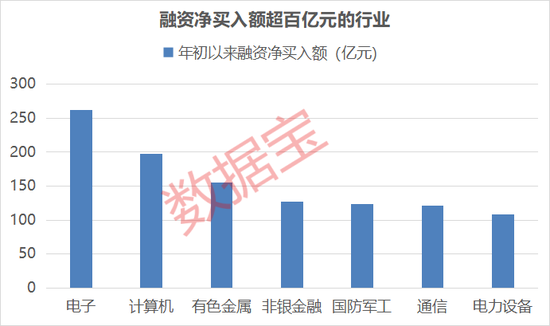
Market Overview - On January 16, the major stock indices experienced fluctuations, with the Shanghai Composite Index down by 0.22%, the Shenzhen Component Index down by 0.1%, and the ChiNext Index slightly down by 0.01% [1][10] - The advanced packaging concept index surged by 6.42%, with semiconductor equipment, memory, and robotics concepts leading the gains [1][10] - Media-related concepts saw a pullback, with virtual humans, short drama games, and millet economy concepts experiencing the largest declines [1][10] Margin Financing - As of January 15, the margin financing balance of the Shanghai and Shenzhen stock exchanges exceeded 2.7 trillion yuan for the first time, reaching 27,187.51 billion yuan [2][11] - The Shanghai market's margin financing balance was 13,604.3 billion yuan, an increase of 91.2 billion yuan from the previous day, while the Shenzhen market's balance was 13,491.83 billion yuan, up by 115.47 billion yuan [2][11] - The margin financing balance has increased for nine consecutive trading days since the beginning of the year, totaling over 170 billion yuan [2][11] - The China Securities Regulatory Commission approved an adjustment to the financing margin ratio, raising the minimum margin requirement from 80% to 100% for new financing [2][12] Sector Performance - Among the 31 industries tracked, 29 saw an increase in financing balances, with seven industries increasing by over 10 billion yuan [3][13] - The technology sector attracted significant financing, with the electronics, computer, defense, and communication industries leading the inflows [3][13] Electronics and AI Sector - The electronics industry saw the largest increase in financing balance, totaling 261.99 billion yuan, followed by the computer industry at 197.9 billion yuan [5][15] - Six stocks in the electronics sector had net inflows exceeding 1 billion yuan, primarily in the consumer electronics and semiconductor sub-sectors [5][15] - The global consumer electronics market is expected to recover starting in 2025, with a projected market size of 1,153.7 billion USD by 2030, growing at a compound annual growth rate (CAGR) of 2.8% from 2024 to 2030 [5][15] Notable Stocks - China Ping An saw net financing inflows exceeding 10 billion yuan over three trading days, despite a stock price decline of 8.03% during that period [8][17] - The company reported a non-annualized comprehensive investment return of 5.4% for the first three quarters of 2025, up by 1.0 percentage points year-on-year [8][17] - Among the 485 stocks with net financing inflows exceeding 1 billion yuan, 38 have released earnings forecasts for 2025, with over 55% expected to report profit increases [8][17] - SAIC Motor Corporation is projected to achieve a net profit of 9 to 11 billion yuan for 2025, representing a significant increase of 438% to 558% compared to the previous year [8][17]




硬科技“吃肉”,软应用“挨打”,资金再次选择方向!
Sou Hu Cai Jing· 2026-01-16 05:02
Core Viewpoint - The A-share market is experiencing extreme structural differentiation, with the Sci-Tech 50 index rising by 0.48% while major indices like the Shanghai Composite and Shenzhen Component are slightly down, indicating a significant shift in market dynamics driven by industry and policy changes [1] Group 1: Leading Sectors - The strong performance of sectors such as electronics, automotive, and machinery is attributed to the resonance between global industrial cycles and domestic precise policies [2] - TSMC's recent earnings report, projecting a 35% year-on-year increase in net profit by Q4 2025 and a gross margin exceeding 60%, signals robust AI computing demand and boosts confidence across the semiconductor supply chain [2] - Domestic policies are facilitating a "targeted" structural easing, with the central bank adjusting monetary policy tools to lower costs and direct financial resources towards hard technology and high-end manufacturing [3] Group 2: Lagging Sectors - The media and computer sectors are experiencing significant adjustments due to external technical frictions, such as the U.S. imposing tariffs on certain semiconductor manufacturing equipment, which heightens concerns over global tech supply chain stability [4] - The shift in market style reflects a migration of funds from high-growth, exploratory business models in "soft" applications to "hard" technology and high-end manufacturing with visible orders and clear policy support [4] Group 3: Market Outlook - The dual themes of "technological self-reliance" and "manufacturing upgrades" remain strong, with investments in semiconductors, AI hardware, robotics, and smart vehicles expected to be market focal points [5] - The market is balancing the pursuit of high growth with a search for certainty, as evidenced by the activity in power and grid equipment sectors and sustained interest in high-dividend assets [6] - The current market environment emphasizes the need for investors to focus on industry trends and company fundamentals, constructing resilient portfolios that include both hard technology and stable value assets [6]
【盘中播报】沪指跌0.07% 传媒行业跌幅最大
Zheng Quan Shi Bao Wang· 2026-01-16 04:48
| 社会服务 | | | | 外服控股 | | | --- | --- | --- | --- | --- | --- | | 国防军工 | -1.80 | 730.52 | -22.40 | 海格通信 | -10.02 | | 计算机 | -2.17 | 1417.00 | -18.96 | 美登科技 | -13.09 | | 传媒 | -4.92 | 618.29 | -30.43 | 流金科技 | -12.71 | (文章来源:证券时报网) 今日各行业表现(截至上午10:27) | 申万行业 | 行业涨跌(%) | 成交额(亿元) | 比上日(%) | 领涨(跌)股 | 涨跌幅(%) | | --- | --- | --- | --- | --- | --- | | 有色金属 | 1.46 | 940.14 | -14.07 | 锌业股份 | 8.70 | | 电子 | 1.39 | 2624.60 | 39.58 | 派瑞股份 | 15.14 | | 建筑装饰 | 1.37 | 281.62 | 31.22 | 中国电建 | 10.07 | | 电力设备 | 1.30 | 1709.83 | 13.8 ...
73股受融资客青睐,净买入超亿元
Zheng Quan Shi Bao Wang· 2026-01-16 03:49
Core Insights - The total market financing balance reached 2.70 trillion yuan as of January 15, with an increase of 20.61 billion yuan from the previous trading day, marking a continuous increase for nine consecutive trading days [1] - Among individual stocks, 1,951 stocks received net financing purchases on January 15, with 730 stocks having net purchases exceeding 10 million yuan, and 73 stocks exceeding 100 million yuan [1] - The top three stocks by net financing purchases were Zhongji Xuchuang with 1.698 billion yuan, Luxshare Precision with 1.447 billion yuan, and Xinye Technology with 1.084 billion yuan [2] Financing Balance and Stock Performance - The financing balance in the Shanghai market was 1.3487 trillion yuan, increasing by 917.8 million yuan, while the Shenzhen market's financing balance was 1.3434 trillion yuan, increasing by 1.1581 billion yuan [1] - The North Exchange saw a slight decrease in financing balance to 9.138 billion yuan, down by 146 million yuan [1] - The average financing balance as a percentage of circulating market value for stocks with significant net purchases was 4.60%, with the highest being Xidian Co. at 11.04% [2] Sector Analysis - The sectors with the highest concentration of stocks receiving net financing purchases over 100 million yuan were electronics, communications, and non-ferrous metals, with 28, 10, and 4 stocks respectively [1] - In terms of board distribution, 43 stocks on the main board, 21 on the ChiNext board, and 9 on the Sci-Tech Innovation board received significant net purchases [1] Individual Stock Highlights - Zhongji Xuchuang had a price increase of 5.40% on January 15, with a net financing purchase of 1.698 billion yuan and a financing balance of 2.3448 billion yuan, representing 3.39% of its circulating market value [2] - Luxshare Precision saw a price increase of 7.07% with a net financing purchase of 1.447 billion yuan, and a financing balance of 823 million yuan, accounting for 1.97% of its circulating market value [2] - Other notable stocks included Xinye Technology, Dongfang Fortune, and Liou Co., with significant net financing purchases and varying price performances [2][3]





汇成股份盘中创历史新高
Zheng Quan Shi Bao Wang· 2026-01-16 03:35
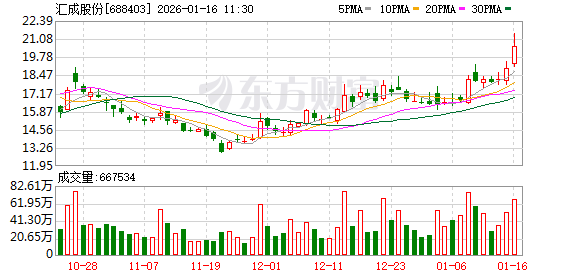
Company Performance - The stock price of Huicheng Co., Ltd. reached a historical high, increasing by 7.22% to 20.35 yuan, with a trading volume of 40.86 million shares and a transaction amount of 807 million yuan, resulting in a turnover rate of 4.70% [2] - For the first three quarters, the company achieved an operating income of 1.295 billion yuan, representing a year-on-year growth of 21.05%, and a net profit of 124 million yuan, with a year-on-year increase of 23.21% [2] - The basic earnings per share were 0.1500 yuan, and the weighted average return on equity was 3.73% [2] Industry Overview - The electronic industry, to which Huicheng Co., Ltd. belongs, saw an overall increase of 1.54%, with 310 stocks rising, including notable gainers such as Pairui Co., Ltd. (16.21%), Tianyue Advanced (12.25%), and Kaide Quartz (12.25%) [2] - Conversely, 172 stocks in the industry experienced declines, with the largest drops seen in Hanshuo Technology (-6.27%), Longxin Zhongke (-4.95%), and Xinya Process (-4.47%) [2] Margin Trading Data - As of January 15, the latest margin trading balance for Huicheng Co., Ltd. was 686 million yuan, with a financing balance of 685 million yuan, reflecting a decrease of 209 million yuan over the past 10 days, which is a 23.36% decline [2]

今元集团匈牙利自营公司成立,锚定中东欧枢纽,响应扩大高水平对外开放
Sou Hu Cai Jing· 2026-01-16 03:08
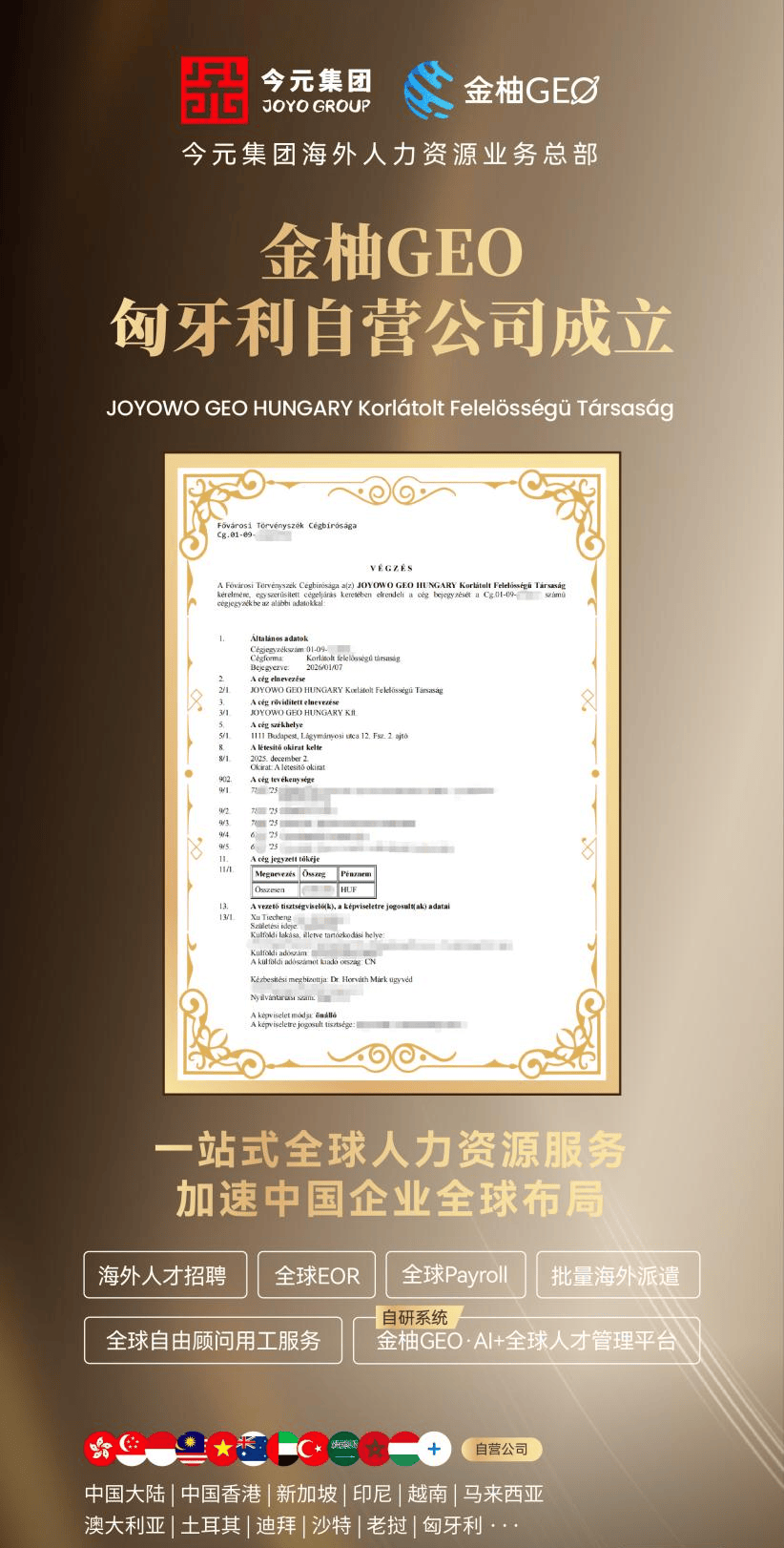
Core Viewpoint - The establishment of the self-operated company by Jinyuan Group's brand Jinyou GEO in Hungary marks a significant step in the company's globalization strategy, enhancing its service network along the "Belt and Road" initiative in Europe, and aligning with China's 14th Five-Year Plan for high-level opening-up and win-win cooperation [1][13]. Group 1: Strategic Importance of Hungary - Hungary is strategically positioned as a key gateway for Chinese enterprises under the "Belt and Road" initiative, serving as a vital portal for high-level opening-up during the 14th Five-Year period [4]. - The geographical location of Hungary connects Western Europe, Central Eastern Europe, and the Balkans, supported by significant "Belt and Road" projects like the Hungary-Serbia railway, facilitating logistics and industrial networks for Chinese companies [4]. Group 2: Investment Environment and Opportunities - Hungary offers a highly attractive investment environment with diverse incentives for foreign enterprises, including funding subsidies, tax reductions, and rent discounts, enhancing the business climate [6]. - In 2024, China is projected to invest €5.2 billion in Hungary, becoming the largest foreign investor, accounting for 51% of the total foreign investment in the country [6]. - The automotive and electronics sectors in Hungary are experiencing strong investment demand, with nearly 40% of foreign capital flowing into the automotive industry and 38.7% into electronics in 2024 [6]. Group 3: Human Resource Challenges - Chinese enterprises face significant human resource challenges in Hungary, including strict labor regulations and a reduced quota for foreign workers, which will be limited to 35,000 by 2025 [8]. - The local labor laws prioritize domestic employment, making it difficult for foreign companies to hire international talent, especially in high-skilled sectors like automotive and electronics [8]. Group 4: Jinyou GEO's Solutions - Jinyou GEO provides a comprehensive cross-border human resource solution leveraging its "localized deep cultivation + technological innovation + full-chain service" model, addressing the core pain points of Chinese enterprises in Hungary and Europe [9]. - The company has developed a one-stop global human resource service system, covering overseas talent recruitment, global Employer of Record (EOR), payroll services, and more, to meet the needs of enterprises in Hungary and over 150 countries [9][10]. - Jinyou GEO's local professional team is well-versed in EU and Hungarian labor standards, providing compliance consulting and operational support to enterprises [10]. Group 5: AI Technology Integration - The integration of AI technology into Jinyou GEO's global talent management platform enhances cross-border human resource management efficiency, automating processes such as employee onboarding and payroll calculations [11]. - The platform monitors labor regulations in real-time, providing alerts for compliance risks, and connects data across enterprises, personnel, and service providers for better management visibility [11][12].