焦炭

Search documents
广发早知道:汇总版-20251205
Guang Fa Qi Huo· 2025-12-05 02:31
1. Report Industry Investment Ratings No specific industry investment ratings are provided in the report. 2. Core Views of the Report - The A - share market is in a state of continuous volume contraction and low volatility, with pro - cyclical sectors showing a structural upward trend. For different futures products, there are various trends and influencing factors, including macro - economic data, policy expectations, and supply - demand fundamentals [2][3][4]. - The bond market has a fragile trading sentiment, with ultra - long bonds leading the decline. The market is affected by expectations of monetary and fiscal policies, as well as institutional behaviors [5][6][7]. - The precious metals market lacks clear direction due to a dull macro - news background. Gold is oscillating at a high level, while silver is in a corrective phase [8][9][11]. - The shipping index of container transportation to Europe is expected to show a short - term oscillating pattern, with the spot market stabilizing and the peak - season expectation slightly recovering [12]. - In the non - ferrous metals sector, different metals have different market situations. For example, copper prices are strongly supported, while alumina is expected to have limited short - term decline space [17][19]. - In the black metals sector, steel mills are reducing production, and the iron ore market is expected to oscillate. Coke and coking coal markets are facing supply - demand imbalances and price fluctuations [49][52][60]. - In the agricultural products sector, different products have different outlooks. For example, the soybean meal market is waiting for the USDA report, and the pig market is in a tug - of - war between upstream and downstream [64][66]. - In the energy and chemical sector, different products such as PX, PTA, and short - fibers have different supply - demand relationships and price trends [82][84][86]. 3. Summaries by Relevant Catalogs Financial Derivatives - Financial Futures Stock Index Futures - Market situation: A - share major indices were narrowly oscillating. The CSI 300, SSE 50, etc. rose, while the Shanghai Composite Index slightly declined. The four major stock index futures contracts also rose [2][3]. - News: Domestically, the market regulatory authority issued a standard for take - out platform services. Overseas, the Bank of Japan officials made statements about monetary policy [3][4]. - Capital flow: A - share trading volume decreased by over 100 billion yuan, and the central bank had a net cash withdrawal of 175.6 billion yuan [4]. - Operation suggestion: Be cautious and wait and see in the short term. Consider a bull spread of put options on the CSI 1000 when there are pull - backs [4]. Treasury Futures - Market performance: Treasury futures closed down across the board, with the 30 - year contract leading the decline. Bond yields generally rose [5][6]. - Capital flow: The central bank had a net cash withdrawal of 175.6 billion yuan, and the inter - bank market liquidity remained loose [6]. - Operation suggestion: Temporarily wait and see. Pay attention to the Politburo meeting and the new regulations on bond fund redemption fees. Consider participating in varieties within 10 - year if the market sentiment improves. The curve strategy may tend to steepen [7]. Financial Derivatives - Precious Metals - Market review: As of the week of November 29, US employment data showed a pattern of low lay - offs and low recruitment. Gold oscillated at a high level, while silver corrected. Platinum and palladium also declined [8][9]. - Outlook: Gold may face resistance at high levels, and short - term trading can consider selling out - of - the - money put options. Silver may see a strong short - term price trend, but attention should be paid to the improvement of scrap aluminum supply and inventory reduction. Platinum is expected to oscillate upward in the medium - to - long term [11]. Financial Derivatives - Container Shipping Index to Europe - Index: As of December 1, the SCFIS European line index and the SCFI composite index declined [12]. - Fundamentals: The global container shipping capacity increased year - on - year, and the demand in the eurozone and the US showed different situations [12]. - Logic: The futures market oscillated, and the spot market stabilized. It is expected to show a short - term oscillating pattern [12]. Commodity Futures - Non - Ferrous Metals Copper - Spot: Copper prices rose, and the discount of electrolytic copper increased. The overall trading was poor [13]. - Macro: The US manufacturing PMI was in a contraction range, and the ADP employment data was lower than expected, increasing the expectation of Fed rate cuts [13]. - Supply: The spot TC of copper concentrate was at a low level, and the 2026 long - term premium proposed by Codelco was significantly higher. The production of electrolytic copper in November increased [14][15]. - Demand: The weekly operating rates of copper rod processing decreased, but the downstream demand showed strong resilience [16]. - Inventory: LME and COMEX copper inventories increased, while domestic social inventories decreased [16]. - Logic: With the significant increase in LME cancelled warrants, copper prices are strongly supported. In the long - term, the supply - demand contradiction will support the upward movement of the bottom price [17]. - Operation suggestion: Adopt a strategy of buying on dips, with the main support level at 88,500 - 89,500 [17]. Alumina - Spot: Alumina prices were stable or slightly declined, and the supply pattern was gradually becoming looser [18]. - Supply: In November, the production of metallurgical - grade alumina decreased slightly month - on - month, mainly due to the phased production reduction in the north [18]. - Inventory: Alumina inventories increased [19]. - Logic: The market is in a state of high supply, high inventory, and cost support. It is expected to maintain a bottom - oscillating pattern [19]. - Operation suggestion: The main contract is expected to operate in the range of 2,575 - 2,775 yuan/ton, with limited short - term decline space [19]. Other Non - Ferrous Metals Similar analysis methods are used for other non - ferrous metals such as aluminum, zinc, tin, etc., considering factors such as spot prices, supply - demand relationships, and inventory changes [20][28][33]. Commodity Futures - Black Metals Steel - Spot: Steel prices were stable, and the basis of the main contracts of rebar and hot - rolled coil changed differently [47]. - Cost and profit: The cost of coking coal and coke decreased, and steel mill profits slightly recovered [48]. - Supply: Iron ore production increased slightly year - on - year, and steel production decreased slightly [48]. - Demand: Domestic demand was weak, and exports remained at a high level. The apparent demand in December was expected to decline seasonally [49]. - Inventory: Steel inventories decreased [49]. - View: Steel prices are expected to oscillate in a range. Consider a long - rebar and short - iron - ore arbitrage [49]. Iron Ore - Spot: Iron ore prices declined [50]. - Futures: The main iron ore futures contract declined slightly [50]. - Basis: The basis of different iron ore varieties changed [50]. - Demand: Steel mill production reduction continued, and iron ore demand decreased [51]. - Supply: The global iron ore shipment increased, and the port arrival volume decreased [51]. - Inventory: Port inventories increased, and steel mill inventories decreased [52]. - View: Iron ore futures are expected to oscillate in the range of 750 - 820 [52]. Coking Coal and Coke Similar analysis methods are used for coking coal and coke, considering factors such as spot prices, supply - demand relationships, and inventory changes [54][57]. Commodity Futures - Agricultural Products Soybean Meal - Spot market: Domestic soybean meal prices were stable or slightly declined, and trading volume decreased [61]. - Fundamental news: Analysts expected changes in US soybean export sales, and the soybean sowing progress in Brazil was high [61][62]. - Market outlook: The soybean meal market is expected to oscillate, and attention should be paid to domestic soybean procurement [64]. Other Agricultural Products Similar analysis methods are used for other agricultural products such as pigs, corn, and sugar, considering factors such as spot prices, supply - demand relationships, and policy impacts [65][67][70]. Commodity Futures - Energy and Chemicals PX - Spot: PX prices continued to correct, and the market trading atmosphere was average [82]. - Profit: PX profit margins changed [82]. - Supply - demand: PX supply may contract in the first quarter, and demand was relatively strong [82]. - Market outlook: PX is expected to oscillate at a high level in the short term [82]. Other Energy and Chemical Products Similar analysis methods are used for other energy and chemical products such as PTA, short - fibers, and ethylene glycol, considering factors such as spot prices, supply - demand relationships, and inventory changes [83][86][89].
《黑色》日报-20251205
Guang Fa Qi Huo· 2025-12-05 01:04
Group 1: Steel Industry Report Industry Investment Rating - Not provided Core View - The steel market is expected to maintain a range - bound oscillation. The rebar is expected to fluctuate between 3000 - 3200 yuan/ton, and hot - rolled coils between 3250 - 3400 yuan/ton. The spread between hot - rolled coils and rebar is expected to continue narrowing in January. The long - position rebar and short - position iron ore arbitrage in the January contract can be held [1]. Summary by Directory - **Steel Prices and Spreads**: Rebar and hot - rolled coil prices in different regions and contracts showed various changes. For example, the spot price of rebar in East China remained at 3300 yuan/ton, while the 01 contract price increased by 11 yuan/ton to 3148 yuan/ton. The spot price of hot - rolled coils in East China increased by 10 yuan/ton to 3310 yuan/ton [1]. - **Cost and Profit**: The cost of steel billets remained unchanged at 2990 yuan/ton, while the cost of Jiangsu electric - arc furnace rebar increased by 2 yuan/ton to 3247 yuan/ton. The profit of East China hot - rolled coils decreased by 5 yuan/ton to - 29 yuan/ton [1]. - **Production**: The daily average pig iron output decreased by 2.0 tons to 232.0 tons, a decline of 0.9%. The output of five major steel products decreased by 26.8 tons to 829.0 tons, a decline of 3.1% [1]. - **Inventory**: The inventory of five major steel products decreased by 35.2 tons to 1365.6 tons, a decline of 2.5%. The rebar inventory decreased by 27.7 tons to 503.8 tons, a decline of 5.2% [1]. - **Transaction and Demand**: The building materials trading volume increased by 0.4 to 9.4, a rise of 4.5%. The apparent demand for five major steel products decreased by 23.8 tons to 864.2 tons, a decline of 2.7% [1]. Group 2: Iron Ore Industry Report Industry Investment Rating - Not provided Core View - The iron ore futures are expected to oscillate between 750 - 820 yuan/ton. Although the supply has increased and the demand has decreased, with the improvement of market expectations and the support of downstream restocking and basis repair, the price will not drop significantly [3]. Summary by Directory - **Iron Ore - related Prices and Spreads**: The warehouse receipt cost of various iron ore types decreased slightly. For example, the warehouse receipt cost of Carajás Fine decreased by 6.6 yuan/ton to 796.7 yuan/ton. The 9 - 1 spread increased by 5.0 yuan/ton to - 41.5 yuan/ton, a rise of 10.8% [3]. - **Spot Prices and Price Indexes**: The spot prices of various iron ore types at Rizhao Port decreased slightly. For example, the price of Carajás Fine at Rizhao Port decreased by 6.0 yuan/ton to 877.0 yuan/ton [3]. - **Supply**: The 45 - port arrival volume decreased by 117.8 tons to 2699.3 tons, a decline of 4.2%, while the global shipment volume increased by 44.8 tons to 3323.2 tons, a rise of 1.4% [3]. - **Demand**: The daily average pig iron output of 247 steel mills decreased by 2.4 tons to 232.3 tons, a decline of 1.0%. The 45 - port daily average desulfurization volume increased by 3.6 tons to 330.6 tons, a rise of 1.1% [3]. - **Inventory Changes**: The 45 - port inventory increased by 27.3 tons to 15237.39 tons, a rise of 0.2%. The imported iron ore inventory of 247 steel mills decreased by 58.8 tons to 8942.5 tons, a decline of 0.7% [3]. Group 3: Coke Industry Report Industry Investment Rating - Not provided Core View - The coke futures are expected to oscillate between 1550 - 1700 yuan/ton. The supply - demand relationship has weakened, but the futures have basically over - discounted the spot price cut expectations, and the downward space is limited. The 1 - 5 reverse arbitrage can be recommended [5]. Summary by Directory - **Coke - related Prices and Spreads**: The prices of Shanxi quasi - first - grade wet - quenched coke (warehouse receipt) and Rizhao Port quasi - first - grade wet - quenched coke (warehouse receipt) remained unchanged. The 01 contract price of coke increased by 27 yuan/ton to 1652 yuan/ton [5]. - **Supply**: The daily average output of all - sample coking plants increased by 0.8 tons to 64.5 tons, a rise of 1.2%. The daily average output of 247 steel mills increased by 0.3 tons to 46.6 tons, a rise of 0.6% [5]. - **Demand**: The pig iron output of 247 steel mills decreased by 2.4 tons to 232.3 tons, a decline of 1.0% [5]. - **Inventory Changes**: The total coke inventory decreased slightly by 1.7 tons to 883.0 tons. The inventory of all - sample coking plants increased by 4.7 tons to 76.4 tons, a rise of 6.5% [5]. - **Supply - Demand Gap**: The coke supply - demand gap increased by 1.8 tons to - 2.5 tons, a rise of 74.2% [5]. Group 4: Coking Coal Industry Report Industry Investment Rating - Not provided Core View - The coking coal futures are expected to oscillate between 1050 - 1150 yuan/ton. The market is in a weak state, with supply and demand both showing certain changes, and the 1 - 5 reverse arbitrage can be recommended [5]. Summary by Directory - **Coking Coal - related Prices and Spreads**: The prices of Shanxi medium - sulfur primary coking coal (warehouse receipt) and Mongolian 5 raw coal (warehouse receipt) remained unchanged. The 01 contract price of coking coal increased by 21 yuan/ton to 1092 yuan/ton [5]. - **Supply**: The raw coal output of Fenwei sample coal mines decreased by 2.7 tons to 853.4 tons, a decline of 0.3%. The clean coal output decreased by 0.6 tons to 438.2 tons, a decline of 0.1% [5]. - **Demand**: The demand for coking coal is affected by the decline in pig iron output and the weakening of market restocking demand [5]. - **Inventory Changes**: The clean coal inventory of Fenwei coal mines increased by 9.6 tons to 107.6 tons, a rise of 9.8%. The coking coal inventory of all - sample coking plants decreased by 1.1 tons to 1009.2 tons, a decline of 0.1% [5].
广发期货日评-20251204
Guang Fa Qi Huo· 2025-12-04 02:38
Report Summary 1) Report Industry Investment Rating No investment rating for the industry is provided in the report. 2) Core Viewpoints - The short - term trading opportunities for A - share index futures are limited due to low trading volume and volatility [2]. - The current interest rate is approaching the high level before the end of September, and the allocation value of bonds within 10 years is relatively improved. The 30 - year bonds may be oversold under emotional drive. It is recommended to wait and see for the unilateral strategy and focus on the Politburo meeting and the new regulations on bond fund redemption fees [2]. - Gold is in a consolidation phase near $4200, and it is advisable to be cautious about chasing long positions unilaterally. Silver is oscillating strongly and may reach $60. Investors are advised to lock in profits after accumulating floating profits [2]. - The container shipping index is expected to fluctuate in the short - term [2]. - For steel, it is recommended to focus on the long - rebar and short - iron ore arbitrage. Iron ore is in high - level consolidation, and coking coal and coke are also in a consolidation state [2]. - Copper prices are rising again, and aluminum prices are rising with increased positions. Different trading strategies are recommended for various non - ferrous metals [2][3]. - For new energy and chemical products, different products have different market trends and corresponding trading suggestions, such as PX having strong support in the medium - term, while PTA's rebound space is limited [3]. - In the energy and chemical industry, different products have different market situations, such as LLDPE's trading volume weakening significantly and PP's supply having an upward expectation [3]. - In the agricultural products market, different products have different trends, such as palm oil falling due to potential inventory growth and sugar oscillating weakly [3]. 3) Summary by Related Catalogs Financial Sector - **Stock Index Futures**: A - share index futures have low trading volume and volatility, and the short - term trading space is limited. The dividend sector is firm, and the index futures are trading weakly [2]. - **Treasury Bonds**: The current interest rate is approaching the high level before the end of September. The 30 - year bonds are relatively weak, and the short - term market driver may come from the policy expectation difference. It is recommended to wait and see for the unilateral strategy and focus on the Politburo meeting and the new regulations on bond fund redemption fees. The positive arbitrage strategy for the 2603 contract is recommended for the spot - futures strategy [2]. - **Precious Metals**: Gold is in a consolidation phase near $4200, and it is advisable to sell out - of - the - money put options to earn time value. Silver is oscillating strongly and may reach $60. Investors are advised to lock in profits after accumulating floating profits. Platinum and palladium should be traded with a short - term high - selling and low - buying strategy, and the long - platinum and short - palladium hedge should take profits at high levels [2]. Black Sector - **Steel**: Steel mills are reducing production. It is recommended to focus on the long - rebar and short - iron ore arbitrage and narrow the spread between hot - rolled coil and rebar [2]. - **Iron Ore**: The shipment is increasing, the arrival is decreasing, and the port inventory is increasing. It is in high - level consolidation, with the range from 750 to 820 [2]. - **Coking Coal**: The price reduction range of coal in the production area is expanding, and the price of Mongolian coal is stable. The futures price is falling again, with the range from 1050 to 1150, and the 1 - 5 reverse spread is recommended [2]. - **Coke**: The first round of price cuts in December has been implemented, and the port trading price is falling. It is in a consolidation state, with the range from 1550 to 1700, and the 1 - 5 reverse spread is recommended [2]. Non - Ferrous Sector - **Copper**: The LME cancelled warehouse receipts are increasing significantly, and copper prices are rising again. The short - term decline space is limited [2]. - **Aluminum**: Aluminum prices are rising with increased positions. Different trading strategies are recommended for aluminum, waste aluminum, and aluminum alloy, with corresponding price ranges [2][3]. - **Other Non - Ferrous Metals**: For zinc, supply reduction and interest - rate cut expectations provide support, but the spot trading is dull [4]. For other non - ferrous metals such as tin, nickel, and stainless steel, different market trends and trading suggestions are provided [3]. New Energy and Chemical Sector - **New Energy**: Different new energy products such as polysilicon and lithium carbonate have different market trends and corresponding trading suggestions, such as polysilicon futures rising while the spot price is stable [3]. - **Chemical Products**: Different chemical products have different market situations, such as PX having strong support in the medium - term, while PTA's rebound space is limited. Different trading strategies are recommended for each product [3]. Energy and Chemical Sector - Different energy and chemical products such as LLDPE, PP, and methanol have different market trends and corresponding trading suggestions, such as LLDPE's trading volume weakening significantly and PP's supply having an upward expectation [3]. Agricultural Products Sector - Different agricultural products such as palm oil, sugar, and cotton have different market trends and corresponding trading suggestions, such as palm oil falling due to potential inventory growth and sugar oscillating weakly [3].
广发期货《黑色》日报-20251203
Guang Fa Qi Huo· 2025-12-03 06:12
钢材产业期现日报 投资咨询业务资格:证监许可 【2011】1292号 2025年12月3日 周敏波 Z0010559 | 钢材价格及价差 | | | | | | | --- | --- | --- | --- | --- | --- | | 品种 | 现值 | 前值 | 涨跌 | 基差 | 单位 | | 螺纹钢现货(华东) | 3300 | 3290 | 10 | 167 | | | 螺纹钢现货(华北) | 3220 | 3220 | O | 87 | | | 螺纹钢现货(华南) | 3350 | 3350 | O | 217 | | | 螺纹钢05合约 | 3169 | 3167 | 2 | 131 | | | 螺纹钢10合约 | 3208 | 3206 | 2 | 92 | | | 螺纹钢01合约 | 3133 | 3134 | -1 | 167 | | | 热卷现货(华东) | 3310 | 3310 | 0 | -15 | 元/吨 | | 热卷现货(华北) | 3240 | 3240 | 0 | -85 | | | 热卷现货(华南) | 3350 | 3350 | 0 | 12 | | | 热卷05合 ...
黑色建材日报:宏观预期继续发力,钢价区间震荡运行-20251203
Hua Tai Qi Huo· 2025-12-03 03:13
Report Industry Investment Ratings - Not provided in the given content Core Views - The steel market is affected by macro - expectations, with steel prices oscillating in a range. The iron ore market has a warming macro - atmosphere, and ore prices continue to fluctuate. The coking coal and coke market shows a "supply rising, demand weak" weak - balance state, and prices continue to oscillate. The power coal market is in a weak state with low downstream demand and high inventory [1][3][5][6] Summary by Related Catalogs Steel - **Market Analysis**: Yesterday, the main contract of rebar futures closed at 3133 yuan/ton, and the main contract of hot - rolled coil closed at 3325 yuan/ton. Today's spot steel transactions were generally weak, and the terminal's willingness to accept the price - increased spot was low. The national building materials transaction volume was 9.82 tons [1] - **Supply and Demand Logic**: The output of finished steel increased slightly, the inventory decline slowed down, and the plate inventory remained high. The current consumption of finished steel was stable, but its sustainability was questionable. The consumption expectation of plates was better. The short - term fundamental contradiction was not prominent, and the macro - policy atmosphere continued to boost market expectations [1] - **Strategy**: Unilateral trading strategy is to expect price oscillations, and there are no strategies for inter - period, inter - variety, spot - futures, and options trading [2] Iron Ore - **Market Analysis**: Yesterday, iron ore futures prices rose slightly, with the 2601 contract closing at 800.5 yuan/ton. Spot prices rose slightly, the trading atmosphere was dull, and supply - demand was loose. The cumulative transaction volume at major national ports was 96.4 tons, a 11.32% increase from the previous day [3] - **Supply and Demand Logic**: The molten iron output decreased, the steel mill profitability rate was continuously compressed, and there was an expectation of a seasonal decline in molten iron. The rigid demand support weakened, and the restocking demand was not significantly released. Port inventory increased significantly, and steel mill imported ore inventory declined, with structural contradictions being more prominent than overall inventory contradictions [3] - **Strategy**: Unilateral trading strategy is to expect price oscillations, and there are no strategies for inter - period, inter - variety, spot - futures, and options trading [4] Coking Coal and Coke - **Market Analysis**: Yesterday, the black commodity sector was generally strong and oscillating, and the coking coal and coke futures prices rose slightly. The current market inquiry activity for imports was low, the port quotations were weak, and the trading volume declined [5] - **Logic and Views**: In the off - season of downstream steel consumption, the coking coal and coke market will present a weak - balance state of "rising supply and weak demand" in the short term. For coking coal, mine production is gradually recovering, and Mongolian coal customs clearance volume remains high, with supply expected to be loose. Downstream coking enterprises have limited procurement enthusiasm. For coke, production enthusiasm has improved, but downstream steel mills are in continuous losses, and their procurement attitude is cautious [5][6] - **Strategy**: Unilateral trading strategy for coking coal and coke is to expect price oscillations, and there are no strategies for inter - period, inter - variety, spot - futures, and options trading [6] Power Coal - **Market Analysis**: In the production area, coal prices continued to be weak, downstream mainly carried out long - term contract transportation, and non - power coal was purchased as needed. Port inventory accumulated rapidly, quotations continued to loosen, downstream demand was poor, and actual transactions were few. Import coal tender prices continued to decline, and some traders took profits and sold [6] - **Demand and Logic**: Recently, coal prices have been in a weak state due to lower - than - expected downstream consumption and relatively high inventory. In the long - term, attention should be paid to changes in the supply pattern, non - power coal consumption, and restocking [6] - **Strategy**: No strategy is provided [7]
广发早知道:汇总版-20251203
Guang Fa Qi Huo· 2025-12-03 01:43
1. Report Industry Investment Ratings - No industry - wide investment ratings are provided in the report. 2. Core Views of the Report - The report comprehensively analyzes various sectors including financial derivatives, precious metals, shipping, and multiple commodities, presenting market conditions, influencing factors, and future outlooks for each. It suggests different trading strategies based on the characteristics of each sector, such as short - term trading, long - term investment, and arbitrage opportunities [1] 3. Summary by Directory Financial Derivatives Financial Futures - **Stock Index Futures**: A - share market declined with reduced trading volume on Tuesday. Major indices and four major stock index futures contracts all fell. There are preparations for commercial real - estate REITs and new regulations on infrastructure REITs. A - share market trading volume decreased, and there was a net capital withdrawal. Short - term strategies include lightly selling December put options and gradually building long - spread positions on dips [2][3][4] - **Treasury Futures**: Treasury futures closed down across the board, with bond yields generally rising. The central bank's bond - buying scale was less than expected, and the bond market sentiment was weak. Although there was a net capital withdrawal in the open market, the inter - bank funds were still relatively loose. It is recommended to reduce left - side operations, temporarily wait and see, and pay attention to the implementation of the bond - fund redemption fee new regulations. Also, consider the positive - spread strategy for the 2603 contract [5][6] Precious Metals - **Gold, Silver, Platinum, Palladium**: Global central banks' expectations of monetary easing have decreased. Gold weakened, while silver continued to rise due to tight inventory. Platinum was dragged down by gold, and palladium rose due to industrial support. In the long - term, the bull market in precious metals is expected to continue, but there are short - term fluctuations. Different trading strategies are recommended for each metal [7][9][10] Shipping Index (European Line) - The SCFIS European line index and related routes' indices declined. The global container shipping capacity increased year - on - year, and the demand in the eurozone and the US showed different trends. The futures market is expected to be volatile in the short term [11][12] Commodity Futures Non - ferrous Metals - **Copper**: The US manufacturing PMI was lower than expected, and the spot premium stabilized. There are concerns about potential supply shortages, and copper prices are expected to remain high in the long - term. Short - term trading should focus on December interest - rate cut expectations. It is recommended to take profits on rallies and pay attention to support levels [12][13][16] - **Alumina**: The visible inventory continued to increase, and the market supply was still abundant. The price is expected to remain in a bottom - range oscillation, and the main contract's reference range has shifted downwards [17][18][19] - **Aluminum**: Driven by both macro and micro factors, the aluminum price is expected to remain strong in the short - term. It is necessary to pay attention to the Fed's monetary policy and domestic inventory reduction [19][20][21] - **Aluminum Alloy**: The supply of scrap aluminum is tight, and the demand maintains resilience. The price is expected to have strong short - term performance, and an arbitrage strategy can be considered [21][22][24] - **Zinc**: The supply reduction expectation provides support, but the spot trading is dull. The price is expected to oscillate, and attention should be paid to the TC inflection point and refined - zinc inventory changes [24][25][27] - **Tin**: There are disturbances on the supply side, and the tin price is oscillating at a high level. It is recommended to hold existing long positions and buy on dips, while paying attention to macro changes [27][29][31] - **Nickel**: The price is oscillating within a range, and the upward driving force is limited due to fundamental pressure. It is expected to oscillate in the short - term, and attention should be paid to macro expectations and Indonesian industrial policies [31][32][33] - **Stainless Steel**: The price oscillated slightly higher, but the fundamental pressure has not improved significantly. It is expected to oscillate weakly in the short - term, and attention should be paid to steel mills' production - cut implementation and nickel - iron prices [33][34][36] - **Lithium Carbonate**: The price is oscillating, and market differences may increase in the future. It is recommended to wait and see, as the market faces issues such as large - scale factory resumption and off - season demand [37][38][40] - **Polysilicon**: The futures price opened lower and fell. The supply is expected to exceed demand in December, and it is recommended to wait and see in the futures market and take profit on put options [40][41][42] - **Industrial Silicon**: The demand is poor, and the futures price oscillated downwards. It is expected to oscillate at a low level, and the price range is estimated [43][44][44] Ferrous Metals - **Steel**: Steel mills are reducing production. The steel price is expected to oscillate within a range, and a long - rebar and short - iron - ore arbitrage strategy can be considered [45][46][47] - **Iron Ore**: The shipping volume increased, the arrival volume decreased, and the port inventory increased. The iron - ore price is expected to oscillate strongly, and the operating range is given [48][50][51] - **Coking Coal**: The price of domestic coking coal decreased, and the price of Mongolian coal stabilized. The futures price rebounded after an oversold situation. It is recommended to view it as an oscillation and consider an inverse - spread strategy [52][53][55] - **Coke**: The first - round price cut in December has been implemented, and the port trading price has declined. The futures price is expected to oscillate, and an inverse - spread strategy is recommended [56][57][58] Agricultural Products - **Meal**: The market lacks guidance, and both domestic and international markets are mainly oscillating. It is recommended to continue to pay attention to China's soybean - purchasing trends [59][60][61] - **Pigs**: The spot price pressure remains, and the month - to - month inverse - spread position can be held. The pig price is expected to oscillate weakly [63][64][64] - **Corn**: The spot price shows a differentiated trend, and the futures price is oscillating. It is necessary to pay attention to the rhythm of corn supply [65][66][66] - **Sugar**: The raw - sugar price is in a bearish pattern, and the domestic sugar price is oscillating at the bottom. It is recommended to maintain a bottom - oscillation mindset [67][68][70] - **Cotton**: The US cotton price is oscillating at the bottom, and the domestic cotton price is oscillating within a range. It is necessary to wait for the global agricultural supply - demand forecast report [70][71][72] - **Eggs**: The egg price is stable with a slight increase, but the pressure is still high. The futures price is expected to oscillate at the bottom [73][74][74] - **Oils and Fats**: The Malaysian palm - oil price rose, and the domestic palm - oil price followed suit. The domestic soybean - oil price is oscillating narrowly. Different outlooks and strategies are provided for each [75][76][77] - **Jujubes**: The price in the production area has weakened, and the futures price is oscillating weakly. It is necessary to pay attention to the terminal consumption during the peak season [78][79][79] - **Apples**: The demand for stored apples is average, and the sales are slow. The market situation is relatively stable [80][80][80] Energy and Chemicals - **PX**: The medium - term supply - demand expectation has improved, and the short - term oil price is strong. The short - term support for PX is relatively strong, and attention should be paid to the pressure around 7000 [80][81][81] - **PTA**: The supply - demand pattern is strong in the near - term and weak in the long - term. The rebound space for PTA is limited. It is recommended to view it as a high - level oscillation and consider a low - level positive - spread strategy [82][83][83] - **Short - Fiber**: The supply - demand expectation is weak, and the processing fee is mainly compressed. The price follows the raw - material fluctuations, and the processing fee should be shorted on rallies [84][85][85] - **Bottle - Chip**: The supply - demand situation in December remains loose. The price follows the raw - material fluctuations, and the processing fee is expected to be compressed. It is recommended to short the processing fee [86][87][87] - **Ethylene Glycol**: Due to expected device maintenance, the inventory - building amplitude in December will narrow, but the supply - demand pattern remains loose. It is expected to oscillate within a range [88][88][88] - **Pure Benzene**: The port inventory is increasing, the supply - demand is weak, and the price is under pressure. It is recommended to short on rebounds [89][90][90] - **Styrene**: The supply - demand is in a tight - balance state, and the profit has improved, but the upward space is limited. It is recommended to view it as a wide - range oscillation [91][92][92] - **LLDPE**: The overall trading is weak, and the spot price has little change. It is expected to oscillate within a range [93][93][94] - **PP**: There are many unexpected device maintenance events, and the downward space is limited. It is recommended to wait and see [94][94][94] - **Methanol**: The spot price is strong, and the trading is acceptable. It is recommended to short the 05MTO spread [95][95][95] - **Caustic Soda**: The supply - demand still has pressure, and the price is expected to run weakly [95][96][96] - **PVC**: The short - term futures price has rebounded, but the supply - demand contradiction has not improved. The price is expected to remain weak at the bottom [98][98][98] - **Soda Ash and Glass**: Soda - ash production has rebounded after a decline, and the futures price is oscillating. The glass sales have declined, and the spot price has fallen. Different strategies are recommended for each [99][100][101] - **Natural Rubber**: The overseas raw - material price has stopped rising and started to fall, and the rubber price is mainly oscillating. It is recommended to wait and see [102][104][104] - **Synthetic Rubber**: Driven by butadiene export news, the BR price has risen strongly. It is expected to oscillate in the short - term, and attention should be paid to the pressure around 10800 [104][106][106]
商品日报(12月2日):利多传闻提振合成橡胶大涨 多晶硅领跌
Xin Hua Cai Jing· 2025-12-02 09:36
其他品种方面,贵金属继续高位盘整,沪银盘中再度刷新历史新高至13700/千克以上的水平,最大涨幅超5%,但终盘涨幅有所回落,仅收涨2.46%。 多晶硅快速回落铂钯转跌低开 12月2日,多晶硅主力合约快速回落,低开后持续下行,以2.70%的跌幅领跌国内商品市场。广期所昨日对多晶硅期货PS2601合约的交易保证金标准及交易 限额作出调整,市场多头情绪快速降温。从基本面来看,光大期货表示,光伏集中式项目收尾,海外需求同步下滑,组件端大版型订单大幅缩水,产业链需 求负反馈效应加剧。硅料厂延续强势挺价、叠加盘面近月挤仓和正套操作,近期现货不跌反涨。硅料厂延续减产降库不降价策略,市场量价分离、有价无市 特征愈发明确。随着交易所改变交易规则,近月挤仓风险出现下降,关注后续持仓量变化。 铂钯今日转跌调整,主力合约均跌超2%。虽然美联储降息预期将强,但此前的上涨已在盘面体现,白银在库存紧张下快速走高,但金价上涨动能有限,同 时日本央行的鹰派言论引发市场对全球流动性收紧的担忧,贵金属市场整体情绪有所回落。就铂钯自身而言,银河期货认为,铂金2025年总体供需处于偏紧 状态,铂金显性库存有去化表现,基本面有支撑,但近期广期所铂价与外 ...

焦炭板块12月2日涨1.48%,安泰集团领涨,主力资金净流入2.16亿元
Zheng Xing Xing Ye Ri Bao· 2025-12-02 09:09
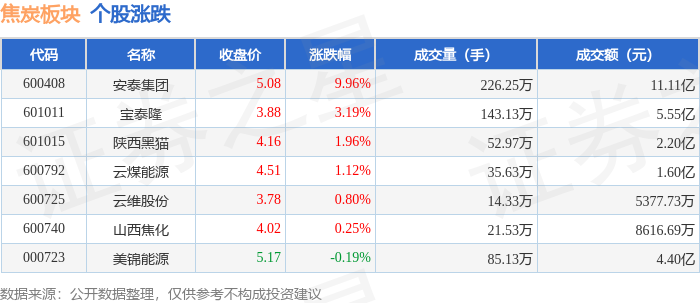
Core Insights - The coke sector experienced a rise of 1.48% on December 2, with Antai Group leading the gains [1] - The Shanghai Composite Index closed at 3897.71, down 0.42%, while the Shenzhen Component Index closed at 13056.7, down 0.68% [1] Sector Performance - Antai Group saw a closing price of 5.08, with a significant increase of 9.96% and a trading volume of 2.2625 million shares, amounting to a transaction value of 1.111 billion yuan [1] - Baotailong closed at 3.88, up 3.19%, with a trading volume of 1.4313 million shares and a transaction value of 0.555 billion yuan [1] - Shaanxi Heimei closed at 4.16, increasing by 1.96%, with a trading volume of 0.5297 million shares and a transaction value of 0.220 billion yuan [1] - Yunnan Coal Energy closed at 4.51, up 1.12%, with a trading volume of 0.3563 million shares and a transaction value of 0.160 billion yuan [1] - Yunwei Co. closed at 3.78, increasing by 0.80%, with a trading volume of 0.1433 million shares and a transaction value of 0.0538 billion yuan [1] - Shanxi Coking Coal closed at 4.02, up 0.25%, with a trading volume of 0.2153 million shares and a transaction value of 0.0862 billion yuan [1] - Meijin Energy closed at 5.17, slightly down by 0.19%, with a trading volume of 0.8513 million shares and a transaction value of 0.044017 billion yuan [1] Capital Flow - The coke sector saw a net inflow of 216 million yuan from main funds, while retail funds experienced a net outflow of 143 million yuan [1] - The main fund inflow for Antai Group was 209 million yuan, accounting for 18.84% of the total, while retail funds saw a net outflow of 152 million yuan [2] - Yunnan Coal Energy had a main fund inflow of 13.83 million yuan, representing 8.64%, with retail funds experiencing a net outflow of 10.79 million yuan [2] - Shaanxi Heimei had a main fund inflow of 3.94 million yuan, accounting for 1.79%, while retail funds saw a net outflow of 8.27 million yuan [2] - Meijin Energy had a minor main fund inflow of 0.94 million yuan, with retail funds experiencing a net outflow of 0.83 million yuan [2] - Yunwei Co. had a slight main fund outflow of 0.079 million yuan, while retail funds saw a net inflow of 0.3713 million yuan [2] - Baotailong experienced a main fund outflow of 0.40279 million yuan, with retail funds seeing a net inflow of 1.633 million yuan [2] - Shanxi Coking Coal had a main fund outflow of 0.79832 million yuan, while retail funds saw a net inflow of 0.45428 million yuan [2]

云煤能源涨2.02%,成交额7407.91万元,主力资金净流入563.68万元
Xin Lang Cai Jing· 2025-12-02 02:39
Core Viewpoint - Yunmei Energy's stock has shown a significant increase this year, with a 21.66% rise, despite some fluctuations in the short term [1][2]. Group 1: Stock Performance - As of December 2, Yunmei Energy's stock price reached 4.55 CNY per share, with a market capitalization of 5.05 billion CNY [1]. - The stock has experienced a net inflow of 563.68 million CNY from major funds, with significant buying activity noted [1]. - The stock has appeared on the trading leaderboard eight times this year, with the most recent occurrence on November 17 [1]. Group 2: Financial Performance - For the period from January to September 2025, Yunmei Energy reported a revenue of 3.96 billion CNY, a decrease of 23.07% year-on-year, while the net profit attributable to shareholders was -182 million CNY, an increase of 41.54% year-on-year [2]. - The company has distributed a total of 99.53 million CNY in dividends since its A-share listing, with 76.58 million CNY distributed over the past three years [3]. Group 3: Shareholder Structure - As of September 30, 2025, the number of shareholders for Yunmei Energy was 40,000, a decrease of 10.20% from the previous period [2]. - The top ten circulating shareholders include major funds such as Guotai Zhongxin Coal ETF and others, with notable increases in their holdings [3].

【钢铁】伦敦现货金银价格比值创2024年8月以来新低水平——金属周期品高频数据周报(11.24-11.30)(王招华/戴默)
光大证券研究· 2025-12-01 23:04
Core Viewpoint - The report highlights the current state of various sectors, including liquidity, infrastructure, real estate, industrial products, and export chains, providing insights into price changes, production rates, and market conditions. Liquidity - The BCI small and medium enterprise financing environment index for November 2025 is 52.50, with a month-on-month increase of 0.17% [4] - The M1 and M2 growth rate difference in October 2025 is -2.0 percentage points, a decrease of 0.80 percentage points from the previous month [4] - The current price of London gold is $4,219 per ounce [4] Infrastructure and Real Estate Chain - Total inventory of five major steel varieties is at the highest level for the same period in four years [5] - Price changes this week include rebar up by 0.93% and cement price index up by 0.22%, while rubber decreased by 0.34% and coking coal by 3.14% [5] - National blast furnace capacity utilization rate, cement, and asphalt operating rates have changed by -0.60 percentage points, -1.27 percentage points, and +8.1 percentage points respectively [5] Real Estate Completion Chain - Prices of titanium dioxide and flat glass remain stable, with glass gross profit at -58 yuan/ton and titanium dioxide gross profit at -4,026 yuan/ton [6] - The operating rate for flat glass this week is 74.52% [6] Industrial Products Chain - Major commodity price changes this week include cold-rolled steel down by 0.25%, copper up by 1.77%, and aluminum up by 0.33% [7] - The gross profit for cold-rolled steel has turned from loss to profit, while the losses for other commodities have increased by 1.86% and 1.49% respectively [7] - The national semi-steel tire operating rate is 69.19%, a decrease of 1.88 percentage points [7] Subcategories - Tungsten concentrate prices have reached a new high since 2012, currently at 339,000 yuan/ton, with a week-on-week increase of 3.04% [8] - The price of graphite electrodes is 18,500 yuan/ton, with a gross profit of 1,357.4 yuan/ton, down by 17.59% [8] - The price of electrolytic aluminum is 21,430 yuan/ton, with estimated profit at 4,223 yuan/ton (excluding tax), up by 1.49% [8] Price Comparison Relationships - The price ratio of rebar to iron ore this week is 4.08 [10] - The price difference between hot-rolled and rebar steel is 40 yuan/ton, while the price difference between cold-rolled and hot-rolled steel is 490 yuan/ton, down by 50 yuan/ton [10] - The price ratio of stainless steel hot-rolled to electrolytic nickel is 0.11 [10] Export Chain - The new export orders PMI for China in October 2025 is 45.90%, a decrease of 1.9 percentage points [11] - The CCFI comprehensive index for container shipping rates is 1,121.80 points, down by 0.09% this week [11] - The capacity utilization rate for crude steel in the U.S. is 76.90%, an increase of 0.70 percentage points [11] Valuation Percentiles - The CSI 300 index has increased by 1.64%, with the best-performing cyclical sector being industrial metals, up by 3.46% [12] - The PB ratio of ordinary steel and industrial metals relative to the CSI 300 is 37.40% and 86.64% respectively [12] - The current PB ratio for the ordinary steel sector relative to the CSI 300 is 0.53, with the highest value since 2013 being 0.82 [12]