
软件

Search documents
微软将于明年7月上调商业版Office订阅价格
Xin Lang Cai Jing· 2025-12-04 23:48
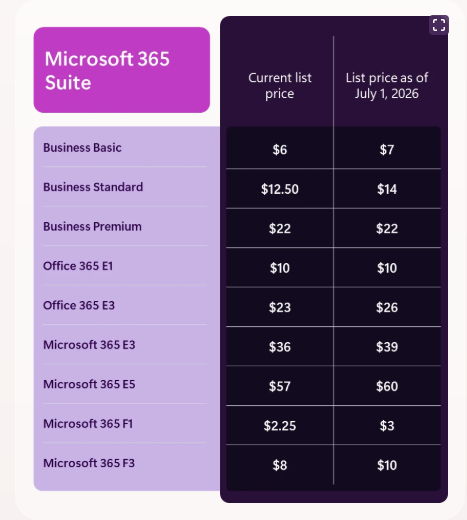
Core Viewpoint - Microsoft announced a price increase for its Office software subscriptions aimed at business and government customers, effective July 1, 2026 [1]. Pricing Summary - Microsoft 365 Business Basic will increase from $6 to $7 [2] - Microsoft 365 Business Standard will rise from $12.50 to $14 [2] - Microsoft 365 Business Premium will remain at $22 [2] - Office 365 E1 will stay at $10 [2] - Office 365 E3 will increase from $23 to $26 [2] - Microsoft 365 E3 will rise from $36 to $39 [2] - Microsoft 365 E5 will increase from $57 to $60 [2] - Microsoft 365 F1 will rise from $2.25 to $3 [2] - Microsoft 365 F3 will increase from $8 to $10 [2]


合肥草源科技有限责任公司成立 注册资本10万人民币
Sou Hu Cai Jing· 2025-12-04 23:21
Group 1 - Hefei Caoyuan Technology Co., Ltd. has been established with a registered capital of 100,000 RMB [1] - The legal representative of the company is Zhang Lingling [1] - The company's business scope includes manufacturing and sales of power electronic components, electronic components, and various related equipment [1] Group 2 - The company is involved in the manufacturing and sales of batteries, electric motors, and their control systems [1] - It also engages in software development, information technology consulting, and system integration services [1] - The company has a focus on new energy equipment manufacturing and sales, including electric vehicles and related components [1]
2025德勤深圳高科技高成长20强及明日之星榜单出炉 四成高科技企业上市首选A股
Shen Zhen Shang Bao· 2025-12-04 23:12
Core Insights - The 2025 Deloitte Shenzhen High-Tech High-Growth Top 20 and Rising Stars list was released, highlighting the top three companies: Shenzhen Qiyu Innovation Technology Co., Ltd., Urban Light (Shenzhen) Unmanned Driving Co., Ltd., and Shenzhen Huixin Biomedical Technology Co., Ltd. [1] - The evaluation aims to discover and recognize local high-growth and innovative companies, with a focus on breaking technological boundaries and cross-domain integration [1][2]. Group 1: Company Performance - The average cumulative revenue growth rate of the Shenzhen Top 20 companies exceeded 350% over the past two years, with the number of companies generating over 100 million yuan in revenue doubling from 4 in 2022 to 8 in 2023 [1]. - The 46 companies on the list are primarily focused on software, hardware, high-end equipment, and life sciences, with software companies making up 30% and hardware companies 24% of the total [1]. Group 2: R&D and Innovation - Shenzhen continues to lead the nation in technology R&D investment and intellectual property, reflecting the city's ongoing innovation strength [2]. - According to the "Shenzhen High-Tech Enterprises CEO Survey," 19% of surveyed companies allocate over 80% of their budget to R&D, with significant investments directed towards artificial intelligence and machine learning (57%) and cloud computing and big data (50%) [2]. Group 3: Sustainable Development and Challenges - Over half of the companies find it challenging to balance short-term profits with long-term sustainable development, with 47% facing regional standard discrepancies and 24% hindered by funding and technology bottlenecks [3]. - Nearly 40% of companies prefer to establish headquarters or branches in the Yangtze River Delta and Greater Bay Area, prioritizing market access, talent supply, and business environment [3]. Group 4: Financing and Expansion - Companies in Shenzhen maintain an optimistic outlook regarding financing, with over 40% expecting to raise more than 100 million yuan in the future, and the A-share market being the preferred listing destination for 40% of these companies [3].

科技股不再领涨美股?机构回应
Di Yi Cai Jing Zi Xun· 2025-12-04 15:36
Core Viewpoint - The article discusses the current state of the U.S. stock market, particularly focusing on the performance of technology and AI-related stocks, which have lagged behind other sectors, raising concerns about an "AI bubble" that major financial institutions are now challenging [2][8]. Group 1: Market Performance - Since October 28, the S&P 500 index has seen a shift in leading sectors, with biotech companies like Eli Lilly, Cardinal Health, and Biogen showing significant gains of 28%, 26%, and 21% respectively, while the overall biotech sector rose by 10.7% [3]. - In contrast, the S&P 500 Information Technology index has declined by 4.2%, with the "Big Seven" tech stocks down by 1.3%, except for Alphabet, which increased by 18.1% [3][6]. - Nvidia, a leading AI stock, has dropped by 9.7%, and AI-related stocks overall have seen declines of 8.4% [3][6]. Group 2: AI Bubble Debate - Major institutions like BlackRock and Bank of America are disputing the notion of an "AI bubble," asserting that the current AI trend is driven by genuine corporate investments and productivity growth, rather than irrational exuberance seen during the internet bubble [2][8]. - BlackRock's Jean Boivin emphasized that the scale and speed of AI expansion make the bubble narrative incomplete, suggesting that AI spending could significantly boost U.S. GDP growth beyond the historical 2% trend [8][10]. - The estimated global corporate AI spending could reach between $5 trillion to $8 trillion by 2030, indicating a substantial commitment to AI investments [8]. Group 3: Investment Dynamics - Despite skepticism towards tech and AI stocks, companies are increasing their investments in AI data centers, which have shown strong earnings growth in recent financial reports [7][9]. - The capital expenditure by U.S. tech firms has risen from 30% of operating cash flow a decade ago to 60% now, although this is still below the 140% peak during the internet bubble [10][11]. - Bank of America predicts that the massive capital expenditures for AI infrastructure will reach $400 billion by 2025 and $510 billion by 2026 for major AI companies [10].



福昕软件熊雨前:标准引领,构建“自主研发+全球协同”技术供应链
Zhong Guo Jing Ying Bao· 2025-12-04 10:55
Core Viewpoint - The software industry is undergoing a transformation from "cost-driven outsourcing" to "technology-driven value output," emphasizing the importance of supply chain capabilities for global competitiveness [5][10]. Group 1: Company Strategy - Foxit Software has transitioned from a follower to a technology leader in the PDF software industry, investing heavily in international standard development [2]. - The company emphasizes the importance of building localized organizations to strengthen its global presence and adapt to regional market needs [6][10]. - Foxit Software adopts a "domestic core R&D + overseas regional branches" structure to balance compliance with local regulations and long-term growth [4][6]. Group 2: Supply Chain Capabilities - The company identifies three core capabilities for supply chain success: connectivity, control, and design [3]. - Foxit Software collaborates with upstream technology providers and downstream local partners to create a closed-loop system of "technology supply - market feedback - product iteration" [3][4]. - The company focuses on mastering key value nodes, such as format parsing and encryption, to avoid dependency on foreign technologies [3][4]. Group 3: Global Market Expansion - Foxit Software plans to expand its market reach beyond traditional regions like Europe and the U.S., targeting emerging markets with high digital transformation needs [5][10]. - The company employs a strategy of "precise selection of regions + layered advancement" to adapt its approach based on market characteristics [5][10]. - The firm aims to build a collaborative ecosystem with local partners to enhance its service network in new markets, particularly along the Belt and Road Initiative [5][10]. Group 4: Collaborative Ecosystem - The company believes in the importance of "collective overseas expansion" to mitigate risks, where leading firms set direction and platforms while supporting enterprises fill in the supply chain [8]. - Foxit Software has established a collaborative network with various partners, enhancing its software capabilities within local digital ecosystems [7][8]. Group 5: Compliance and Resilience - The company stresses the need for compliance as a prerequisite, localization as a key factor, and resilience as a guarantee for successful overseas operations [11]. - Foxit Software aims to build a technology supply chain system that avoids reliance on a single region, thereby reducing geopolitical risks [10].

独家深度|一文读懂以色列独角兽
Sou Hu Cai Jing· 2025-12-04 10:49
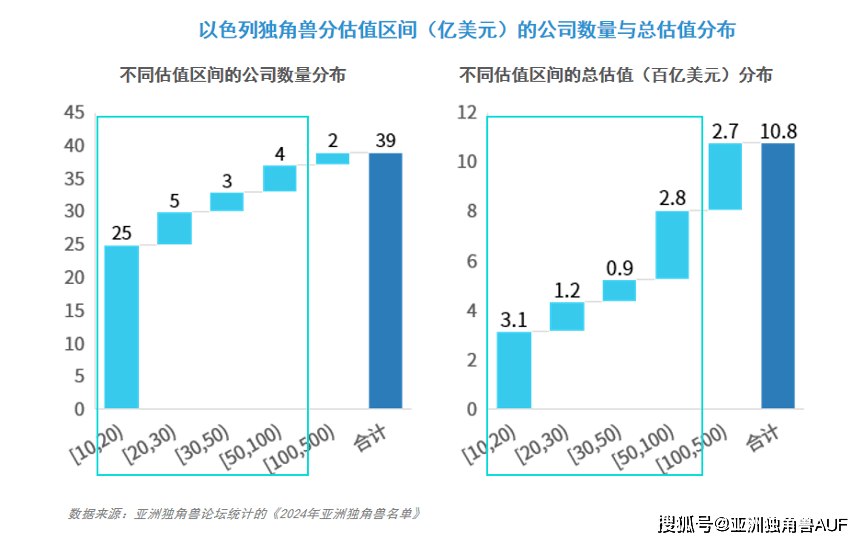
Core Insights - As of the end of 2024, Israel has 39 unicorns with a total valuation of $107.6 billion and an average valuation of $2.7 billion, ranking third in Asia for total number, valuation, and historical financing [1][3] Group 1: Valuation and Financing - The historical cumulative financing amount for the 39 Israeli unicorns is $15.36 billion, with an average financing amount of $390 million; 62% of companies are below the average financing level [3] - The valuation distribution of Israeli unicorns shows a typical "long-tail structure," with 74% of unicorns valued below $2.7 billion [1][4] - Companies valued between $1 billion and $5 billion account for 2 firms with a combined valuation of $27 billion, while 33 companies valued below $5 billion represent 85% of the total [4][5] Group 2: Geographic Distribution - The majority of Israeli unicorns are located in four districts: Tel Aviv (31 companies, 79%), Central (6 companies, 15%), Haifa (1 company), and Jerusalem (1 company) [9][12] - Tel Aviv contributes the highest total valuation of $89 billion, accounting for 83% of the total valuation of Israeli unicorns [12] Group 3: Industry Breakdown - Israeli unicorns span six primary industries, with the software industry leading with over 10 companies, representing 64% of the total [15] - The cybersecurity sector has the highest representation among secondary industries, with 10 companies making up 25% of the total [15][19] - Other notable industries include transportation (5 companies, 13%) and fintech, entertainment, healthcare, and hard tech, each with fewer than 5 companies [15]
2026年将是打新超级大年?从OpenAI到“美国两房”,万亿“私募库存”待上市!
Zhi Tong Cai Jing· 2025-12-04 09:25
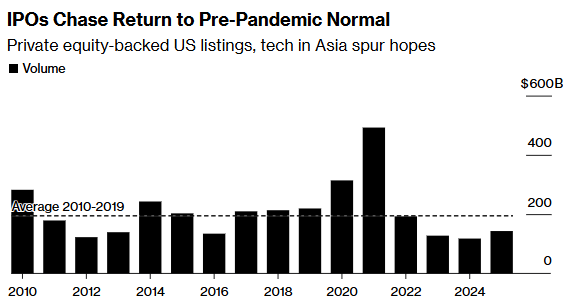
Group 1 - Investment bankers are urging private equity firms to continue driving the IPO market recovery in 2026, following a strong momentum in 2025 where private equity-backed IPOs reached their highest level since 2021 in Q3 [1][2] - A range of large companies across various sectors are expected to go public in 2026, with significant potential transactions globally, including Jio Platforms Ltd. in India, which could be valued at $170 billion [2] - In 2023, IPOs (excluding SPACs) raised $146 billion, still below the pre-pandemic average, indicating that large-scale listings could help surpass this threshold if market conditions are favorable [3] Group 2 - The performance of private equity-backed IPOs has been mixed, with some companies like Verisure Plc showing positive stock performance, while others like SailPoint Inc. and NIQ Global Intelligence Plc have seen significant declines [6] - The number of private equity-backed IPOs in 2025 is projected to be among the lowest since 2010, with only 137 companies expected to go public [6] - Investment banks are actively promoting new projects to companies, with major firms like Blackstone announcing their largest IPO plans since 2021 [6] Group 3 - The year 2026 is anticipated to be significant for private equity-backed companies entering the IPO market, depending on valuation agreements between investors and asset owners [7] - Private equity firms are utilizing various methods to return capital to investors, including selling assets to continuation funds, providing greater flexibility in deciding when to go public [8] - In Europe, the IPO activity is gradually increasing, although the region still lags behind others globally, with companies considering moving to U.S. exchanges for better valuations [10] Group 4 - High expectations remain for private equity-backed IPOs, but they may be overshadowed by the potential listings of major companies like Fannie Mae and Freddie Mac, as well as high-profile tech firms like OpenAI and Databricks [11] - The private market's capacity for funding billion-dollar startups is uncertain, but the public market is believed to have a much larger capacity [12] - Factors driving market activity recovery include attractive stock valuations, international capital inflow to Asia, and innovation in sectors like technology and healthcare [12]
dbg markets:ADP爆冷点燃降息预期,美股小盘股狂欢、铜金创历史
Sou Hu Cai Jing· 2025-12-04 08:29
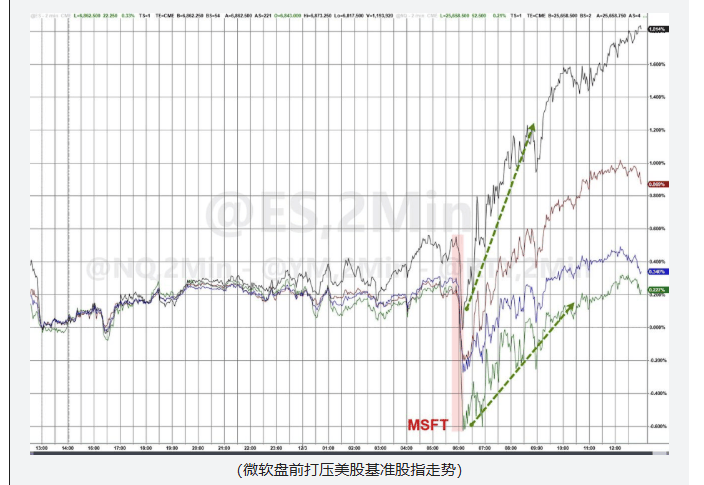
Group 1 - The unexpected decline of 32,000 jobs in the US ADP employment data for November marks the largest drop since March 2023, leading to a surge in expectations for a Federal Reserve interest rate cut [2] - Following the employment data release, stock index futures rose sharply, while US Treasury yields fell across the board, and the US dollar index dropped below its 50-day moving average, reaching a one-month low [2] - The Russell 2000 index experienced a significant rebound, closing up 1.91%, marking its largest single-day gain in two months, while the S&P 500 regional bank ETF rose by 2.08% [2] Group 2 - The technology sector showed mixed results, with Microsoft shares down 2.5%, resulting in a market cap loss of approximately $75 billion, while Tesla shares surged 4% due to reports of potential support for the robotics industry [3] - The Philadelphia Semiconductor Index rose by 1.83%, with notable gains in TSMC ADR and AMD, indicating a recovery in chip stocks [3] - Commodity markets also reacted positively, with copper prices hitting a new historical high, and gold and silver prices rising, reflecting increased risk appetite [3] Group 3 - The bond market fully priced in a December interest rate cut, with the 10-year Treasury yield falling to 4.06% and the 2-year yield to 3.49%, indicating a steepening yield curve [4] - The US dollar index decreased by 0.51%, leading to a strengthening of non-US currencies, with the offshore yuan appreciating for the third consecutive day [4] - European markets showed mixed performance, with the STOXX600 index slightly up, while major indices like DAX30 and CAC40 experienced minor fluctuations, reflecting a narrow trading range [4]
东方甄选将在京开首家旗舰店|首席资讯日报
首席商业评论· 2025-12-04 04:16
Group 1 - Dongfang Zhenxuan will open its first flagship store in Beijing, marking the beginning of its plan to establish 100 stores nationwide. The store will have an area of approximately 400 square meters and will offer fresh produce, snacks, daily necessities, and a dining area [2] - Moore Threads announced that it will be listed on the Shanghai Stock Exchange's Sci-Tech Innovation Board on December 5, 2025, following approval from the Shanghai Stock Exchange [3] - Douyin e-commerce has adjusted the rules for its "Super Lucky Bag," prohibiting misleading terms such as "random delivery" and "mystery box" due to violations found during inspections [3] - McDonald's sold a store in Hong Kong for 38 million HKD, part of a strategy where it has sold four stores in the region within a month, totaling approximately 300 million HKD [3] - LVMH responded to accusations from the Hermes heir, denying any secret shareholding in Hermes and stating that such claims have been dismissed by Swiss authorities [4] Group 2 - TikTok announced plans to invest in its first data center in Latin America, located in Brazil, as part of its expansion strategy in the region [5] - Microsoft has lowered its sales targets for AI software due to lukewarm responses from enterprise customers, reflecting a shift in market expectations for AI product adoption [6] - The film "Unnamed: Meaning Extraordinary" has been postponed to ensure quality, originally scheduled for release on December 31 [7] - Doubao Mobile Assistant responded to privacy infringement allegations, clarifying that user consent is required for data access and that no data is stored on the cloud [8] - Liu Xin, a prominent investor, publicly announced a search for a partner, revealing that his stock holdings exceed 1 billion CNY, attracting attention in the financial community [9] - Huawei signed a cooperation agreement with the China Foreign Languages Publishing Administration to enhance collaboration in areas such as innovation and AI technology in the media industry [10] - Luzhou Laojiao's board has nominated Yi Zhi and Chen Guoxiang as independent director candidates, confirming their qualifications and commitment to independence [11]


前10月软件业务收入同比增长13.2%
Ren Min Ri Bao· 2025-12-03 21:58
Core Insights - The software industry in China has shown robust growth in revenue and profit, with a total software business revenue of 1,251.04 billion yuan, marking a year-on-year increase of 13.2% [1] - The total profit of the software industry reached 157.21 billion yuan, reflecting a year-on-year growth of 7.7% [1] - Software exports amounted to 51.09 billion USD, with a year-on-year increase of 6.7%, maintaining positive growth for eight consecutive months [1] Revenue Breakdown - Software product revenue reached 265.04 billion yuan, growing by 11.2% year-on-year, accounting for 21.2% of the total industry revenue [1] - Basic software product revenue was 15.83 billion yuan, with a growth rate of 12.0% [1] - Industrial software product revenue stood at 26.19 billion yuan, increasing by 9.9% [1] Information Technology Services - Revenue from information technology services was 860.53 billion yuan, showing a year-on-year growth of 14.4%, representing 68.8% of the total industry revenue [1] - Cloud computing and big data services generated 130.78 billion yuan, with a growth of 13.4% [1] - Integrated circuit design revenue reached 35.91 billion yuan, growing by 17.2% [1] - E-commerce platform technology service revenue was 115.76 billion yuan, increasing by 12.1% [1] Other Revenue Streams - Revenue from information security products and services was 18.10 billion yuan [1] - Revenue from embedded system software was 107.36 billion yuan [1]