
数据中心

Search documents
美银美林:电价上涨带来居民抵制,美国数据中心面临挑战,太阳能和储能将是短期关键
美股IPO· 2025-09-29 00:18
Core Viewpoint - The construction boom of AI data centers is driving a significant increase in electricity demand, leading to rising electricity prices and creating a dual challenge of "power scarcity" and "community opposition" in the U.S. [1][3][5] Group 1: Electricity Price Surge - The capacity price in the PJM interconnection has skyrocketed from $2.2 billion in the 2023/2024 delivery year to $16.1 billion in the 2026/2027 delivery year [7] - Capacity prices in the PJM "rest of market" region surged from $29 per megawatt-day in the 2024/2025 delivery year to $269 per megawatt-day in the 2025/2026 delivery year, marking an increase of over five times within a year [7][8] - This price surge has resulted in average electricity bills for residents in the PJM region increasing by 18% to 25% [8][10] Group 2: Community and Regulatory Response - At least 12 states in the U.S. are considering new policies to ensure data centers bear the costs of their electricity consumption to avoid passing these costs onto consumers [3][11] - Local policymakers are under pressure to create special rate structures that internalize the costs associated with data centers, indicating a shift in policy focus [11][12] - Community opposition, driven by concerns over rising electricity costs, water resource consumption, and noise pollution, is becoming a significant barrier to data center projects [13][14] Group 3: Energy Solutions - Solar and energy storage technologies accounted for 80% of the new electricity generation capacity in the U.S. in 2024, making them key solutions for meeting the rising electricity demand [4][16] - Natural gas is expected to play a crucial role in providing stable power in the short term, while nuclear energy is viewed as a long-term solution beyond the 2030s [18][19] - Major tech companies like Microsoft, Amazon, and Google are exploring agreements with nuclear energy firms to directly supply power to their data centers [19]

高澜股份20250926
2025-09-28 14:57
Summary of Gaolan Co., Ltd. Conference Call Company Overview - **Company**: Gaolan Co., Ltd. (高澜股份) - **Industry**: Thermal management and cooling solutions, particularly in high voltage and data center applications - **Market Position**: Leading player in ultra-high voltage pure water cooling with approximately 70% market share [8][20] Key Points and Arguments Business Performance - **Order Growth**: Orders increased from less than 600 million CNY on June 30, 2024, to nearly 1.139 billion CNY by June 30, 2025, representing a doubling in growth [9][22] - **Revenue Forecast**: Expected revenue from data center business to exceed 300 million CNY in 2024, a 50% year-on-year increase [3][10] - **Main Business Recovery**: The main business has shown signs of stabilization and recovery, with a positive outlook for 2026 due to a strong order backlog [5][11] Industry Dynamics - **Market Trends**: The upgrade from GB200 to GB300 standards is anticipated to significantly enhance liquid cooling penetration and improve pricing and volume [2][6] - **Electricity Demand**: Continuous growth in domestic electricity demand, with significant investments planned by State Grid and Southern Grid, expected to benefit Gaolan [5][19] - **Data Center Growth**: The data center liquid cooling segment is essential for temperature control, expected to grow alongside the rapid expansion of data centers and AI servers [10][24] Technological and Competitive Advantages - **Technical Expertise**: Gaolan has over 20 years of experience in thermal management, with advanced technology recognized both domestically and internationally [8][13] - **Product Range**: The company offers high-power electronic thermal management products and high-power density device thermal management products, catering to various sectors including data centers and energy storage [14][27] - **Patents and Standards**: Involvement in drafting numerous national and industry standards, holding over 300 patents, which strengthens its competitive position [13] International Expansion - **Overseas Market Entry**: Established a wholly-owned subsidiary in the U.S. to prepare for future overseas opportunities, although significant breakthroughs are still pending [7][20] - **International Orders**: Secured a 500 million CNY order in Saudi Arabia, with potential for further contracts in emerging markets [20] Future Outlook - **Growth Potential**: The company is positioned as a key player in AI computing, with potential for significant growth in the high-speed data center market [11][29] - **Investment Recommendation**: Analysts recommend focusing on Gaolan due to its recovery in main business and potential for growth, suggesting it is a good time for investors to pay attention [30] Additional Important Information - **Client Base**: Gaolan's clients include major players like State Grid, Southern Grid, CATL, ByteDance, Alibaba, and Tencent, indicating a strong market presence [9][10] - **Financial Performance**: Despite a revenue decline in 2023 due to the divestment of a subsidiary, a recovery is expected in 2025 with a projected profit turnaround [17][30] - **Liquid Cooling Technology**: The company is involved in various liquid cooling technologies, including cold plate and immersion cooling, with a focus on meeting the increasing demands of data centers [26][24]

AIDC投资机会展望:算力需求持续加码,重视技术迭代契机
2025-09-28 14:57
Summary of Key Points from Conference Call Industry Overview - The conference call discusses the opportunities in the AI Data Center (AIDC) sector, highlighting the increasing demand for computing power and the technological advancements in the industry [1][2]. Core Insights and Arguments - **Collaboration between OpenAI and NVIDIA**: OpenAI is set to deploy at least 10 GW of NVIDIA systems, with NVIDIA investing up to $100 billion. This collaboration indicates a surge in computing power demand, with the cost of building 1 GW estimated at $50 billion, leading to a total investment of approximately $500 billion for the 10 GW project [2]. - **Market Potential in Cooling Technologies**: The liquid cooling, HVDC, and PSU segments are projected to generate market opportunities of $70 billion, $15 billion, and $20 billion respectively. The rapid growth in market size and new technology developments are expected to drive domestic companies to accelerate their international expansion, with initial overseas orders anticipated by 2026 and accelerated growth by 2027 [3][4]. - **Alibaba's AI Infrastructure Investment**: Alibaba plans to invest ¥380 billion (approximately $53 billion) in AI infrastructure over the next three years, aiming to increase global data center energy consumption to ten times the current level by 2032. They are also collaborating with NVIDIA on Physical AI to enhance smart application development [5]. - **Financing Activities by Domestic Internet Companies**: Tencent, Alibaba, and Baidu have issued notes for financing to establish new application areas, while ByteDance has secured a $10 billion loan for expansion. These actions reflect a strategic push towards internationalization and the establishment of overseas cloud technology facilities [6]. Emerging Technologies - **Microchannel Cooling Technology (MLCP)**: NVIDIA's MLCP is designed to improve cooling efficiency for high-power chips, with costs 3-5 times higher than traditional water cooling solutions. This technology is expected to be implemented in the Ruby GPU by the second half of 2026 [7][9]. - **Advantages of Microchannel Cooling**: The technology features miniaturized internal structures that enhance heat exchange efficiency and integrates multiple components into a single unit, significantly improving cooling performance [8][12]. Investment Opportunities - **Power Supply Innovations**: The transition from traditional UPS systems to high-voltage direct current (HVDC) systems presents significant investment opportunities, particularly in the AIGC sector. Companies like Megmeet and Euron are well-positioned to benefit from this shift [16][19]. - **Market Outlook**: The overall sentiment towards the AIDC sector remains optimistic, with expectations of accelerated market growth by 2026. There are currently no signs of price competition deterioration or market saturation, indicating a favorable environment for investment [20]. Additional Important Insights - **Technological Trends in Power Supply**: The power technology sector is witnessing a shift towards integrated solutions to enhance efficiency and reduce costs. Solid-state transformer (SST) technology is emerging as a potential long-term solution [18]. - **Beneficiaries of Technological Changes**: Companies capable of transitioning from single products to comprehensive solutions, such as Megmeet and Euron, are expected to gain significantly from these technological advancements [19].



阿里云栖大会观展反馈
2025-09-28 14:57
Summary of Key Points from Conference Call Records Industry Overview - The conference call primarily discusses the developments in the domestic computing power industry, particularly focusing on AI hardware and data center infrastructure in China, with significant contributions from companies like Alibaba, Huawei, and ByteDance [1][2][3]. Core Insights and Arguments - **Domestic Computing Power Commercialization**: A commercial closed loop for domestic computing power is expected to form and strengthen by October 2024, driven by advancements in AI models and breakthroughs in chip technology from companies like Huawei and Cambricon [1][3]. - **Data Center Growth**: Alibaba's data center capacity is projected to reach 10 times its 2022 levels by 2032, with annual additions of 6-7 GW [1][4]. - **AI Hardware Ecosystem**: The domestic AI hardware ecosystem is rapidly developing, with companies like ZTE and ByteDance entering the chip market, indicating strong demand for training and inference models [1][6]. - **Token Consumption**: ByteDance's token consumption has surpassed that of Google, highlighting a significant increase in demand for AI applications [4]. - **Profitability Improvements**: Companies in the domestic computing power sector, such as Huafeng and Ruijie Networks, have shown notable improvements in gross and net profit margins [22]. Important Developments - **Technological Innovations**: Alibaba's new Cube 5.0 data center design emphasizes rapid delivery and compatibility with future technologies, including both air and liquid cooling systems [16][17]. - **Interconnect Protocols**: The introduction of open interconnect protocols by Alibaba, Huawei, and Haiguang facilitates better integration among GPU and switch chip companies, enhancing overall system efficiency [5][9]. - **Liquid Cooling Demand**: There is a significant increase in demand for liquid cooling technologies, with many companies participating in various cooling components [11][26]. - **AI Server Cooling Technologies**: New materials like liquid metal and graphene are being explored for AI server cooling, with Alibaba adopting liquid metal solutions to manage high power outputs [18]. Additional Noteworthy Content - **Market Trends**: The global computing power market has experienced significant fluctuations, with domestic computing power previously facing challenges such as limited capital expenditure and restrictions on high-quality model training due to chip bans [2]. - **Future Infrastructure Needs**: The demand for data center infrastructure is expected to rise, with Alibaba planning to increase its energy consumption tenfold by 2032, indicating a positive outlook for the industry [19][20]. - **Emerging Competitors**: The domestic computing power landscape is evolving, with companies developing their own GPUs and launching new products, reflecting a shift towards self-sufficiency in technology [21]. This summary encapsulates the key points discussed in the conference call, highlighting the advancements and trends within the domestic computing power industry and the strategic moves by leading companies.
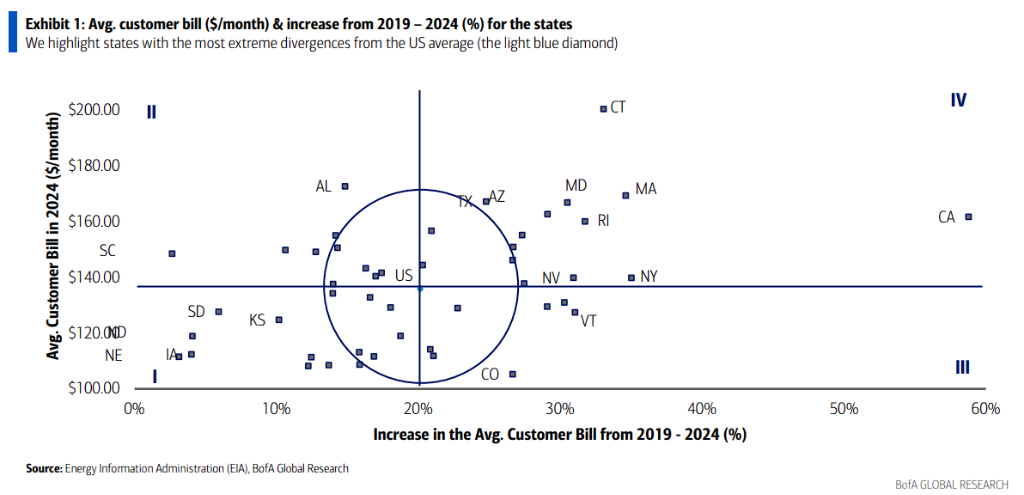
电价上涨带来居民抵制,美国数据中心面临挑战,太阳能和储能将是短期关键
Hua Er Jie Jian Wen· 2025-09-28 11:57
Core Insights - The construction of data centers in the U.S. is facing a dual challenge of power scarcity and community opposition, exacerbated by rising electricity prices driven by increased demand from these centers [1][6][8] Group 1: Electricity Price Surge - The capacity price in the PJM interconnection has skyrocketed from $2.2 billion in the 2023/2024 delivery year to $16.1 billion in the 2026/2027 delivery year, indicating a significant increase in electricity costs [3] - Capacity prices in the PJM "rest of market" area surged from $29 per megawatt-day in the 2024/2025 delivery year to $269 per megawatt-day in the 2025/2026 delivery year, marking a more than fivefold increase within a year [3] - This surge in electricity prices has resulted in an average bill increase of 18% to 25% for residents in the PJM region [3][6] Group 2: Policy Responses and Community Resistance - At least 12 states are considering new policies to ensure data centers bear the full costs of their electricity consumption, aiming to prevent the financial burden from falling on ordinary consumers [1][7] - Local policymakers are under pressure to create special rate structures that internalize the costs associated with data centers, reflecting a significant policy shift [7] - Community opposition, driven by concerns over rising electricity costs, water resource depletion, and noise pollution, is increasingly becoming a threat to data center projects [8][9] Group 3: Energy Solutions - Short-term solutions to the electricity demand crisis include solar and energy storage, which accounted for 80% of new generation capacity in the U.S. in 2024 [2][10] - The U.S. Energy Information Administration (EIA) reported that 48.6 GW of new capacity was added, with approximately 80% coming from solar and storage [10] - In the long term, natural gas and nuclear energy are viewed as essential components for ensuring stable power supply, with large tech companies exploring direct power agreements with nuclear energy providers [10][14]

全球AI功耗正在迅速失控
半导体芯闻· 2025-09-28 09:47
Core Insights - By 2030, the energy consumption of AI racks is expected to be 20 to 30 times that of traditional racks, with individual AI racks potentially consuming up to 1MW of power [1][4]. Group 1: Energy Consumption and Capacity - The average power capacity of data center racks is projected to rise to 30-50kW, reflecting an increase in computing density, particularly in comparison to AI workloads [2]. - The energy demands of AI racks will necessitate new requirements for power delivery and cooling infrastructure [3]. Group 2: Cooling Solutions - Cooling has become a central focus in the industry due to increased computing density and AI workloads, with a growing interest in liquid cooling methods [3]. - Current cooling methods, such as cooling plates, have limitations, prompting companies like Microsoft to explore microfluidic technology for more efficient cooling solutions [5]. Group 3: Industry Collaboration and Innovation - There is a notable increase in collaboration among manufacturers, engineers, and end-users to address complex cooling challenges [5]. - Smaller operators may find competitive opportunities in the market due to potential delivery bottlenecks faced by larger operators, emphasizing agility and innovation as key advantages [6].

通信行业点评:液冷技术再突破,IDC热管理“变纪元”开启
Minsheng Securities· 2025-09-28 07:29
Investment Rating - The report maintains a "Recommended" rating for Invec, Gaolan Co., and a "Cautious Recommendation" for Kexin New Source [4]. Core Insights - Microsoft's breakthrough in liquid cooling technology, specifically in-chip microfluidic cooling, significantly enhances heat removal efficiency by 2-3 times compared to traditional methods, allowing for stable high-frequency operation of chips and reducing peak temperature by 65% [2][3]. - The introduction of this technology is expected to reshape the IDC liquid cooling landscape, potentially leading to a "second impact" on the industry as more chip servers may come with built-in liquid cooling systems [2]. - The global electricity demand for data centers is projected to double from approximately 460 TWh in 2024 to over 1000 TWh by 2030, indicating a substantial increase in infrastructure energy consumption [3]. Summary by Sections Liquid Cooling Technology - Microsoft's new liquid cooling method utilizes microfluidic technology, which involves etching micron-level channels on the back of chips to directly cool heat sources, improving operational efficiency and sustainability [2]. - The potential for a 20%-30% improvement in Power Usage Effectiveness (PUE) could lead to significant reductions in data center operational costs [2]. Market Opportunities - The report highlights the growing need for advanced cooling solutions as AI development continues to drive demand for higher computing power, positioning liquid cooling as a critical technology to address power constraints [3]. - Companies to watch include Invec, Gaolan Co., and Kexin New Source, which are expected to benefit from these advancements in cooling technology [3]. Financial Projections - The report provides earnings per share (EPS) forecasts for key companies, with Invec projected to have an EPS of 0.61 in 2024, while Gaolan Co. is expected to recover from a loss to an EPS of 0.09 in 2025 [4].

润滑油巨头嘉实多押宝液冷,瞄准中国数据中心能效升级需求
2 1 Shi Ji Jing Ji Bao Dao· 2025-09-28 06:33
Core Viewpoint - BP's subsidiary Castrol is betting on the Chinese liquid cooling server market by launching an end-to-end liquid cooling solution aimed at enhancing the efficiency of data centers in China [1][4]. Group 1: Market Trends - The data center industry is facing significant energy consumption challenges, particularly with the rise of AI applications, leading to increased power demands from high-end GPU/AI chips, which have surged from approximately 500-700W to levels of 1000W and even 2000W [1][3]. - The power density of server cabinets has exceeded 50kW, with leading AI cabinets commonly reaching over 100kW, making liquid cooling the only viable solution for effective heat management beyond this threshold [1][3]. - The Chinese data center market is rapidly transitioning to liquid cooling, with IDC forecasting a market size of $2.37 billion in 2024, representing a 67% increase from 2023 [7]. Group 2: Technical Insights - Liquid cooling technology is seen as a major upgrade for data centers, addressing the need for improved energy efficiency and lower operational energy consumption, with PUE (Power Usage Effectiveness) being a critical metric [5][6]. - The cooling liquid is a unique medium that interacts with all components of the data center infrastructure, necessitating in-depth research and understanding of its properties, including material compatibility and lifecycle changes [4][6]. - Castrol emphasizes an end-to-end solution that integrates the entire system, addressing the complexities of liquid cooling deployment, operation, and retirement while ensuring compatibility with existing equipment [4][6]. Group 3: Financial Considerations - The cost structure of liquid cooling can be divided into CAPEX (capital expenditures) and OPEX (operational expenditures), with CAPEX covering design, hardware, and deployment, while OPEX benefits from reduced energy and maintenance costs due to improved efficiency [6]. - The company is investing heavily in compatibility testing for various chip and server types to ensure confidence among clients and facilitate the adoption of liquid cooling solutions [6]. Group 4: Strategic Importance of China - China is identified as a key strategic market for Castrol due to its competitive supply chain and partnerships with local firms like Inspur and Yixin Technology [7]. - The liquid cooling server market in China is projected to grow at a compound annual growth rate (CAGR) of 46.8% from 2024 to 2029, with the market size expected to reach $16.2 billion by 2029 [7].

润滑油巨头嘉实多押宝液冷 瞄准中国数据中心能效升级需求
2 1 Shi Ji Jing Ji Bao Dao· 2025-09-28 06:28
Core Insights - BP's subsidiary Castrol is betting on the Chinese liquid cooling server market by launching an end-to-end liquid cooling solution tailored for data centers in China [1][6] - The data center industry faces significant energy consumption challenges, exacerbated by the rise of AI applications, with GPU/AI chip power consumption increasing dramatically [1][3] - Liquid cooling is becoming essential for managing heat in high-density server environments, especially as power density exceeds 100kW [1][5] Group 1: Market Dynamics - The Chinese data center market is projected to see a rapid increase in electricity consumption, with a forecasted total of approximately 2.7 trillion kilowatt-hours in 2022, marking a year-on-year growth of about 24.7% [3] - The Ministry of Industry and Information Technology in China has set a target for new large data centers to achieve a Power Usage Effectiveness (PUE) of less than or equal to 1.3 by 2025 [3] - The liquid cooling server market in China is expected to grow to $2.37 billion in 2024, representing a 67% increase from 2023 [6] Group 2: Technical Insights - Castrol's liquid cooling solutions emphasize an "end-to-end" approach, integrating the entire system from deployment to operation and decommissioning [2] - Liquid cooling technology is seen as a significant upgrade for data centers, requiring changes in supply chains, design solutions, and standards [3][4] - The company is focusing on compatibility testing with various chip and server types to ensure effective integration of liquid cooling systems [4] Group 3: Financial Considerations - The primary costs for data centers remain in GPU and server hardware, while liquid cooling is viewed as an infrastructure enhancement to manage increased heat loads [5] - Liquid cooling costs can be categorized into capital expenditures (CAPEX) and operational expenditures (OPEX), with potential reductions in energy and maintenance costs due to improved efficiency [5]
研报掘金丨东兴证券:维持汉钟精机“强烈推荐”评级,光伏行业资本开支有望见底
Ge Long Hui A P P· 2025-09-28 02:53
Core Viewpoint - The penetration rate of magnetic levitation compressors is expected to increase, benefiting Hanzhong Precision Machinery's products due to rising demand for cooling systems in data centers driven by AI computing power growth [1] Group 1: Magnetic Levitation Compressors - The collaboration between NVIDIA and OpenAI includes a significant investment of up to $100 billion (approximately 711.5 billion RMB) for building large data centers, which will drive the demand for upgraded cooling systems [1] - Traditional cooling technologies face energy consumption bottlenecks, making magnetic levitation compressors a key technology for energy-saving retrofits in data centers [1] - Hanzhong Precision Machinery offers a total of 9 models in the RTM series of magnetic levitation refrigeration compressors suitable for data center applications, indicating potential for substantial benefits in the future [1] Group 2: Vacuum Pumps and Industry Outlook - Currently, the company's vacuum pumps are primarily used in the photovoltaic industry, specifically in crystal pulling and battery cell segments [1] - As capital expenditures in the photovoltaic and semiconductor industries are expected to recover, the company is likely to benefit significantly from this trend [1] - The report maintains a "strongly recommended" rating for the company, reflecting positive expectations for its future performance [1]

