
能源

Search documents
能源化工期权策略早报:能源化工期权-20251023
Wu Kuang Qi Huo· 2025-10-23 02:20
1. Report Industry Investment Rating There is no information provided regarding the report industry investment rating in the given content. 2. Core Viewpoints of the Report - The energy - chemical sector is mainly divided into energy, alcohols, polyolefins, rubber, polyesters, alkalis, and others. Options strategies and suggestions are provided for selected varieties in each sector, and option strategy reports are prepared for each option variety based on underlying market analysis, option factor research, and option strategy suggestions [9]. - Overall, the report suggests constructing option combination strategies mainly based on sellers, as well as spot hedging or covered strategies to enhance returns [3]. 3. Summary by Relevant Catalogs 3.1 Futures Market Overview - The report provides the latest prices, price changes, price change percentages, trading volumes, volume changes, open interests, and open interest changes of various energy - chemical futures, including crude oil, liquefied petroleum gas (LPG), methanol, ethylene glycol, etc. For example, the latest price of crude oil futures (SC2512) is 449, with a price increase of 7 and a price increase percentage of 1.65% [4]. 3.2 Option Factor - Volume and Open Interest PCR - It shows the trading volumes, volume changes, open interests, open interest changes, volume PCR (Put - Call Ratio), volume PCR changes, open interest PCR, and open interest PCR changes of various energy - chemical options. For instance, the volume PCR of crude oil options is 0.52, with a change of - 0.13, and the open interest PCR is 0.56, with a change of 0.01 [5]. 3.3 Option Factor - Pressure and Support Levels - The report presents the at - the - money strike prices, pressure points, pressure point offsets, support points, support point offsets, maximum call option open interests, and maximum put option open interests of various energy - chemical options. For example, the pressure point of crude oil options is 500, and the support point is 400 [6]. 3.4 Option Factor - Implied Volatility - It provides the at - the - money implied volatility, weighted implied volatility, weighted implied volatility changes, annual average implied volatility, call option implied volatility, put option implied volatility, 20 - day historical volatility, and implied - historical volatility differences of various energy - chemical options. For example, the at - the - money implied volatility of crude oil options is 28.2, and the weighted implied volatility is 30.84, with a change of - 2.19 [7]. 3.5 Strategy and Suggestions 3.5.1 Energy - related Options (Crude Oil) - **Underlying Market Analysis**: OPEC maintains a principle - based production increase of 137,000 barrels per day. The U.S. shale oil production has slightly increased, and refineries are in a seasonal decline but are about to enter a small demand peak. The crack spread of refined oil has declined, and the monthly spread of crude oil is stronger than the single - price performance. Since July, crude oil has gradually weakened and then traded in a range, showing a weak market trend with upward pressure [8]. - **Option Factor Research**: The implied volatility of crude oil options has declined to near the average. The open interest PCR is around 0.60, indicating a recent weak crude oil market. The pressure point is 500, and the support point is 400 [8]. - **Option Strategy Suggestions**: No directional strategy is recommended. A volatility strategy of selling a relatively neutral combination of call and put options is proposed to obtain option time value and directional returns, with dynamic adjustment of positions to keep the delta neutral. A spot long - hedging strategy of constructing a long collar strategy is also suggested [8]. 3.5.2 Energy - related Options (LPG) - **Underlying Market Analysis**: In September, the estimated domestic LPG commercial volume was 1.6221 million tons, a month - on - month decrease of 5.65%. Since July, LPG has shown a market trend of over - sold rebound with upward pressure [10]. - **Option Factor Research**: The implied volatility of LPG options has significantly declined to below the average. The open interest PCR is around 0.70, indicating a recent weak LPG market. The pressure point is 4500, and the support point is 3600 [10]. - **Option Strategy Suggestions**: No directional strategy is recommended. A volatility strategy of selling a relatively neutral combination of call and put options is proposed, along with a spot long - hedging strategy of constructing a long collar strategy [10]. 3.5.3 Alcohol - related Options (Methanol) - **Underlying Market Analysis**: The port inventory is 1.4914 million tons, a month - on - month decrease of 51,800 tons. The enterprise inventory is 359,900 tons, a month - on - month increase of 20,500 tons. Since July, methanol has shown a weak market trend with upward pressure [10]. - **Option Factor Research**: The implied volatility of methanol options fluctuates around the historical average. The open interest PCR is below 0.80, indicating a recent weak and volatile methanol market. The pressure point is 2300, and the support point is 2250 [10]. - **Option Strategy Suggestions**: No directional strategy is recommended. A volatility strategy of selling a relatively bearish combination of call and put options is proposed, along with a spot long - hedging strategy of constructing a long collar strategy [10]. 3.5.4 Alcohol - related Options (Ethylene Glycol) - **Underlying Market Analysis**: The port inventory is 541,000 tons, a month - on - month increase of 34,000 tons. Since July, ethylene glycol has shown a weak market trend with upward pressure [11]. - **Option Factor Research**: The implied volatility of ethylene glycol options fluctuates below the average. The open interest PCR is around 0.70, indicating strong recent bearish forces. The pressure point is 4500, and the support point is 4050 [11]. - **Option Strategy Suggestions**: A directional strategy of constructing a bear - spread combination of put options is recommended. A volatility strategy of shorting volatility is proposed, along with a spot long - hedging strategy [11]. 3.5.5 Polyolefin - related Options (Polypropylene) - **Underlying Market Analysis**: The inventory of PP production enterprises, traders, and ports has decreased. Since July, polypropylene has shown a weak market trend with upward bearish pressure [11]. - **Option Factor Research**: The implied volatility of polypropylene options has declined to near the average. The open interest PCR is around 0.70, indicating a recent weak polypropylene market. The pressure point is 7300, and the support point is 6300 [11]. - **Option Strategy Suggestions**: No directional or volatility strategy is recommended. A spot long - hedging strategy of holding a long position in the underlying + buying an at - the - money put option + selling an out - of - the - money call option is proposed [11]. 3.5.6 Rubber - related Options (Rubber) - **Underlying Market Analysis**: The social inventory of natural rubber in China has decreased. Since July, rubber has shown a weak and volatile market trend with support below and pressure above [12]. - **Option Factor Research**: The implied volatility of rubber options has rapidly increased and then declined to near the average. The open interest PCR is below 0.60. The pressure point has significantly moved down to 17000, and the support point is 14000 [12]. - **Option Strategy Suggestions**: No directional strategy is recommended. A volatility strategy of selling a relatively bearish combination of call and put options is proposed. No spot hedging strategy is provided [12]. 3.5.7 Polyester - related Options (PTA) - **Underlying Market Analysis**: The overall social inventory of PTA (excluding credit warehouse receipts) has increased slightly. Since July, PTA has shown a weak and bearish market trend with upward pressure [12]. - **Option Factor Research**: The implied volatility of PTA options fluctuates at a relatively high level above the average. The open interest PCR is around 0.70, indicating a recent volatile PTA market. The pressure point is 4600, and the support point is 4300 [12]. - **Option Strategy Suggestions**: No directional strategy is recommended. A volatility strategy of selling a relatively bearish combination of call and put options is proposed. No spot hedging strategy is provided [12]. 3.5.8 Alkali - related Options (Caustic Soda) - **Underlying Market Analysis**: The average capacity utilization rate of caustic soda sample enterprises has decreased. Since July, caustic soda has shown a weak and bearish market trend with upward pressure [13]. - **Option Factor Research**: The implied volatility of caustic soda options fluctuates at a relatively high level. The open interest PCR is around 0.90, indicating a recent weak and volatile caustic soda market. The pressure point is 2600, and the support point is 2280 [13]. - **Option Strategy Suggestions**: A directional strategy of constructing a bear - spread combination is recommended. No volatility strategy is provided. A spot collar hedging strategy is proposed [13]. 3.5.9 Alkali - related Options (Soda Ash) - **Underlying Market Analysis**: The in - plant inventory of soda ash has increased. Since July, soda ash has shown a low - level and volatile market trend with support below [13]. - **Option Factor Research**: The implied volatility of soda ash options fluctuates at a relatively high historical level. The open interest PCR is below 0.60, indicating strong bearish pressure. The pressure point is 1400, and the support point is 1100 [13]. - **Option Strategy Suggestions**: A volatility strategy of shorting the volatility combination is proposed. A spot long - hedging strategy of constructing a long collar strategy is also suggested [13]. 3.5.10 Other Options (Urea) - **Underlying Market Analysis**: The enterprise and port inventories of urea have increased. Since July, urea has shown a low - level and volatile market trend [14]. - **Option Factor Research**: The implied volatility of urea options fluctuates slightly around the historical average. The open interest PCR is below 0.60, indicating strong bearish pressure. The pressure point is 1800, and the support point is 1600 [14]. - **Option Strategy Suggestions**: A directional strategy of constructing a bear - spread combination of put options is recommended. A volatility strategy of selling a relatively bearish combination of call and put options is proposed, along with a spot hedging strategy [14].
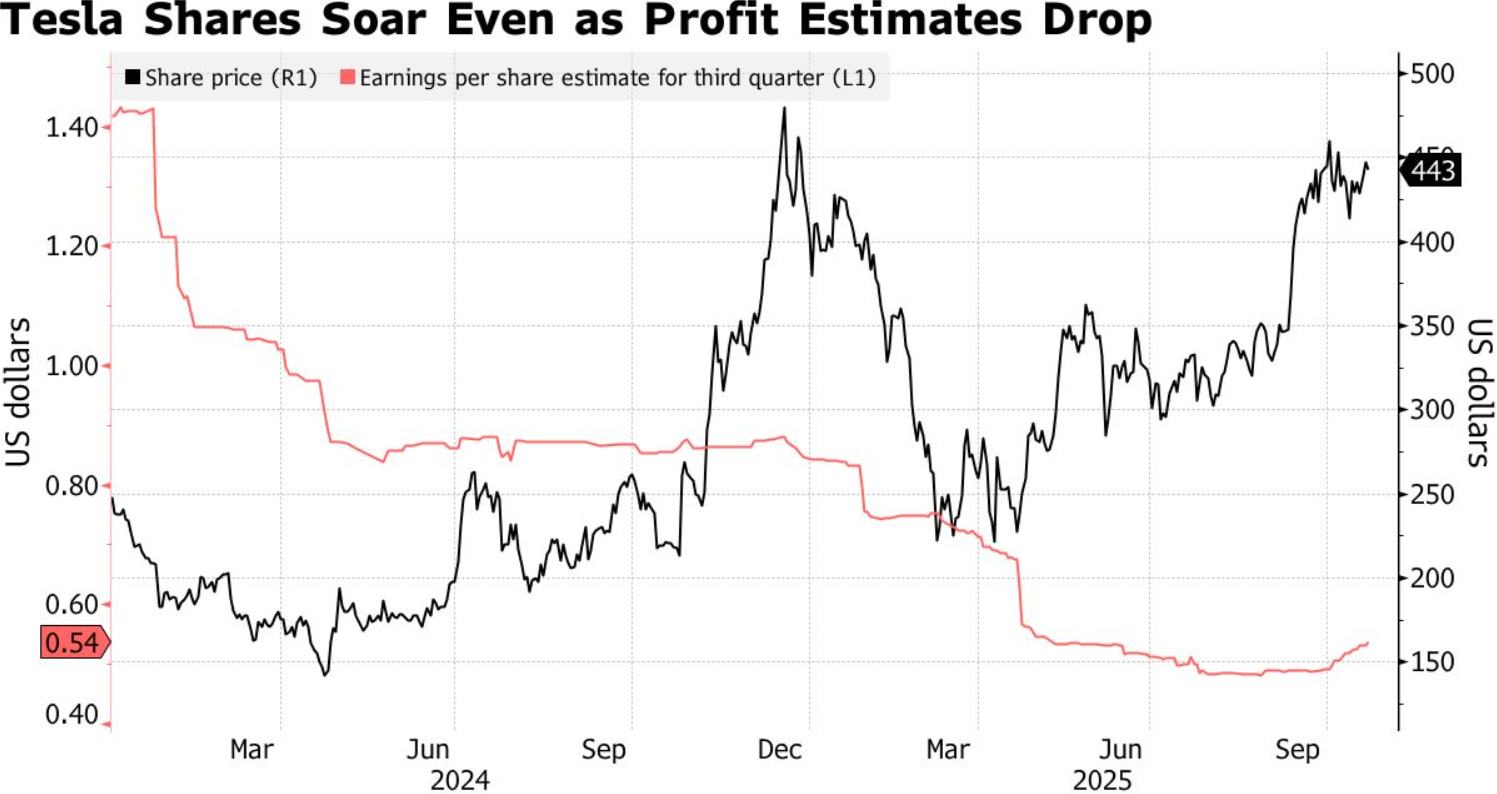
马斯克的“AI与机器人愿景”撞上车企报表现实 特斯拉(TSLA.US)Q3利润大降超30%
Zhi Tong Cai Jing· 2025-10-23 00:32
Core Insights - Tesla reported a 12% year-over-year revenue growth in Q3, reaching approximately $28.1 billion, exceeding Wall Street's expectations of around $26.3 billion [1] - However, Tesla's earnings per share of approximately $0.50 fell short of the expected $0.54, marking a significant year-over-year decline of 31% [1][2] - The company's free cash flow saw a notable increase, reaching nearly $4 billion, a 46% rise compared to the previous year, and significantly above the expected $1.25 billion [1] Revenue and Profitability - Tesla's automotive business revenue grew by about 6% year-over-year, from $20 billion to $21.2 billion in Q3 [2] - Operating expenses surged by 50% to $3.4 billion, influenced by rising costs in the U.S. automotive industry and the anticipated negative impact of U.S. tariff policies estimated at $400 million [2] - The net profit under GAAP decreased by 37% to $1.37 billion, with earnings per share at $0.39, down from $2.17 billion and $0.62 per share in the same period last year [2] Market Dynamics - Tesla's Q3 saw a record high in vehicle deliveries at 497,099 units, with total production at 447,450 units [4] - The company faced challenges in the European market due to declining sales and increased competition from manufacturers like Volkswagen and BYD [4] - The decline in regulatory credit revenue by 44% to $417 million also impacted overall revenue [4] Future Outlook and Strategic Initiatives - Tesla's energy business revenue surged by 44% to $3.42 billion, driven by large backup battery storage systems and solar products [5] - The company is focusing on the development of its full self-driving (FSD) system, with only 12% of its current fleet subscribed to FSD services [10] - Plans for mass production of the Cybercab and Megapack 3 are set for 2026, with expectations for significant advancements in AI and robotics [10][11] Analyst Perspectives - Analysts express concerns over Tesla's growth narrative and profitability trajectory, indicating a period of uncertainty for the company's near- and mid-term earnings growth [7][12] - Some analysts remain optimistic about Tesla's long-term potential, particularly in AI and robotics, with projections of significant market value contributions from these sectors [13][14]


前三季度810个省重点项目完成投资超7500亿元
Si Chuan Ri Bao· 2025-10-23 00:20
Core Insights - The completion rate of annual investment for 810 key projects in Sichuan reached 96.7%, with a total investment of 756.77 billion yuan in the first three quarters, exceeding the scheduled progress by 21.7 percentage points [1] - Infrastructure projects had a completion rate of 94.7%, with an investment of 332.16 billion yuan; industrial projects achieved a completion rate of 98.7% with 387.72 billion yuan invested; social welfare projects had a completion rate of 92.6% with 25.69 billion yuan; and ecological projects reached 97% completion with 11.2 billion yuan invested [1] Group 1 - The provincial government has initiated a project-driven investment push, with a focus on accelerating project implementation and addressing challenges through direct coordination and tracking [2] - The government aims to ensure that all 285 new projects included in the national "14th Five-Year Plan" are launched, with significant projects like Chengdu Tianfu International Airport already completed [2] - Seven working groups have been formed to provide policy guidance and technical support across 21 cities, facilitating the construction of local government special bond projects and other significant investments [2] Group 2 - The provincial development and reform commission plans to implement the spirit of the 20th National Congress and prepare for the selection of key projects for 2026, while ensuring the successful completion of current project goals [3] - Continuous emphasis will be placed on providing lifecycle services for key projects to ensure their successful execution [3]
利润大幅下滑超三成,特斯拉盘后下挫超3%
第一财经· 2025-10-23 00:12
Core Viewpoint - Tesla reported a 12% year-over-year revenue growth in Q3, reaching $28.1 billion, ending a two-quarter decline trend, with market expectations at $26.37 billion [3][4] Financial Performance - Automotive revenue increased from $20 billion in the same period last year to $21.2 billion, a 6% year-over-year growth [3][4] - Q3 net profit decreased by 37% from $2.17 billion (62 cents per share) to $1.37 billion (39 cents per share) [4] - Regulatory credit revenue for the automotive business fell 44% year-over-year from $739 million to $417 million [5] Market Dynamics - The expiration of the U.S. federal electric vehicle tax credit led to a surge in vehicle purchases before the deadline, resulting in a record delivery of 497,099 vehicles in Q3 [4] - Tesla's total vehicle production for the quarter was 447,450 units, but cumulative deliveries for the first three quarters of 2025 were approximately 1.2 million, down about 6% from the same period in 2024 [4] Strategic Initiatives - To boost sales, Tesla launched lower-cost "standard versions" of the Model Y and Model 3, aiming to make products more affordable post-tax credit expiration [5] - Analysts warn that this move may pressure profit margins, as cost reductions per vehicle may not fully offset the impact of lower prices [5] Future Outlook - Tesla did not provide specific sales targets but plans to start mass production of Cybercab, Semi, and Megapack 3 by 2026 [6] - The energy production and storage segment saw a 44% year-over-year revenue increase, reaching $3.42 billion [6] - The company is building the first-generation production line for its humanoid robot, Optimus, indicating a strategic shift towards autonomous technology [6][7] Valuation and Market Position - Tesla's valuation of approximately $1.5 trillion reflects investor confidence in its robotics and AI business [7] - The company has shifted its focus from pure automotive sales to a model centered around autonomous driving technology [7]

帮主郑重聊大宗商品:油价反弹、黄金回调,伦铜这波异动藏啥信号?
Sou Hu Cai Jing· 2025-10-22 22:56
Group 1: Oil Market - The recent rise in oil prices is attributed to technical corrections and supportive inventory data, with U.S. crude oil inventories decreasing by approximately 4.2 million barrels, reaching the lowest level since the end of September [3] - Despite the short-term rebound, the overall trend indicates a potential for a third consecutive month of price decline due to ongoing supply surplus concerns [3] - Additional factors influencing the market include potential trade agreements between the U.S. and India, which may reduce Indian imports of Russian oil, and U.S. Treasury Secretary's comments on increasing sanctions against Russia [3] Group 2: Gold Market - The significant drop in gold prices, marking the worst decline in 12 years, is primarily due to technical selling after a period of being overbought since early September [4] - Analysts suggest that the recent volatility should not deter long-term investors, as there is an expectation for gold to regain momentum in the following year [5] - The focus for long-term investors should be on maintaining key support levels rather than reacting to short-term price fluctuations [5] Group 3: Copper Market - Copper prices increased by 0.37% to $10,663 per ton, influenced by trade policy concerns, particularly regarding potential restrictions on software exports by the U.S. government [5] - The market's reaction to policy changes highlights the importance of understanding the broader supply and demand dynamics rather than making decisions based on short-term price movements [5] - Long-term investment strategies should focus on sustainable supply-demand factors rather than temporary market fluctuations [5]

特斯拉三季度调整后净利润 17.7 亿美元,同比下降 29%
Sou Hu Cai Jing· 2025-10-22 22:49
Core Insights - Tesla reported Q3 2025 financial results with a revenue of $28.1 billion, a 12% year-over-year increase, surpassing the estimated $26.36 billion [3] - Adjusted net income for Q3 was $1.77 billion, reflecting a 29% decline year-over-year, while adjusted earnings per share (EPS) was $0.50, down from $0.72 in the same period last year [3] - The company produced over 447,000 vehicles and delivered over 497,000 vehicles in Q3, alongside deploying 12.5 GWh of energy storage products [4] Financial Performance - Total automotive revenues for Q3 were $20.016 billion, with energy generation and storage revenue at $2.376 billion and services and other revenue at $2.790 billion [4] - The total gross profit for Q3 was $4.997 billion, with a gross margin of 19.8% [4] - Free cash flow reached $3.99 billion, significantly exceeding the forecast of $1.25 billion [3][4] Future Plans - Tesla plans to launch the Cybercab autonomous taxi service, the heavy-duty electric truck Semi, and the new energy storage system Megapack 3 by 2026 [5] - The company is also constructing the production line for the humanoid robot Optimus, with the third generation expected to be released in Q1 next year [5] - Robotaxi services are anticipated to operate in 8-10 regions by the end of the year, with full autonomous operations expected in Austin [5]

国新能源龙虎榜数据(10月22日)
Zheng Quan Shi Bao Wang· 2025-10-22 14:38
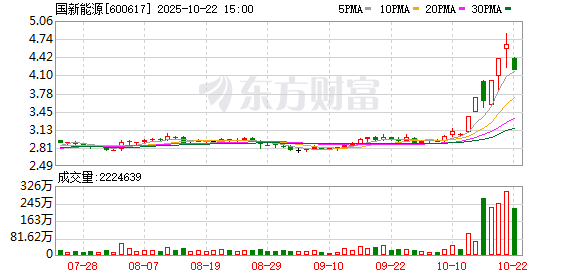
国新能源10月22日交易公开信息 | 买/ | 会员营业部名称 | 买入金额(万 | 卖出金额(万 | | --- | --- | --- | --- | | 卖 | | 元) | 元) | | 买一 | 国信证券股份有限公司浙江互联网分公司 | 1877.25 | | | 买二 | 东方财富证券股份有限公司昌都两江大道证券营业部 | 1347.81 | | | 买三 | 东方财富证券股份有限公司拉萨金融城南环路证券营业 部 | 1282.23 | | | 买四 | 沪股通专用 | 1200.22 | | | 买五 | 中国银河证券股份有限公司北京中关村大街证券营业部 | 1097.07 | | | 卖一 | 沪股通专用 | | 5493.96 | | 卖二 | 华泰证券股份有限公司厦门厦禾路证券营业部 | | 1474.83 | | | | | 1193.49 | | | | 国新能源(600617)今日跌停,全天换手率12.53%,成交额9.42亿元,振幅5.74%。龙虎榜数据显示,沪 股通净卖出4293.74万元,营业部席位合计净买入751.53万元。 上交所公开信息显示,当日该股因日跌幅偏离值达-9. ...

超两千亿发行落地 前三季度ESG债务融资工具统计结果出炉
Xin Hua Cai Jing· 2025-10-22 13:47
Core Insights - The trading association reported the issuance of ESG debt financing tools in the first three quarters of 2025, highlighting a total of 222 green debt financing tools issued, amounting to 205.794 billion yuan, making it the largest in the green corporate credit bond market [1] Group 1: Issuance Overview - In the first three quarters, green debt financing tools were issued across 24 provinces and regions, including Beijing, Guangdong, Jiangsu, and Tianjin, with funds primarily allocated to clean energy, infrastructure upgrades, and energy-saving projects [1] - A total of 10 private enterprises issued 15 green debt financing tools, raising 7.325 billion yuan [1] - Nine issuers made their debut in the interbank market through green debt financing tools, with a total scale of 5.164 billion yuan [1] Group 2: Product Types - There were 53 carbon-neutral bonds issued, totaling 52.894 billion yuan, expected to achieve an annual CO2 reduction of 7.1613 million tons and energy savings of 3.4826 million tons [1] - A total of 32 sustainable development-linked bonds (SLBs) were issued, amounting to 22.302 billion yuan, focusing on performance targets such as gas extraction utilization, renewable energy usage, and water supply network leakage rates [1] - Two transition bonds were issued, totaling 3 billion yuan [1] Group 3: Carbon Asset Financing - The issuance of carbon asset debt financing tools is gaining traction, with four tools issued in the first three quarters, amounting to 1.7 billion yuan [2] - The primary issuers are energy sector companies, utilizing structures that link floating interest rates to carbon asset revenues [2]
1至9月共建成渝地区双城经济圈重点项目完成投资超3700亿元
Xin Hua Cai Jing· 2025-10-22 13:46
Core Insights - The Sichuan Provincial Development and Reform Commission reported that from January to September, 320 key projects in the Chengdu-Chongqing economic circle completed an investment of 377.31 billion yuan, achieving an investment completion rate of 85.77% [1] Investment Breakdown - Modern infrastructure projects completed an investment of 218.23 billion yuan, with an investment completion rate of 76.41% [1] - Modern industry and technological innovation projects completed an investment of 136.85 billion yuan, exceeding the target with an investment completion rate of 108.72% [1] - Cultural tourism, ecological, and public service projects completed an investment of 22.65 billion yuan, achieving an investment completion rate of 78.29% [1] Project Highlights - Key infrastructure projects include the successful topping out of the first "four electricity" building for the Chengdu-Chongqing high-speed railway and the completion of the main structure for the Suining North Station of the Chengdu-Dazhou-Wanzhou high-speed railway [1] - In the modern industry sector, the completion of the first phase of the 12-inch integrated circuit specialty process line in Chongqing High-tech Zone and the launch of the Sichuan Meida Kang Chinese medicine modernization technology industrial base were noted [1] - Ecological and public service projects include the completion of the Longxi River ecological restoration project and the main structure completion of the New Tian Port railway logistics center [1]
世界银行批准向乌兹别克斯坦提供8亿美元优惠贷款
Shang Wu Bu Wang Zhan· 2025-10-22 12:26
Core Points - The World Bank's Executive Board approved an $800 million concessional loan to Uzbekistan to support large-scale structural reforms aimed at reducing poverty, creating jobs, promoting private sector development, and enhancing the competitiveness of national strategic industries [1] Group 1: Social Security Reforms - The loan will increase natural gas and electricity subsidies for low-income households from 270,000 soums to 1,000,000 soums (approximately from $22 to $81) [1] - Measures will be implemented to uphold women's economic rights and protect them from workplace violence and discrimination [1] - The initiative aims to attract NGOs to provide services for vulnerable groups and expand the coverage of social services [1] Group 2: Economic and Sectoral Reforms - The program includes reforms in state-owned enterprises, agricultural development, and enhancing trade liberalization [1] - It will also support the development of the energy sector and promote green public procurement [1]