非银行金融

Search documents
国金证券:北上重新回流 两融活跃度升至近三周高点
智通财经网· 2025-11-03 22:40
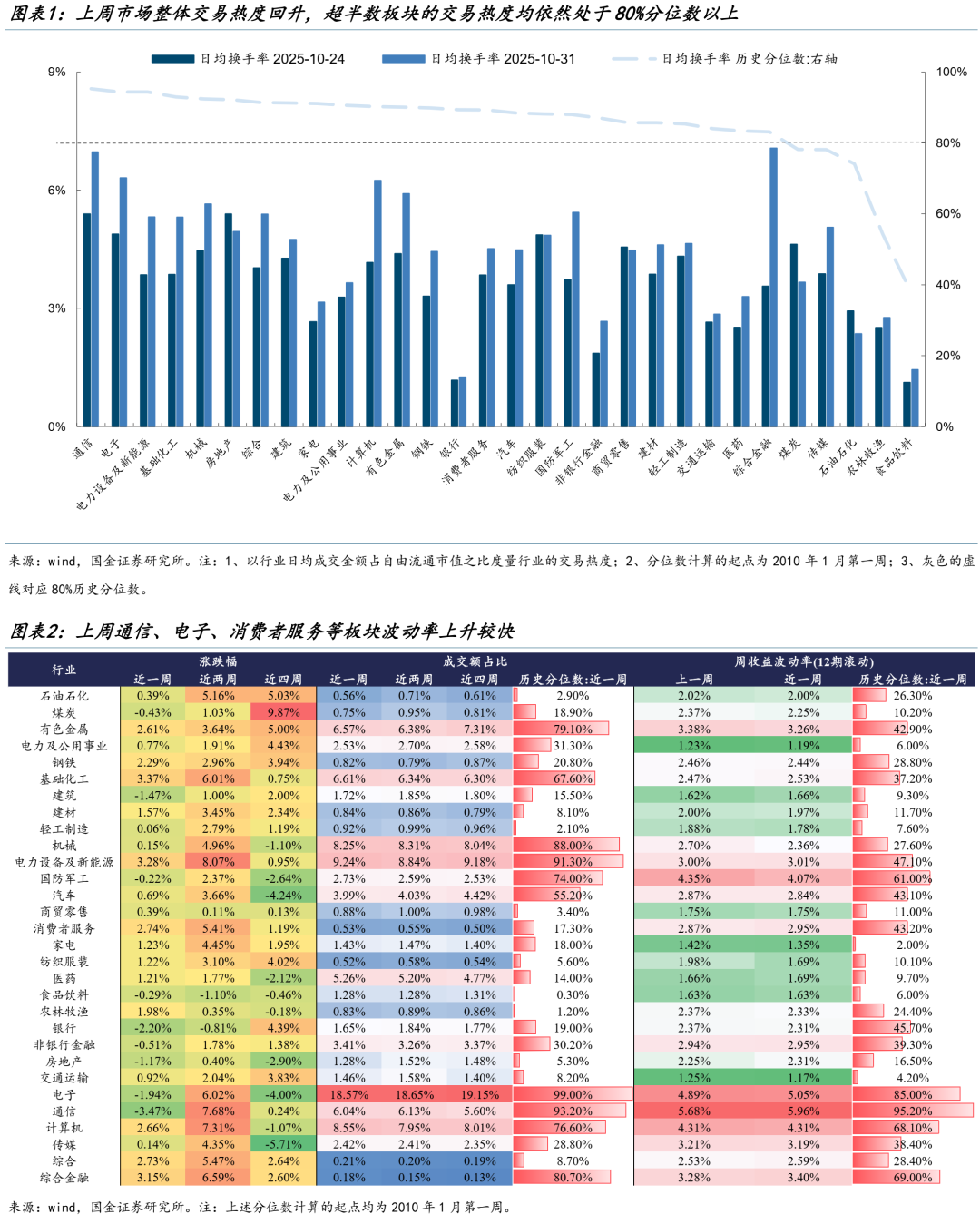
Group 1 - Northbound capital activity has rebounded, with a net buying of A-shares, particularly in the computer, food and beverage, and non-ferrous metal sectors, while there was net selling in the machinery sector [1][10] - Margin trading activity has also slightly increased, reaching a three-week high, with net buying mainly in the electric new energy, communication, and machinery sectors, and net selling in food and beverage, oil and petrochemicals, and coal sectors [16][39] - The trading heat and volatility in the market have risen, with sectors like communication, electronics, electric new energy, chemicals, machinery, and real estate showing trading heat above the 80th percentile [2][5] Group 2 - The ETF market has seen net subscriptions, primarily in institutional ETFs, with significant net buying in sectors such as electronics, non-bank financials, and pharmaceuticals, while there was net selling in electric new energy, chemicals, and banking sectors [31][32] - The buy-sell ratio of the top 10 active northbound stocks compared to the overall northbound trading has shown a slight increase, indicating a shift in trading dynamics [13] - The buy consensus for ETFs and northbound trading has decreased, while the buy consensus for margin trading and the dragon and tiger list has increased, suggesting a mixed sentiment among market participants [39]


资金跟踪系列之十八:北上重新回流,两融活跃度升至近三周高点
SINOLINK SECURITIES· 2025-11-03 13:27
Group 1: Macro Liquidity - The US dollar index continued to rise, and the degree of "inversion" in the China-US interest rate spread deepened, with inflation expectations increasing [1][14] - Offshore dollar liquidity has generally loosened, while the domestic interbank funding environment remains balanced and slightly loose [1][18] Group 2: Market Trading Activity - Overall market trading activity has rebounded, with volatility in major indices, except for the Shenzhen 100, also increasing [2][25] - Trading activity in sectors such as telecommunications, electronics, electric new energy, chemicals, machinery, and real estate remains above the 80th percentile [2][25] - The volatility of major indices has mostly increased, with telecommunications and electronics remaining above the 80th historical percentile [2][31] Group 3: Institutional Research - Research activity is high in sectors such as electronics, pharmaceuticals, non-ferrous metals, food and beverage, and telecommunications, with a month-on-month increase in research intensity for pharmaceuticals, non-ferrous metals, electronics, textiles, and retail [3][43] Group 4: Analyst Forecasts - Net profit forecasts for the entire A-share market for 2025/2026 have been adjusted, with non-bank financials, non-ferrous metals, electric power, and public utilities seeing upward revisions [4][21] - The proportion of stocks with upward revisions in net profit forecasts for 2025/2026 has decreased [4][17] - The net profit forecasts for the CSI 500 index for 2025/2026 have been downgraded [4][23] Group 5: Northbound Trading Activity - Northbound trading activity has rebounded, with a net buying of A-shares overall [5][31] - In the top 10 active stocks, the buying and selling ratio in sectors such as electric new energy, telecommunications, and non-ferrous metals has increased [5][32] - For stocks with northbound holdings of less than 30 million shares, net buying was mainly in the computer, electronics, and chemicals sectors [5][33] Group 6: Margin Financing Activity - Margin financing activity has continued to slightly rebound, reaching a three-week high [6][35] - The main net buying in margin financing was in electric new energy, telecommunications, and machinery sectors [6][36] - The proportion of financing purchases in banking, media, and pharmaceuticals has increased month-on-month [6][38] Group 7: Fund Activity - The positions of actively managed equity funds have increased, with net subscriptions in ETFs overall [7][45] - Actively managed equity funds have mainly increased positions in telecommunications, non-ferrous metals, and electric new energy sectors [7][46] - New equity fund establishment scales have rebounded, with both actively and passively managed funds seeing increases [7][50]
广发中证港股通非银ETF(513750.OF)的核心投资价值——政策托底、行业景气向好、估值洼地
KAIYUAN SECURITIES· 2025-11-03 08:52
Group 1 - The core investment logic indicates that the non-bank financial sector has strong allocation value, supported by policies, improving industry fundamentals, and attractive valuations, particularly in the Hong Kong market compared to A-shares [11][12][27] - Policy support for the financial market includes measures such as liquidity support tools and encouraging long-term capital to enter the market, which aims to enhance market confidence and promote high-quality development in the financial sector [12][14] - The insurance sector is expected to see an improvement in industry conditions due to increased premium income and a higher allocation of equity assets, which will enhance investment returns [21][24] Group 2 - The Hong Kong Stock Connect Non-Bank Index is characterized by a significant concentration in the insurance sector, large-cap style, and strong profitability, with 64.66% of its weight in insurance [43][44] - The index has a relatively low valuation, with a price-to-earnings ratio of 8.01, indicating substantial room for valuation recovery [29][53] - The index also exhibits a high dividend yield of 3.07%, which is notably higher than the 2.11% yield of the CSI 300 Non-Bank Index, highlighting its attractive income potential [33][56] Group 3 - The Guangfa CSI Hong Kong Stock Connect Non-Bank Financial Theme ETF is the only ETF tracking the Hong Kong Non-Bank Index, showcasing its unique investment opportunity [3][59] - As of October 30, 2025, the ETF has a market size of 21.91 billion, reflecting strong investor interest and growth since its launch [62] - The fund is managed by experienced professionals with a solid track record in managing index funds, enhancing investor confidence in its management [65][68]
行业轮动策略月报:“预期共振”行业轮动模型十一月最新推荐-20251103
CMS· 2025-11-03 01:09
Strategy Logic - The report introduces the "Shouzheng Chuq" market investment prosperity indicator, which aims to identify investment opportunities in industries that can become market investment main lines, based on the phenomenon of industry rotation in the A-share market [1][5] - The strategy combines three major dimensions: investment prosperity, volume-price indicators, and analyst expectations, resulting in 12 detailed industry rotation indicators [1][5] - The investment prosperity indicator utilizes market data and alternative data to construct positive and negative screening factors, capturing the marginal upward beta factor and the super-expected report factor while preventing trading overheating [5][6] Strategy Performance - In October, the "Shouzheng Chuq" investment prosperity long portfolio achieved a return of 0.40%, while the analyst expectation indicator long portfolio returned 1.19%, closely matching the benchmark return of 1.06% [2][11] - The volume-price indicator performed exceptionally well, with a long portfolio return of 3.29%, resulting in an excess return of 2.23% [2][11] - The comprehensive "Expectation Resonance" model long portfolio yielded a return of 2.56%, with an excess return of 1.50% [2][11] Latest Recommendations - Based on the latest data, the top recommended industries for November according to the "Shouzheng Chuq" model include computer, petroleum and petrochemicals, light industry manufacturing, non-bank financials, commercial retail, and pharmaceuticals [3][19] - The "Expectation Resonance" model ranks non-bank financials, commercial retail, banking, petroleum and petrochemicals, light industry manufacturing, and home appliances as the leading industries [3][19] Industry Scores and ETF Recommendations - The report provides detailed scores for recommended industries, with non-bank financials scoring 1.00, commercial retail 0.97, and banking 0.93 under the "Expectation Resonance" composite indicator [19] - Corresponding ETFs for the recommended industries include various options for computer, petroleum, light industry manufacturing, non-bank financials, commercial retail, and pharmaceuticals [20]
十大券商策略:4000点后如何应对?结构性机会仍存 盘整震荡中布局再平衡
Zheng Quan Shi Bao Wang· 2025-11-02 23:31
Group 1 - The current index level is more favorable than in 2015, with significantly lower valuation levels, suggesting that there is no need to overly focus on the index points themselves [1] - Structural opportunities still exist in various sectors such as new energy, chemicals, consumer electronics, resources, and machinery, despite short-term investor caution primarily in the technology sector [1] - The market is expected to experience a structural adjustment, with a focus on traditional manufacturing upgrades, Chinese companies going abroad, and edge AI [1] Group 2 - The overall growth is entering a recovery cycle, with improvements in net profit margins and a broadening of growth across sectors due to accelerated overseas expansion and the resolution of internal competition [2] - The third quarter saw a continued recovery in performance for non-financial sectors, with large and mid-cap stocks showing greater earnings elasticity [2] - Certain industries, such as new technology and global pricing resources, are in a recovery and expansion phase, while others face excess pressure [2] Group 3 - The market is expected to experience a period of consolidation and adjustment, with a potential shift in market style and themes [4] - The electronic industry and growth style have reached historically high levels of allocation, which may trigger structural adjustments [4] - Key sectors to focus on include coal, oil and gas, new energy, non-bank financials, public utilities, media, food and beverage, and transportation [4] Group 4 - The external environment has improved with the recent US-China trade talks, alleviating market concerns about external uncertainties [5] - Macro policies are expected to continue to strengthen, creating a favorable environment for the A-share market [5] - The focus for investment should be on technology companies with real technological barriers and sectors benefiting from domestic consumption [5] Group 5 - The focus of the market is shifting towards internal structural optimization following the completion of the third-quarter reports [6] - The consensus reached in US-China trade discussions, along with a mild recovery in overseas demand, is expected to boost domestic export-related sectors [6] - Key sectors to watch include AI, software, power, energy storage, and emerging themes like controlled nuclear fusion and commercial aerospace [6] Group 6 - The market is likely to experience a period of volatility and consolidation in the short term, with a more optimistic long-term outlook [7] - The current economic growth targets and stable policy environment are expected to support further market gains [7] - Attention should be given to low-base sectors that may release greater elasticity in the coming year, particularly in cyclical and consumer areas [7] Group 7 - The market is undergoing a rebalancing phase, with a high concentration of holdings in the TMT sector and improvements in capital returns for various industries [8] - The focus is shifting from excitement over capital expenditure to skepticism about its expansion, with a notable shift in AI investments towards traditional industries [8] - Opportunities exist in upstream resources and sectors benefiting from domestic price stabilization and economic recovery [8] Group 8 - The technology growth sector is experiencing a slowdown in short-term over-allocation, leading to increased volatility [9] - The TMT sector's allocation by funds has reached historical highs, indicating a strong focus on this area despite potential fluctuations [10] - The market may see a transition in style as it approaches a clearer economic recovery phase, with a focus on cyclical and consumer sectors [11]
十大券商:4000点后如何应对?结构性机会仍存,盘整震荡中布局再平衡
Zheng Quan Shi Bao Wang· 2025-11-02 23:09
Group 1 - The current index level is not as critical as the underlying quality of the market, with structural opportunities still present despite short-term fears in the technology sector [1] - The overall growth is entering a recovery phase, with improvements in net profit margins across various sectors, particularly in emerging technologies and cyclical industries [2] - The market is expected to experience a period of consolidation, with a potential shift in investment styles as the year-end approaches [4] Group 2 - The focus is shifting towards internal structural optimization following the completion of the third-quarter reports, with an emphasis on sectors like AI and export-related industries [6] - The technology sector remains a key investment theme, although short-term volatility may increase due to adjustments in fund allocations [8] - The outlook for the market remains optimistic in the medium to long term, supported by stable policies and a recovering economic environment [9]

十大券商一周策略:4000点后如何应对?盘整震荡中布局再平衡
Zheng Quan Shi Bao· 2025-11-02 22:27
Group 1 - The current index level is not as critical as the underlying quality of the market, with structural opportunities still present despite short-term fears in the technology sector [1] - The overall growth is entering a recovery phase, with improvements in net profit margins across various sectors, indicating a broadening of growth opportunities [2] - The market is expected to experience a period of consolidation, with a potential shift in investment styles as the year-end approaches [4] Group 2 - The recent U.S.-China trade discussions have alleviated external uncertainties, contributing to a positive outlook for the A-share market [5] - The focus is shifting towards internal structural optimization, with an emphasis on sectors like AI and emerging technologies for medium-term growth [6] - The market is likely to see increased volatility in the technology sector due to high allocation levels and potential style shifts [11] Group 3 - The A-share market is anticipated to maintain a bullish trend, supported by a favorable macroeconomic environment and ongoing policy support [10] - There is a notable concentration of fund holdings in technology and growth sectors, indicating strong investor interest despite potential risks [8] - The recovery in profitability is expected to solidify the bull market, with a focus on cyclical and consumer sectors for future growth [10]
中信建投:A股或进入新一轮横盘调整 关注主线和风格切换
Zheng Quan Shi Bao Wang· 2025-11-02 10:33
Group 1 - The core viewpoint of the report indicates that after the previous upward momentum in the A-share market has been exhausted and three major favorable factors were realized at the end of October, the market is facing pressure from emotional decline, a lack of favorable news, and a need for adjustment and consolidation [1] - The report predicts that the market will undergo a new round of sideways adjustment in November, suggesting that investors should pause on increasing positions [1] - The report highlights three main investment directions: "economic recovery indicators, year-end portfolio adjustments, and short-term sector rotations" [1] Group 2 - Key sectors to focus on include coal, oil and petrochemicals, new energy (such as energy storage and solid-state batteries), non-bank financials (including brokerage and insurance), public utilities, media, food and beverage, and transportation [1]

非银确认日线上涨,商贸零售迎来日线下跌
GOLDEN SUN SECURITIES· 2025-11-02 08:00
- The non-bank financial sector confirmed an upward trend on the daily chart, while the retail sector experienced a downward trend on the daily chart[1][8][28] - The A-share prosperity index stood at 20.44 as of October 31, 2025, up 15.01 from the end of 2023, indicating an upward cycle[2][31] - The A-share sentiment index signals for bottom and top were both empty, with the overall signal being empty[2][39] - The CSI 500 enhanced portfolio underperformed the benchmark by 0.54%, while the CSI 300 enhanced portfolio outperformed the benchmark by 0.59%[2] - The Beta factor showed higher excess returns among style factors, while growth exhibited significant negative excess returns[2][58] - High-leverage stocks performed well recently, while factors such as residual volatility and non-linear market capitalization performed poorly[2][58] - The CSI 500 enhanced portfolio achieved a relative excess return of 51.82% since 2020, with a maximum drawdown of -5.73%[47] - The CSI 300 enhanced portfolio achieved a relative excess return of 39.01% since 2020, with a maximum drawdown of -5.86%[53] - The market's preference for high Beta stocks led to better performance in indices like CSI 500 and ChiNext, while indices like SSE Composite and SSE 50 performed poorly in style factors[65]
中金 | 三季报业绩总结:整体盈利改善,结构亮点增多
中金点睛· 2025-11-01 01:25
Core Insights - A-share companies' profits showed a year-on-year growth of 5.4% in the first three quarters of 2025, with non-financial profits increasing by 1.7% [2][5][25] - The third quarter saw a significant improvement in profit growth across various sectors, with non-financial net profits rising by 11.4% year-on-year, compared to 3.8% in the second quarter [2][5][7] Performance Growth - A-share companies' net profits for the first three quarters of 2025 were 5.4% for all A-shares, 9.5% for financials, and 1.7% for non-financials [5][25] - In Q3 2025, the net profit growth for non-financial sectors was 11.4%, with a notable improvement from Q2 [2][7] - The revenue for non-financial sectors increased by 0.6% year-on-year, indicating a slight recovery in profit margins [2][5] Industry Performance - The number of industries with profit improvements increased, with 48 industries (37% of total) reporting a year-on-year net profit growth exceeding 20% [15][19] - The TMT sector, non-ferrous metals, and certain midstream industries performed well, reflecting the positive impact of policy shifts [15][19] - The energy and raw materials sector saw a decline in profit share from nearly 40% in 2022 to 30.5% in Q3 2025 [13][19] Economic Segmentation - New economy sectors showed a profit growth of 12.1% year-on-year in Q3, while traditional sectors experienced a reduced decline of -2.1% [11][19] - Upstream, midstream, and downstream profit growth rates were 4.0%, 10.3%, and -3.1%, respectively, indicating a recovery in upstream profits [16][19] - The performance of the consumer sector was weak due to policy rollbacks and weak demand, with significant declines in various sub-sectors [17][19] Profit Quality - A-share non-financial ROE stabilized in Q3 2025, with a slight increase compared to Q2, indicating potential stabilization after a prolonged decline [25][26] - The cash flow situation showed improvements, with operating cash flow remaining at a high level, supporting dividend certainty for A-share companies [31][33] - Non-financial companies' free cash flow to equity ratio maintained at around 5.2%, providing a solid foundation for dividends [33]