
智能手机

Search documents
汽车业务首度盈利、高端化创新业务全面兑现 小米Q3业绩打破增长天花板
Xin Lang Zheng Quan· 2025-11-19 11:52
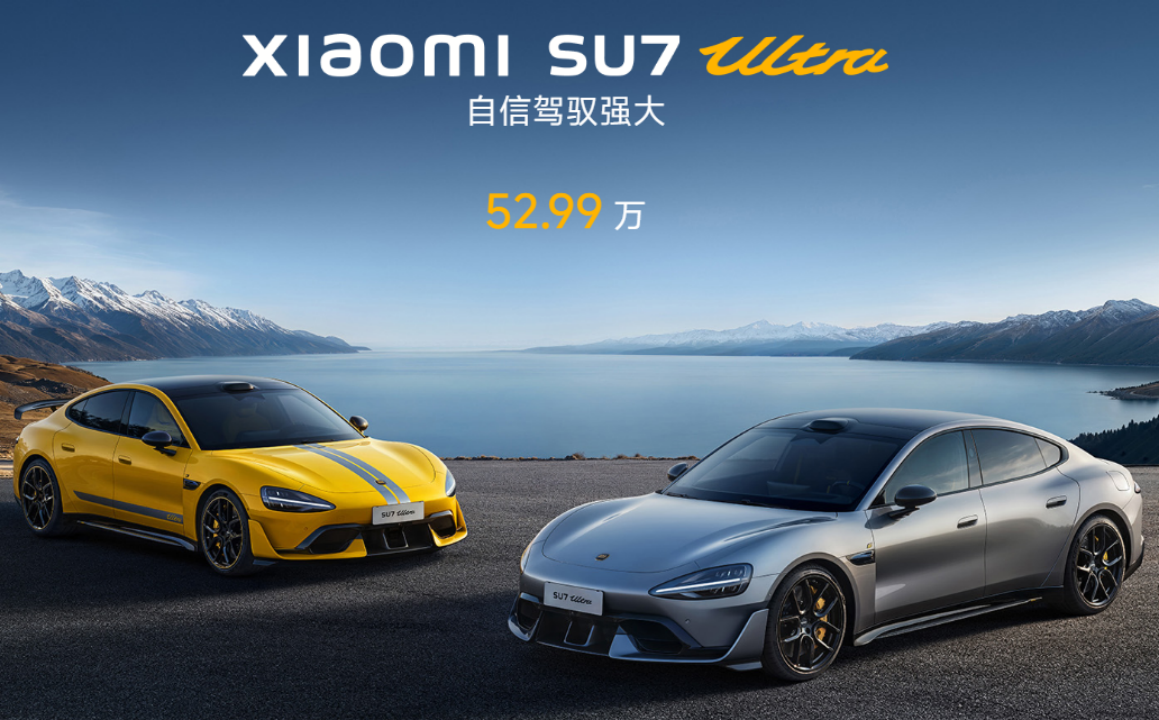
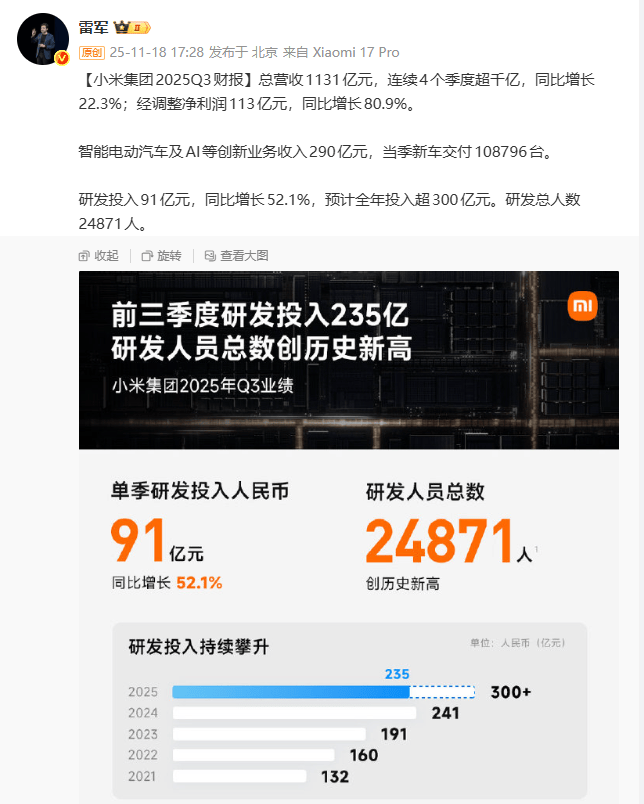
Core Insights - Xiaomi Group reported a record-breaking Q3 performance with revenue of 113.1 billion yuan, a year-on-year increase of 22.3%, marking the fourth consecutive quarter exceeding the 100 billion yuan threshold [2][3] - Adjusted net profit reached 11.3 billion yuan, surging 80.9% year-on-year, setting a historical high [2][3] - The company’s total revenue for the first three quarters reached 340.4 billion yuan, nearing last year's total, with adjusted net profit surpassing the entire previous year's figure [2][3] Financial Performance - Q3 revenue was 113.1 billion yuan, up 22.3% year-on-year, with adjusted net profit at 11.3 billion yuan, exceeding Bloomberg's consensus estimate [3][4] - For the first three quarters, total revenue was 340.4 billion yuan, with adjusted net profit of 32.8 billion yuan, indicating strong growth momentum [3][4] - Gross margin for Q3 reached 22.9%, reflecting a 2.5 percentage point increase year-on-year, showcasing the effectiveness of the company's product structure optimization [6] Business Segments - Revenue from the smartphone and AIoT segment was 84.1 billion yuan, with smartphone revenue at 46 billion yuan, maintaining a top-three global position for 21 consecutive quarters [3][4] - IoT and lifestyle product revenue was 27.6 billion yuan, up 5.6% year-on-year, while internet services revenue reached 9.4 billion yuan, growing 10.8% [3][4] - The automotive and AI innovation segment generated 29 billion yuan, with electric vehicle revenue at 28.3 billion yuan, achieving a quarterly delivery record of 109,000 units [3][4] Strategic Initiatives - Xiaomi's R&D investment for Q3 was 9.1 billion yuan, a 52.1% increase year-on-year, with total investment for the first three quarters nearing 23.5 billion yuan [2][10] - The company aims to be a "contributor to industrial value" and "promoter of industrial progress," focusing on innovation rather than price competition [4][10] - The high-end strategy has shown results, with market share in the 4,000-6,000 yuan smartphone segment reaching 18.9%, a 5.6 percentage point increase year-on-year [7][11] Future Outlook - The automotive business, international expansion, and high-end strategy are expected to drive future growth [11][12] - Xiaomi has raised its 2025 delivery target for vehicles from 300,000 to 350,000 units, with some forecasts suggesting it could reach 400,000 [8][11] - The company maintains a strong cash reserve of 236.7 billion yuan, positioning itself for future growth opportunities [11][12]

雷军不再“沉默”
Sou Hu Cai Jing· 2025-11-19 11:41
Core Viewpoint - Xiaomi's CEO Lei Jun has recently made strong statements regarding the safety of Xiaomi cars, responding to previous criticisms and controversies surrounding the brand's safety standards and public relations approach [2][5][15]. Group 1: Safety Concerns and Public Response - Lei Jun emphasized the importance of safety in his recent social media posts, stating that "safety is the foundation" and "safety is paramount," while addressing previous comments that were perceived as prioritizing aesthetics over safety [7][8][10]. - The company faced significant backlash following two serious accidents involving Xiaomi vehicles, which resulted in fatalities and raised concerns about the cars' safety features, such as the inability of doors to open after collisions [10][11][31]. - Despite a recent quarterly report showing profitability in Xiaomi's automotive and AI sectors, the stock price fell over 4%, indicating that public sentiment remains affected by safety concerns [5][6]. Group 2: Changes in Public Relations Strategy - Reports suggest that Xiaomi's public relations head, Wang Hua, may be reassigned, indicating a potential shift in the company's communication strategy in response to recent controversies [16][20]. - Wang Hua has been a key figure in managing Xiaomi's public image, often countering negative rumors and defending the brand's reputation [21][22][25]. - The anticipated change in leadership within the public relations department may lead to a new approach in how Xiaomi engages with consumers and addresses public concerns [26]. Group 3: Consumer Sentiment and Brand Loyalty - Xiaomi has historically built a loyal customer base, known as "Mi Fans," who have supported the brand due to its reputation for high-quality, cost-effective products [27][28]. - However, recent issues, including poor customer service and product quality complaints, have led some former supporters to become critical of the brand, expressing their dissatisfaction on social media [30][31]. - The company's handling of safety issues and customer grievances will be crucial in regaining the trust of its consumer base, as many former fans have voiced their disappointment over the lack of adequate responses to safety concerns [31][33].

小米市值,两个月跌没了整个“蔚小理零”
第一财经· 2025-11-19 11:06
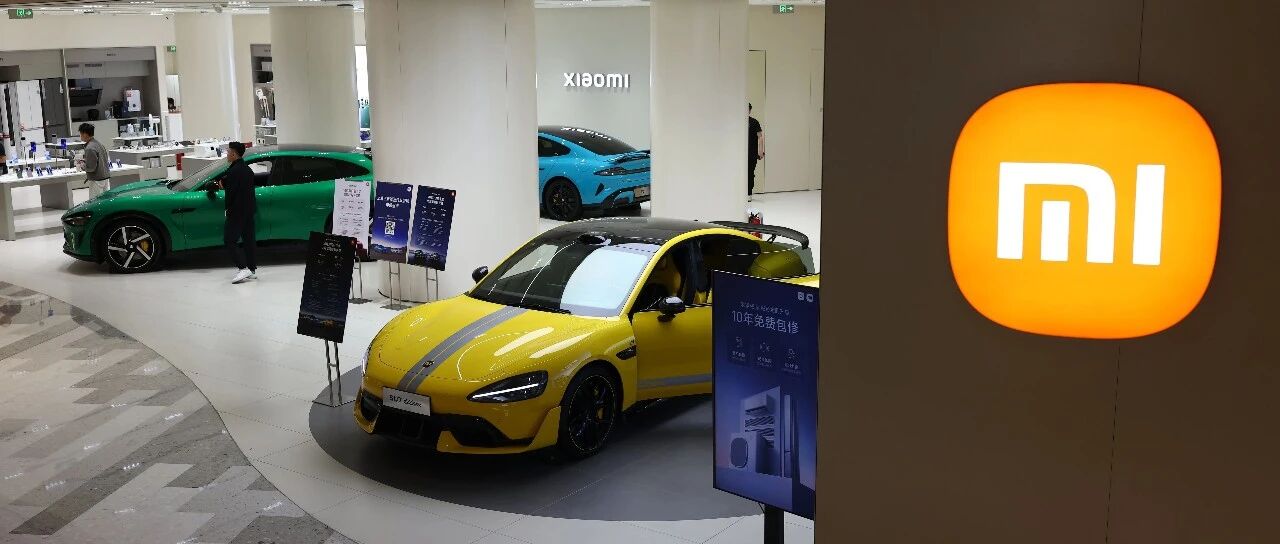
Core Viewpoint - Despite a strong performance in Xiaomi Group's Q3 financial report, market sentiment remains negative, leading to a significant drop in stock price and market capitalization [3][4]. Financial Performance - Xiaomi Group reported a total revenue of 113.1 billion yuan for Q3, a year-on-year increase of 22.3%, and an adjusted net profit of 11.3 billion yuan, up 80.9% year-on-year [3]. - The company's innovative sectors, including automotive and AI, achieved a quarterly profit of 700 million yuan for the first time [3]. Stock Market Reaction - Following the Q3 earnings report, Xiaomi's stock price fell to a low of 38.22 HKD, dropping below the 40 HKD mark and resulting in a total market value loss of over 530 billion HKD since September 25 [3][4]. - The stock has seen a cumulative decline of 36.83% from its year-high of 61.45 HKD on June 27 [3]. Market Sentiment and Short Selling - Market sentiment has turned pessimistic, with a 53% increase in short positions against Xiaomi reported by Goldman Sachs prior to the earnings release [4]. - Institutional trading has leaned towards selling, particularly from pension funds and hedge funds, indicating a widespread bearish outlook on Xiaomi [4]. Safety and Production Issues - Safety concerns arose from incidents involving the SU7 model, including a collision that resulted in fatalities and a recall of 117,000 vehicles due to defects in the L2 level highway navigation assistance feature [4][5]. - Production delays have been reported, with the second-phase factory's output ramp-up postponed, affecting the expected annual production capacity of 300,000 vehicles [5]. Analyst Opinions - Goldman Sachs downgraded Xiaomi's target price by over 10%, citing rising storage chip costs that could further squeeze profit margins [6]. - Citic Securities remains optimistic about Xiaomi's long-term growth potential, highlighting the profitability of its automotive and AI sectors in Q3 [6]. Challenges Ahead - Xiaomi faces significant challenges in addressing safety controversies, ramping up production capacity, and rebuilding market trust, which will be crucial for its valuation recovery and long-term growth [6].
汽车业务首次盈利!小米三季度净利飙涨81%创新高,卢伟冰称手机或涨价应对存储成本上升
Xin Lang Cai Jing· 2025-11-19 10:41
Core Viewpoint - Xiaomi Group reported a significant increase in net profit for Q3 2025, driven by strong performance in its automotive and AI segments, marking a historic high for the company [1] Financial Performance - Revenue for Q3 2025 reached approximately 1131.21 billion yuan, representing a year-on-year growth of 22.3%, marking the fourth consecutive quarter exceeding 100 billion yuan [1] - Adjusted net profit was 113 billion yuan, a substantial increase of 80.9% year-on-year, achieving a record high [1] Automotive and Innovation Segment - Revenue from the smart electric vehicle and AI innovation business segment amounted to 290 billion yuan, showing a remarkable year-on-year increase of over 199% [1] - Within this segment, smart electric vehicle revenue was 283 billion yuan, while other related income contributed 7 billion yuan [1] - This segment achieved its first-ever quarterly operating profit, with a reported operating profit of 7 billion yuan [1] Cost Management and Pricing Strategy - Xiaomi's President, Lu Weibing, indicated that the current rise in memory prices is a long-term trend, and the company has proactively secured supply agreements for 2026 to mitigate supply chain disruptions [1] - The company may consider price increases and product structure upgrades to manage cost pressures in the future [1]
苹果开放日区Siri语音助手更换,第三方商店落地在即
2 1 Shi Ji Jing Ji Bao Dao· 2025-11-19 10:10
Core Insights - Apple is enabling Japanese iPhone users to replace Siri with third-party voice assistants and is also supporting third-party app stores, following the new Japanese law aimed at reducing monopolistic practices in the smartphone software market [1][2] Group 1: Regulatory Changes - The new law, effective December 18, 2023, mandates that dominant companies like Apple and Google must open their app stores and payment systems to third-party services [2] - Companies are prohibited from blocking third-party app stores, restricting developers' payment options, or discriminating against developers [2] - Violations of the law could result in fines of up to 20% of a company's domestic revenue, increasing to 30% for repeated offenses [2] Group 2: Impact on Developers - Developers, including those in the gaming sector, will benefit from diversified distribution and payment channels within the Japanese iOS ecosystem [3] - Smaller teams can now turn to third-party platforms if their games face challenges in passing App Store reviews, while larger companies may establish their own stores for direct user engagement [3] - Localized payment options such as PayPay and convenience store payments can be integrated directly, potentially reducing the commission costs that have historically ranged from 15% to 30% [3]

小米,准备告别「雷布斯」模式?
36氪· 2025-11-19 09:44
Core Viewpoint - Xiaomi's public relations strategy is undergoing significant changes, particularly in light of recent controversies surrounding safety concerns in its automotive division, necessitating a clear separation between the founder's persona and the company's brand identity [3][30]. Group 1: Public Relations Strategy - The public relations model that integrates founder Lei Jun's persona with Xiaomi's brand has reached a critical point, especially following the recent backlash regarding automotive safety [4][5]. - Lei Jun's public image has been a double-edged sword, as it has both elevated Xiaomi's brand and created vulnerabilities when safety issues arise [26][29]. - The potential change in the head of public relations indicates a shift in strategy to better manage public perception and address criticisms more effectively [7][30]. Group 2: KML Model - The KML model, which stands for Key Opinion Leaders, Media, and Loyal Fans, was initially effective for Xiaomi but has since become problematic as it has evolved into a more insular and defensive structure [9][10]. - The transformation of the KML model has led to a situation where loyal fans act more as protectors of Lei Jun rather than constructive critics, complicating the company's ability to respond to legitimate concerns [20][21]. - The KML model's effectiveness has diminished, as it has created a polarized environment where rational discourse is stifled, making it difficult for Xiaomi to navigate public relations crises [21][27]. Group 3: Need for Change - Xiaomi must establish a clear "IP firewall" to delineate the roles of Lei Jun, the company, and its automotive division, ensuring that the founder's persona does not overshadow the brand's integrity [30][31]. - The company needs to focus on product quality and safety to regain public trust, rather than relying solely on the founder's charisma to drive brand loyalty [31].

研报掘金丨申万宏源:维持传音控股“买入”评级,智能机出货量全球第四
Ge Long Hui A P P· 2025-11-19 09:05
Core Viewpoint - Transsion Holdings reported a year-on-year and quarter-on-quarter revenue increase in Q3 2025, but faced pressure on gross and net profit margins, with net profit falling below expectations [1] Group 1: Financial Performance - Q3 2025 revenue showed growth both year-on-year and quarter-on-quarter, indicating a strong seasonal performance [1] - Gross margin and net margin were under pressure, leading to a net profit that was lower than market expectations [1] Group 2: Market Position - Transsion Holdings ranks fourth globally in smartphone shipments, maintaining over 40% market share in Africa and leading positions in Pakistan, Bangladesh, and India [1] Group 3: AI Development - The company is actively developing practical AI features, with TECNO AI and Infinix AI supporting local dialects in Africa and South Asia, addressing low-resource language limitations [1] - AI applications include image enhancement, voice assistants, and AI writing, with a series of AI-assisted applications being developed to promote comprehensive AI integration [1] Group 4: Strategic Initiatives - Boomplay has maintained a leading market position and user base in Africa, showing progress in commercialization efforts [1] - The average PE ratio for comparable companies (Lingyi iTech, Luxshare Precision, Lens Technology) for 2025 is 29X, which is 63% higher than Transsion Holdings' 2025 PE of 18X, leading to a "Buy" rating [1]

抛开舆论看小米:赚钱能力持续攀升,增长远未看到天花板
Tai Mei Ti A P P· 2025-11-19 08:24
Core Insights - Xiaomi is facing challenges in the market, with its stock under pressure from short-selling despite strong financial performance [2] - The company reported a significant increase in revenue and profit for Q3, indicating sustained high growth [3][4] - Xiaomi's strategy to target the high-end market is showing results, with increased market share in premium segments [6][7] Financial Performance - For Q3, Xiaomi achieved revenue of 113.1 billion RMB, a year-on-year increase of 22.3%, and a net profit of 11.3 billion RMB, up 80.9% [3] - The overall gross profit for the quarter was 25.9 billion RMB, with a gross margin of 22.9% [3] - The smartphone and AIoT segments contributed significantly to revenue, with the smartphone segment generating 46 billion RMB [4][6] Business Segments - Xiaomi's automotive and AI innovation business reported a revenue increase of over 199% year-on-year, achieving a quarterly operating profit of 700 million RMB [8][11] - The smartphone segment has seen a continuous increase in shipment volume, maintaining a position among the top three globally for 21 consecutive quarters [4][7] - The IoT and lifestyle products segment also showed growth, with revenue reaching 27.6 billion RMB, a 5.6% increase [8] Market Position and Strategy - Xiaomi's market share in the high-end smartphone segment (priced 4000-6000 RMB) reached 18.9%, an increase of 5.6 percentage points year-on-year [6] - The company aims to penetrate the ultra-high-end market (above 6000 RMB) as part of its high-end strategy [6][7] - Xiaomi's AIoT platform has connected over 1 billion devices, indicating strong ecosystem growth [8][12] Future Outlook - Xiaomi plans to expand its home appliance business overseas, with successful entries into Southeast Asia and Europe [13][15] - The company aims to establish a global retail network with plans for 10,000 stores in the next five years [15] - Xiaomi's automotive business is expected to grow, with plans to enter international markets by 2027 [15]
财报亮眼拉不动股价,小米集团股价今早跌破40港元,较6月最高点已跌超30%
Sou Hu Cai Jing· 2025-11-19 07:46
11月19日早间,小米集团(01810)股价跌破40港元,较今年6月最高点的61.45港元已跌超30%,市值 也大幅缩水。 与股价表现不同的是,前一晚11月18日,小米集团发布的业绩公告显示业绩亮眼。2025年第三季度小米 实现营收约1131.21亿元,同比增长22.3%,连续4个季度突破千亿元;经调整净利润为113亿元,创历史 新高,同比增长80.9%。 具体来看,第三季度,智能电动汽车及AI等创新业务分部收入290亿元,同比增长超199%。其中,智能 电动汽车收入283亿元,其他相关收入7亿元。小米汽车及AI(人工智能)等创新业务分部首次实现单 季度经营收益转正,实现单季经营收益7亿元。 官方数据显示,2025年1至9月,小米汽车累计交付量已超过26万辆。其中,第三季度累计交付约10.88 万辆新车,创单季度历史新高。小米集团合伙人、集团总裁卢伟冰在业绩电话会上透露,"小米汽车预 计将于本周完成全年35万辆的交付目标。" 手机业务方面,财报披露,智能手机三季度贡献收入460亿元,全球出货量达到4330万台,同比增长 0.5%,实现连续九个季度同比增长。 18日晚间,小米创办人,董事长兼CEO雷军在微博发文 ...
小米的周期对冲法:新引擎盈利,旧引擎转型
2 1 Shi Ji Jing Ji Bao Dao· 2025-11-19 07:33
Core Insights - Xiaomi Group's Q3 2025 financial results show a total revenue of 113.1 billion yuan, a year-on-year increase of 22.3%, and an adjusted net profit of 11.3 billion yuan, up 81%, marking a historical high [2][3] - The company successfully transitioned from traditional smartphone business to new growth engines, particularly in smart electric vehicles and AI, which achieved quarterly profitability for the first time [2][3] - The smartphone segment is under pressure due to rising memory costs, impacting gross margins, while the company is focusing on high-end strategies to enhance product structure and resilience [2][4] Financial Performance - Xiaomi's revenue from innovative businesses, including smart electric vehicles and AI, reached 29 billion yuan, accounting for 25.6% of total revenue, with a gross margin of 25.5% and a profit of 700 million yuan in the quarter [3][4] - The smartphone business saw a shipment of 43.3 million units, generating revenue of 45.969 billion yuan, with a gross margin dropping to 11.1% due to supply chain cost pressures [3][4] Strategic Initiatives - Xiaomi is implementing three core strategies to build long-term competitiveness: increasing R&D investment, advancing high-end strategies, and exploring new growth opportunities in global markets [2][3] - The company plans to enhance its R&D capabilities, with Q3 spending reaching 9.1 billion yuan, a 52.1% increase year-on-year, and total R&D investment expected to exceed 30 billion yuan for the year [8][9] Market Trends - The current memory price increase is driven by strong demand for HBM (High Bandwidth Memory) from AI applications, differing from previous cycles driven by mobile and laptop demand [4] - Xiaomi's IoT business generated 27.6 billion yuan in revenue, maintaining growth for seven consecutive quarters, with a gross margin of 23.9% [5][6] Operational Developments - Xiaomi has expanded its automotive sales network, with 402 stores in 119 cities in mainland China, and aims to deliver 350,000 vehicles by the end of the year [3][6] - The company has launched a new smart appliance factory in Wuhan, enhancing its production capabilities and supporting its high-end strategy [6][9] Challenges and Outlook - Despite achieving profitability in the automotive sector, challenges remain, including reduced purchase tax subsidies and increased competition expected in 2026 [9] - The smartphone segment faces ongoing pressure from rising memory costs, while the IoT business must navigate a competitive landscape and potential price wars [9]