国防军工

Search documents
关税冲击下两市低开高走【情绪监控】
量化藏经阁· 2025-10-14 00:08
Market Performance - Most indices are in a downward trend, with the CSI 1000 index performing relatively well, while the CSI 300 index fell by 0.50% and the CSI 500 index decreased by 0.29% [7] - Among sector indices, the Sci-Tech 50 index showed strong performance, increasing by 1.40%, while the automotive, media, pharmaceutical, comprehensive finance, and home appliance sectors performed poorly, with declines ranging from -1.45% to -2.36% [9] - Concept themes such as rare earths, rare earth permanent magnets, and photolithography machines performed well, with gains of 9.49% and 8.09%, while consumer electronics and PTA showed declines of -2.91% and -2.86% respectively [12] Market Sentiment - At market close, 72 stocks hit the daily limit up, while 10 stocks hit the limit down, indicating a mixed sentiment [3][15] - The closing return for stocks that were limit up yesterday was 2.01%, while those that were limit down returned 0.68% today [18] - The sealing rate was 77%, up 7% from the previous day, and the consecutive sealing rate was 25%, also up 7% [21] Market Capital Flow - As of October 10, 2025, the margin trading balance was 24,418 billion yuan, with a financing balance of 24,257 billion yuan and a securities lending balance of 161 billion yuan [4][25] - The margin trading balance accounted for 2.5% of the total market capitalization, while margin trading accounted for 11.4% of the total market turnover [27] Premium and Discount - On October 10, 2025, the Sci-Tech 50 ETF showed a premium of 2.02%, while the Southbound Sci-Tech 50 ETF had a discount of 0.81% [29] - The average discount rate for block trades over the past six months was 6.09%, with a discount rate of 4.70% on the same day [31] - The annualized discount rates for major stock index futures were 0.04% for the SSE 50, 2.55% for the CSI 300, 10.16% for the CSI 500, and 12.72% for the CSI 1000 [35] Institutional Attention and Rankings - The stocks with the most institutional research in the past week included Jiufeng Energy, Dangseng Technology, and Juyi Sockets, with Jiufeng Energy being researched by 110 institutions [36] - The top ten stocks with net inflows from institutional special seats included Canxin Co., Duoflu, and Wangzi New Materials, while the top ten with net outflows included Huahong Semiconductor and Ganfeng Lithium [40][43]


浙商早知道-20251014
ZHESHANG SECURITIES· 2025-10-13 23:31
Market Overview - On October 13, the Shanghai Composite Index fell by 0.19%, the CSI 300 decreased by 0.5%, the STAR 50 rose by 1.4%, the CSI 1000 dropped by 0.19%, the ChiNext Index declined by 1.11%, and the Hang Seng Index decreased by 1.52% [3][4] - The best-performing sectors on October 13 were non-ferrous metals (+3.35%), environmental protection (+1.65%), steel (+1.49%), national defense and military industry (+0.86%), and banking (+0.74%). The worst-performing sectors were automotive (-2.33%), home appliances (-1.74%), beauty and personal care (-1.58%), media (-1.54%), and pharmaceutical biology (-1.47%) [3][4] - The total trading volume of the A-share market on October 13 was 23,742 billion yuan, with a net inflow of 19.804 billion Hong Kong dollars from southbound funds [3][4] Key Insights - The textile and apparel sector is expected to see a manufacturing recovery, with ongoing brand differentiation [5] - Market sentiment indicates that brand sales are sluggish, and most leading manufacturers faced pressure in Q3, with no significant improvement on a month-over-month basis [5] - The priority for investment is shifting towards leading manufacturers over brands [5] - Key drivers include clearer tariff arrangements and reduced inventory pressure for some leading brands like Nike; retail performance continues to vary based on track, positioning, product, and channel strategies [5] - Despite market concerns regarding Q3 performance pressures for some leading brands, there is optimism for overall recovery in the export chain, suggesting early positioning is advisable [5]
美国那边又搞事?复盘历次冲击后市场走势
Sou Hu Cai Jing· 2025-10-13 13:58
Market Overview - The US stock market experienced a significant decline last Friday, with Hong Kong stock futures dropping by 5%, causing distress among investors [1] - However, the market sentiment shifted quickly, with US stock futures rebounding before the opening, leading to a recovery in the Hong Kong market later in the day [1] Historical Context - Since 2018, market fluctuations have been heavily influenced by external events, particularly those initiated by "Old Trump," affecting both US and Hong Kong markets [2] - The market has gone through multiple bull and bear cycles, with notable downturns following significant events, such as a 5.58% drop after the May Day holiday in 2019 [2][4] - The overall market trend from 2018 to the present has shown that while external events can cause short-term declines, the medium-term trend is more influenced by domestic policies and liquidity conditions [6] Current Market Dynamics - The current market is characterized by strong performance in sectors such as rare earths, semiconductors, and military industries, while overseas-related sectors like automotive parts and consumer electronics are underperforming [6] - The upcoming third-quarter earnings reports are expected to validate the positive outlook for certain sectors, particularly in military and technology [6] Future Outlook - The timing of the upcoming summit at the end of October is seen as critical, with potential for market recovery if tensions ease [7] - The market is currently showing a favorable stock-bond yield spread of 5.28%, indicating a relatively high attractiveness of equities compared to bonds [10] Trading Strategies - A grid trading strategy has been activated for 20 trading varieties, with specific ETFs in sectors like consumption, real estate, and new energy showing activity [8] - Quantitative signals indicate trends in broad indices such as the ChiNext 50 and the Sci-Tech 50, suggesting potential investment opportunities [9]
【13日资金路线图】电子板块净流入约159亿元居首 龙虎榜机构抢筹多股
证券时报· 2025-10-13 12:26
Market Overview - The A-share market experienced an overall decline on October 13, with the Shanghai Composite Index closing at 3889.5 points, down 0.19%, the Shenzhen Component Index at 13231.47 points, down 0.93%, and the ChiNext Index at 3078.76 points, down 1.11% [1] - Total trading volume in the A-share market was 23745.34 billion, a decrease of 1599.58 billion compared to the previous trading day [1] Capital Flow - The A-share market saw a net outflow of main funds amounting to 398.64 billion, with an opening net outflow of 240.33 billion and a tail-end net inflow of 40.31 billion [2] - The CSI 300 index recorded a net outflow of 100.45 billion, while the ChiNext and STAR Market saw net outflows of 157.96 billion and 39.57 billion, respectively [4] Sector Performance - Among the 16 sectors, the electronics industry led with a net inflow of 158.99 billion, followed by non-ferrous metals with 125.83 billion [6][7] - The automotive sector experienced the largest net outflow of 72.77 billion, followed by pharmaceuticals with 24.57 billion and food and beverage with 23.07 billion [7] Individual Stock Highlights - Baogang Co. saw the highest net inflow of main funds at 14.37 billion [8] - Institutions showed significant interest in stocks like Canxin Technology, which had a net institutional buy of 203.48 million, and Duofluoride with 176.91 million [10][11] Institutional Focus - Recent institutional ratings highlighted stocks such as Huaguang Co. with a target price of 48.45, indicating a potential upside of 33.69%, and Changshu Automotive with a target price of 26.60, suggesting a 46.23% upside [12]






A股奇迹日,自主可控乘风而起!稀土黄金大涨,有色龙头续刷新高,银行再走强,7.6亿资金进场512800
Xin Lang Ji Jin· 2025-10-13 11:53
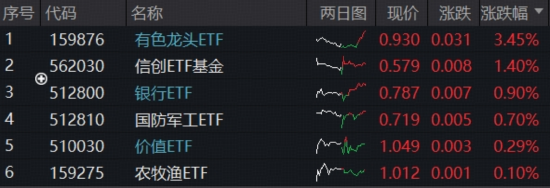
Market Overview - On October 13, the A-share market experienced a miraculous day, initially opening lower due to tariff uncertainties but later rebounding, with the Shanghai Composite Index closing down only 0.19% after a nearly 2% drop at the open [1] - A total of 1,682 stocks in the market rose, with a median decline of only 0.8% [1] Sector Performance - The Rare Earth sector saw a surge, with the Rare Earth Leading ETF (159876) experiencing a price increase of over 4.2% at one point, ultimately closing up 3.45% [2][5] - The domestic software sector also showed significant movement, with the Innovation ETF (562030) rising by 1.4% [3] - The Defense and Military sector outperformed, with the Defense ETF (512810) closing up 0.7%, driven by strong domestic demand and minimal impact from international trade disruptions [3][22] - The Banking sector demonstrated resilience, with the Bank ETF (512800) rising by 0.9% amid increased defensive positioning due to tariff uncertainties [3][14] Fund Flows and Investment Trends - The Rare Earth Leading ETF (159876) attracted significant capital, with a net inflow of 330 million units and a total of 2.58 billion yuan in the last three days [5][10] - The Bank ETF (512800) also saw substantial inflows, with a total of 7.63 billion yuan over the past three days, indicating strong investor interest [16][19] Regulatory Impact - The Ministry of Commerce's new regulations on rare earth exports have tightened controls, affecting the entire supply chain and potentially leading to price increases [7][12] - Analysts believe that the tightening of export controls will strengthen the supply side of the rare earth market, while demand is expected to remain robust due to seasonal factors [7][12] Earnings and Profitability - In the first half of 2025, over 91% of the 60 stocks in the China Nonferrous Metals Index reported profits, with notable increases in net profits for key players like Northern Rare Earth, which saw a staggering 1,951% increase [10][12] - The banking sector is expected to maintain stable profitability, with projected cash dividends exceeding 200 billion yuan from major state-owned banks, reflecting their strong earnings capacity [18][19] Future Outlook - The Rare Earth sector is anticipated to undergo a revaluation due to the supply-demand dynamics and regulatory changes, with analysts recommending strategic investments in this area [3][12] - The Defense and Military sector is expected to benefit from upcoming government plans and increased domestic orders, suggesting a positive outlook for the next few quarters [25][22]
关税风波再起,国防军工尽显自主可控本色,512810逆市收涨!长城军工等多股涨停
Xin Lang Ji Jin· 2025-10-13 11:46
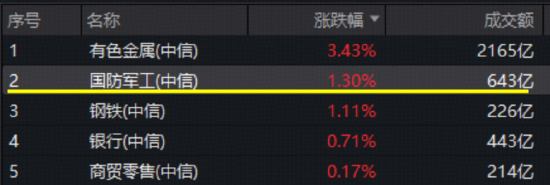
Group 1 - The defense and military industry sector has shown strong performance, ranking second among 30 CITIC primary industries with a growth of 1.30% on October 13 [1][2] - The sector's ETF (512810) demonstrated resilience, with a trading volume of 976.6 million and a daily fluctuation of 3.5%, indicating strong buying interest [2][3] - Out of 79 constituent stocks, 60 closed in the green, with notable performances from companies like Great Wall Military and Aopu Optoelectronics, while a few stocks like Feilihua experienced declines [2][3] Group 2 - The defense and military industry is characterized by strong planning, rigid domestic demand, and self-control, making it less susceptible to tariff impacts and potentially yielding excess returns [3][4] - The sector has recently rebounded after a period of stagnation since the "9·3" event, with profit-taking gradually clearing out and a noticeable upward trend emerging [3][4] - Looking ahead, the industry is expected to improve fundamentally as the "14th Five-Year Plan" concludes and the "15th Five-Year Plan" begins, with increasing market expectations for new orders [6][7] Group 3 - The ETF (512810) is positioned as an efficient tool for investing in core assets of the defense and military sector, covering various emerging themes such as controllable nuclear fusion and commercial aerospace [6][7] - The National Defense Science and Technology Industry Administration has accelerated efforts to ensure high-quality completion of tasks for the year, further supporting the sector's outlook [6]

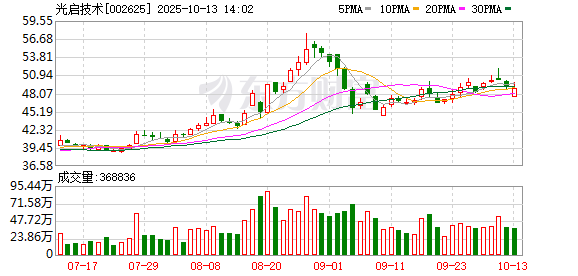
光启技术再签5.16亿元超材料订单,年内订单累计近26亿元
Zheng Quan Shi Bao Wang· 2025-10-13 06:01
Core Viewpoint - Guangqi Technology has signed contracts totaling 516 million yuan for the mass production of metamaterial products, reflecting a significant increase in demand and setting a new record for the company's annual order amount [2][4]. Group 1: Orders and Demand - The company reported a total order amount of nearly 2.6 billion yuan in the first three quarters of the year, breaking its historical record for annual orders [2]. - In just one month, Guangqi Technology disclosed orders amounting to 1.794 billion yuan, which accounts for over 70% of the total signed amount in the first three quarters, indicating a rapid acceleration in order delivery and strong downstream demand [2][4]. - The orders for metamaterials are characterized by a fast release frequency and short delivery cycles, driven by the urgent need for advanced equipment modernization [2][4]. Group 2: Production Capacity and Technological Readiness - In response to the surging demand, the company is enhancing its production capacity and technological capabilities, focusing on the production of next-generation metamaterial aerospace structures [3]. - Guangqi Technology has established multiple new bases, including Zhuzhou, Tianjin, and Leshan, which are set to commence operations in the second half of this year, effectively addressing the large-scale release and delivery of orders [3]. Group 3: Industry Outlook - The surge in orders for Guangqi Technology is indicative of the overall high prosperity in the defense advanced equipment sector, with the modernization of defense equipment entering a critical phase as part of the 14th Five-Year Plan [4]. - Analysts expect a recovery in the military industry’s fundamentals, with significant orders expected to be disclosed in the second half of the year, enhancing market optimism for long-term demand in the military sector [4]. - The transition from policy-driven growth to a dual-driven model of demand and technology is anticipated to further boost the military industry, particularly with the integration of new and upgraded equipment [4]. Group 4: Competitive Advantage - The metamaterial aerospace structure products are considered the company's flagship products, characterized by high customer loyalty and significant technological barriers [5]. - Guangqi Technology is leveraging an "order feedback to R&D" model to strengthen its technological moat, allowing for accelerated technological iterations and reinforcing its core position in the customer supply chain [5]. - The continuous landing of mass production orders is expected to support the company's capacity release, technological breakthroughs, and enhancement of market competitiveness in the coming years [5].
今日11只A股跌停 汽车行业跌幅最大
Zheng Quan Shi Bao Wang· 2025-10-13 05:23
Market Overview - The Shanghai Composite Index fell by 1.30% today, with a trading volume of 977.15 million shares and a total transaction value of 1,590.694 billion yuan, a decrease of 3.91% compared to the previous trading day [1] Industry Performance - The banking sector showed the smallest decline with a change of 0.02%, leading to a transaction value of 26.969 billion yuan, which is an increase of 5.62% from the previous day. The top-performing stock in this sector was Pudong Development Bank, which rose by 4.48% [1] - The automotive sector experienced the largest decline at 3.26%, with a transaction value of 81.481 billion yuan, down by 5.28% from the previous day. The leading stock in this sector was RY Electronics, which fell by 10.00% [2] - Other sectors with significant declines included electric power equipment (-2.71%), communication (-2.65%), and non-bank financials (-1.99%) [1][2] Notable Stocks - In the banking sector, Pudong Development Bank was the standout performer with a gain of 4.48% [1] - In the automotive sector, RY Electronics led the decline with a drop of 10.00% [2] - In the electric power equipment sector, Mingzhi Electric fell by 8.33% [2]
刚刚,A股突变!发生了什么?
天天基金网· 2025-10-13 05:15
Market Overview - The A-share market opened lower but rebounded, with the Shanghai Composite Index closing at 3846.25 points, down 1.3% [3] - The total market turnover was 1.59 trillion yuan, slightly lower than the previous day, with 4545 stocks declining and 840 stocks rising [5] Sector Performance - The aerospace, banking, shipping, and environmental protection sectors showed gains, while sectors like automotive, communication, and media struggled [5] - The banking sector led the gains among major industries, with Shanghai Pudong Development Bank rising over 4% and Nanjing Bank up over 3% [10][11] Concept Stocks - Rare earth, photolithography, and semiconductor concept stocks performed well, with rare earth stocks rising by 7.77% and photolithography stocks by 6.10% [6] - Domestic software stocks surged, with Rongji Software and China Software hitting the daily limit, and Chengmai Technology and Kingsoft Office also seeing significant increases [15] Notable Stocks - WuXi Biologics fell over 9%, while WuXi AppTec and Sunny Optical Technology dropped more than 8%, leading the decline in the Hang Seng Index [9] - Environmental stocks like Huicheng Environmental Protection and Huahong Technology saw significant gains, with Huicheng Environmental Protection hitting the daily limit [12] Recent Developments - The Ministry of Commerce announced new export controls on certain rare earth-related items, which has sparked discussions in the market [17] - The upcoming Bay Area Semiconductor Industry Ecological Expo is expected to attract attention, with Shenzhen's semiconductor companies participating [19]







A股,突变!
中国基金报· 2025-10-13 05:04
Market Overview - The A-share market opened lower but showed resilience, with the Shanghai Composite Index closing at 3846.25 points, down 1.3%, and the Shenzhen Component Index down 2.56% [1] - The total market turnover was 1.59 trillion yuan, slightly lower than the previous day, with 4545 stocks declining and 840 stocks rising [3] Sector Performance - The banking sector led the gains among major industries, with notable increases in stocks such as Shanghai Pudong Development Bank up over 4% and Nanjing Bank up over 3% [8] - The environmental protection sector also performed well, with Huicheng Environmental reaching a 20% limit up and several other stocks hitting their daily limits [10] - Aerospace and military industries showed strength, with stocks like Changcheng Military Industry and Aopu Optoelectronics hitting their daily limits [11] Concept Stocks - The "New Kailai" concept stocks were particularly active, with Tonghui Electronics hitting a 30% limit up and several other stocks like Xinlai Materials and Kaimeite Gas also reaching their daily limits [18] - The domestic software sector saw a collective surge, with stocks like Rongji Software and China Software hitting their daily limits [12] Notable Stock Movements - The banking sector saw significant gains, with Shanghai Pudong Development Bank at 12.37 yuan, up 4.48%, and Nanjing Bank at 11.19 yuan, up 3.52% [9] - In the environmental sector, Huicheng Environmental reached 169.85 yuan, up 19.28%, and Guolin Technology at 21.55 yuan, up 13.18% [10] - The military sector saw North Long Dragon at 152.66 yuan, up 15.41%, and Licheng Navigation at 59.45 yuan, up 12.70% [11] Regulatory and Policy Updates - The Ministry of Commerce announced new export controls on certain rare earth-related items, which has sparked discussions in the market [15] - The Ministry of Industry and Information Technology, along with six other departments, released a plan to promote service-oriented manufacturing innovation from 2025 to 2028, focusing on technology services and industrial design [15]