
交通运输

Search documents
7月份全国服务业生产指数同比增长5.8%
Xin Hua Wang· 2025-08-15 05:39
Group 1 - The core viewpoint of the article highlights the growth of the service industry in July, with a production index increase of 5.8% year-on-year, driven by increased summer tourism and related services [1] - The transportation, warehousing, and postal services sector also saw a production index growth of 5.5% in July, which is an acceleration of 0.4 percentage points compared to the previous month [1]
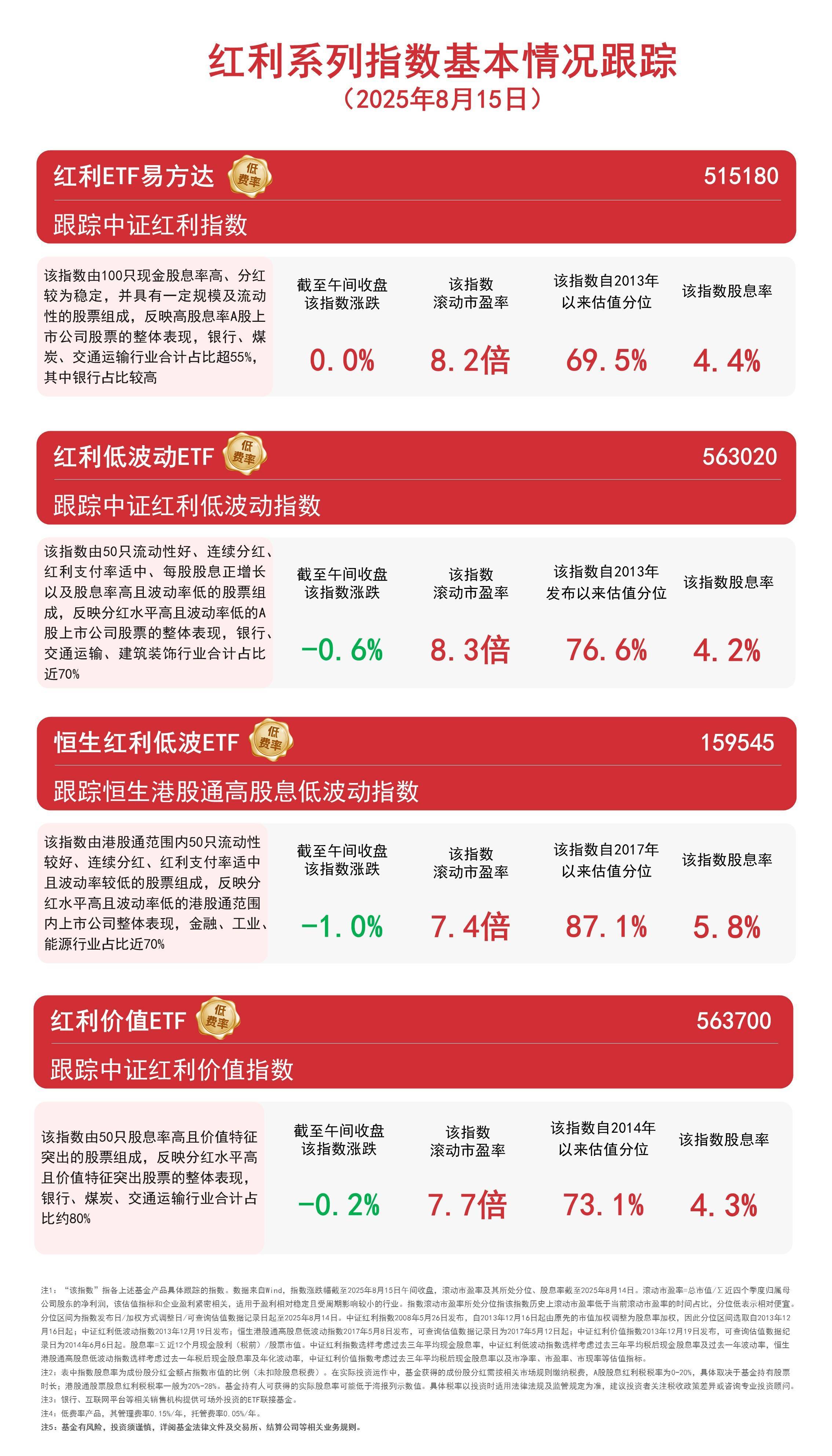
红利板块回调获资金逆势布局,恒生红利低波ETF(159545)半日净申购超2800万份
Sou Hu Cai Jing· 2025-08-15 05:01
Group 1 - The CSI Dividend Index rose by 0.03% while the CSI Dividend Value Index fell by 0.2% and the CSI Dividend Low Volatility Index decreased by 0.6% as of midday close [1] - The Hang Seng High Dividend Low Volatility Index dropped by 1%, and the Hang Seng Dividend Low Volatility ETF (159545) saw a net subscription of over 28 million units in the first half of the day [1] - The composition of the dividend-paying stocks reflects high dividend levels and low volatility, with the banking, transportation, and construction industries accounting for approximately 70% [5] Group 2 - The Hang Seng Dividend Low Volatility ETF tracks the Hang Seng High Dividend Low Volatility Index [6] - The index consists of 50 liquid stocks within the Stock Connect that have a history of continuous dividends, moderate dividend payout ratios, and low volatility, with financial, industrial, and energy sectors making up nearly 70% [7] - The Dividend Value ETF tracks the CSI Dividend Value Index, which includes 50 stocks characterized by high dividend yields and value traits [7]

国家统计局:1—7月全国固定资产投资增长1.6%
Guo Jia Tong Ji Ju· 2025-08-15 02:25
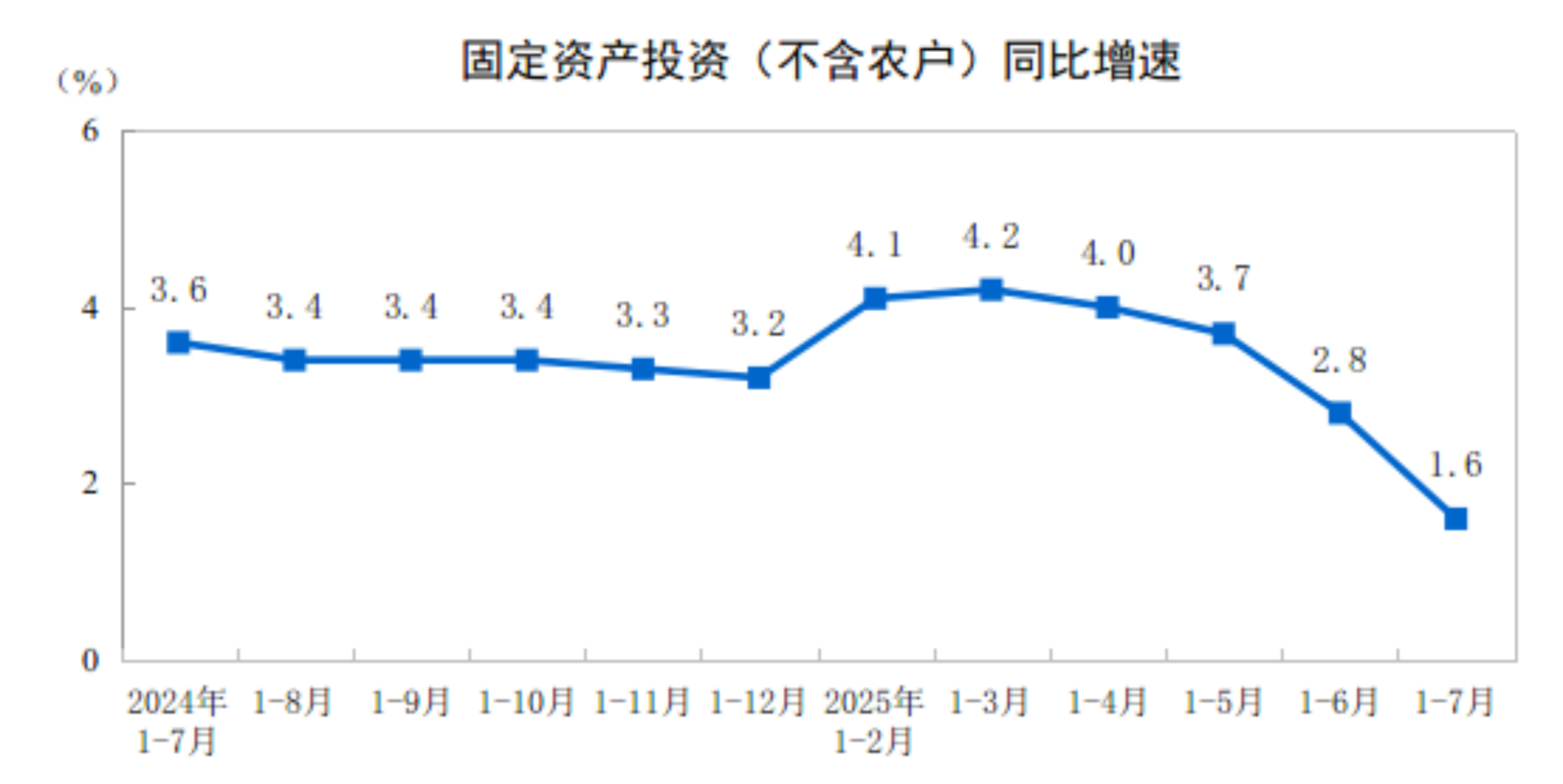
Core Insights - National fixed asset investment (excluding rural households) reached 288,229 billion yuan from January to July 2025, showing a year-on-year growth of 1.6% [1][5] - Private fixed asset investment declined by 1.5% year-on-year during the same period [1][5] - In July 2025, fixed asset investment (excluding rural households) decreased by 0.63% month-on-month [1] Investment by Industry - First industry investment totaled 5,646 billion yuan, with a year-on-year increase of 5.6% [3][5] - Second industry investment reached 104,455 billion yuan, growing by 8.9% [3][5] - Third industry investment was 178,128 billion yuan, experiencing a decline of 2.3% [3][5] Second Industry Breakdown - Industrial investment within the second industry grew by 9.0% year-on-year [4] - Mining investment increased by 3.0%, manufacturing investment rose by 6.2%, and investment in electricity, heat, gas, and water production and supply surged by 21.5% [4] Third Industry Insights - Infrastructure investment (excluding electricity, heat, gas, and water production and supply) in the third industry grew by 3.2% [4] - Notable increases in water transportation investment (18.9%), water conservancy management investment (12.6%), and railway transportation investment (5.9%) were observed [4] Regional Investment Trends - Eastern region investment declined by 2.4%, while the central region saw a growth of 3.2%, and the western region increased by 3.6% [4] - Northeast region investment decreased by 3.0% [4] Investment by Registration Type - Domestic enterprise fixed asset investment grew by 1.7%, while investment from Hong Kong, Macau, and Taiwan enterprises increased by 3.5% [4] - Foreign enterprise fixed asset investment saw a significant decline of 15.7% [4]
2025年1—7月份全国固定资产投资增长1.6%
Guo Jia Tong Ji Ju· 2025-08-15 02:01
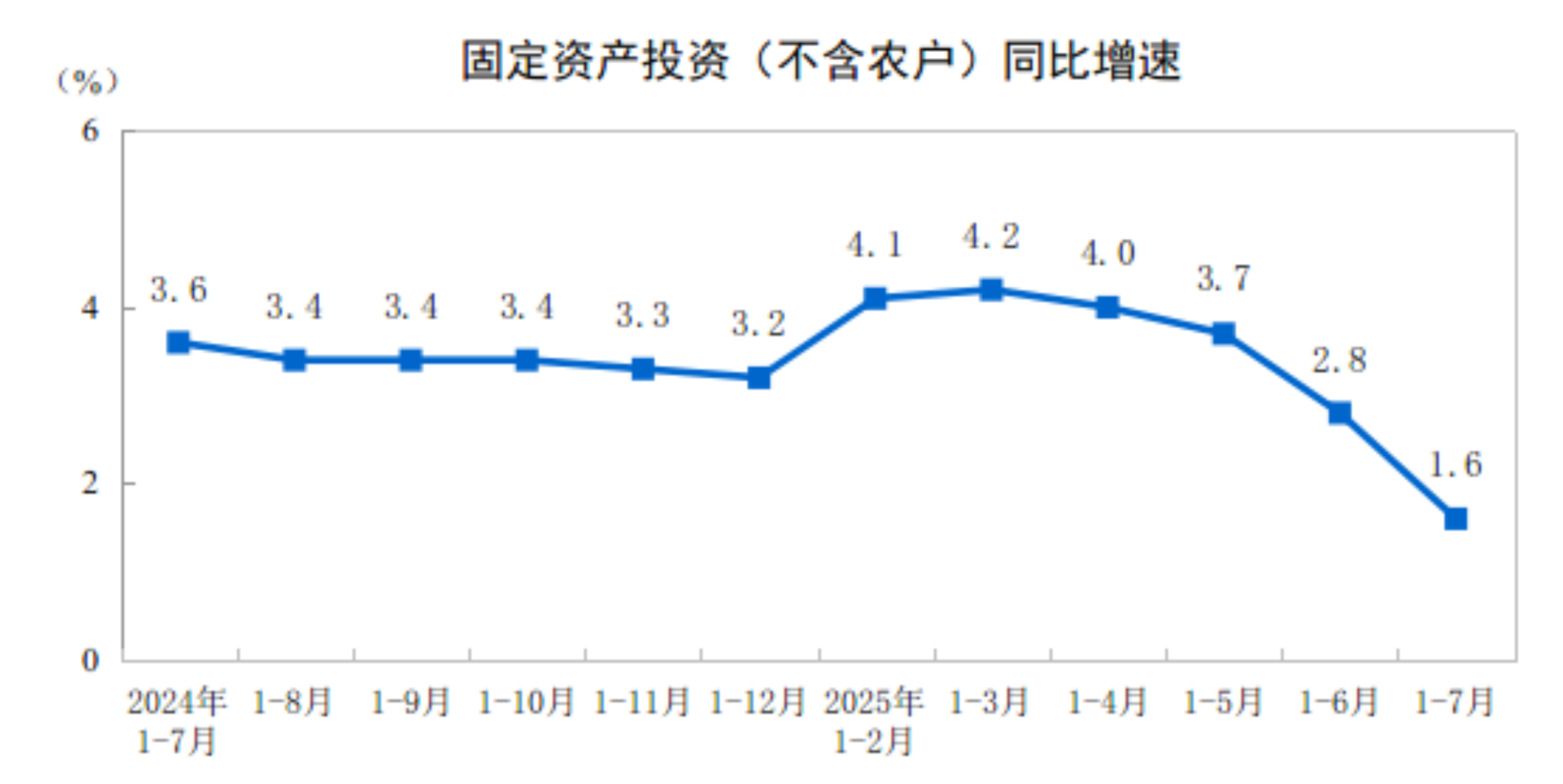
Core Insights - In the first seven months of 2025, China's fixed asset investment (excluding rural households) reached 288,229 billion yuan, showing a year-on-year growth of 1.6% on a comparable basis [1][5][17] - Private fixed asset investment experienced a decline of 1.5% year-on-year [1][5] - In July 2025, fixed asset investment (excluding rural households) decreased by 0.63% month-on-month [1] Investment by Industry - Investment in the primary industry amounted to 5,646 billion yuan, with a year-on-year increase of 5.6% [3][6] - The secondary industry saw an investment of 104,455 billion yuan, growing by 8.9% year-on-year, with industrial investment specifically increasing by 9.0% [3][6] - The tertiary industry experienced a decline in investment, totaling 178,128 billion yuan, down 2.3% year-on-year [3][6] - Within the secondary industry, mining investment grew by 3.0%, manufacturing investment increased by 6.2%, and investment in electricity, heat, gas, and water production and supply surged by 21.5% [3][6] Infrastructure and Regional Investment - Infrastructure investment (excluding electricity, heat, gas, and water production and supply) in the tertiary industry rose by 3.2% year-on-year, with notable increases in water transport (18.9%), water conservancy management (12.6%), and railway transport (5.9%) [3][6] - Investment trends varied by region: eastern regions saw a decline of 2.4%, while central and western regions experienced growth of 3.2% and 3.6%, respectively; northeastern regions faced a decline of 3.0% [3][6] Investment by Ownership Type - Domestic enterprises' fixed asset investment grew by 1.7%, while investment from Hong Kong, Macau, and Taiwan enterprises increased by 3.5%; foreign enterprises, however, saw a significant decline of 15.7% [4][6]
改革架桥梁 共促一体化(有所思)
Ren Min Ri Bao· 2025-08-14 21:59
Core Insights - The Yangtze River Delta plays a crucial role in China's economic landscape, with a GDP exceeding 16 trillion yuan in the first half of this year [1] Group 1: Market Integration and Regulation - The dual approach of "breaking market segmentation" and "establishing operational rules" is being advanced, with a focus on unified institutional design to enhance the region's role in creating a national unified market [2] - Efforts to eliminate both explicit local protectionism and implicit barriers related to capital, technology, and talent are underway, including unified enforcement standards and regulatory teams [2] Group 2: Infrastructure and System Innovation - Significant infrastructure projects like the Hu-Su-Hu High-Speed Railway and Hu-Ning Yangtze River High-Speed Railway are reducing commuting times and lowering market transaction costs, enhancing regional industrial interaction [3] - The integration of "soft connections" through initiatives like cross-province tourism agreements and a "Credit Yangtze River Delta" platform is fostering deeper regional collaboration [3] - The innovative practices in market integration within the Yangtze River Delta reflect a synergy between proactive government actions and effective market mechanisms, contributing to a positive cycle of institutional innovation, factor flow, and industrial upgrading [3]
策略解读:反内卷,更要买高门槛资产
Guoxin Securities· 2025-08-14 13:39
Core Insights - The current "anti-involution" market trend represents a phase of reversal from difficulties, characterized by a clear four-stage evolution, alternating between systematic market opportunities (β) and individual stock excess returns (α) [3][5] - Investors are encouraged to focus on high-barrier assets that are naturally immune to "involution," identifying three core long-term investment themes: monopolistic barrier assets, globally competitive assets, and AI-enabled efficiency revolution assets [3][4][19] Group 1: Four Stages of "Anti-Involution" Market - The first stage (Anti-Involution 1.0) is driven by supply-side contraction expectations, benefiting upstream resource sectors like steel and coal, leading to a typical β opportunity [5][6] - The second stage (Anti-Involution 2.0) sees a shift in focus from industry-wide gains to individual stock differentiation, where leading firms gain market share through strict production discipline, creating α opportunities [6][7] - The third stage (Anti-Involution 3.0) involves a fundamental improvement in supply-demand relationships, leading to a recovery in overall corporate profits and product prices, marking a new round of market upturn [7][8] - The fourth stage (Anti-Involution 4.0) features the emergence of new core assets in a stabilized competitive landscape, driven by technological innovations and global expansion [8][9] Group 2: Current Market Positioning - The market is transitioning from Anti-Involution 1.0 to 2.0, necessitating a dual focus on both β opportunities in specific sectors and the identification of high-quality stocks with strong α characteristics [8][13] - The current "anti-involution" differs fundamentally from the 2015 policy-driven "three reductions" approach, relying more on market-driven self-discipline rather than administrative mandates [8][13] Group 3: Long-Term Investment Themes - The report emphasizes the importance of investing in industries with natural high barriers to entry, such as public utilities and strategic rare resources, which provide stable cash flows and are less affected by economic cycles [19][27] - The three core elements supporting high-barrier industries include licensing barriers, resource barriers, and network effect barriers, which create exclusive pricing power and stable cash flows [27][28] - Companies that successfully "go global" and break overseas monopolies are identified as key players in the "anti-involution" narrative, particularly in high-tech sectors [29][30] Group 4: AI Empowerment - The rise of AI technology is seen as a transformative force accelerating the "anti-involution" process by enhancing productivity and driving market clearing [33][35] - Industries that can effectively leverage AI to reduce costs and reshape competitive dynamics are positioned to thrive in the evolving market landscape [35][36]
底仓再审视(一):红利与现金流,买在无人问津处
Guoxin Securities· 2025-08-14 13:28
Group 1: Report Industry Investment Rating - Not available in the provided content Group 2: Core Views of the Report - The high - dividend strategy's returns come from capital gains and dividend income, investing in mature - stage companies. It forms a positive cycle of "stable profits - continuous dividends - increased ROE", supporting its high win - rate [8]. - Market mainstream high - dividend indices include pure dividend indices, broad - based dividend enhancements, and Smart Beta dividend strategies, with significant differences in weighting methods, sampling constraints, number of components, and industry distributions [8]. - There are three key cognitive biases about the high - dividend strategy: it can outperform the market in various market conditions, not just in bear markets; interest rate movements have no significant overall impact; and the "ex - rights filling" market is not significant [8]. - The allocation of high - dividend assets should follow the principles of "long - termism, considering quality factors, avoiding crowded chips, and valuing expected dividends" [8]. - "Cash - cow" enterprises have abundant and stable cash flows, and their essence is related to business models, including resource allocation and profit - driving models [8]. - Different asset and liability structures form four cash - cow paradigms, and investing in cash - cow assets should combine business model paradigms and industrial cycles [8]. Group 3: Summaries According to the Table of Contents High - Dividend Strategy's Income Source and Nature - The high - dividend strategy's income comes from capital gains (due to stock price changes and value - restoration) and dividend income. Its essence is to invest in mature companies with limited investment returns, low revenue and net - profit growth, but strong profitability, high ROE, and good cash - flow protection [8][22][26]. - From 2014 to July 2025, the annualized returns of four typical dividend indices (CSI Dividend, Dividend Low - Volatility, 300 Dividend, and Dividend Value) reached 13.22%, 13.86%, 13.84%, and 15.72% respectively, with dividends contributing 71%, 68%, 71%, and 58% to these returns [30]. - High - dividend companies in the mature stage tend to pay dividends due to limited investment returns. Dividends are an important way to increase ROE, and high - dividend companies generally have strong cash - flow protection capabilities [33][37]. High - Dividend Strategy's Available Investment Tools - Mainstream high - dividend strategy indices include pure dividend indices, broad - based dividend enhancements, and Smart Beta dividend strategies. The products linked to the Dividend Low - Volatility and CSI Dividend indices have the largest scale [48]. - These indices differ in weighting methods (dividend - rate weighted, volatility weighted, comprehensive - score weighted, free - float market - value weighted), sampling methods (most require three - year continuous dividends and have dividend - payout ratio constraints), number of components (mostly 50 or 100), and other constraints (such as company attributes, ROE fluctuations) [58][61]. - In terms of industry distribution, CSI Dividend and Dividend Low - Volatility are relatively concentrated. The CSI Dividend Index has a bank weight of over 25%, and the Dividend Low - Volatility Index has a bank weight of up to 50% [64]. - Year - to - date, dividend indices have generally underperformed the Wind All - A Index. In the past 10 years, Smart Beta dividend strategies have been relatively dominant. High - dividend indices generally have a lower turnover rate relative to the All - A Index [67][81]. Three Cognitive Gaps in the High - Dividend Strategy - The high - dividend strategy is not just a "bear - market haven". It can outperform the market in bull markets, volatile markets, and during bull - bear transitions, such as in the 2006 - 2007 bull market, the 2008 and 2022 bear markets, and the 2015 - 2018 bull - bear transition [8][98]. - Interest rate movements have little impact on the high - dividend strategy. In the interest - rate up - cycle, inflation supports pro - cyclical assets; in the down - cycle, the dividend - income advantage is magnified, and absolute - return funds flow in [141]. - The "ex - rights filling" market is not significant. The probability of positive returns after ex - rights and ex - dividends is often less than 50% in the short - term, and the "ex - rights filling" market usually occurs after 180 trading days [151]. Allocation of High - Dividend Assets - The allocation of high - dividend assets should follow the principles of long - termism, considering quality factors, avoiding crowded chips, and valuing expected dividends. Long - term holding works well in a balanced market. Strategies can include selecting indices, constructing "high - dividend + low - turnover" portfolios, and focusing on expected dividend rates [8][178]. - Operationally, the best way to invest in dividend assets is Buy & Hold. Different investment methods for bank stocks (fixed - point buying, continuous定投, and inverted - triangle adding) have different returns, and the combination of dividend and micro - cap stocks in certain weights can achieve a better risk - return ratio [184]. From "High - Dividend" to "Cash - Cow" - "Cash - cow" enterprises have abundant and stable cash flows, and understanding their essence requires considering business models, including resource allocation (reflected in the balance sheet) and profit - driving models (reflected in the income statement) [8]. Cash - Cow Paradigms in Heavy - Asset and Light - Asset Industries - Four cash - cow paradigms are formed by different asset and liability structures: heavy - asset high - liability industries rely on asset scale and quality; heavy - asset low - liability industries rely on cost control; light - asset brand + channel - driven industries rely on brand premium and channel efficiency; light - asset product + channel - driven industries rely on product and channel efficiency [8]. How to Invest in Cash - Cow Assets - Investing in cash - cow assets should combine business model paradigms and industrial cycles. The best time to invest is when the industrial cycle shifts from the growth stage to the exit stage, and high - quality companies within the paradigms should be selected [8].
社保基金二季度调仓动向曝光,近50只重仓股年内平均涨幅超20%
Di Yi Cai Jing· 2025-08-14 13:10
Core Insights - The Social Security Fund has significantly increased its holdings in over 50 listed companies, with a total shareholding exceeding 800 million shares and a market value surpassing 15.1 billion yuan [1][5] - More than 60% of the companies in which the fund has invested reported a year-on-year increase in net profit for the first half of the year [6] Group 1: Investment Strategy - In the second quarter, the Social Security Fund entered 17 new stocks and increased holdings in 15 stocks, while reducing holdings in 9 stocks [1] - The new investments span various sectors, including basic chemicals, home appliances, social services, computers, and transportation, indicating a diversified investment approach [4][3] - The fund's preference is for stocks with stable and growing performance, particularly in the banking, chemical, and electronics sectors [3] Group 2: Performance Metrics - The average increase in stock prices for the fund's holdings since the beginning of the year is over 22%, with more than 70% of the stocks experiencing price increases [2][5] - Notable performers include Guomai Culture with a cumulative increase of over 140%, and Dingtong Technology with an increase exceeding 133% [5] - In the second quarter alone, the average increase for the fund's holdings was 0.51%, with 11 out of the 17 new stocks showing price increases [5] Group 3: Financial Performance - Over 70% of the companies in which the Social Security Fund is invested reported a year-on-year increase in net profit for the first half of the year, with some companies like Rongzhi Rixin showing a staggering increase of 2063.42% [6][7] - However, some companies in the fund's portfolio, particularly in the basic chemicals and building materials sectors, experienced significant declines in net profit [7] - The fund's adjustments reflect a keen focus on the performance of individual stocks, with notable reductions in holdings for companies like Huajing Co. and Aidesheng Biology, which saw declines in net profit [4][7]
龙江交通(601188.SH):穗甬控股大宗交易减持1.01%股份
Ge Long Hui A P P· 2025-08-14 11:08
格隆汇8月14日丨龙江交通(601188.SH)公布,公司于2025年8月14日收到持股5%以上股东穗甬控股有限 公司(以下简称"穗甬控股")发来的《关于权益变动触及1%整数倍的告知函》,获悉其于2025年8月7 日-2025年8月13日期间,通过大宗交易方式减持其持有的公司无限售流通股1335.3万股,占公司总股本 的比例为1.01%。穗甬控股及其一致行动人广州辰崧投资合伙企业(有限合伙)合计持有公司股份的比 例由6.89%减少至5.88%,权益变动触及1%整数倍。 ...

龙江交通今日大宗交易折价成交47万股,成交额153.22万元
Xin Lang Cai Jing· 2025-08-14 09:36
8月14日,龙江交通大宗交易成交47万股,成交额153.22万元,占当日总成交额的2.57%,成交价3.26元,较市场收盘价3.49元折价6.59%。 | 交易日期 | 证券简称 | 证券代码 | 成交价(元) 成交金额(万元) 成交量( * ) 买入营业部 | | | | 卖出营业部 | | --- | --- | --- | --- | --- | --- | --- | --- | | 2025-08-14 | 龙江交通 | 601188 | 153.22 3.26 | 47 | 华泰证券股份有限 | 中泰证券股份有限 公司上海周家嘴路 | | | | | | | | 公司重庆江北嘴证 | | | | | | | | | Jack 2010 . 11 . 4412 | Ver 244 22 . 11, 407 | | ...
