券商

Search documents
A股节后冲击4000点?私募重仓透露三大信号,这类股成最大赢家
Sou Hu Cai Jing· 2025-10-08 00:50
Market Overview - During the National Day holiday, global markets experienced a rally, with the Nasdaq, S&P 500, and Hong Kong's Hang Seng Tech Index reaching new highs, driven by rising expectations of Federal Reserve interest rate cuts [2] - The People's Bank of China conducted a significant reverse repurchase operation of 1.1 trillion yuan, injecting 300 billion yuan in liquidity, boosting market confidence [2] - The A-share market is focused on whether it can break through the 3900-point level, with predictions of a potential rise to 4000 points by the end of the year [2] Technical Analysis - The Shanghai Composite Index has been in a consolidation phase for 26 trading days, forming an ascending triangle pattern, indicating a potential breakout [4] - A successful breakout above the 3800-3885 point range could lead to the index reaching 3900 points [4] Private Equity Sentiment - A survey indicated that 65.38% of private equity firms are heavily invested, reflecting overall optimism for the post-holiday market [5] - However, the uniformity in institutional behavior may pose risks, as any slight changes in market conditions could lead to significant volatility [5] Sector Performance - The technology sector saw significant activity, with collaborations between OpenAI and South Korean chip companies, leading to a surge in semiconductor stocks [6] - The semiconductor and new energy sectors are emerging as dual main lines in the A-share market, with storage chip prices driving a broad rally [6] Earnings Reports - The upcoming third-quarter earnings reports, starting October 9, will be crucial for the performance of technology stocks, with over 70% of companies showing positive forecasts [6] - Companies with strong earnings support, such as Tianji Co. and CATL, are expected to stand out [6] Resource Sector Insights - The supply-demand gap in resource stocks is widening due to production halts in Myanmar and increased copper demand from the electric vehicle sector [6] - The long lead time for new mines to come online supports the bullish outlook for resource stocks [6] Value Opportunities - The brokerage and insurance sectors are currently undervalued, with brokerage firms like Huatai Securities and CITIC Securities trading at around 18 times earnings [9] - The insurance sector is benefiting from improving fundamentals, with adjustments in the third-quarter interest rates expected to alleviate risks [9] Investment Strategy - Investors are advised to remain rational amid market emotions, with a focus on sectors that have lagged behind, such as resources and financials [13] - The upcoming earnings reports will provide clarity on whether to pursue short-term trends or maintain a focus on value [13]

A股关键时刻:3900点争夺战打响,节后首日走势决定十月行情方向!
Sou Hu Cai Jing· 2025-10-07 16:37
Market Overview - The A-share market has reached 3882.78 points, just 18 points away from the critical 3900 mark, a level not seen since 2025 [1] - The outcome of the market battle at this level will significantly influence investment returns for the fourth quarter [3] Technical Analysis - The 3896 point level serves as a dual resistance, being both a previous high and close to the psychological barrier of 3900 [3] - A successful breakthrough requires trading volume to return to approximately 1.2 trillion yuan, similar to mid-September levels; current volume has decreased, raising concerns [3] Economic Environment - The international environment presents mixed signals, with the Federal Reserve cutting rates by 25 basis points in September and expectations for further cuts, which could benefit the A-share market [3] - Domestic policies are supportive, focusing on technology upgrades and consumption recovery, particularly in AI and semiconductors [4] Financial Conditions - The liquidity remains ample, with expectations of capital inflow post-holiday; historical data shows an average net inflow of 14.7 billion yuan on the first trading day after holidays [6] - The central bank has introduced a new liquidity support mechanism for non-bank financial institutions, allowing them to exchange ETFs or stocks for cash, with an initial scale of 500 billion yuan [6] Market Sentiment - The structure of market participants is improving, with more institutional investors entering the A-share market, including domestic insurance and pension funds [7] - Investor sentiment is positive, with 63.1% of respondents in a recent survey believing the A-share market will rise, an increase from April [7] Valuation Metrics - The MSCI China Index is trading at approximately 17 times earnings, slightly above historical averages, while the median P/E ratio for the CSI 300 Index is around 18 times [8] - Current valuation levels do not indicate excessive inflation, providing room for future market growth [9] Market Trends - The market is expected to experience a "first decline, then rise" pattern on October 9, with initial technical adjustment pressures [10] - The market may stabilize and recover towards the end of the trading day, influenced by capital flows and the performance of key stocks [11] Sector Performance - The market has shown a "strong deep, weak Shanghai" pattern in September, with the ChiNext Index rising 12.04% and the STAR 50 Index up 11.48% [16] - Sectors such as new energy and semiconductors have led the market, while traditional sectors like finance and consumption have faced pressure [16] Investment Opportunities - Key investment themes include AI and new energy, with a focus on semiconductor equipment and storage chips [24] - Potential rotation opportunities exist in resource sectors, particularly non-ferrous metals, and in the financial sector, where valuations are at historical lows [28] Future Outlook - The upcoming October meetings and reports, including the Fourth Plenary Session and third-quarter earnings, are critical for market direction [30] - The market is expected to maintain a positive trend into 2026, driven by improved liquidity conditions and capital inflows from overseas [38]

大摩首席:外资眼中,中国真正的“核心资产”不是茅台,而是它们
Sou Hu Cai Jing· 2025-10-07 12:52
Group 1 - Core Point 1: The current market rally is not merely driven by liquidity but is supported by improving corporate earnings fundamentals, as indicated by the positive Earnings Revision Breadth for the MSCI China Index in August [4][5][6][27]. - Core Point 2: Identifying the right sectors is crucial, with strong performance expected in technology, internet, finance, and biotechnology, while traditional sectors like consumer goods and real estate are facing downward revisions in earnings expectations [7][9][10][11][31]. - Core Point 3: AI is not a bubble; leading companies in China are significantly undervalued compared to their U.S. counterparts, with the potential for substantial growth as they leverage AI for business enhancement [12][13][14][15]. Group 2 - Core Point 4: Foreign investment interest in the Chinese stock market is increasing, particularly among U.S. investors, with over 90% expressing plans to increase their exposure to Chinese equities, focusing on sectors where China has established global leadership [16][17][18][32][33]. - Core Point 5: The market dynamics are shifting towards a more structured environment, emphasizing the need for investors to focus on companies with core competitiveness that can withstand economic cycles, rather than relying on macroeconomic trends [20][21][22][23][24].

科技股出现大幅回调,谁将接棒?三大板块或成A股新主线
Sou Hu Cai Jing· 2025-10-06 20:31
Market Overview - The A-share market is experiencing significant "index differentiation, widespread individual stock declines, and capital rotation" characteristics [1] - The technology sector, represented by the Sci-Tech 50 index, has seen a substantial pullback with a single-day decline of 2.51%, while the ChiNext index surged by 2.34% [1] - Market funds are withdrawing from overvalued sectors like semiconductors and communication equipment, with a net outflow exceeding 10 billion yuan in a single day, and are flowing into battery and consumer sectors [1] Financial Sector - The financial sector holds a weight of nearly 24% in the Shanghai Composite Index, serving as a key support for the index [3] - Brokerage firms have shown outstanding performance in the first half of the year, with many institutions achieving net profit growth of several tens of percent or even doubling [3] - The banking sector's net interest margin has dropped to a historical low of 1.43%, with risks from real estate and technology sector loans not fully released [3] - The insurance sector is benefiting from policy support, such as the issuance of guidelines to boost consumption, which injects liquidity expectations into the industry [3] - Financial stocks are becoming the preferred choice for institutions to avoid risks, with the margin financing balance exceeding 2.05 trillion yuan by August 2025 [3] Consumer Sector - The consumer sector has a weight of approximately 16% in the CSI 300 index and is one of the areas with the largest recent declines [3] - Policies aimed at boosting consumption have been prioritized, with the "old-for-new" policy driving sales of 1.1 trillion yuan and issuing about 175 million subsidies [3] - The number of applications for the "old-for-new" subsidy for automobiles reached 4.12 million, with significant year-on-year growth in sales of home appliances and digital products [3] Specific Industries - In the food and beverage sector, there has been a net inflow of over 1.6 billion yuan, and the summer blockbuster film "Nezha 2" has surpassed 15 billion yuan in box office revenue, indicating a continued rise in service consumption [5] - The raw materials sector holds a weight of about 15.2% in the Shanghai Composite Index, with many sub-sectors undergoing critical capacity clearance [5] - The energy sector shows clear differentiation, with coal mining expanding due to high profits and a capital expenditure growth rate of 48%, while oil service engineering and cement industries are experiencing sufficient supply contraction [6][7] Market Dynamics - The current adjustment is fundamentally a shift of funds from overvalued technology sectors to areas with stronger certainty [9] - Technology stocks have a financing ratio of 58%, leading to significant short-term profit-taking pressure, while financial, consumer, and raw materials sectors benefit from low valuations and policy dividends [9] - Institutions like Galaxy Securities suggest that market style will shift from a "single bridge" to a "dual lane," with defensive sectors temporarily attracting funds during the technology sector's pullback [9]
摩根斯坦利首席Laura Wang:外资眼中,中国真正的“核心资产”不是茅台,而是它们
雪球· 2025-10-06 13:00
Group 1 - The core viewpoint is that the current market rally is driven by fundamental performance rather than liquidity, indicating a shift from a "liquidity bull market" to a "performance bull market" [6][7][22] - The "Earnings Revision Breadth" for the MSCI China Index turned positive in August, signaling that the number of companies with upward earnings revisions exceeds those with downward revisions, marking a recovery in corporate profitability [8][27] - The sectors showing strong performance include technology, internet, finance, and biotechnology, while traditional sectors like consumer goods and real estate are facing downward revisions in earnings expectations [10][11][12][31] Group 2 - The importance of selecting the right sectors is emphasized, with a recommendation to focus on "hot" sectors while avoiding "cold" ones, as the market is experiencing significant internal differentiation [9][10][12] - AI is not viewed as a bubble; instead, leading companies in this space are considered undervalued compared to their U.S. counterparts, presenting a significant investment opportunity [14][15][16] - Global investor interest in the Chinese stock market is rising, particularly among U.S. investors, with over 90% expressing plans to increase their exposure to Chinese stocks [17][18][33] Group 3 - The market dynamics are changing, moving towards a more structured market that requires deeper understanding and insight into specific industries rather than relying on macroeconomic trends [21][22] - Investors are encouraged to focus on companies with strong competitive advantages and the potential for growth, particularly in sectors like AI, automation, and biotechnology [19][20][24] - The upcoming consumption data from the Golden Week holiday and the 14th Five-Year Plan meeting are seen as potential catalysts for market movement [35][36]

情满中秋,月圆家圆!
Sou Hu Cai Jing· 2025-10-06 02:48
Group 1 - The article discusses the emerging leadership within Midea Group, indicating a potential successor to the current leadership [3] - It highlights the competitive landscape among the three major white goods manufacturers, focusing on their strategic responses to market challenges [3] - The article mentions significant investments and initiatives in technology showcased at the Shanghai Cooperation Organization summit [3] Group 2 - The article notes the ongoing interviews for the new chair of the Federal Reserve, which could impact financial markets and economic policies [3] - It points out the challenges faced by Baidu's significant investment, referring to it as a "failure" in the context of its expected returns [3] - The article provides insights into the performance of 42 listed brokerage firms, suggesting a competitive analysis among them [3]

前三季度,这些ETF开挂了!
Sou Hu Cai Jing· 2025-10-05 02:44
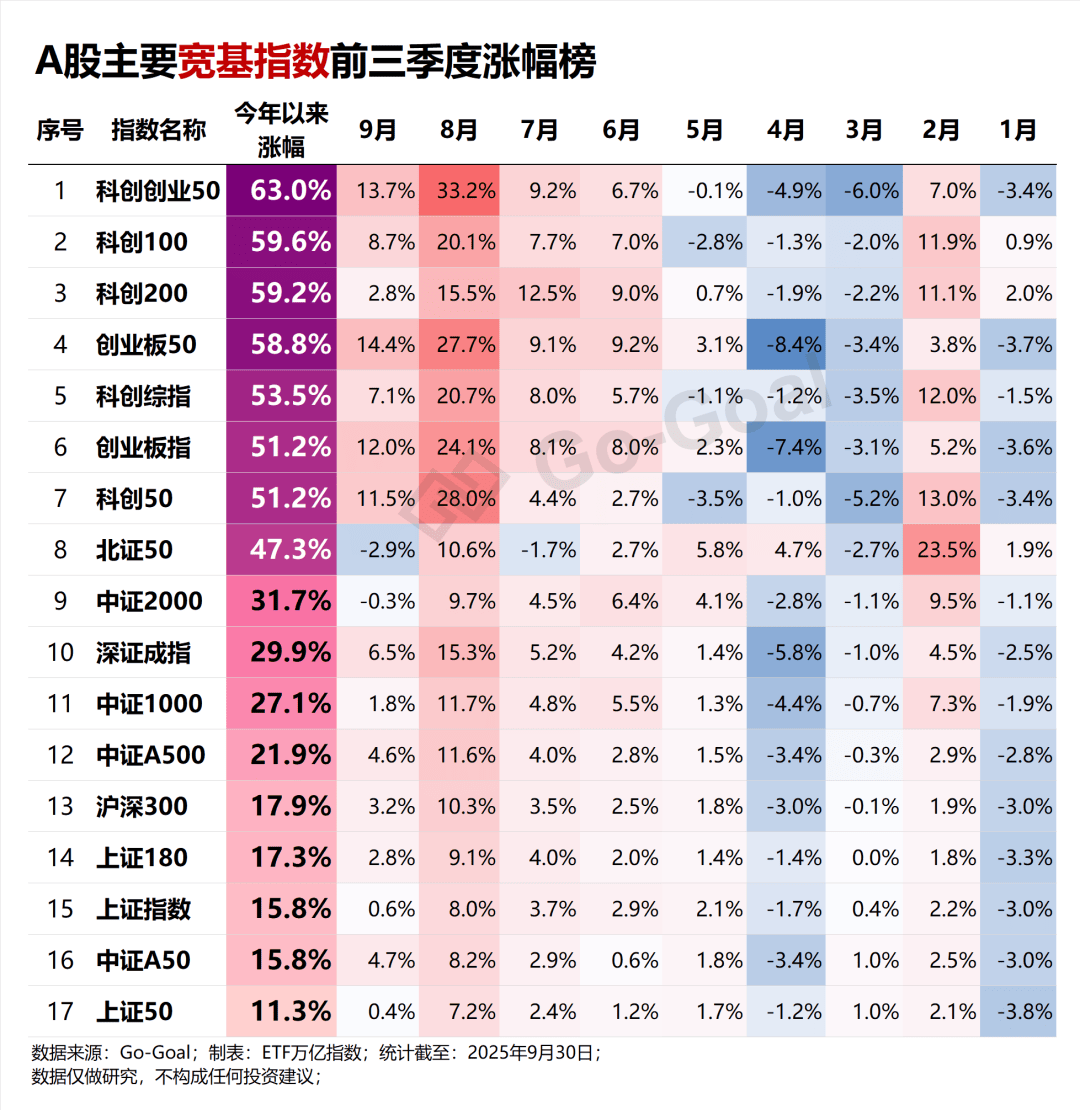
Core Insights - The A-share market showed strong performance in September, with major indices rising, particularly in the technology growth sectors like renewable energy and semiconductors [1][2] - The ChiNext 50 index led the gains in September with a 14.4% increase, while the overall trend for the year has seen significant growth in technology-focused indices [1][2] Index Performance - The ChiNext 50 index rose by 14.4% in September, followed by the ChiNext index at 12.0%, and the Sci-Tech 50 index at 11.5% [1][2] - Year-to-date, the top three performing indices are the Sci-Tech Entrepreneur 50 (up 63%), Sci-Tech 100 (up 59.6%), and Sci-Tech 200 (up 59.2%) [1][2] Sector Highlights - In September, ETFs related to batteries and semiconductor equipment performed exceptionally well, with several lithium battery and battery-themed ETFs seeing monthly gains exceeding 30% [3][4] - The strong performance in these sectors is attributed to breakthroughs in solid-state battery technology and the long-term demand for computing power infrastructure driven by AI [3][4] Fund Flows - Significant capital inflows were observed in ETFs related to securities companies, robotics, and Hong Kong internet sectors, indicating a shift in investment focus [4][5] - The top three ETFs by net inflow include the Hong Kong Internet ETF, Securities ETF, and the CSI A500 ETF [5][6] Year-to-Date Performance - The Hong Kong innovative drug sector has been a standout performer this year, with several related ETFs doubling in value [7] - The top performing ETFs in the innovative drug sector include the Hong Kong Innovative Drug ETF (up 113.48%) and the Hong Kong Innovative Drug 50 ETF (up 108.61%) [7] Industry Trends - The non-ferrous metals sector has shown the highest growth among industries in the first three quarters, with a 67.5% increase [9][10] - Other strong sectors include communications (up 62.6%) and electronics (up 53.5%) [9][10] Valuation Insights - The ChiNext index and CSI 300 index are still considered undervalued, with battery sector valuations around 30% [11][12] - In the Hong Kong market, the Hong Kong Internet, Hang Seng Technology, and Hong Kong Innovative Drug sectors are also viewed as undervalued [11][12] Market Outlook - The technology growth sector remains a focal point, with expectations of internal differentiation and a potential shift towards AI applications and consumer electronics [13][14] - There is a possibility of a market style rebalancing, with lower-performing cyclical sectors like securities and non-ferrous metals expected to see a rebound [13][14] - The Hong Kong market is highlighted for its potential value, especially with favorable liquidity conditions anticipated from potential interest rate cuts by the Federal Reserve [14]
10月3日凌晨!传来4大紧急消息,休市股民急得原地转圈
Sou Hu Cai Jing· 2025-10-03 17:33
Group 1 - The surge in global markets, including the Hong Kong stock market, is driven by rising expectations of a Federal Reserve interest rate cut and breakthroughs in AI technology, particularly with OpenAI's Sora2 model, which has increased demand for computing power and positively impacted semiconductor companies like SMIC [3] - SMIC's 14nm production capacity utilization has reached full capacity, leading to a stock price increase of over 10%, reflecting a shift in foreign investors' perception of China's semiconductor industry from concerns over supply chain issues to a reassessment of its value due to technological advancements [3] - The FTSE China A50 index showed significant movement during the holiday, indicating that international funds are positioning themselves for the post-holiday market, which historically tends to see a rebound in A-shares after long breaks [3] Group 2 - The People's Bank of China plans to conduct a 1.1 trillion yuan reverse repurchase operation, signaling a commitment to stabilize growth through monetary policy, with a new multi-price bidding mechanism aimed at directing funds to institutions with urgent needs [5][6] - The introduction of a new policy allowing qualified foreign investors to participate in onshore ETF options trading is expected to encourage long-term investment in A-shares, as it provides risk management tools rather than speculative opportunities [5][6] - The consumer goods replacement policy has successfully allocated 300 billion yuan in central funds, significantly boosting sales in the automotive and home appliance sectors, with over 270 million vehicles updated and more than 52.1 million home appliances sold, contributing to over 1 trillion yuan in sales [8] Group 3 - The market is experiencing a multi-faceted boost from various policies, contrasting with previous single-factor stimuli, as evidenced by the Shanghai Composite Index nearing 3900 points with a trading volume of 973.2 billion yuan [8] - The financial sector, particularly brokerage firms, is expected to benefit from increased market activity due to the central bank's liquidity injections, which will enhance brokerage revenue from trading activities [12] - Companies in the consumer sector, especially those benefiting from the replacement policy, and technology firms with strong ties to AI advancements, are positioned to gain from the growing global demand for computing power [12]


帮主郑重聊10月行情:券商金股名单出炉,“红十月”该往哪踩油门?
Sou Hu Cai Jing· 2025-10-03 12:22
Group 1 - The article highlights the strong performance of the ChiNext index in September, prompting discussions on stock strategies for October [1] - Four stocks, Hikvision, Zhaoyi Innovation, Huayou Cobalt, and Luoyang Molybdenum, are identified as "golden stocks" for October, with Huayou Cobalt noted for a significant 37% increase in September [3] - The focus for October is on three main themes: technology, "anti-involution," and third-quarter earnings reports, with specific sectors like AI computing, semiconductor self-sufficiency, and solid-state batteries being emphasized [3] Group 2 - Investment strategies suggest avoiding blind chasing of stocks that have already surged, like Huayou Cobalt, and instead focusing on stocks with stable fundamentals that have not seen excessive price increases [4] - Investors are advised to concentrate on one main theme, either technology or "anti-involution," rather than diversifying too broadly across multiple sectors [4] - The third-quarter earnings reports are seen as a critical indicator, with recommendations to research stocks that are expected to exceed earnings expectations, particularly in the semiconductor and brokerage sectors [4]


证监会再次发声!三大信号说明主力调仓方向,这些板块恐会翻倍
Sou Hu Cai Jing· 2025-10-03 03:13
Group 1 - The insurance sector has thousands of billions of incremental funds waiting to enter the market, with a focus on long-term assessments for institutions [2] - A new regulatory framework requires public funds to increase their A-share market value by 10% annually over the next three years, addressing the volatility caused by retail investors [2] - As of the end of August, long-term funds held A-share market value of 21.4 trillion yuan, a 28% increase from the beginning of the year, with their turnover rate significantly lower than that of retail investors [2] Group 2 - OpenAI's release of the Sora 2.0 video generation model showcases advanced capabilities, including multi-angle storytelling and realistic visual effects [4] - Institutional investors are systematically increasing their holdings in AI computing power stocks, with notable net purchases in companies like Zhongke Shuguang and Inspur Information [4][6] - The advertising sector is also seeing growth, with the daily usage of AIGC creation platforms doubling within two weeks [6] Group 3 - The market shows a historical trend where the Wande All A Index has a 60% probability of rising in the first five trading days after the holiday [7] - The financial metrics indicate that the banking sector has a dividend yield of 6.84%, suggesting limited downside for the index due to high dividend assets [7] Group 4 - In October, 97 companies will have lock-up shares released, totaling a market value of 238.9 billion yuan, with Tianshan Shares alone accounting for 25.86 billion yuan [11] - There is an increasing trend in the willingness of industrial capital to reduce holdings, with the number of companies announcing reduction plans reaching a yearly high [11] Group 5 - The current market environment creates two types of investment opportunities: assets with a dividend yield over 5% and a PEG ratio below 1, and technology companies with R&D expenses exceeding 15% [13] - The domestic production rate of semiconductor equipment is increasing by 5 percentage points annually, indicating a positive trend in the sector [13] Group 6 - The average recovery period for retail investors entering the market on October 8, 2024, is projected to be nine months, highlighting the challenges faced by individual investors [15] - The impact of the AI technology revolution raises questions about the disparity between capital returns and labor returns, particularly in the context of content creation [15]