休闲食品

Search documents
休闲食品板块1月13日跌1.45%,立高食品领跌,主力资金净流出3.11亿元
Zheng Xing Xing Ye Ri Bao· 2026-01-13 09:00
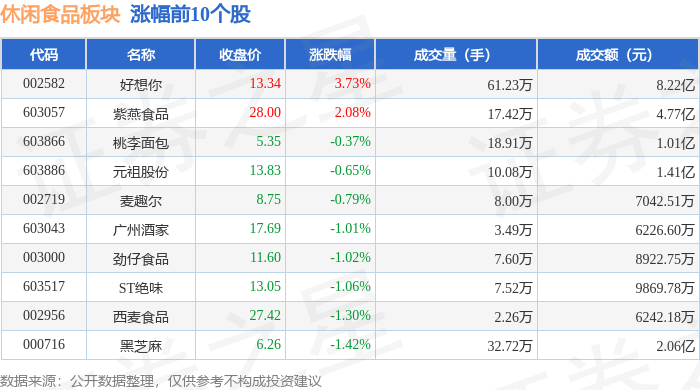
Market Overview - The leisure food sector experienced a decline of 1.45% on January 13, with Lihigh Food leading the drop [1] - The Shanghai Composite Index closed at 4138.76, down 0.64%, while the Shenzhen Component Index closed at 14169.4, down 1.37% [1] Individual Stock Performance - The following stocks showed notable performance: - Haoxiangni (002582) closed at 13.34, up 3.73% with a trading volume of 612,300 shares and a turnover of 822 million yuan [1] - Ziyan Food (603057) closed at 28.00, up 2.08% with a trading volume of 174,200 shares and a turnover of 477 million yuan [1] - Lihigh Food (300973) closed at 44.52, down 4.36% with a trading volume of 46,600 shares and a turnover of 211 million yuan [2] - Three squirrels (300783) closed at 24.91, down 3.04% with a trading volume of 225,600 shares and a turnover of 570 million yuan [2] Capital Flow Analysis - The leisure food sector saw a net outflow of 311 million yuan from main funds, while retail investors contributed a net inflow of 269 million yuan [2] - The following stocks had significant capital flow: - Haoxiangni (002582) had a main fund net inflow of 30.36 million yuan, while retail investors had a net outflow of 4.83 million yuan [3] - Yanjin Food (002847) had a main fund net inflow of 16.06 million yuan, but a retail net outflow of 21.49 million yuan [3] - Ganyuan Food (002991) experienced a main fund net outflow of 7.07 million yuan, with a retail net inflow of 6.08 million yuan [3]


煌上煌跌2.01%,成交额7008.07万元,主力资金净流出524.27万元
Xin Lang Cai Jing· 2026-01-13 05:46
Core Viewpoint - The stock price of Jiangxi Huangshanghuang Group Food Co., Ltd. has shown fluctuations, with a recent decline of 2.01% on January 13, 2025, and a total market capitalization of 6.81 billion yuan [1]. Group 1: Stock Performance - The stock price has increased by 3.66% since the beginning of the year, with a 2.44% rise over the last five trading days and a 3.40% increase over the last 20 days, while it has decreased by 2.80% over the last 60 days [2]. - As of January 9, 2025, the number of shareholders is 32,300, a decrease of 1.48% from the previous period, with an average of 15,833 circulating shares per person, which is an increase of 1.50% [2]. Group 2: Financial Performance - For the period from January to September 2025, the company achieved a revenue of 1.379 billion yuan, a year-on-year decrease of 5.08%, while the net profit attributable to the parent company was 101 million yuan, reflecting a year-on-year increase of 28.59% [2]. - The company has distributed a total of 518 million yuan in dividends since its A-share listing, with 169 million yuan distributed over the last three years [3]. Group 3: Business Overview - Jiangxi Huangshanghuang Group specializes in the development, production, and sales of marinated meat products and quick-consumption side dishes, with its main business revenue composition being 60.71% from fresh products, 31.67% from rice products, 4.12% from slaughter processing, 1.97% from packaging products, and 1.49% from other sources [2]. - The company is classified under the food and beverage industry, specifically in the leisure food and cooked food segments, and is associated with concepts such as prepared dishes, unmanned retail, new retail, and leisure food [2]. Group 4: Shareholding Structure - As of September 30, 2025, Hong Kong Central Clearing Limited is the sixth largest circulating shareholder, holding 3.8874 million shares, which is an increase of 2.4422 million shares compared to the previous period [3].

达利食品上市前的核心产品矩阵包含哪些品牌?这些品牌是如何逐步培育起来的?
Sou Hu Cai Jing· 2026-01-12 09:14
Group 1 - Dali Foods was listed on the Hong Kong Stock Exchange in 2015, establishing a product matrix centered on snack foods and extending into beverages, with core brands including Daliyuan, Kexi, Haochidian, Heqizheng, and Lehu, covering various categories such as pastries, puffed snacks, biscuits, herbal tea, and functional drinks [1] - The brand Daliyuan was launched in 2002, focusing on the pastry segment with egg yolk pies as the core product, targeting the demand for consumer upgrades, and quickly gaining market traction through celebrity endorsements and effective marketing strategies [1] - In 2003, Dali introduced Kexi potato chips to penetrate the puffed snack market, which was dominated by foreign brands, offering prices one-third lower than imported brands and leveraging celebrity endorsements to attract young consumers [1] Group 2 - The biscuit brand Haochidian was launched in 2004, breaking the dominance of foreign brands in the high-end biscuit market, with a widely recognized advertising slogan endorsed by a popular celebrity [2] - Dali expanded into the beverage sector with the launch of Heqizheng herbal tea in 2007 and Lehu functional drinks in 2013, continuing the strategy of celebrity endorsements while establishing nine production bases nationwide to enhance regional marketing and create an efficient sales network [2] - The company successfully built a multi-brand collaborative product matrix, laying a solid foundation for its listing and achieving nationwide brand coverage [2]
休闲食品板块1月12日涨0.75%,三只松鼠领涨,主力资金净流出5513.14万元
Zheng Xing Xing Ye Ri Bao· 2026-01-12 09:04
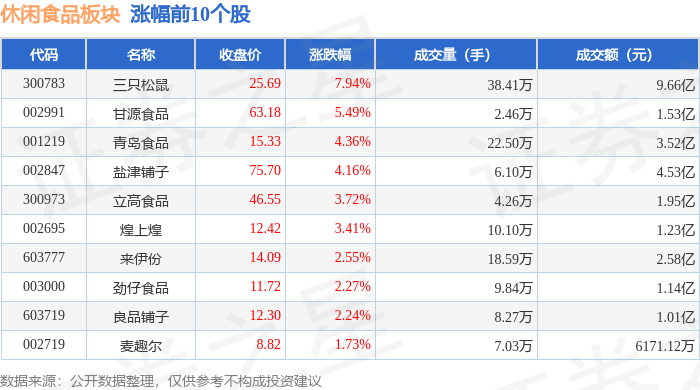
Market Performance - The leisure food sector increased by 0.75% on January 12, with Three Squirrels leading the gains [1] - The Shanghai Composite Index closed at 4165.29, up 1.09%, while the Shenzhen Component Index closed at 14366.91, up 1.75% [1] Individual Stock Performance - Three Squirrels (300783) closed at 25.69, up 7.94% with a trading volume of 384,100 shares and a transaction value of 966 million [1] - Other notable performers include: - Ganyuan Food (002991) at 63.18, up 5.49% [1] - Qingdao Food (001219) at 15.33, up 4.36% [1] - Yanjin Puzhou (002847) at 75.70, up 4.16% [1] - Ligao Food (300973) at 46.55, up 3.72% [1] Capital Flow Analysis - The leisure food sector experienced a net outflow of 55.13 million from institutional investors and 7.52 million from retail investors, while retail investors saw a net inflow of 62.66 million [2] - Three Squirrels had a net inflow of 68.83 million from institutional investors, but a net outflow of 51.26 million from retail investors [3] - Qingdao Food had a net inflow of 25.90 million from institutional investors, with a net outflow of 23.42 million from retail investors [3]
西麦食品(002956):燕麦龙头引领行业发展,大健康二次增长空间广阔
Shanxi Securities· 2026-01-12 08:17
Investment Rating - The report maintains a "Buy-A" rating for Ximai Food [2][4][54] Core Viewpoints - Ximai Food is the leading player in the Chinese oatmeal market, achieving steady revenue growth with a projected revenue of 1.896 billion yuan in 2024, representing a year-on-year increase of 20.16% [2][19] - The company has established a complete industry chain covering breeding, planting, research and development, production, and sales, which positions it well to lead the market [2][11] - The oatmeal industry in China is experiencing a significant increase in market size, expected to exceed 10 billion yuan in 2024, driven by rising health consciousness among consumers [3][28] Summary by Relevant Sections Company Performance - Ximai Food's revenue for 2024 is projected at 1.896 billion yuan, with a net profit of 133 million yuan, reflecting a year-on-year growth of 20.16% and 15.36% respectively [2][19] - The company has a five-year compound annual growth rate (CAGR) of 16.65% from 2020 to 2024, indicating strong market demand for its products [2][19] Industry Analysis - The Chinese oatmeal market is still in its early stages, with a current market concentration (CR3) of approximately 51.9%, indicating room for growth compared to more concentrated markets in developed countries [3][31] - The market is expected to continue expanding due to increasing health awareness and the aging population, with a projected CAGR of around 11.52% from 2011 to 2019 [28][30] Product and Channel Strategy - Ximai Food's product lineup includes composite oatmeal, pure oatmeal, and cold oatmeal, with composite oatmeal becoming the largest category, contributing significantly to revenue growth [3][35] - The company employs a dual-channel strategy combining online and offline sales, with a growing number of distributors and a strong presence in e-commerce platforms like Douyin and Tmall [3][39] Financial Forecast and Valuation - Revenue forecasts for 2025-2027 are 2.286 billion, 2.878 billion, and 3.461 billion yuan, with respective growth rates of 20.6%, 25.9%, and 20.3% [4][54] - The projected net profit for the same period is expected to reach 184 million, 255 million, and 307 million yuan, with growth rates of 38.5%, 38.1%, and 20.4% [4][54]
三只松鼠股价涨5.17%,南方基金旗下1只基金位居十大流通股东,持有219.84万股浮盈赚取270.4万元
Xin Lang Cai Jing· 2026-01-12 03:43
Group 1 - The stock price of Three Squirrels increased by 5.17%, reaching 25.03 CNY per share, with a trading volume of 326 million CNY and a turnover rate of 4.77%, resulting in a total market capitalization of 10.054 billion CNY [1] - Three Squirrels Co., Ltd. is located in Wuhu City, Anhui Province, and was established on February 16, 2012, with its IPO on July 12, 2019. The company specializes in the research, testing, packaging, and sales of its own brand of snack foods [1] - The main revenue composition of Three Squirrels includes nuts at 56.30%, comprehensive products at 28.81%, baked goods at 14.06%, and other products at 0.83% [1] Group 2 - Southern Fund's Southern CSI 1000 ETF (512100) entered the top ten circulating shareholders of Three Squirrels in the third quarter, holding 2.1984 million shares, which accounts for 0.78% of the circulating shares, with an estimated floating profit of approximately 2.704 million CNY [2] - The Southern CSI 1000 ETF (512100) was established on September 29, 2016, with a latest scale of 76.63 billion CNY. Year-to-date returns are 7.05%, ranking 1300 out of 5579 in its category, while the one-year return is 45.31%, ranking 1627 out of 4202 [2] Group 3 - The fund manager of Southern CSI 1000 ETF (512100) is Cui Lei, who has a cumulative tenure of 7 years and 68 days. The total asset scale under management is 122.76 billion CNY, with the best fund return during the tenure being 234.52% and the worst being -15.93% [3]
卫龙美味涨超3% 管理层展望今年魔芋产品可实现稳健增长 口味创新打开增长空间
Zhi Tong Cai Jing· 2026-01-12 03:00
Core Viewpoint - Wei Long Wei Wei (09985) has seen a stock price increase of over 3%, currently trading at 12.5 HKD with a transaction volume of 23.37 million HKD, following a Goldman Sachs report highlighting the company's growth prospects and management's guidance for fiscal year 2025 [1] Group 1: Company Guidance - Management has indicated a revenue growth of over 15% year-on-year for fiscal year 2025, with a net profit margin expected to be between 18% and 20% [1] - The company anticipates steady growth in its konjac products this year, while its flavored noodle products are expected to recover growth through innovative product launches and channel expansion [1] Group 2: Product Insights - According to Aijian Securities, konjac products have high plasticity and good flavoring properties, making them naturally suitable for diverse seasonings, which opens up growth opportunities through flavor innovation [1] - The inherent blandness of konjac allows it to absorb seasoning flavors effectively, resulting in low marginal costs for flavor iteration and significant marginal returns [1] Group 3: Cost and Supply Dynamics - The cost of konjac flour is expected to rise significantly in 2024, with the gross profit margin for vegetable products projected to decline by 6 percentage points year-on-year due to high costs in the first half of 2025 [1] - Rising prices have stimulated upstream farmers' planting enthusiasm, leading to an expansion in planting area, and with new production capacity expected to be released gradually by 2025, a downward cycle in konjac flour costs is anticipated by 2026 [1]
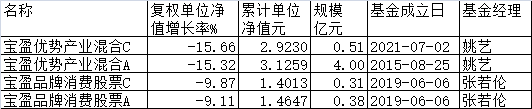
2025年宝盈基金旗下4只基金跌超9%?2只基金跌幅达15%
Zhong Guo Jing Ji Wang· 2026-01-09 14:34
Group 1 - The core point of the article highlights that four funds under Baoying Fund experienced a decline of over 9% in 2025, with specific funds managed by Yao Yi and Zhang Ruolun showing significant losses [1][2] - Baoying Advantage Industry Mixed C and A funds reported declines of 15.66% and 15.32% respectively, with Yao Yi managing these funds since March 2021 after a tenure at Huatai Securities [1][2] - The top ten holdings of Baoying Advantage Industry Mixed fund include companies such as Bai Li Tianheng, Heng Rui Pharmaceutical, and WuXi AppTec, indicating a focus on the pharmaceutical sector [1] Group 2 - Baoying Brand Consumption Stock C and A funds recorded declines of 9.87% and 9.11% respectively, managed by Zhang Ruolun since August 2025 [1][2] - The Baoying Brand Consumption fund maintains a diversified portfolio across major consumer sectors, with top holdings including Kweichow Moutai, Tencent Holdings, and Haidilao [1][2] - The funds have been operational since 2019, with the Brand Consumption funds focusing on sectors like liquor, home appliances, and leisure food [1][2]
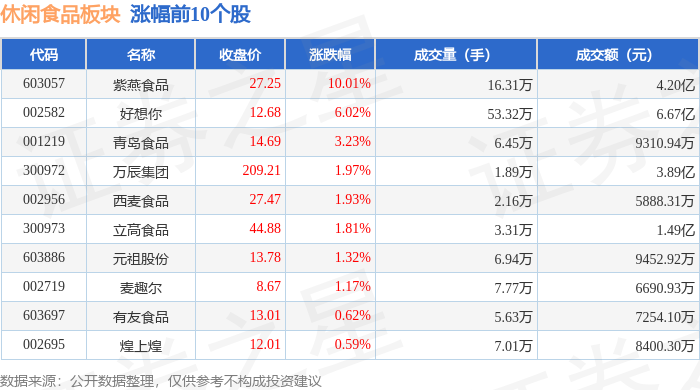
休闲食品板块1月9日涨1.27%,紫燕食品领涨,主力资金净流出7985.97万元
Zheng Xing Xing Ye Ri Bao· 2026-01-09 08:54
Market Overview - The leisure food sector increased by 1.27% on January 9, with Ziyan Food leading the gains [1] - The Shanghai Composite Index closed at 4120.43, up 0.92%, while the Shenzhen Component Index closed at 14120.15, up 1.15% [1] Stock Performance - Ziyan Food (603057) closed at 27.25, up 10.01% with a trading volume of 163,100 shares and a transaction value of 420 million yuan [1] - Other notable performers include: - Haoxiangni (002582) at 12.68, up 6.02% with a transaction value of 667 million yuan [1] - Qingdao Food (001219) at 14.69, up 3.23% with a transaction value of 93.11 million yuan [1] - Wancheng Group (300972) at 209.21, up 1.97% with a transaction value of 389 million yuan [1] Capital Flow - The leisure food sector experienced a net outflow of 79.86 million yuan from institutional investors, while retail investors saw a net inflow of 100 million yuan [2] - The overall capital flow indicates a mixed sentiment, with institutional investors withdrawing funds while retail investors are increasing their positions [2] Individual Stock Capital Flow - Notable capital flows include: - Zhizhi Food (002557) with a net outflow of 9.91 million yuan from institutional investors [3] - Qingdao Food (001219) saw a net inflow of 7.52 million yuan from institutional investors [3] - Purple Onion Food (603057) had a net inflow of 5.18 million yuan from institutional investors [3]

来伊份控股股东拟套现约1.4亿元 此前已套现4.14亿元
Zhong Guo Jing Ji Wang· 2026-01-09 07:24
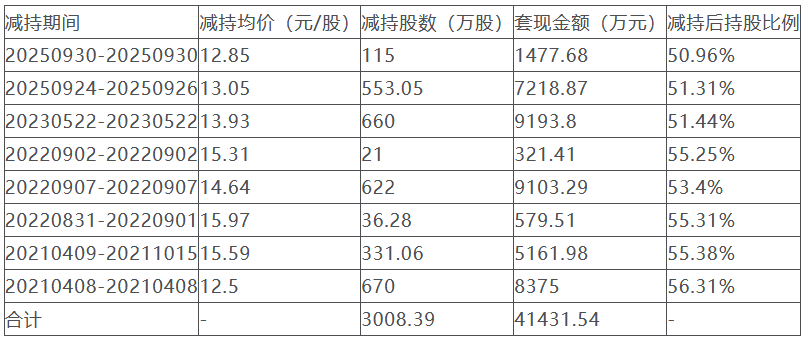
Core Viewpoint - The controlling shareholder of Laiyifen, Shanghai Aiwu Enterprise Management Co., Ltd., plans to reduce its shareholding by up to 10,032,724 shares, representing no more than 3% of the total share capital of the company [1] Shareholding Reduction Plan - The reduction will occur through centralized bidding and block trading, with a maximum of 3,344,241 shares (1% of total share capital) to be sold via centralized bidding within three months starting from January 30, 2026 [1] - Additionally, up to 6,688,483 shares (2% of total share capital) will be sold through block trading during the same period [1] Financial Implications - Based on the previous trading day's closing price of 14.20 yuan, the total cash to be raised from the share reduction is approximately 142,464,680.80 yuan [2] - As of the announcement date, Aiwu Enterprise holds 170,428,983 shares, accounting for 50.96% of the total share capital [2] Shareholder Composition - The controlling shareholder, Aiwu Enterprise, is 80% owned by Shi Yonglei and 20% by Yu Ruifen, who are married [3] - Other significant shareholders include the Yingshui Xunyang No. 10 Private Securities Investment Fund (2%), Yu Ruifen (3.22%), and several other entities, bringing the total shareholding of Aiwu Enterprise and its concerted actions to 203,314,983 shares, or 60.80% of the total share capital [2] Historical Context - Aiwu Enterprise initially held 197 million shares, representing 58.29% of the total share capital, and has reduced its holdings by 30,083,900 shares since April 8, 2021, realizing approximately 414 million yuan in cash [4] - The historical share reduction data shows various prices and amounts sold, with the highest average price being 15.97 yuan per share [5]