
卫星通信

Search documents
星链彻底成功那天,地球人要被美国拿捏了?马斯克的星链计划要是真能彻底成功,别被所谓 “全球通信革新” 的噱头骗了,这根本不是全人类的福利,而是藏着獠牙的科技威胁。是美国在太空搞霸权霸凌的赤裸裸表现,其他国家要是没拿出靠谱的反制手段,往后在太空领域只会处处被动,后果真的没法想象。...
Sou Hu Cai Jing· 2026-01-13 02:31
Core Viewpoint - The success of SpaceX's Starlink program may not be a global benefit but rather a manifestation of U.S. technological dominance, posing significant risks to other nations' sovereignty and security [1][2]. Group 1: Technological Implications - Starlink's network, consisting of over 40,000 terminals, allows for direct communication without traditional ground infrastructure, enabling effective military operations in conflict zones like Ukraine [2]. - The introduction of the "Starshield" program, which plans to launch 15,000 satellites, indicates a shift from civilian to military applications, raising concerns about the potential for coercive control over nations reliant on this technology [2][3]. Group 2: Geopolitical Risks - The limited physical space in low Earth orbit and the scarcity of radio frequencies create a competitive environment where the first to occupy these resources can exert control over others, likening it to monopolizing a vital road [3][4]. - The aggressive deployment of Starlink satellites has previously posed collision risks to international space stations, highlighting the potential for geopolitical tensions and operational hazards in space [4][6]. Group 3: Security Concerns - The proliferation of Starlink technology could inadvertently facilitate global terrorism, as the widespread availability of such systems may fall into the wrong hands, complicating security measures [5]. - Without developing independent satellite systems, nations risk becoming overly dependent on foreign technology, which could lead to vulnerabilities in national defense and communication infrastructures [5].


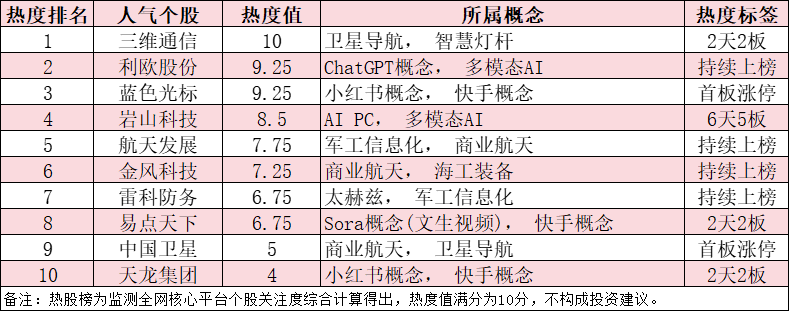
今日十大热股:AI营销与商业航天概念齐飞,三维通信2天2板领衔,利欧股份、岩山科技、金风科技持续上榜
Jin Rong Jie· 2026-01-13 01:30
Market Overview - On January 12, A-shares saw a collective rise, with the Sci-Tech Innovation 50 index leading at 2.43%, while the Shanghai Composite Index increased by 1.09% and both the Shenzhen Component Index and ChiNext Index rose over 1.7% [1] - The total trading volume in the Shanghai and Shenzhen markets reached 3.6 trillion yuan, an increase of approximately 478.7 billion yuan compared to the previous day [1] - A total of 3,872 stocks rose while 1,167 stocks fell, indicating a broad market rally [1] Sector Performance - The software development and internet services sectors attracted significant capital inflows, while the electronic components and battery sectors experienced notable outflows [1] - AI-related sectors, including GEO concepts, AI marketing, and Sora concepts, saw substantial gains, while TDI concept stocks and the mining industry faced leading declines [1] Company Highlights - **Sanwei Communication**: Benefiting from a strong position in the commercial aerospace sector, the company has established stable growth in satellite communication services and leads in maritime satellite communication operations [2] - **Lio Co., Ltd.**: The company's AI-related business has made significant progress, with AI capabilities being implemented across various business scenarios, particularly in marketing through its subsidiary Lio Digital [2] - **BlueFocus Communication Group**: As the largest advertising agency for Meta, the company’s AI marketing business is synergistic with Meta's acquisition of AI capabilities, attracting attention from investors [2] - **Yanshan Technology**: The company has made substantial technological advancements in AI PCs, smart driving, and brain-computer interfaces, showcasing its innovative capabilities at CES [3] - **Aerospace Development**: The company benefits from multiple favorable factors in the commercial aerospace sector, including government support and the anticipated launch of new space missions [3] - **Goldwind Technology**: The company’s stake in Blue Arrow Aerospace has drawn market attention due to its implications in the commercial aerospace sector [3] - **Reiko Defense**: The company’s business aligns closely with current market trends, covering satellite applications, radar systems, and military information technology [3] - **Easy Point World**: The company is positioned at the intersection of AI marketing and international expansion, enhancing its collaboration with Amazon Ads to explore global marketing strategies [4] Popular Stocks - The top ten popular stocks in the A-share market include Sanwei Communication, Lio Co., Ltd., BlueFocus Communication Group, Yanshan Technology, Aerospace Development, Goldwind Technology, Reiko Defense, Easy Point World, China Satellite, and Tianlong Group [5]



【点金互动易】AI智能体+DEEPSEEK+金融科技,推出基于DeepSeek-R1的银行智能体,这家公司为两家香港拥有虚拟银行牌照企业服务
财联社· 2026-01-13 01:15
Group 1 - The article emphasizes the importance of timely and professional information interpretation in investment decision-making [1] - It highlights the use of AI technology, specifically the DeepSeek-R1 banking AI, to enhance financial services for virtual banks in Hong Kong [1] - The company is also focusing on satellite communication and chip technology, with products already being shipped for low Earth orbit satellite communication [1] Group 2 - The article mentions the goal of utilizing gallium nitride (GaN) RF chips for satellite applications, indicating a strategic direction in advanced technology [1]

军工对话通信-商业逻辑如何实现闭环
2026-01-13 01:10
Summary of Key Points from the Conference Call Industry Overview - The conference call discusses the satellite communication industry, particularly the relationship between ground operators and satellite operators in China and abroad. The development of overseas satellite networks is driven by insufficient ground network coverage and high prices, which contrasts with the domestic operators' responsibilities to provide services in remote areas [1][2]. Core Insights and Arguments - **Collaboration Over Competition**: The future relationship between ground operators and satellite operators is expected to be collaborative rather than competitive. This is exemplified by the partnership between T-Mobile and SpaceX, where frequency authorization allows for mutual benefits [3][4]. - **Market Transformation Timeline**: The transition to satellite services in remote areas is anticipated to occur around 2030, with potential market impacts beginning as early as 2027-2028. This shift is influenced by the National Development and Reform Commission's (NDRC) inclusion of profit in the assessment of ground operators [4]. - **User Density and Market Potential**: Approximately 25% of China's population lives in areas where ground communication is economically unfeasible. This demographic is likely to be served by satellite networks in the future, leading to a significant market opportunity [5][6]. - **Market Size Estimation**: If satellite network penetration reaches 25%, it could correspond to a market size exceeding 200 billion yuan, with the overall market potential estimated to exceed 500 billion yuan, potentially reaching a trillion yuan level in the future [6]. Important but Overlooked Content - **Quantitative Analysis of Market Space**: The analysis emphasizes the SaaS business model, where increased user numbers lead to reduced costs, making profitability achievable. The model considers factors such as base station costs, operational expenses, and average revenue per user (ARPU) [5][6]. - **Key Companies to Watch**: In the network construction phase, companies with anti-deflation attributes such as Taikang Technology, Wuhan Institute of Communication, and Fenghuo Communication are highlighted. In the application phase, HaiGe Communication is noted for its strong partnerships with China Mobile and China Star Network, positioning it as a key player in the commercial space [7]. Conclusion - The satellite communication industry is poised for significant growth driven by collaboration between ground and satellite operators, with substantial market opportunities in underserved regions. Key players in both the network construction and application phases are positioned to benefit from this evolving landscape.


格林大华期货早盘提示-20260113
Ge Lin Qi Huo· 2026-01-12 23:30
早盘提示 Morning session notice 更多精彩内容请关注格林大华期货官方微信 格林大华期货研究院 证监许可【2011】1288 号 2026 年 1 月 13 日 星期二 研究员: 于军礼 从业资格: F0247894 交易咨询资格:Z0000112 联系方式:yujunli@greendh.com | 板块 | 品种 | 多(空) | | | --- | --- | --- | --- | | | | 【重要资讯】 | | | | | | 1、美国哥伦比亚特区联邦检察官办公室已就美国联邦储备委员会华盛顿总部翻修 | | | | | 相关事宜,对美联储主席鲍威尔启动刑事调查。鲍威尔说,刑事指控的威胁,实因 | | | | | 美联储依据对公共利益的最佳评估设定利率,而非追随总统的偏好。 | | | | | 2、中国 2025 年 12 月向国际电信联盟申请了超 20 万颗卫星的频轨资源,其中 19 | | | | | 万颗来自刚成立的"国家队"无线电创新院。这是无线电领域首家以技术创新和成 | | | | | 果转化为目标的新型研发机构,意味着卫星频轨资源申请已上升至国家战略层面。 | | ...
影响市场重大事件:浙江支持民营企业依托自有卫星星座参与卫星物联网业务;上海积极引导企业投资布局商业航天等新兴领域
Mei Ri Jing Ji Xin Wen· 2026-01-12 22:41
Group 1 - Zhejiang Province supports private enterprises to participate in satellite IoT business using their own satellite constellations as part of the "14th Five-Year" digital economy and infrastructure planning [1] - Shanghai encourages investment in emerging fields such as commercial aerospace, embodied intelligence, and smart terminals through its three-year action plan for advanced manufacturing [2] - Multiple satellite-related ETFs experienced significant gains, with several reaching the daily limit up on January 12, indicating strong market interest in the commercial aerospace sector [3] Group 2 - The Brain-Machine Interface Laboratory successfully conducted the first human "space brain-machine interface experiment" in a space station, contributing to advancements in aerospace technology [4] - The Ministry of Industry and Information Technology emphasizes the implementation of the "Artificial Intelligence + Manufacturing" initiative to enhance the integration of AI in various industries [5] - New margin trading accounts reached a record high in 2025, indicating increased investor participation in the market [6] Group 3 - Zhejiang Province is seeking public input on its "14th Five-Year" new industrialization plan, which includes the establishment of a multi-dimensional and controllable computing power facility [7] - The province plans to optimize the layout of the Beidou station network and enhance the integration of satellite communication and ground mobile communication systems [8] - The Ministry of Industry and Information Technology will focus on quantum technology, humanoid robots, and brain-machine interfaces during the "14th Five-Year" period [9] Group 4 - Energy Singularity successfully developed a high-temperature superconducting magnet with a pure conduction cooling structure, achieving a magnetic field of 20.8 Tesla [10]
中国卫通(601698.SH):近期公司股票价格脱离公司基本面
智通财经网· 2026-01-12 12:16
Core Viewpoint - China Satcom (601698.SH) has experienced a significant stock price fluctuation, with a cumulative increase of 100% over 10 consecutive trading days from December 26, 2025, to January 12, 2026, indicating severe abnormal trading activity [1] Summary by Categories Stock Performance - The stock price of China Satcom has deviated significantly from its fundamental value, leading to a cumulative price increase of 100% over the specified period [1] Regulatory Compliance - The company issued a notice regarding the abnormal stock price movement in accordance with the trading rules of the Shanghai Stock Exchange, highlighting the need for transparency in trading activities [1] Investor Risk - Despite no major changes in the company's fundamentals, the significant price movement suggests that investors may face substantial risks when participating in trading [1]

A股行情持续,哪些ETF强势吸金
Sou Hu Cai Jing· 2026-01-12 12:05
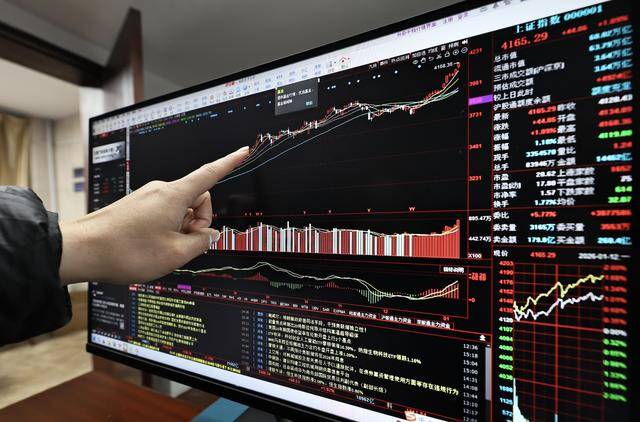
Core Viewpoint - The A-share market continues its strong performance at the beginning of the year, with significant trading volumes and a notable increase in various sectors, particularly in commercial aerospace and technology-related ETFs [3][6][10]. Market Performance - As of January 12, the Shanghai Composite Index surpassed 4165 points, with a total trading volume exceeding 3.64 trillion yuan, marking a historical high. The Shanghai index rose by 1.09%, while the Shenzhen Component and ChiNext indices increased by 1.75% and 1.82%, respectively [3]. - Over 4100 stocks in the market saw gains, with 202 stocks hitting the daily limit up [3]. Sector Analysis - The cultural media, military electronics, and IT services sectors all experienced gains exceeding 7%, while real estate, insurance, agricultural chemicals, and oil processing sectors faced declines [3]. - The commercial aerospace sector remains hot, with related ETFs experiencing significant surges. Multiple satellite industry ETFs saw daily gains of over 9% [3][6]. ETF Market Dynamics - A total of 1875 ETFs were analyzed, with 1487 showing increases, indicating a positive market sentiment. Notably, 50 ETFs had daily gains exceeding 9% [6]. - The Morgan Stanley CSI AI ETF led the gains with a 16.59% increase, while other technology-related ETFs also performed strongly [6][7]. Fund Flows - There is a clear divergence in fund flows, with fixed-income ETFs experiencing significant redemptions, particularly in the sci-tech bond category, which accounted for over 60% of the outflows [8]. - Conversely, equity ETFs saw substantial inflows, with satellite communication-related ETFs attracting over 80 billion yuan [9]. Investment Outlook - Analysts suggest that the commercial aerospace sector, despite high valuations, has significant long-term growth potential. The industry is expected to see accelerated development, with dynamic P/E ratios projected to decrease significantly by 2026 and 2027 [12]. - Investment strategies should focus on cyclical sectors, technology innovation, and areas benefiting from domestic demand and consumption recovery, such as entertainment and social services [11].
中国卫通:公司基本面未发生重大变化 公司股票存在短期大幅下跌的风险
Ge Long Hui A P P· 2026-01-12 10:22
Core Viewpoint - China Satcom's stock price has experienced significant fluctuations, with a cumulative increase of over 20% in closing prices over three consecutive trading days, indicating abnormal trading activity [1] Group 1: Stock Performance - The company's stock price has deviated from its fundamental value, with a cumulative deviation of 100% over the last 10 trading days, categorizing it as a severe abnormal trading fluctuation [1] - The short-term price increase of the company's stock exceeds that of the industry and the Shanghai Composite Index, suggesting potential market overreaction and irrational speculation [1] Group 2: Market Sentiment and Risks - There is a notable "hot potato" effect in trading, indicating high trading risks and the potential for a significant short-term price drop [1] - Investors are facing substantial risks due to the disconnection between stock price movements and the company's fundamental performance [1]
中国卫通:基本面未发生重大变化 公司股票存在短期大幅下跌的风险
Mei Ri Jing Ji Xin Wen· 2026-01-12 10:05
每经AI快讯,1月12日,中国卫通(601698)发布异动公告,公司股票价格于2026年1月8日、1月9日和 2026年1月12日连续三个交易日内收盘价格涨幅偏离值累计超过20%。根据《上海证券交易所交易规 则》的有关规定,属于股票交易异常波动。截至2026年1月12日收盘,公司股票连续10个交易日内收盘 价格涨幅偏离值累计达到100%。根据《上海证券交易所交易规则》的有关规定,属于股票交易严重异 常波动。公司基本面未发生重大变化,但近期公司股票价格脱离公司基本面,投资者参与交易面临极大 风险。公司股票短期涨幅高于同期行业及上证指数涨幅,存在市场情绪过热及非理性炒作的情形,公司 股票击鼓传花效应十分明显,交易风险极大,存在短期大幅下跌的风险。 ...