家具

Search documents
600337,披露重组预案,1月5日复牌
中国基金报· 2026-01-01 15:34
Core Viewpoint - Meike Home (600337) is transforming its business by acquiring Wande Technology, aiming to enter the high-speed copper cable interconnection sector, with stock resuming trading on January 5, 2026 [1] Group 1: Acquisition Details - Meike Home plans to acquire 100% equity of Wande Technology through a combination of share issuance and cash payment, with fundraising for the acquisition [3] - The transaction is not expected to constitute a major asset restructuring for Meike Home, nor will it change the company's control [3] - Wande Technology's products include active and passive high-speed copper cable components and LOOPBACK intelligent loopback testing modules, enhancing communication bandwidth and transmission efficiency in data centers [3] Group 2: Financial Performance - Wande Technology has an annual automated production capacity of 500,000 units, with its 800G/400G high-speed cable production line already operational, achieving an efficiency of 150 UPH [4] - For the period of January to September 2025, Wande Technology reported total revenue of 76.29 million and a net profit attributable to shareholders of 18.35 million [4] Group 3: Strategic Shift - Meike Home is shifting from traditional furniture business to new productive forces, emphasizing strategic contraction in its core furniture operations while exploring government-supported industries [4] - The acquisition is seen as a step towards enhancing R&D, production, and sales capabilities in the high-speed interconnection sector, leveraging Wande Technology's expertise [4] Group 4: Industry Trends - Several real estate companies are pursuing acquisitions to transition into other industries, with examples including Time Space Technology acquiring a semiconductor storage firm and New Dazheng aiming to enter the high-growth IFM sector [4]



【图解】2026年1月起 这些国家标准将实施
Xin Lang Cai Jing· 2026-01-01 01:18
Group 1 - The implementation of new national standards starting January 1, 2026, will support the healthy development of emerging industries and create a favorable consumer environment while ensuring the safety of people's lives and property [2][3] - Key standards include safety requirements for infant and children's furniture, photovoltaic component disposal, automotive maintenance and diagnostics, information system disaster recovery, and information security management systems [2][3][4] Group 2 - The "Safety Technical Specification for Infant and Children's Furniture" (GB 28007-2024) sets universal safety requirements for furniture used by children aged 0 to 14, covering materials, structure, fire resistance, electrical safety, harmful substance limits, and warning labels [4][5] - The "Photovoltaic Component Disposal Technical Requirements" (GB/T 45922-2025) outlines the basic requirements for the disposal of photovoltaic components used in buildings, including the process and criteria for determining when components should be discarded [6][7][8] Group 3 - The "Automotive Maintenance, Inspection, and Diagnosis Technical Specification" (GB/T 18344-2025) establishes maintenance levels, cycles, operational requirements, and quality assurance for automotive services [10][11] - The "Information System Disaster Recovery Specification" (GB/T 20988-2025) and "Information Security Management System Requirements" (GB/T 22080-2025) provide guidelines for disaster recovery and information security management, enhancing support across various industries [13][14][15] Group 4 - The "Toilet Chair" standard (GB/T 24434-2025) specifies classifications, technical requirements, inspection rules, and packaging for toilet chairs, aiming to improve product quality for individuals with mobility challenges [16][18] - The "General Requirements for Age-Friendly Fitness Equipment" (GB/T 45180-2024) outlines requirements for fitness equipment designed for older adults, promoting the healthy development of this industry [19][21] Group 5 - The "Age-Friendly Technical Requirements for Smart Multimedia Terminals" (GB/T 45919-2025) and its evaluation method (GB/T 45934-2025) aim to enhance the usability of multimedia products for older adults, improving their experience with audio-visual technology [22][24] - The "Technical Specifications for Convenient Services of Medical Security Information Platforms" (GB/T 45938-2025) details the access methods, functional requirements, performance, and security for medical service platforms [25]

2026年1月起一批重要国家标准实施 为良好消费环境提供标准支撑
Xin Hua She· 2025-12-31 11:53
Group 1: National Standards Implementation - A set of important national standards will be implemented starting January 2026, focusing on children's furniture safety, aging-friendly products, electric vehicle energy consumption limits, and automotive maintenance and diagnostics [1][2][3] Group 2: Children's Furniture Safety - The "Safety Technical Specifications for Infant and Children's Furniture" establishes mandatory safety requirements for furniture used by children aged 0 to 14, including limits on harmful substances, structural safety, and specific safety requirements for products like high chairs and cribs [1] Group 3: Aging-Friendly Products - The "General Requirements for Aging-Friendly Fitness Equipment" outlines common requirements for fitness equipment designed for older adults, including specific requirements for various types of equipment such as treadmills and strength training devices [2] - The "Toilet Chair" standard specifies classification, technical requirements, inspection rules, and packaging for toilet chairs aimed at elderly users [1][2] Group 4: Electric Vehicle Standards - The "Energy Consumption Limits for Electric Vehicles Part 1: Passenger Cars" introduces mandatory energy consumption limits based on vehicle weight, with a requirement that electric vehicles weighing around 2 tons must not exceed 15.1 kWh per 100 km, potentially improving average driving range by approximately 7% [2] Group 5: Automotive Maintenance and Safety - The "Automotive Maintenance, Inspection, and Diagnostic Technical Specifications" sets standards for the classification and frequency of automotive maintenance, as well as quality assurance requirements [3] Group 6: Emerging Industries and Information Security - The "Technical Requirements for the Disposal of Photovoltaic Modules" outlines basic requirements for the disposal of photovoltaic components used in buildings, including the process and conditions for determining when components should be discarded [3] - The "Cybersecurity Technical Information System Disaster Recovery Specifications" provides guidelines for disaster recovery in information systems, including principles, lifecycle, and evaluation methods [3] - The "Cybersecurity Technical Information Security Management System Requirements" details the requirements for establishing and maintaining an information security management system within organizations [3]
喜临门龙虎榜数据(12月31日)
Zheng Quan Shi Bao Wang· 2025-12-31 09:46
喜临门(603008)今日下跌8.49%,全天换手率9.82%,成交额7.62亿元,振幅13.21%。龙虎榜数据显示, 机构净买入2754.07万元,沪股通净卖出316.90万元,营业部席位合计净卖出3608.77万元。 上交所公开信息显示,当日该股因日跌幅偏离值达-8.58%上榜,机构专用席位净买入2754.07万元,沪 股通净卖出316.90万元。 | 卖二 | 国泰海通证券股份有限公司北京中关村南大街证券营业 | 4860.00 | | --- | --- | --- | | | 部 | | | 卖三 | 西部证券股份有限公司深圳科苑路证券营业部 | 3720.58 | | 卖四 | 华泰证券股份有限公司总部 | 2879.26 | | 卖五 | 东莞证券股份有限公司宜昌献福路证券营业部 | 2856.76 | (文章来源:证券时报网) 融资融券数据显示,该股最新(12月30日)两融余额为7.08亿元,其中,融资余额为7.07亿元,融券余 额为62.89万元。近5日融资余额合计增加287.25万元,增幅为0.41%。融券余额合计减少9.39万元,降幅 13.00%。 10月30日公司发布的三季报数据显示 ...


2025年A股十大牛股:上纬新材暴涨超18倍,天普股份、海博思创均涨超1200%
Ge Long Hui· 2025-12-31 08:57
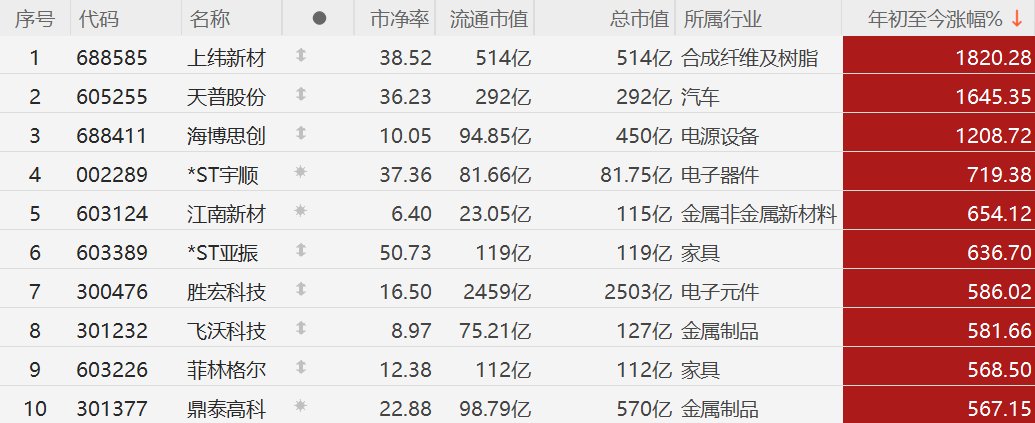
Core Insights - The A-share market in 2025 has seen significant stock performance, with the top ten stocks achieving remarkable gains, led by Shangwei New Materials with an increase of 1820.28% [1][2] - Shangwei New Materials has issued a risk warning, stating that its intelligent robot business is still in the product development stage and has not yet achieved mass production or sales, which is expected to have no positive impact on its 2025 performance [1] Group 1: Top Performing Stocks - Shangwei New Materials (688585) has a year-to-date increase of 1820.28%, with a market capitalization of 514 billion and a price-to-book ratio of 38.52 [2] - Tianpu Co., Ltd. (605255) has seen a rise of 1645.35%, with a market capitalization of 292 billion and a price-to-book ratio of 36.23 [2] - Haibo Sichuang (688411) has increased by 1208.72%, with a market capitalization of 450 billion and a price-to-book ratio of 10.05 [2] - ST Yushun (*ST宇顺) has a gain of 719.38%, with a market capitalization of 81.75 billion and a price-to-book ratio of 37.36 [2] - Jiangnan New Materials (603124) has risen by 654.12%, with a market capitalization of 115 billion and a price-to-book ratio of 6.40 [2] - ST Yazhen (*ST亚振) has increased by 636.70%, with a market capitalization of 119 billion and a price-to-book ratio of 50.73 [2] - Shenghong Technology (300476) has seen a rise of 586.02%, with a market capitalization of 2503 billion and a price-to-book ratio of 16.50 [2] - Feiwo Technology (301232) has increased by 581.66%, with a market capitalization of 127 billion and a price-to-book ratio of 8.97 [2] - Filinger (603226) has risen by 568.50%, with a market capitalization of 112 billion and a price-to-book ratio of 12.38 [2] - Ding Tai High-Tech (301377) has increased by 567.15%, with a market capitalization of 570 billion and a price-to-book ratio of 22.88 [2]


董宇辉狂卖1亿元的网红沙发,创始人已套现200亿
Feng Huang Wang Cai Jing· 2025-12-30 12:55
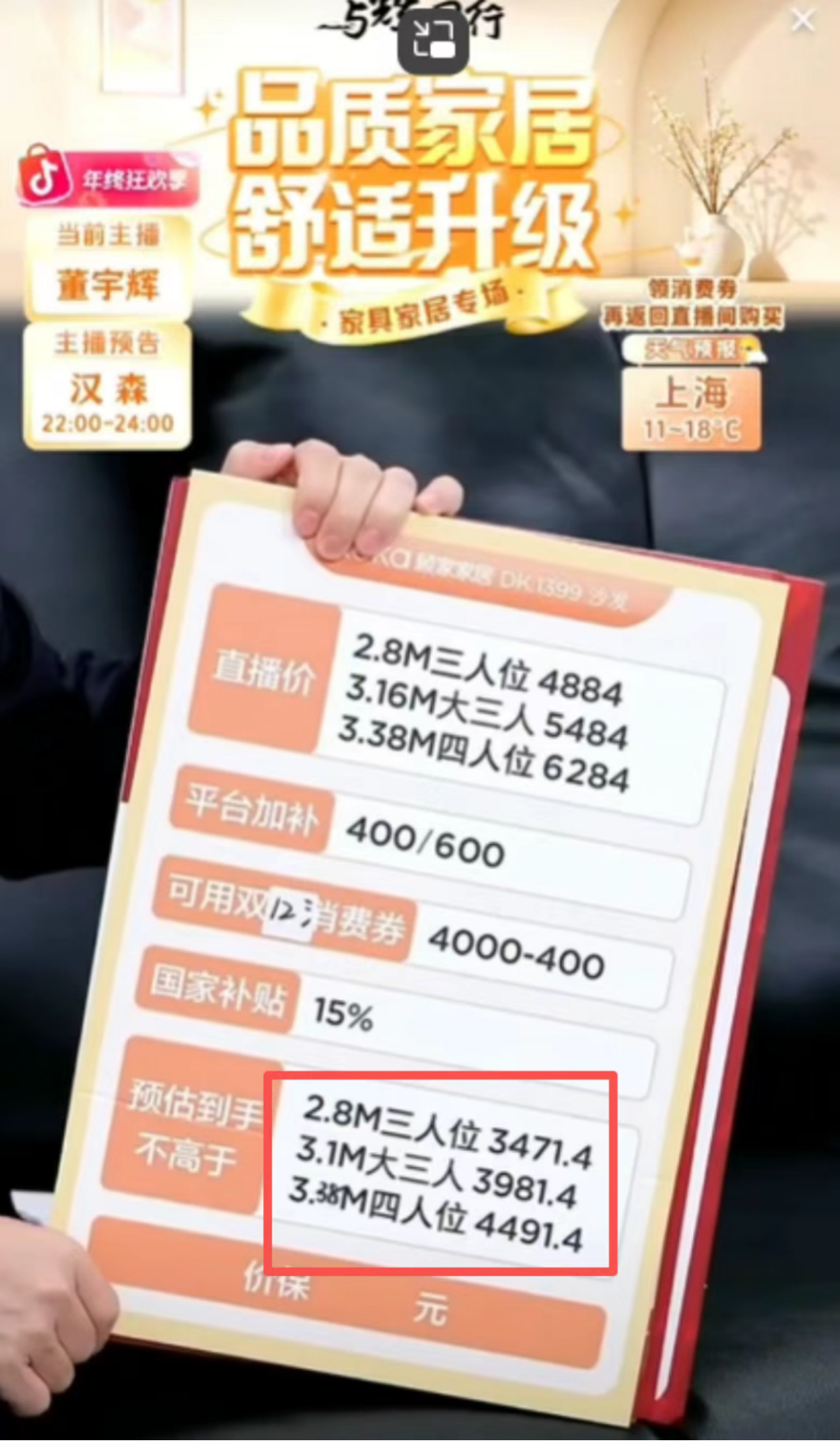
Core Viewpoint - The controversy surrounding Dong Yuhui's live-streaming event, which generated sales of 3.56 billion yuan, has raised questions about the production capacity and quality of the products sold, particularly a popular leather sofa from Gujia Home [1][2][5]. Group 1: Sales Performance and Controversy - The live-streaming event on December 10 featured a leather sofa priced at 3,471.4 yuan, achieving over 1 billion yuan in sales for that model alone [2][6]. - Concerns emerged regarding whether Gujia's own factories could handle the high order volume, leading to speculation about outsourcing production to third-party manufacturers [5][6]. - The significant discount on the sofa raised doubts about whether the quality would match that of products sold in physical stores [5][9]. Group 2: Company Response and Production Assurance - Gujia Home responded to the concerns by stating that the sofas sold during the live stream were produced in-house and that they were working to expedite production [6][10]. - The company emphasized that the products were official and guaranteed to be genuine [6]. Group 3: Financial Analysis and Profitability - Despite the low selling price, Gujia Home is estimated to still have a profit margin, as the average cost per unit is 2,503.59 yuan, leading to a gross margin of approximately 27.88% for the live-streamed sofas [11][12]. - The average selling price of standard sofa sets in the first three quarters of the year was 3,893.05 yuan, indicating a 12.15% premium over the live-stream price [10][12]. - Gujia Home's financial performance showed a revenue of 184.80 billion yuan for the year, a decline of 3.81% year-on-year, with net profit dropping by 29.38% [14]. Group 4: Capital Operations and Shareholder Concerns - The founder's family has engaged in significant capital operations, having cashed out approximately 200 billion yuan since the company's IPO, raising concerns about the long-term operational strategy of Gujia Home [16][17]. - Recent low-priced capital increases have sparked allegations of potential benefits to insiders at the expense of minority shareholders, as the pricing was significantly below market value [20][22]. - The company's financial maneuvers, including high dividends and substantial investment plans, have led to skepticism about its actual liquidity needs and the motivations behind its fundraising efforts [24].

顺差破1万亿美元,工业利润却在下滑:中国经济正在发生什么?
Sou Hu Cai Jing· 2025-12-30 10:01
Group 1 - The core viewpoint is that while the Chinese yuan has stabilized against the US dollar and trade surplus has exceeded $1 trillion, there are underlying issues such as declining industrial profits and pressure on traditional export sectors, indicating a structural transition in the economy [1][15][31] - The importance of the US as an export destination is decreasing, with ASEAN, the EU, Africa, and Latin America emerging as new growth sources for Chinese exports [7][8] - The current trade surplus is not a distortion but reflects a shift from low-cost goods to high-tech products and critical intermediate goods in the global supply chain [18][20] Group 2 - The decline in industrial profits, particularly in traditional export industries like textiles and footwear, contrasts sharply with the record trade surplus, highlighting the challenges faced by companies during this transition [17][21] - The structural changes in the economy are leading to a focus on profitability and upgrading rather than merely expanding through low prices, which is a significant shift from previous business models [24][27] - The profitability in high-tech sectors such as electronics and semiconductors is increasing, indicating a concentration of resources towards areas with long-term competitive advantages [26][29] Group 3 - The simultaneous occurrence of the yuan breaking 7, the trade surplus surpassing $1 trillion, and profit pressures reflects different facets of the same transformation, emphasizing China's critical position in global competition while acknowledging the exit of old growth models [31][33] - The focus should be on whether new growth drivers can develop quickly enough to fill the gap left by the decline of old drivers, as this transition is expected to be accompanied by discomfort and challenges [33]

11月经济数据解读:延续稳中有进发展态势
East Money Securities· 2025-12-30 09:54
Consumption - In November 2025, the total retail sales of consumer goods reached 43,898 billion yuan, with a year-on-year growth of 1.3%, down 1.6 percentage points from the previous value of 2.9%[12] - Sales of "two new" products and real estate-related consumption continued to decline, with automotive consumption down 8.3% and home appliances down 19.4% year-on-year[12] - Service retail sales grew by 5.4% year-on-year from January to November, indicating a gradual release of service consumption potential[14] Investment - Fixed asset investment continued to decline, with a year-on-year decrease of 2.6% in November, marking three consecutive months of negative growth[23] - Real estate development investment fell by 31.4% year-on-year in November, a significant increase in the decline compared to the previous month's 23.2%[23] - Equipment purchase investment showed a year-on-year growth of 6.3%, contributing 1.8 percentage points to overall investment growth[24] Trade - In November, exports increased by 5.9% year-on-year, rebounding from a previous decline of 1.1%[32] - Exports to the EU saw a significant recovery with a growth rate of 14.8%, while exports to the US decreased by 28.6%[32] - Imports rose slightly by 1.9% year-on-year, with notable increases in the import of integrated circuits and automatic data processing equipment[34]
*ST亚振录得10天6板
Zheng Quan Shi Bao Wang· 2025-12-30 07:27
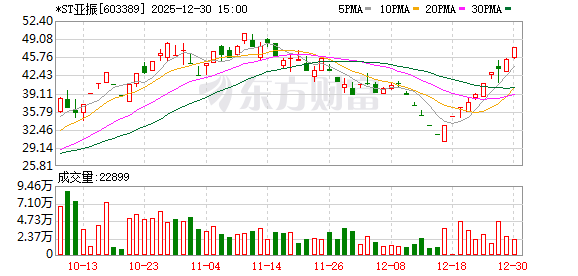
Group 1 - The stock of Yazhen Home Co., Ltd. (*ST亚振) has experienced a significant increase, with 6 limit-up days in the last 10 trading days, resulting in a cumulative increase of 50.35% and a turnover rate of 10.76% [2] - As of 14:58, the stock's trading volume reached 2.2622 million shares, with a transaction amount of 106 million yuan, and a turnover rate of 0.86% [2] - The total market capitalization of A-shares has reached 12.491 billion yuan [2] Group 2 - The stock has appeared on the Dragon and Tiger List twice due to a cumulative closing price deviation of 12% over three consecutive trading days, with a net selling amount of 2.1107 million yuan from the leading brokerage firms [2] - The company was established on August 15, 2000, with a registered capital of 262.752 million yuan [2] - Recent trading data shows fluctuating daily price changes and net capital inflows, with notable negative net inflows on several days, including a peak of -3260.35 million yuan on December 19, 2025 [2]
董宇辉直播间亿元沙发陷“代工”质疑 顾家家居回应:均为自主生产
Zhong Guo Neng Yuan Wang· 2025-12-30 00:33
Group 1 - The core point of the article highlights the record-breaking sales achieved by the top streamer Dong Yuhui, with a single live stream generating sales of 3.56 billion yuan, including over 1 billion yuan from a single sofa product by Kuka Home [2] - Kuka Home confirmed that all sofas sold during the live stream were self-manufactured, addressing concerns about third-party production [2] - The company stated that external cooperation is only used to alleviate production pressure for non-core products, while core products like sofas and custom furniture are designed and produced in-house [2] Group 2 - In the first three quarters of the year, the company reported total revenue of 15.012 billion yuan, an increase of 8.77% year-on-year, with third-quarter revenue of 5.211 billion yuan, up 6.50% year-on-year [3] - The net profit attributable to shareholders was 1.539 billion yuan, reflecting a year-on-year growth of 13.24%, indicating improved operational efficiency [3] - In January 2024, Yingfeng Group became the controlling shareholder of Kuka Home, marking a change in control [3]