
水泥

Search documents
水泥股多数上涨 近日多片区水泥开始提价 机构看好旺季行业需求边际改善
Zhi Tong Cai Jing· 2025-09-19 03:38
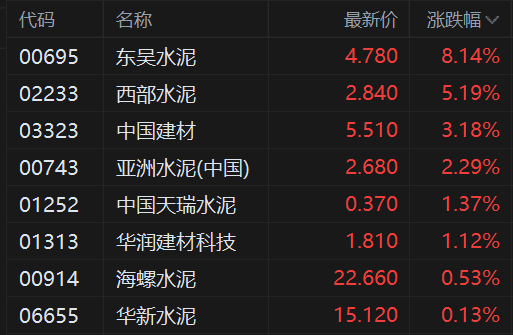
Group 1 - Cement stocks mostly rose, with Dongwu Cement up 7.92% to HKD 4.77, Western Cement up 5.56% to HKD 2.85, China National Building Material up 3% to HKD 5.5, and Conch Cement up 0.62% to HKD 22.68 [1] - On September 5, major clinker line enterprises in the Yangtze River Delta began staggered production for 12 days, alleviating inventory pressure and leading to a strong willingness to raise prices due to severe losses [1] - From September 17-18, some leading enterprises in the Yangtze River Delta announced a price increase of HKD 30 per ton for cement and clinker, with others expected to follow suit [1] Group 2 - According to CICC, the national cement shipment rate in August 2025 was 45.2%, down from 48.8% in the same month last year, with a year-on-year decrease in cement production of 6.2% to 14.8 million tons [2] - The average cement price in July-September 2025 was HKD 338 per ton, with a slight rebound observed in September, where the national average cement price was HKD 338 per ton, up by HKD 2 per ton month-on-month [2] - The estimated gross profit per ton for cement enterprises in September was HKD 58, an increase of HKD 3 per ton month-on-month, indicating potential marginal improvement in industry demand as the peak season approaches [2]
港股异动丨建材水泥股反弹 东吴水泥涨超8%止步4连跌
Ge Long Hui· 2025-09-19 03:27
Group 1 - Cement stocks have rebounded after a continuous decline, with Dongwu Cement rising over 8%, Western Cement up over 5%, China National Building Material increasing over 3%, and Asia Cement up over 2% [1] - According to a report from China Galaxy Securities, cement demand remains weak in August due to seasonal factors, high temperatures, and rainy weather affecting downstream construction, leading to a decrease in operating load of cement mills [1] - The average price of cement in August was 271.67 yuan per ton, showing a month-on-month decline [1] Group 2 - The clinker inventory has shifted from an increase to a decrease, but the issue of oversupply in the industry still exists [1] - Looking ahead, demand is expected to seasonally improve from September to November, combined with accelerated capacity reduction in the industry, which may help ease supply and demand pressures and support cement prices [1]

生态环境部:上半年风电项目增长超四成 产业结构得到优化调整
Jing Ji Guan Cha Wang· 2025-09-19 03:04
Core Viewpoint - The article emphasizes China's commitment to high-quality development through the implementation of the "Green Mountains and Clear Water are Gold and Silver Mountains" philosophy, focusing on optimizing the industrial structure and promoting green projects [1] Group 1: Environmental Policy and Project Approvals - During the "14th Five-Year Plan" period, the number of environmental impact assessments (EIAs) for high-emission and high-pollution projects has been continuously decreasing, while EIAs for wind power and new energy vehicles have increased by 44.4% and 31.3% respectively in the first half of 2025 compared to the previous year [1] - A total of 14,600 EIA documents for high-tech electronic information manufacturing projects have been approved since the beginning of the "14th Five-Year Plan," involving a total investment of 6.28 trillion yuan, providing strong support for the development of new productive forces [1] Group 2: Policy Framework and Standards - China has established an effective policy framework to promote new productive forces through high-level protection, covering various areas such as standards and norms, precise regulation, EIA reform, market mechanisms, and green financial support [1] - A total of 32 emission standards have been revised and completed, enhancing the green transformation of key industries [1] Group 3: Industrial Transformation and Technological Innovation - Since the beginning of the "14th Five-Year Plan," 198 million tons of coking capacity and 110 million tons of cement clinker capacity have completed ultra-low emission transformations, along with organized emission modifications for over 2,000 coal-fired boilers [1] - Over 5,000 outstanding technological achievements have been gathered to assist enterprises in achieving green and low-carbon development, contributing to the establishment of the world's largest clean steel production system [1] Group 4: Green Finance - The development of green finance has also facilitated the transition to a low-carbon economy, supporting the overall green transformation efforts [1]
生态环境部:截至9月18日,全国碳排放权交易市场累计成交额达489.61亿元
Zheng Quan Shi Bao Wang· 2025-09-19 03:04
Core Viewpoint - The expansion of China's carbon emissions trading market is a significant step towards achieving carbon peak and carbon neutrality goals, effectively managing over 60% of the country's carbon dioxide emissions [1] Group 1: Market Expansion - The carbon emissions trading market in China has expanded to include the steel, cement, and smelting industries this year [1] - This expansion allows for effective control of over 60% of the national carbon dioxide emissions [1] Group 2: Market Performance - As of September 18, 2025, the cumulative trading volume of carbon emission allowances in the national market reached 714 million tons [1] - The cumulative transaction value of the carbon emissions trading market amounted to 48.961 billion yuan [1] Group 3: Data Accuracy and Market Stability - The standardization, accuracy, and timeliness of carbon emissions data statistics have significantly improved [1] - The national carbon emissions trading market has achieved stable initiation and operation, contributing positively to climate change efforts [1]
【光大研究每日速递】20250919
光大证券研究· 2025-09-18 23:07
Group 1: Macroeconomic Insights - The risk of unilateral tariff increases in the US has subsided, and consumer confidence has rebounded from its low point in Q2, indicating that the most dangerous phase for the US economy may have passed [4] - With consumption accounting for nearly 70% of US GDP, the stabilization of consumer spending suggests that the US economy is unlikely to experience a sharp downturn [4] - The current interest rate cut cycle is more preventive in nature, rather than reactive [4] Group 2: Industry Performance - As of September 10, 2025, the narrow credit bond market has 12,837 active industrial bonds with a total outstanding scale of 14.48 trillion yuan, covering 29 primary industries [4] - More than half of the industries have seen a year-on-year increase in net profit margins, while most industries have experienced a year-on-year increase in interest-bearing debt [4] - Industries such as textiles and media have shown strong short-term debt repayment capabilities, and over half of the industries have achieved a year-on-year increase in operating cash flow [4] Group 3: Steel Industry Analysis - The average return on assets (ROA) for the rebar sector is at its lowest level since 2010, with the price-to-book ratio (PB_LF) still having a 6.67% gap compared to the average since 2013 [5] - Currently, 12 rebar companies have a PB_LF of less than 1, and 11 companies in the steel sector have a dividend yield of over 3% [5] - The completion of ultra-low emission transformations in the industry is expected to further increase the dividend payout ratio for rebar companies [5] Group 4: Company-Specific Reports - Qingsong Jianhua reported a 14% year-on-year decline in revenue, with net profit down 49% in H1 2025, indicating pressure on both volume and price in its cement business [7] - Qibin Group's H1 2025 revenue decreased by 7%, but net profit increased by 10%, with significant growth in photovoltaic glass sales [7] - Baidu maintains a healthy net cash flow, achieving breakeven in the Wuhan region, and its self-developed chips and AI ecosystem are expected to enhance its valuation [7]
【青松建化(600425.SH)】水泥业务量价承压,化工板块盈利有待改善——跟踪点评报告(孙伟风/陈奇凡)
光大证券研究· 2025-09-18 23:07
Core Viewpoint - The company reported a significant decline in revenue and net profit for the first half of 2025, indicating challenges in both its cement and chemical business segments [4][5][6]. Group 1: Financial Performance - In H1 2025, the company achieved revenue of 1.77 billion, a decrease of 14% year-on-year, with net profit attributable to shareholders dropping by 49% to 110 million [4]. - In Q2 2025, revenue was 1.3 billion, with net profit at 170 million, reflecting a year-on-year decline of 15% and 28% respectively [4]. Group 2: Cement Business - The cement segment generated revenue of 1.24 billion in H1 2025, with a gross profit of 350 million and a gross margin of 28.5% [5]. - The company's cement sales volume decreased, and prices were lower compared to the same period last year, leading to a decline in gross margin [5]. - In the Xinjiang region, cement production was 1.9 million tons in H1 2025, up 5% year-on-year, with projected growth rates of +25% and -5% for 2023-2024 [5]. Group 3: Chemical Business - The chemical segment reported revenue of 440 million in H1 2025, with a gross loss of 20 million and a negative gross margin of 4.2% [6]. - The decline in sales for key products such as urea and PVC contributed to the poor performance, with significant price drops observed in the urea market [6].

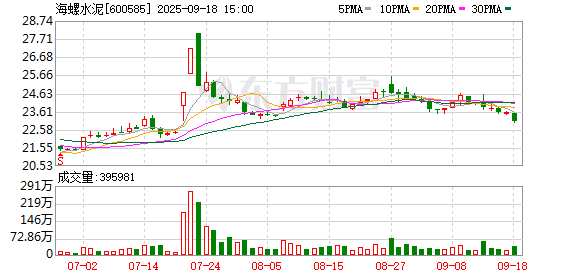
安徽海螺水泥股份有限公司关于担保实施进展的公告
Shang Hai Zheng Quan Bao· 2025-09-18 20:09
Group 1 - The company announced the progress of guarantees provided for its subsidiaries, specifically for a loan agreement signed by Sanming Haizhong Environmental Protection and China Construction Bank Qingliu Branch for an amount of 10 million yuan [2][4] - Anhui Haizhong Environmental Protection Co., Ltd., a subsidiary of the company, has signed a guarantee contract to provide a full joint liability guarantee for the aforementioned loan [2][4] - The total guarantee amount approved by the company's board and shareholders for 20 subsidiaries is up to 1.85965 billion yuan, and the current guarantee falls within this approved limit [3][6] Group 2 - The guarantee covers the principal, interest (including penalties and compound interest), default penalties, compensation, and costs incurred by the creditor in realizing their rights [4][6] - As of the announcement date, the total amount of external guarantees provided by the company and its subsidiaries is 838 million yuan, which is 0.45% of the company's audited net assets attributable to the parent company for 2024 [6] - The company has not provided guarantees for controlling shareholders, actual controllers, or related parties, and there are no overdue guarantee items [6]
海螺水泥:本公司不存在逾期担保事项
Zheng Quan Ri Bao· 2025-09-18 13:36
证券日报网讯 9月18日晚间,海螺水泥发布公告称,本公司不存在逾期担保事项。 (文章来源:证券日报) ...
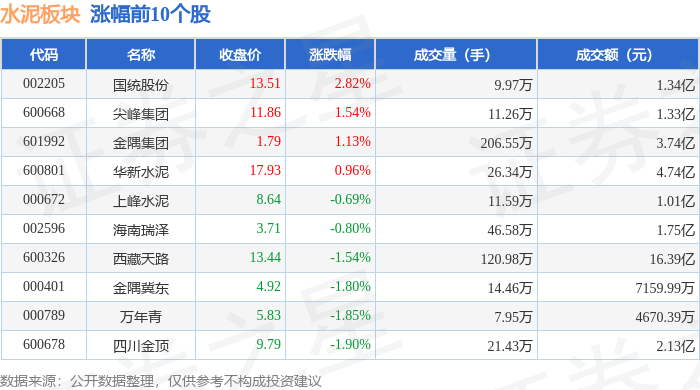
水泥板块9月18日跌1.64%,福建水泥领跌,主力资金净流出2.34亿元
Zheng Xing Xing Ye Ri Bao· 2025-09-18 08:52
Market Overview - On September 18, the cement sector declined by 1.64%, with Fujian Cement leading the drop [1] - The Shanghai Composite Index closed at 3831.66, down 1.15%, while the Shenzhen Component Index closed at 13075.66, down 1.06% [1] Individual Stock Performance - Notable gainers included: - Guotong Co., Ltd. (002205) with a closing price of 13.51, up 2.82% [1] - Jianfeng Group (600668) at 11.86, up 1.54% [1] - Fuying Jiao Guo (601992) at 1.79, up 1.13% [1] - Decliners included: - Sichuan Jinding (600678) at 9.79, down 1.90% [1] - Wanniangqing (000789) at 5.83, down 1.85% [1] - Shangfeng Cement (000672) at 8.64, down 0.69% [1] Capital Flow Analysis - The cement sector experienced a net outflow of 234 million yuan from institutional investors, while retail investors saw a net inflow of 162 million yuan [2] - Key capital flows included: - Huaxin Cement (600801) with a net inflow of 29.3 million yuan from institutional investors [2] - Jianfeng Group (600668) with a net inflow of 19.3 million yuan from institutional investors [2] - Fujian Cement (600802) had a minor net inflow of 0.5 million yuan from retail investors [2]




刘晓曙解读“反内卷”:本质是打破零和博弈,推动高质量价值创造
Xin Lang Cai Jing· 2025-09-18 06:50
Core Viewpoint - The concept of "anti-involution" has evolved into a strategic issue affecting the overall economy of China, particularly as the country transitions to high-quality development. This phenomenon is characterized by supply-demand mismatches and disorderly competition in various industries, which hinder productivity and pose significant challenges to achieving high-quality growth [1][2]. Group 1: New Trends in "Anti-Involution" - The current "anti-involution" movement exhibits three new trends compared to the previous supply-side reform 1.0: upgraded goals, expanded governance targets, and evolved policy tools [3][4][5][6]. - The upgraded goals focus on quality improvement and breaking the cycle of involution, shifting from merely reducing excess capacity to establishing high-quality competition rules applicable to all market entities [4]. - The governance targets have expanded to include not only traditional industries but also emerging sectors and platform economies, addressing issues of blind investment and vicious competition [5]. - The policy tools have transitioned from administrative commands to rule-making and macro-guidance, emphasizing the establishment of legal frameworks and market mechanisms to facilitate industry upgrades [6]. Group 2: Impacts on the Banking Industry - The banking sector is experiencing "involution" due to insufficient effective demand and a continuous narrowing of net interest margins, leading to a reliance on "involution" as a survival strategy [2][13]. - The short-term response to this "involution" is characterized by a focus on expanding scale to counteract profit pressures, which can lead to a vicious cycle of price wars and increased operational risks [14][15]. - Long-term, the "involution" in banking can compress profit margins and increase operational risks, ultimately affecting the stability of the financial system and its support for the real economy [15][16]. Group 3: Solutions for the Banking Sector - To effectively counter "involution," banks must adapt their customer structures to align with the changing economic landscape, enhancing risk management capabilities and focusing on new economic sectors [16][17]. - The transition from traditional economic sectors to new ones is essential for banks to escape the "involution" trap, as the demand from traditional sectors continues to decline [16]. - A shift towards a more diversified customer base and improved risk management will enable banks to better serve the evolving needs of the economy and enhance their sustainability [16].